Knowunity’s Series A deck is a high-signal, low-noise presentation that prioritizes traction and social validation over technical complexity. By 2022, the Berlin-based startup had already secured +2.4m total users and +300k content pieces, positioning itself as the fastest-growing student app in Europe. The deck successfully frames education as a social experience, utilizing a 'Knower loop' to explain its organic growth. While the deck lacks a formal team slide or detailed financial projections, it compensates with a 75% Product-Market Fit score and a clear allocation of funds: 55% for growth…
Key takeaways
- The deck leads with massive scale, citing +2.4m total users and +300k content pieces on Slide 1.
- Knowunity frames the problem as education being 'stuck in the 80s' and an 'isolated chore' on Slide 3.
- Product-Market Fit is quantified with a 75% PMF score and a 4.7-star rating from 20k reviews on Slide 6.
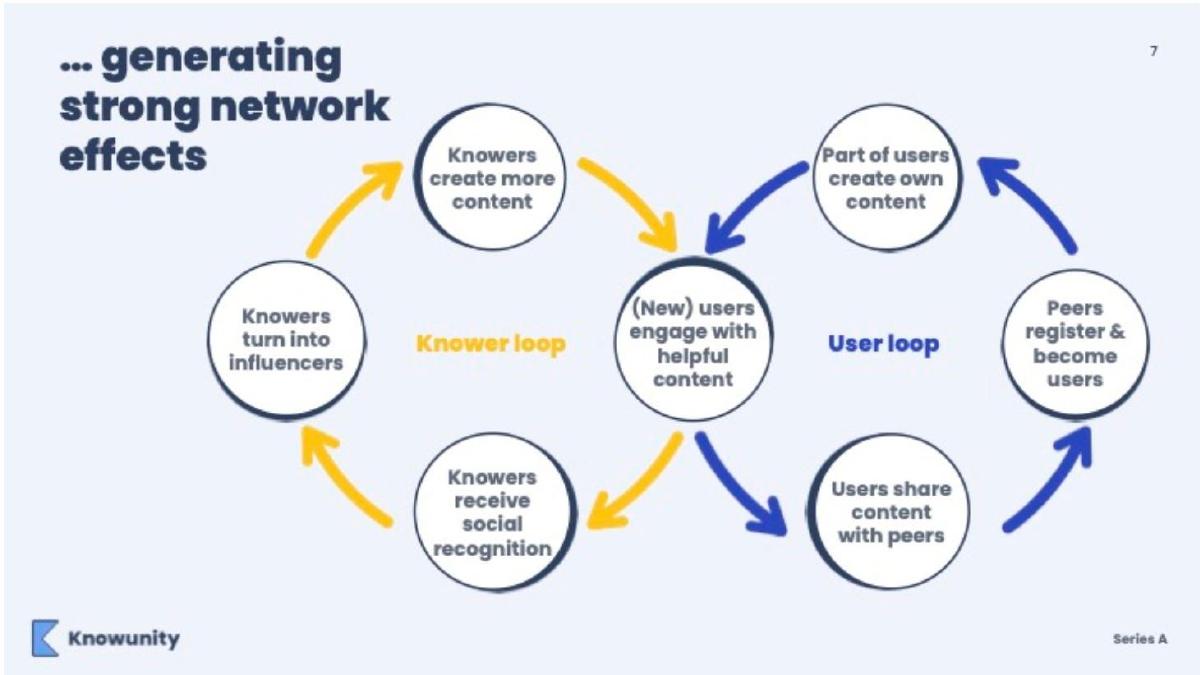
- The growth engine is visualized through a dual 'Knower loop' and 'User loop' to demonstrate network effects on Slide 7.
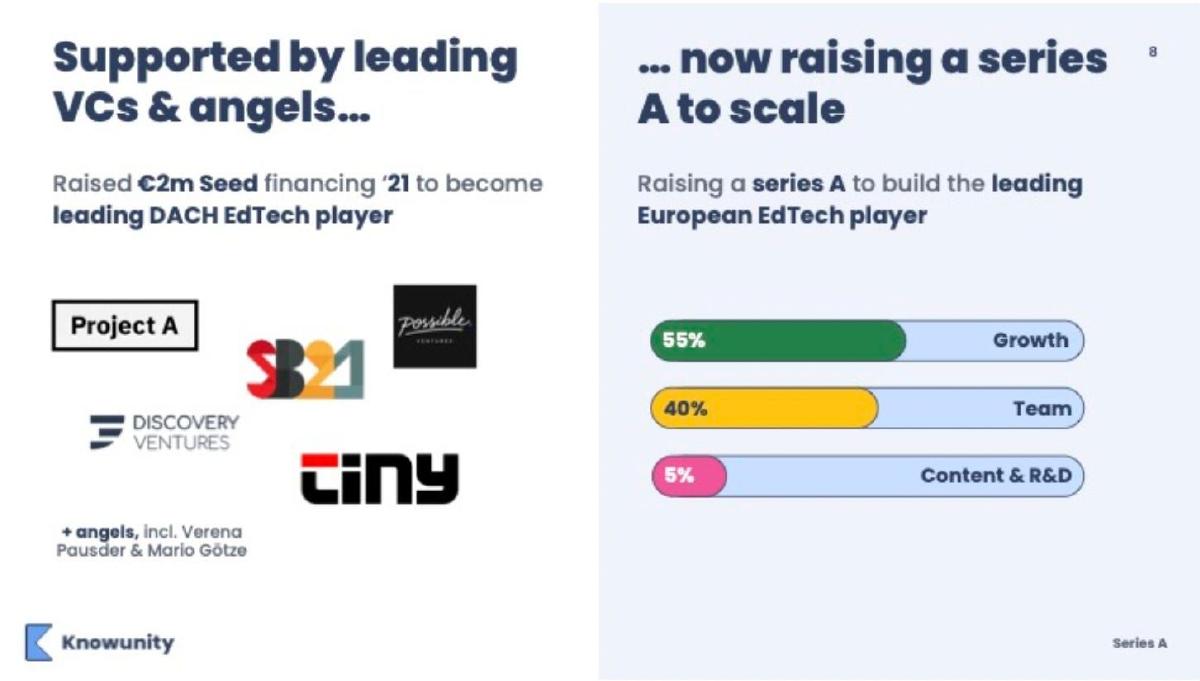
- The startup raised a €2m Seed round in 2021 before seeking Series A capital to scale across Europe, as noted on Slide 8.
- Use of funds is clearly delineated: 55% for Growth, 40% for Team, and 5% for Content & R&D on Slide 8.
- The deck completely omits a dedicated team slide, relying instead on the founders' narrative of sitting in school two years prior (Slide 2).
- Engagement is highlighted as a core metric, with users interacting with the app multiple times per week across various academic years (Slide 5).
The Power of Social Proof in EdTech
Knowunity’s 10-slide Series A deck is a study in momentum. In the venture capital world, traction solves all problems, and Knowunity leads with it immediately. By the time this deck was circulated in 2022, the company had already moved past the 'idea' phase and into the 'domination' phase of the DACH (Germany, Austria, Switzerland) market. The deck is designed to convince investors that the model is proven and the capital is simply fuel for geographic expansion.
Slide 1: The Hook
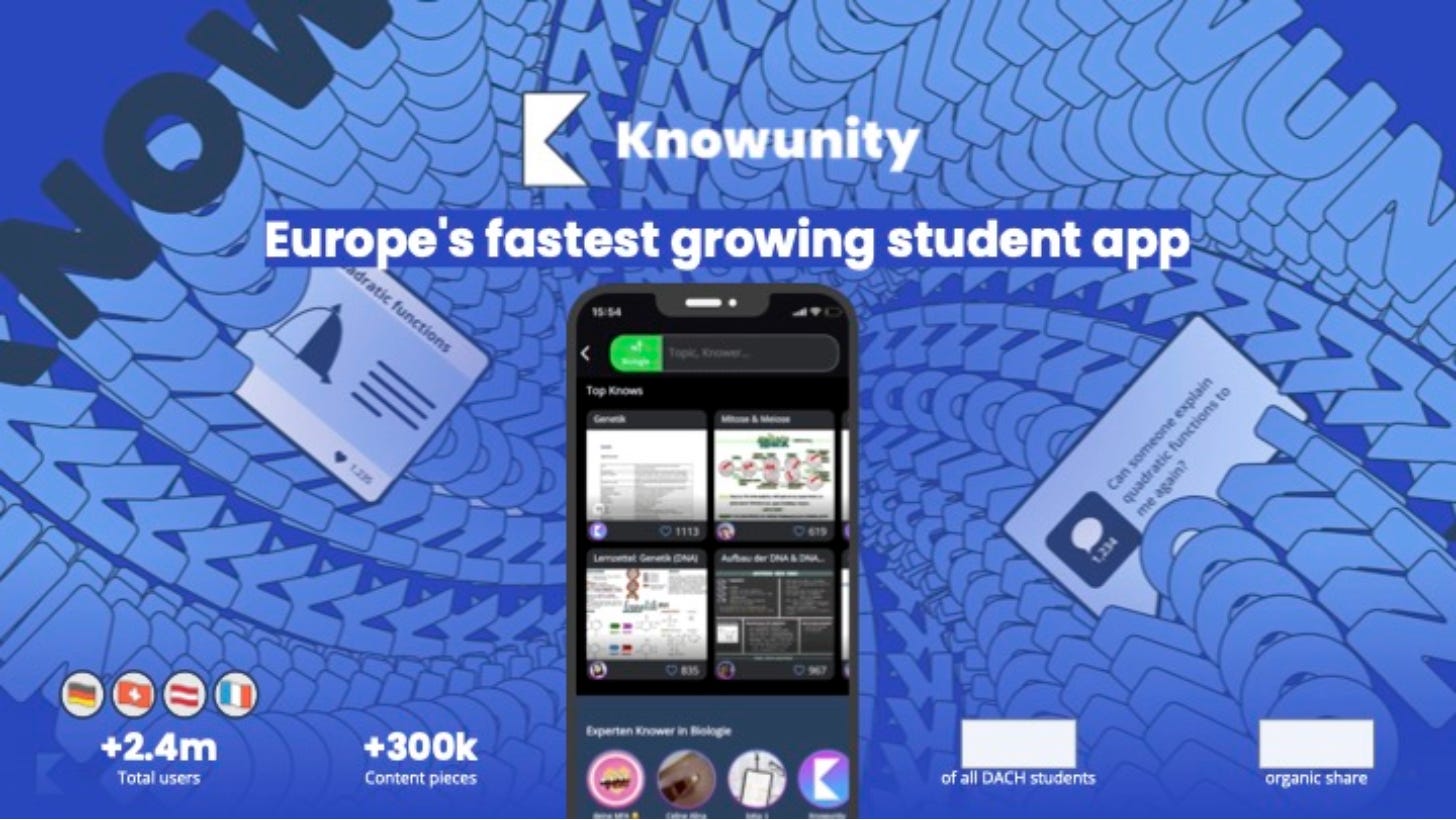
The cover slide does more than state the company name. It establishes a dominant market position: "Europe's fastest growing student app." The visual hierarchy emphasizes four key metrics: +2.4m total users , +300k content pieces , and two redacted boxes for DACH student penetration and organic share. By placing the flags of Germany, Austria, Switzerland, and France at the bottom left, they signal their current footprint and immediate expansion targets.
Slide 2 & 3: The Narrative and the Problem
Slide 2 uses a relatable, founder-led narrative: "2 Years ago, we sat in school & realized there was a big problem in education." This establishes the founders as 'insiders' to the problem. Slide 3 defines that problem: "Education is stuck in the 80s." They identify three pain points: education is perceived as an "antiquated & isolated chore," textbooks cannot compete with "social apps," and high-quality education is "reserved to a privileged few." This sets the stage for a solution that is social, mobile-first, and democratic.
Slide 4: The Solution
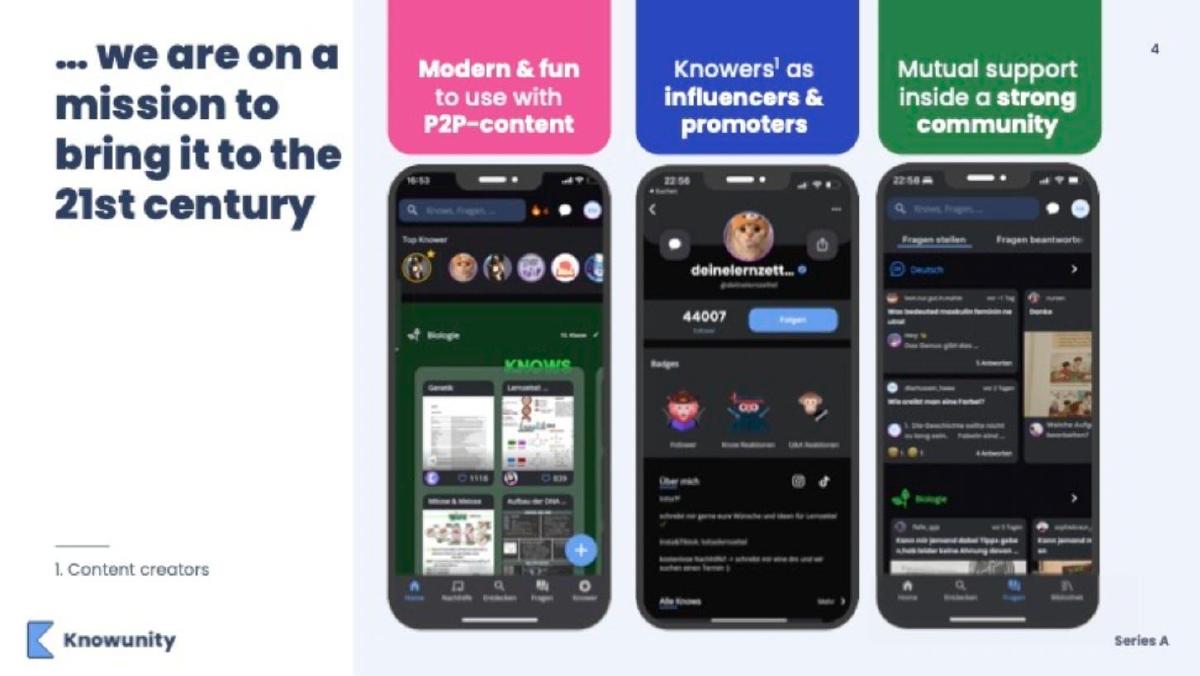
The solution is presented as a 21st-century upgrade. Knowunity highlights three pillars: "Modern & fun to use with P2P-content," "Knowers as influencers & promoters," and "Mutual support inside a strong community." The screenshots show a UI that looks more like Instagram or TikTok than a traditional Learning Management System (LMS), reinforcing the idea that they have successfully 'socialized' studying.
Slide 5: Market Leadership
Slide 5 reinforces the traction mentioned on the cover. It claims Knowunity is the "leading student platform" and notes they onboarded "+xm users in 1.5 years." The slide uses placeholders for YoY user growth , MAUs , Weekly sessions , and Year 1 retention . Even with the specific numbers redacted in this version, the categories chosen show that Knowunity is being measured as a consumer social app, not just a utility tool.
Slide 6: Validating Product-Market Fit
This is arguably the strongest slide in the deck. Instead of just claiming people like the app, they provide a "75% PMF score" and cite "20k App store reviews" with a 4.7-star rating . The background is a collage of user testimonials and social media mentions, proving that the brand has organic 'cool' factor among its target demographic.
Slide 7: The Growth Engine
To justify a Series A valuation, a company must show that its growth is sustainable and defensible. Knowunity uses a "strong network effects" diagram. The "Knower loop" (creators) and "User loop" (consumers) feed into each other. When Knowers receive "social recognition," they create more content, which attracts more users, who then share content with peers, bringing in more users. This flywheel explains how they achieved the +2.4m users mentioned on Slide 1 without massive ad spend.
Slide 8: The Ask and Allocation
Slide 8 transitions from the past to the future. It notes they "Raised €2m Seed financing '21" and are now "raising a series A to scale." The use of funds is specific: 55% for Growth , 40% for Team , and 5% for Content & R&D . The presence of logos like Project A , Discovery Ventures , and Tiny provides institutional validation, while the mention of angels like Verena Pausder and Mario Götze adds local star power.
Slide 9 & 10: The Vision and Closing
Slide 9 expands the mission from Europe to "students globally." It positions Knowunity as the "21st century social platform" for education. Slide 10 is a simple branding close. The brevity of these final slides suggests the founders believe the traction data in the middle of the deck has already done the heavy lifting.
What Knowunity Does Well
Knowunity excels at framing . They don't call themselves a 'study note repository'; they call themselves a 'social platform.' By adopting the language and metrics of social media (influencers, recognition, sessions), they move the conversation away from the low-multiple edtech sector and into the high-multiple consumer tech sector. The use of a PMF score is also a sophisticated way to quantify 'user love,' which is usually a hand-wavy metric in early-stage decks.
What is Missing from the Deck
The most glaring omission is a Team Slide . While Slide 2 hints at the founders' background as students, there are no names, photos, or professional histories for the leadership team. For a $10M raise, investors typically want to see the operational experience behind the growth. Additionally, there is no Business Model or Monetization slide. The deck focuses entirely on user acquisition and engagement, leaving the question of how they will turn 2.4 million students into a profitable business unanswered in these 10 slides. Finally, there is no Competitive Landscape analysis, which is surprising given the presence of established players like Chegg or Photomath.
Founder's Playbook: What to Copy
Lead with your 'North Star' metric: If you have millions of users, put that on Slide 1. Don't make investors wait until Slide 8 to see your scale. · Quantify Product-Market Fit: Use the Sean Ellis test (the PMF score) or App Store ratings to turn qualitative feedback into quantitative data. · Visualize the Flywheel: Don't just say you have network effects; draw them. Show exactly how one user's action leads to the next user's acquisition. · Keep it Lean: 10 slides is the gold standard. Knowunity proves you don't need 30 slides to raise $10M if your traction is undeniable. · Use Social Proof Collages: A wall of real tweets, TikToks, or reviews is more convincing than a single polished quote from a 'satisfied customer.'
Frequently asked questions
- How much did Knowunity raise with this deck?
- According to publisher-reported facts from Business Insider, Knowunity raised a $10M Series A round in 2022. The deck itself mentions a previous €2m Seed round raised in 2021 on Slide 8, but does not specify the exact dollar amount of the Series A 'ask' beyond the percentage allocation of funds.
- What is the 'Knower loop' mentioned in the deck?
- On Slide 7, Knowunity illustrates its network effect through two cycles. The 'Knower loop' involves content creators (Knowers) creating content, receiving social recognition, and turning into influencers, which encourages more content creation. This feeds into the 'User loop' where new users engage with content and share it with peers.
- Does the deck include a competitor analysis?
- No. The deck focuses entirely on Knowunity's own growth and market position. It claims to be the 'leading student platform' in the DACH region (Germany, Austria, Switzerland) on Slide 5, but does not name or compare itself to other edtech companies like Quizlet or Brainly.
- What metrics does Knowunity use to prove Product-Market Fit?
- On Slide 6, the company presents a '75% PMF score' based on benchmarks. They also showcase a 4.7-star rating from 20,000 App Store reviews and a collage of social media testimonials from TikTok and Instagram to prove user love.
- Why is there no team slide in the Knowunity deck?
- The deck opts for a narrative approach. Slide 2 mentions the founders were students '2 years ago' who identified a problem in education. While it omits professional bios, the inclusion of logos from VCs like Project A and Discovery Ventures on Slide 8 serves as a proxy for team credibility.