The 1huddle pitch deck is a masterclass in lead-with-traction storytelling. By slide two, the company establishes massive credibility with logos like the Super Bowl, Madison Square Garden, and the New York Mets. The deck focuses on a specific pain point—the $486 billion corporate training market that is often boring and ineffective—and positions its 'Jeopardy-style' mobile game platform as the solution. While the deck is visually sparse and lacks a formal 'Ask' or detailed financial projections, it compensates with high-growth metrics, reporting $204,000 in total sales for 2015 and a 69% mont…
Key takeaways
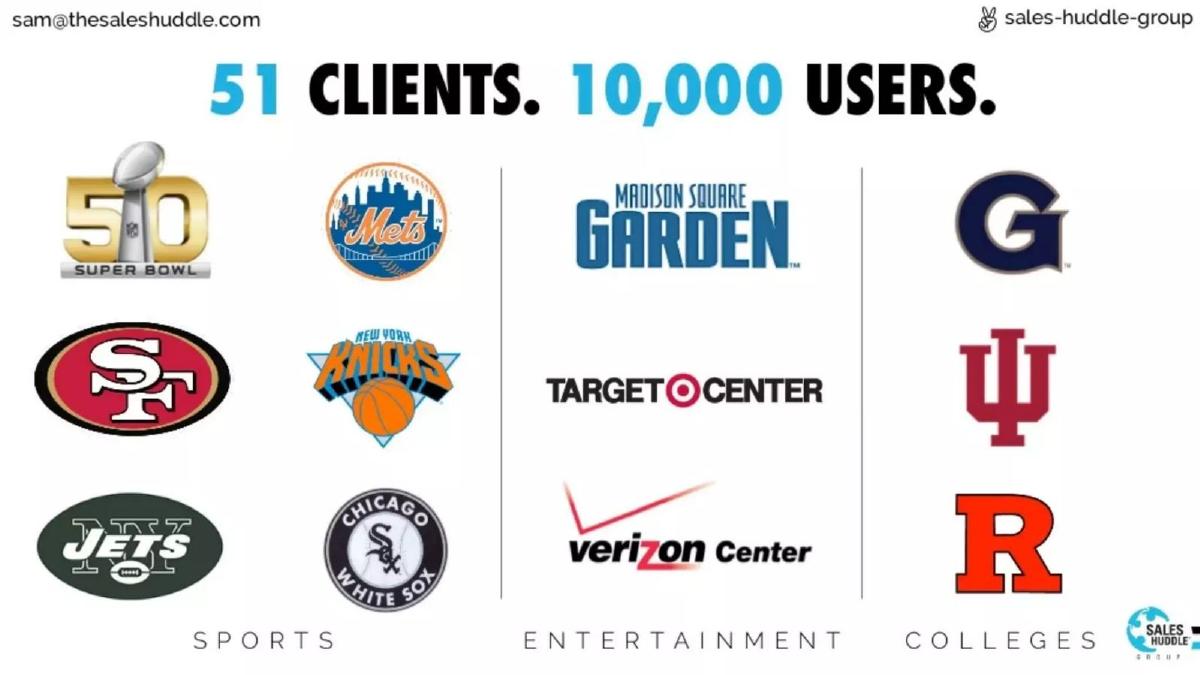
- The deck leads immediately with social proof, listing 51 clients and 10,000 users on slide 2.
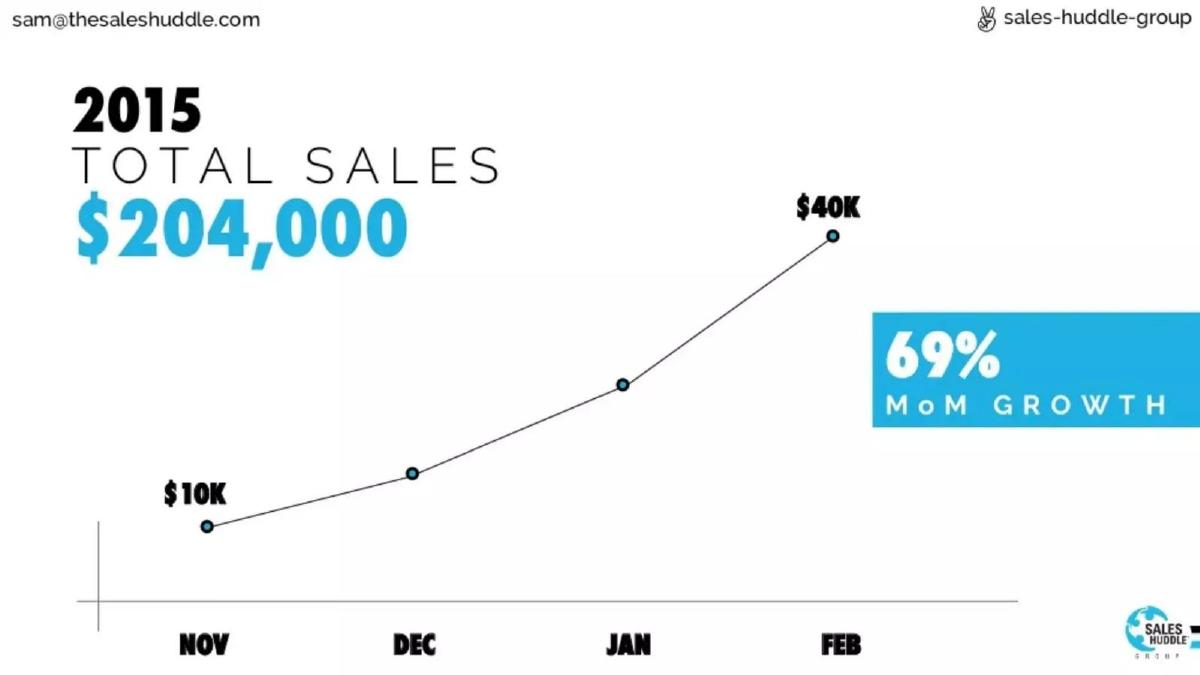
- Traction is quantified early, showing a jump from $10k in November to $40k in February on slide 3.
- The company claims a 69% month-over-month growth rate as of early 2015 on slide 3.
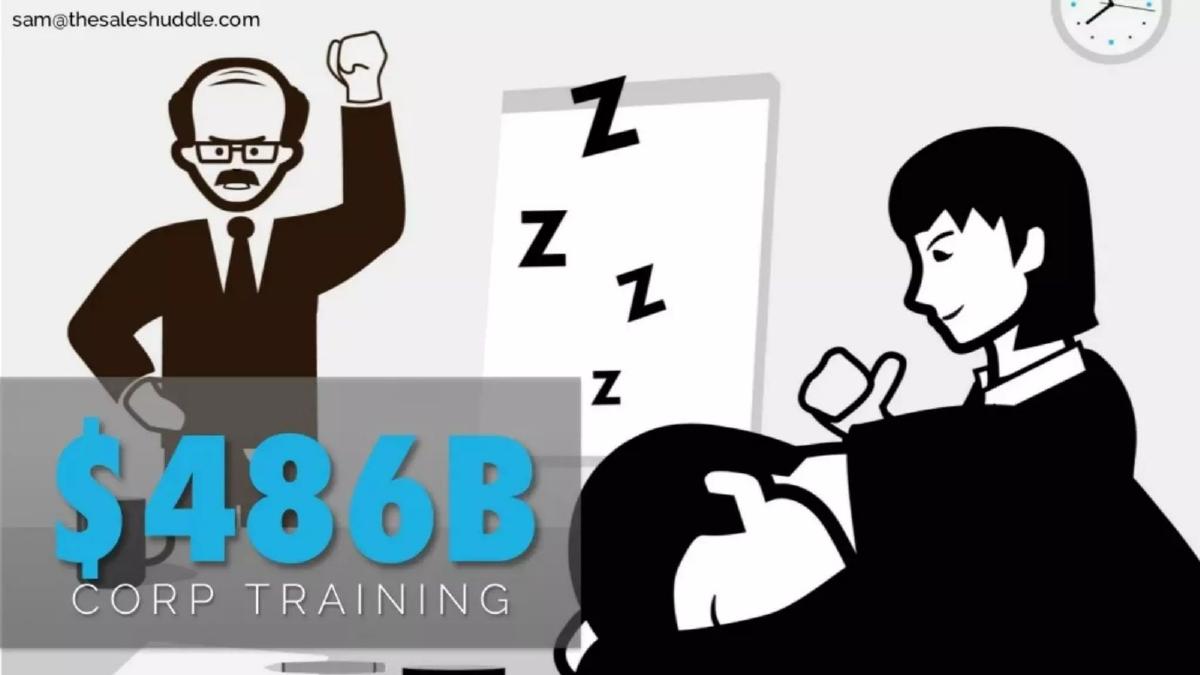
- The total addressable market for corporate training is valued at $486 billion on slide 4.
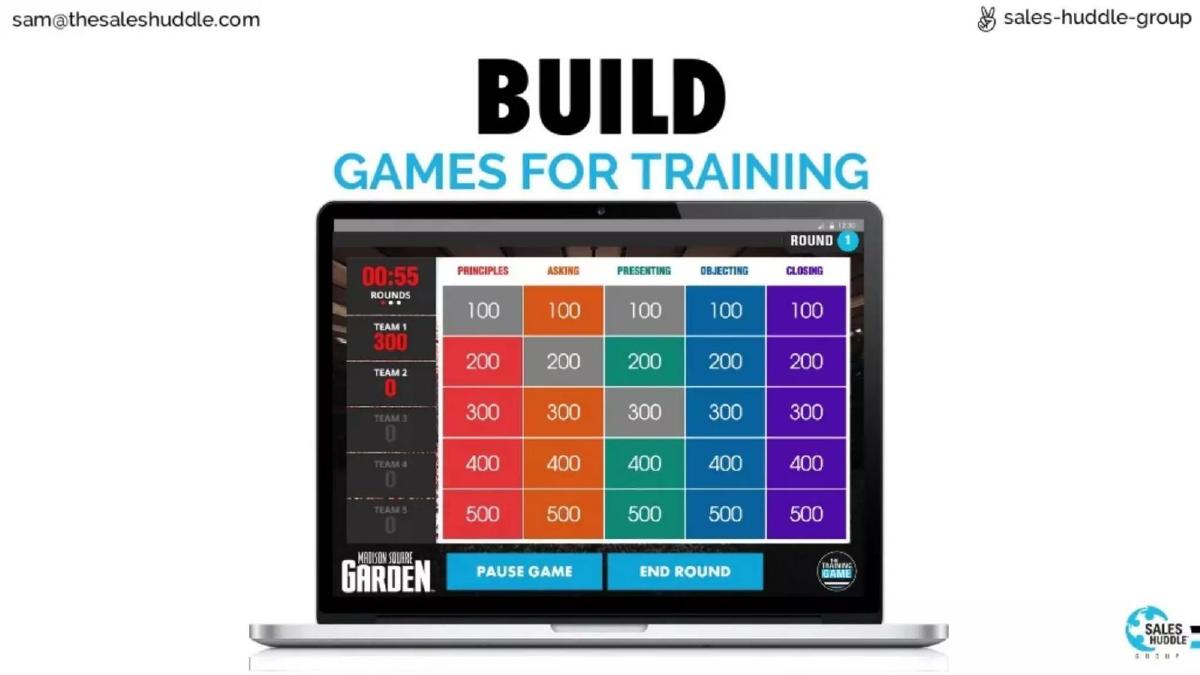
- Product functionality is demonstrated through three core actions: Build, Play, and Reward, across slides 5, 6, and 7.
- The deck highlights a specific success story involving a $10 million increase in sales on slide 9.
- The team slide emphasizes domain expertise, noting the CEO has 10+ years in sales training on slide 10.
- There is no slide detailing the specific funding amount sought or the intended use of proceeds.
The 1huddle Pitch Deck: A Traction-First Approach to Series A
The pitch deck for 1huddle (presented under its former name, Sales Huddle Group) is a lean, 11-slide presentation that prioritizes social proof and growth metrics over technical jargon. In an industry like corporate training, which is often perceived as a commodity, 1huddle uses its deck to prove that it has captured the attention of high-value enterprise clients in the sports and entertainment sectors. By the time an investor reaches the end of the deck, the message is clear: the product works, the biggest brands in the world are using it, and the revenue is scaling rapidly.
Slides 1-3: The Hook and The Proof
Slide 1: Title Slide The deck opens with the Sales Huddle Group logo and a clear value proposition: "Gamify sales training to boost sales." It is simple and outcome-oriented. The contact information for the CEO is prominently displayed at the top left, a practice maintained throughout the deck.
Slide 2: Social Proof Instead of waiting for the end of the deck to show clients, 1huddle puts them on slide two. Under the headline "51 CLIENTS. 10,000 USERS.", the slide displays a grid of high-profile logos categorized into Sports, Entertainment, and Colleges. Notable logos include Super Bowl 50, the San Francisco 49ers, the New York Mets, Madison Square Garden, and Rutgers University. This slide immediately validates the startup as an enterprise-ready solution.
Slide 3: Revenue Growth Slide 3 provides the financial evidence to support the client list. It shows a line graph of "2015 TOTAL SALES" reaching "$204,000". The graph highlights a monthly increase from $10k in November to $40k in February. A large blue call-out box emphasizes "69% MoM GROWTH". This is a critical slide for a Series A deck, as it demonstrates the transition from a pilot project to a scalable business model.
Slides 4-7: The Problem and The Product
Slide 4: The Problem The deck uses a cartoon illustration to depict the status quo of corporate training: a frustrated manager and sleeping employees. The slide features a large figure: "$486B CORP TRAINING". This establishes the massive size of the market while simultaneously pointing out the inefficiency of current methods.
Slide 5: Build This slide introduces the first step of the product workflow. It shows a laptop screen with a Jeopardy-style game board customized for Madison Square Garden. Categories include "Principles," "Asking," "Presenting," "Objecting," and "Closing." The headline is a simple command: "BUILD GAMES FOR TRAINING."
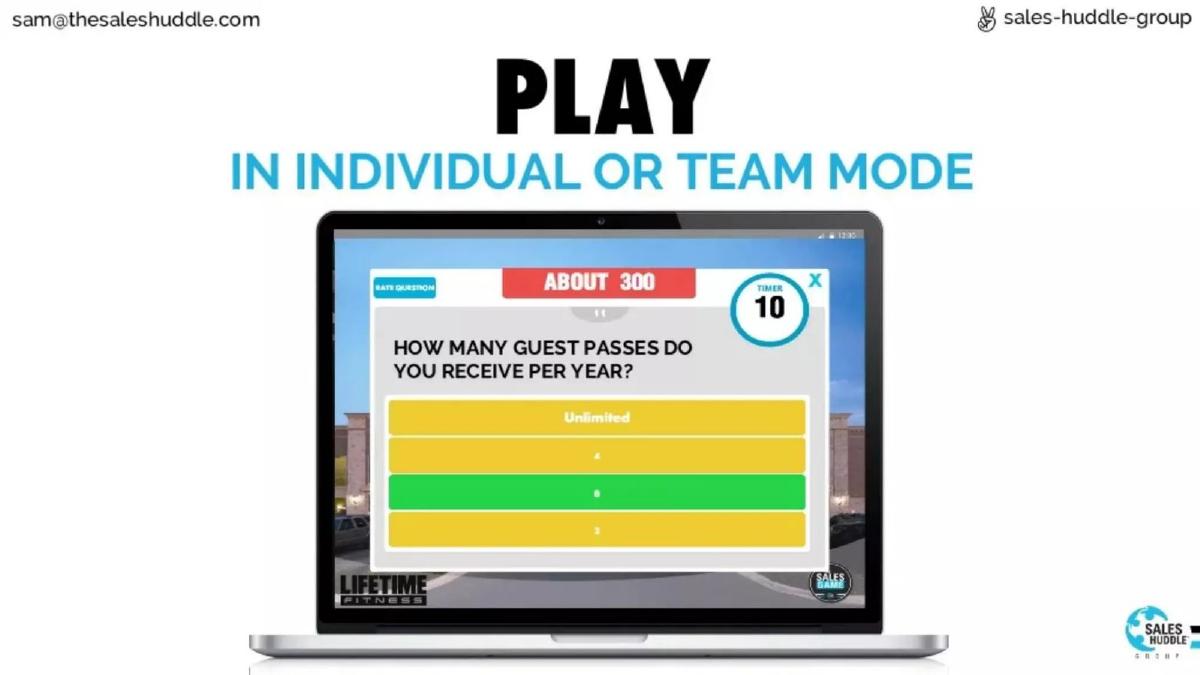
Slide 6: Play The next step in the workflow is engagement. The slide shows a mobile-responsive interface with a multiple-choice question: "How many guest passes do you receive per year?" It notes that users can play in "INDIVIDUAL OR TEAM MODE" and features a 10-second timer to emphasize the "quick-burst" nature of the gameplay mentioned in the company's self-description.
Slide 7: Reward The final piece of the product loop is the incentive. Slide 7 shows a leaderboard with user photos and point totals. To the right, it displays digital gift cards for Nike, Virgin, and W Hotels. The headline "REWARD TOP PLAYERS" completes the gamification narrative: training leads to competition, which leads to tangible rewards.
Slides 8-9: High-Stakes Case Studies
Slide 8: The $15M Question This slide serves as a mini-case study for Super Bowl 50. It shows a question regarding the price of a game day suite ($1,000,000 vs $2,000,000). By showing the product in the context of the world's largest sporting event, 1huddle reinforces its position as a tool for high-stakes enterprise environments.
Slide 9: ROI Evidence Slide 9 is perhaps the most powerful in terms of business impact. Over a background image of a packed hockey arena (Tampa Bay Lightning), the slide displays a massive white text: "$10M INCREASE IN SALES." This provides a direct link between the use of the 1huddle platform and bottom-line results for a client, moving the product from a "nice-to-have" HR tool to a "must-have" sales driver.
Slides 10-11: The Team and The Summary
Slide 10: Team The team slide features three individuals. Sam Caucci (Founder & CEO) is highlighted with "10+ years training sales & service reps." Roger Bernardino (Director of Sales) is credited with "6 years selling enterprise SaaS." Ben Powers is listed as the "Client Success Manager" and "Game Building Guru." The bottom of the slide features a "Featured In" section with logos from Fox News, TechCrunch, Bloomberg, CNN, ESPN, and Forbes, further cementing their authority in the space.
Slide 11: Conclusion The final slide returns to the black background and repeats the core metrics: "51 CLIENTS," "204k 2015 SALES," and "69% MoM GROWTH." It provides the CEO’s email address one last time, serving as a clear call to action for interested investors.
What Works in the 1huddle Deck
The primary strength of this deck is its unapologetic focus on traction . Many early-stage decks spend five or six slides explaining the "why" and the "how" before showing any results. 1huddle does the opposite. By putting the Super Bowl and Madison Square Garden logos on slide two, they force the investor to take the rest of the presentation seriously.
The visual simplicity is also a major asset. Each slide has one clear message. Whether it is the $486B market size or the $10M sales increase, the data points are impossible to miss. The use of actual product screenshots (Slides 5, 6, 7, and 8) gives investors a clear sense of the user experience without requiring a live demo.
Finally, the ROI-centric narrative is compelling. By framing the product as a way to "boost sales" rather than just "improve learning," 1huddle appeals to the revenue-focused mindset of enterprise buyers and venture capitalists alike.
What is Missing from the 1huddle Deck
While the deck is effective as a teaser, it leaves several critical questions unanswered. Most notably, there is no "Ask" slide . A standard pitch deck should specify how much money the company is looking to raise and what milestones that capital will help them achieve. Without this, the deck feels more like a sales presentation for a client than a fundraising document for an investor.
The deck also lacks competitive analysis . The corporate training and LMS (Learning Management System) market is incredibly crowded. Investors would want to know how 1huddle differentiates itself from incumbents like SAP Litmos or newer gamification competitors. The deck assumes that the "boring training" problem is enough to justify their existence, but it doesn't explain why a client would choose them over a cheaper or more established alternative.
Lastly, there is a lack of unit economics . While total sales and growth rates are provided, there is no mention of Customer Acquisition Cost (CAC), Lifetime Value (LTV), or churn rates. For a Series A round, investors typically look for these metrics to ensure that the growth shown on slide 3 is sustainable and profitable in the long run.
What a Founder Should Copy
Founders should emulate the "Logo First" strategy if they have high-profile clients. If you are working with household names, do not bury them at the end of the deck. Use them to build immediate credibility.
The three-step product explanation (Build, Play, Reward) is another excellent takeaway. It breaks down a potentially complex software platform into a simple, easy-to-understand workflow. This helps investors quickly grasp the value proposition without getting bogged down in technical specifications.
Finally, the repetition of key metrics on the final slide is a smart move. It ensures that the last thing an investor sees is the company's strongest data points, reinforcing the growth story one last time before the meeting ends.
Company: 1huddle (formerly Sales Huddle Group) · Sector: HR Tech / Corporate Training · Stage: Series A · Year: 2015 · Slides: 11 · Outcome: Raised $7,900,000 (total across rounds) · HQ: Newark, NJ
Frequently asked questions
- What is the core product offering described in the deck?
- 1huddle offers a gamified mobile platform that converts training materials into competitive games. As shown on slides 5 and 6, the interface resembles a trivia board where employees can play in individual or team modes. The goal is to move away from traditional, 'boring' training methods toward a high-engagement, reward-based system that uses leaderboards and prizes to motivate staff.
- How does 1huddle demonstrate its market traction?
- The deck uses two primary methods: logo density and revenue growth. Slide 2 features logos from the NFL (Super Bowl 50), NBA (Knicks), NHL (Lightning), and MLB (White Sox, Mets), alongside major venues like Madison Square Garden. Slide 3 backs this up with hard numbers, showing total 2015 sales of $204,000 and a clear upward trajectory in monthly revenue.
- What is the primary problem 1huddle is trying to solve?
- Slide 4 illustrates the problem visually: a manager shouting at sleeping employees. It identifies the $486 billion corporate training market as being ripe for disruption because traditional methods fail to engage workers. The implication is that current training is a massive expense that lacks a return on engagement, which 1huddle addresses through gamification.
- Who are the key people behind the company according to the deck?
- The team slide (Slide 10) lists three key members: Sam Caucci (Founder & CEO) with 10+ years in sales training; Roger Bernardino (Director of Sales) with 6 years in enterprise SaaS; and Ben Powers (Client Success Manager). The slide also highlights their media presence, showing the CEO on Bloomberg and listing features in TechCrunch, Forbes, and ESPN.
- What critical information is missing from this pitch deck?
- The deck is notably missing a 'The Ask' slide, which usually defines how much capital is being raised and at what valuation. It also lacks a detailed competitive landscape, a slide on unit economics (LTV/CAC), and a multi-year financial forecast. It functions more as a high-level teaser or a 'traction-first' deck rather than a comprehensive business plan.