The 1inch Network Series B deck is a masterclass in 'traction as narrative.' In just 10 slides, the company moves from a high-level mission to dense, verifiable on-chain data. By highlighting a $96B+ total USD volume on Ethereum and a 53% retention rate (Slide 3), the team established immediate dominance in the decentralized exchange (DEX) aggregator space. The deck avoids the typical 'problem/solution' fluff found in early-stage pitches, opting instead to prove technical superiority through a direct price-impact comparison table (Slide 5) against giants like Binance and Coinbase. While it la…
Key takeaways
- The deck claims 1inch is the #2 biggest DeFi project by unique number of wallets as of the time of the pitch (Slide 3).
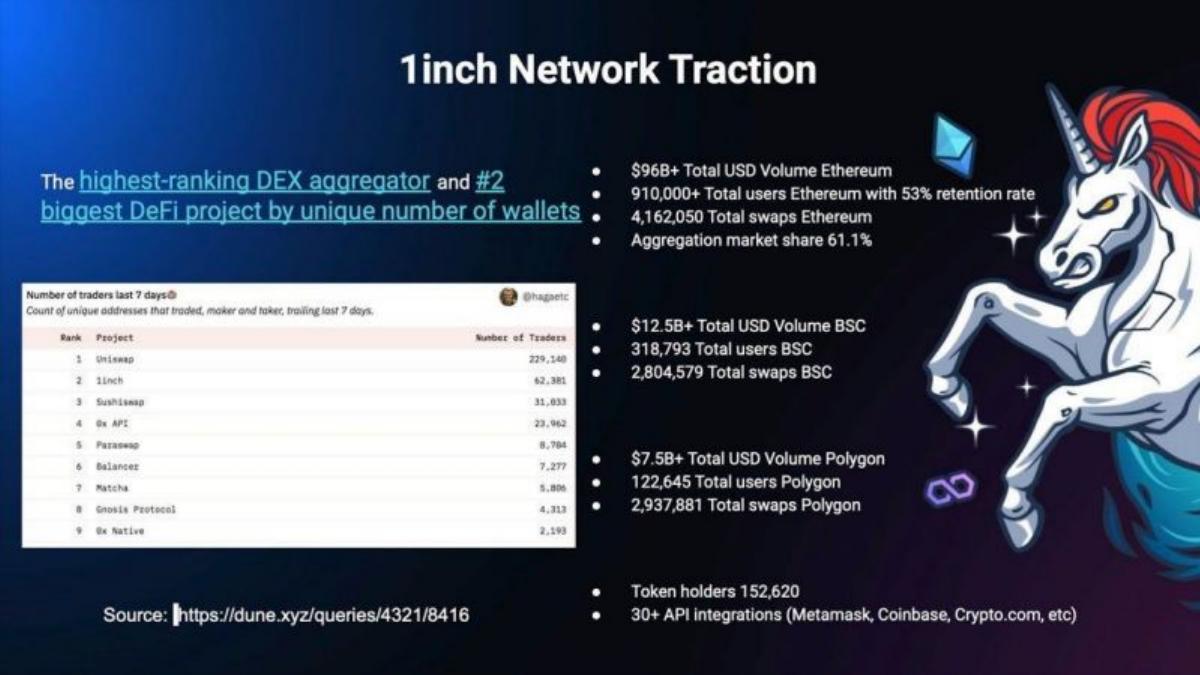
- Ethereum operations accounted for $96B+ in total USD volume with a 53% user retention rate (Slide 3).
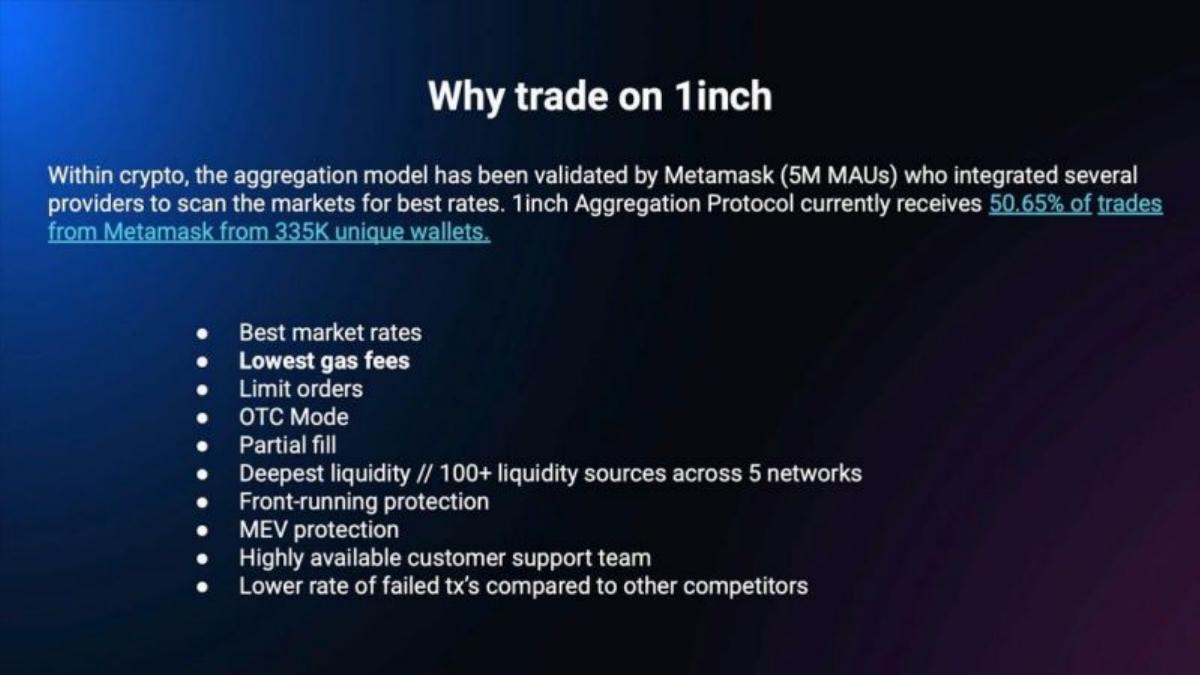
- The company highlights a significant partnership with Metamask, stating 50.65% of trades from Metamask's 335K unique wallets flow through the 1inch Aggregation Protocol (Slide 4).
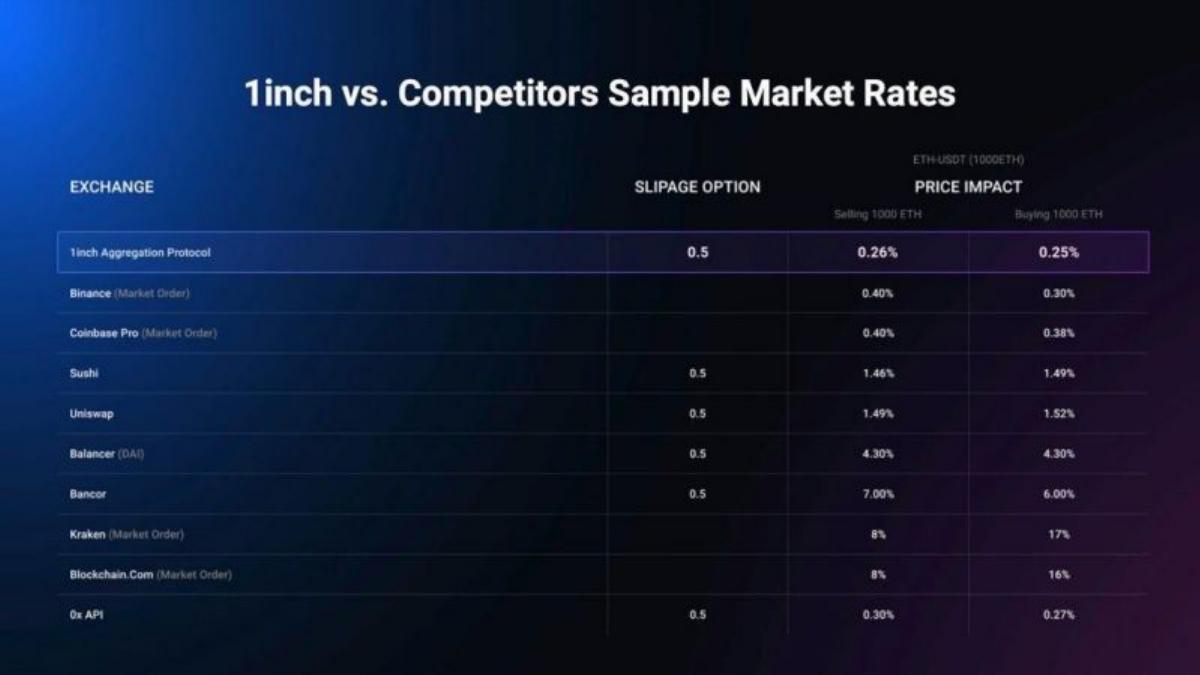
- A competitive analysis table shows 1inch offers a 0.26% price impact on a 1000 ETH sell order, outperforming Binance (0.40%) and Uniswap (1.49%) (Slide 5).
- The platform's multi-chain reach is quantified with $12.5B+ volume on BSC and $7.5B+ on Polygon (Slide 3).
- The deck lists over 30 API integrations including Coinbase, Crypto.com, and Metamask (Slide 3).
- The team slide features 42 individual headshots but provides no names, titles, or professional backgrounds (Slide 7).
- There is no slide dedicated to the specific investment ask, valuation, or use of funds within the 10-slide deck.
1inch Network Series B Teardown: Data Over Narrative
The 1inch Network pitch deck is a concise, 10-slide presentation used to raise $175M in 2021. At the Series B stage, companies usually transition from selling a vision to selling a machine. This deck reflects that transition by stripping away the emotional hooks and focusing almost exclusively on on-chain metrics, market share, and technical benchmarks. It is a document designed for sophisticated crypto-native investors who value liquidity depth and routing efficiency over traditional corporate structure.
Slide 1: Title Slide
The deck opens with the 1inch Network logo and the tagline 'Trade on 1inch.' The branding is consistent with their unicorn-themed identity. There is no mention of the specific round or date on this slide, keeping the focus on the brand itself.
Slide 2: Overview Mission
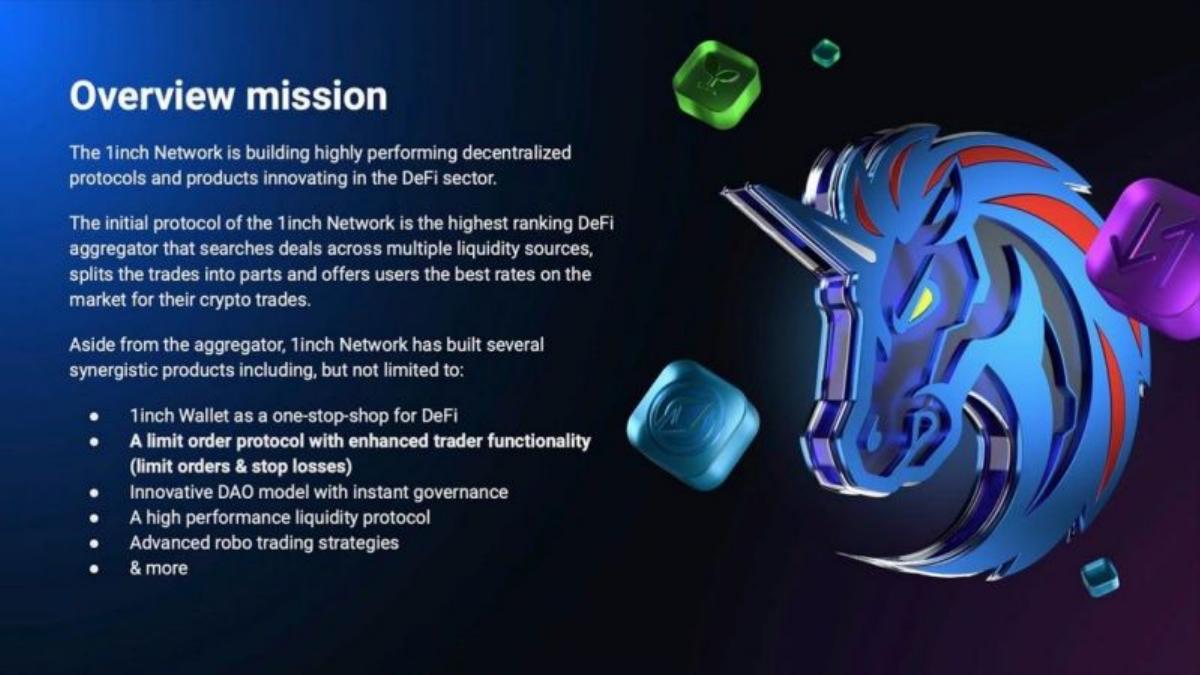
This slide defines the 1inch Network as a builder of 'highly performing decentralized protocols.' It identifies their primary product as a DeFi aggregator that 'searches deals across multiple liquidity sources' and 'splits the trades into parts.' Crucially, it lists synergistic products beyond the aggregator, including the 1inch Wallet, a limit order protocol, a DAO model, and a liquidity protocol. This establishes that 1inch is an ecosystem, not just a single-feature tool.
Slide 3: 1inch Network Traction
This is the most important slide in the deck. It provides a dense breakdown of performance across three major networks: Ethereum, BSC, and Polygon. Slide 3 claims $96B+ in total USD volume on Ethereum and an 'Aggregation market share 61.1%.' The inclusion of a 53% retention rate is a vital metric for proving product-market fit. The slide also includes a screenshot from Dune Analytics showing 1inch ranked #2 in number of traders (62,381) over a 7-day period, trailing only Uniswap. This third-party verification adds significant credibility to the self-reported figures.
Slide 4: Why Trade on 1inch
This slide focuses on validation through partnership. It highlights that the 1inch Aggregation Protocol receives 50.65% of trades from Metamask (Slide 4). By tethering their success to Metamask, which the slide notes has 5M MAUs, 1inch demonstrates its role as the back-end infrastructure for the most popular wallet in the industry. The slide also lists technical benefits such as 'Lowest gas fees,' 'Front-running protection,' and 'MEV protection.'
Slide 5: 1inch vs. Competitors Sample Market Rates
1inch uses a direct comparison table to prove its technical edge. The table compares the 'Price Impact' of selling and buying 1000 ETH. Slide 5 shows 1inch at 0.26% impact, while competitors like Sushi (1.46%), Uniswap (1.49%), and even centralized exchanges like Kraken (8%) show significantly higher slippage. This slide is a powerful tool for convincing investors that 1inch has a 'moat' built on superior algorithms.
Slide 6: Billions of Volume Together
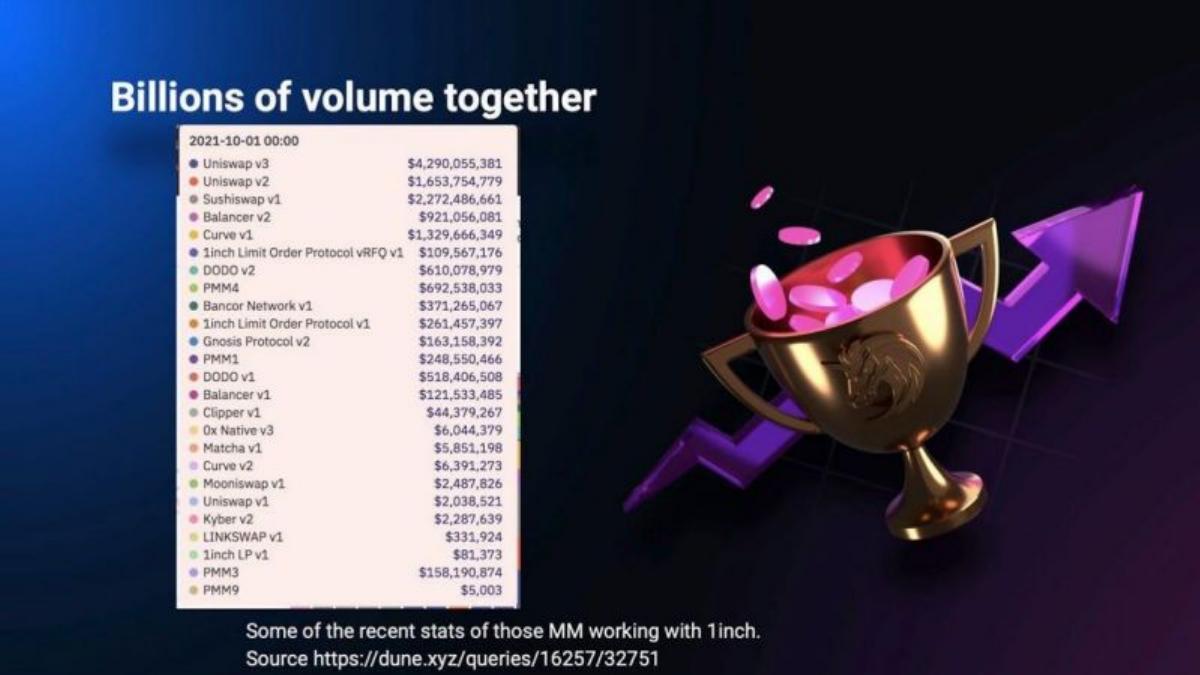
This slide reinforces the scale of the ecosystem by listing specific volumes from market makers (MM) working with 1inch. It features another Dune Analytics screenshot showing volumes ranging from $4.2B for Uniswap v3 down to smaller amounts for various PMMs (Private Market Makers). The visual of a trophy filled with coins is the only 'hype' element in an otherwise clinical deck.
Slide 7: Team and 'Thank You'
The team slide is unusually minimalist. It features 42 headshots arranged over a digital globe (Slide 7). There are no names, no titles, and no LinkedIn links. In a traditional VC deck, this would be a red flag. In the context of a decentralized project in 2021, it emphasizes the collective 'network' over individual personalities, though it leaves investors to do their own due diligence on leadership.
Slide 8: Our Partners
Slide 8 displays a grid of 30 logos, including major industry players like Near, Binance Chain, Coinbase Wallet, Metamask, and Chainlink. This slide serves as a 'who's who' of the 2021 crypto landscape, proving that 1inch is deeply integrated into the broader Web3 stack.
Slide 9: Our Investors
The penultimate slide lists 18 investment firms. High-profile names include Pantera, Binance Labs, Dragonfly Capital, and Galaxy Digital (Slide 9). The presence of Alameda Research is also noted, reflecting the investor landscape at the time of the 2021 raise. This slide provides the final layer of social proof, showing that top-tier capital has already vetted the project.
Slide 10: BestPitchDeck Call to Action
The final slide is a promotional page for the source of the deck and is not part of the original 1inch presentation.
What 1inch Network Does Well
The 1inch deck excels at using comparative data to tell a story of dominance. By including third-party data from Dune Analytics (Slides 3 and 6), they remove the skepticism often associated with founder-reported metrics. The price impact table on Slide 5 is particularly effective because it translates complex routing math into a simple 'we are cheaper' message that any investor can understand. Furthermore, the deck does a great job of showing multi-chain competency, proving they aren't just an Ethereum-only play.
What is Missing from the 1inch Network Deck
The most glaring omission is a Business Model slide . There is no explanation of how the protocol captures value, whether through swap fees, governance token utility, or other mechanisms. Additionally, there is no Financial Forecast or Use of Funds slide. While a $175M Series B usually requires deep financial scrutiny, this deck appears to be the 'high-level' version used to secure interest rather than the full due diligence package. The lack of names and backgrounds on the Team slide is also a significant departure from fundraising best practices, relying entirely on the project's existing reputation.
Founder Lessons: Copy the Data, Not the Omissions
Founders should emulate 1inch’s use of social proof through integration . Showing that 50% of a major partner's (Metamask) traffic flows through your protocol is more convincing than any growth chart. Founders should also copy the direct competitive benchmark style of Slide 5; if your product is technically superior, show the numbers side-by-side with the market leaders. However, unless you are already a top-10 project in your sector, do not skip the business model or the detailed team bios. 1inch could afford to be brief because their on-chain data was already public and undeniable; most startups will need to work harder to explain how they will make money and who is steering the ship.
$96B+ Total USD Volume on Ethereum (Slide 3). · 61.1% Aggregation market share (Slide 3). · 50.65% of trades from Metamask flow through 1inch (Slide 4). · 0.26% Price impact on 1000 ETH trades, beating all listed competitors (Slide 5).
Frequently asked questions
- What is the primary value proposition 1inch presents to investors?
- 1inch positions itself as a high-performance DeFi aggregator that identifies the most efficient swapping routes across multiple liquidity sources. According to Slide 2, the protocol splits trades into parts to offer users the best market rates. The deck emphasizes technical efficiency, specifically citing 'lowest gas fees' and 'front-running protection' as key reasons users choose their platform over competitors (Slide 4).
- How does 1inch demonstrate its competitive advantage in the market?
- The deck uses a direct 'Sample Market Rates' table on Slide 5. It compares the price impact of a 1000 ETH-USDT trade across 11 different exchanges. By showing that 1inch has a lower price impact (0.26%) than centralized giants like Binance (0.40%) and decentralized rivals like Uniswap (1.49%), they provide empirical evidence of their routing algorithm's superiority.
- What metrics does 1inch use to prove user retention and growth?
- On Slide 3, 1inch highlights a 53% retention rate among its 910,000+ Ethereum users. They also showcase their market dominance by stating they hold a 61.1% aggregation market share. These figures, combined with a list of 152,620 token holders, suggest a deeply entrenched user base that is not merely transient but actively participating in the ecosystem.
- Does the deck explain the 1inch business model or revenue streams?
- No. The deck is notably silent on how the 1inch Network generates revenue or captures value from the billions in volume it processes. It focuses entirely on volume, user count, and technical features like the 'Innovative DAO model' and 'limit order protocol' (Slide 2). For a Series B, this suggests the investors were already familiar with the underlying tokenomics or fee structures.
- How does the deck handle the team and leadership section?
- The team presentation is unconventional for a Series B. Slide 7 features a 'Thank You' header above a graphic of a globe covered in 42 small circular headshots. There are no names, no bios, and no mention of the founders' previous successes. This approach relies entirely on the 'strength in numbers' visual rather than the individual pedigree of the leadership team.