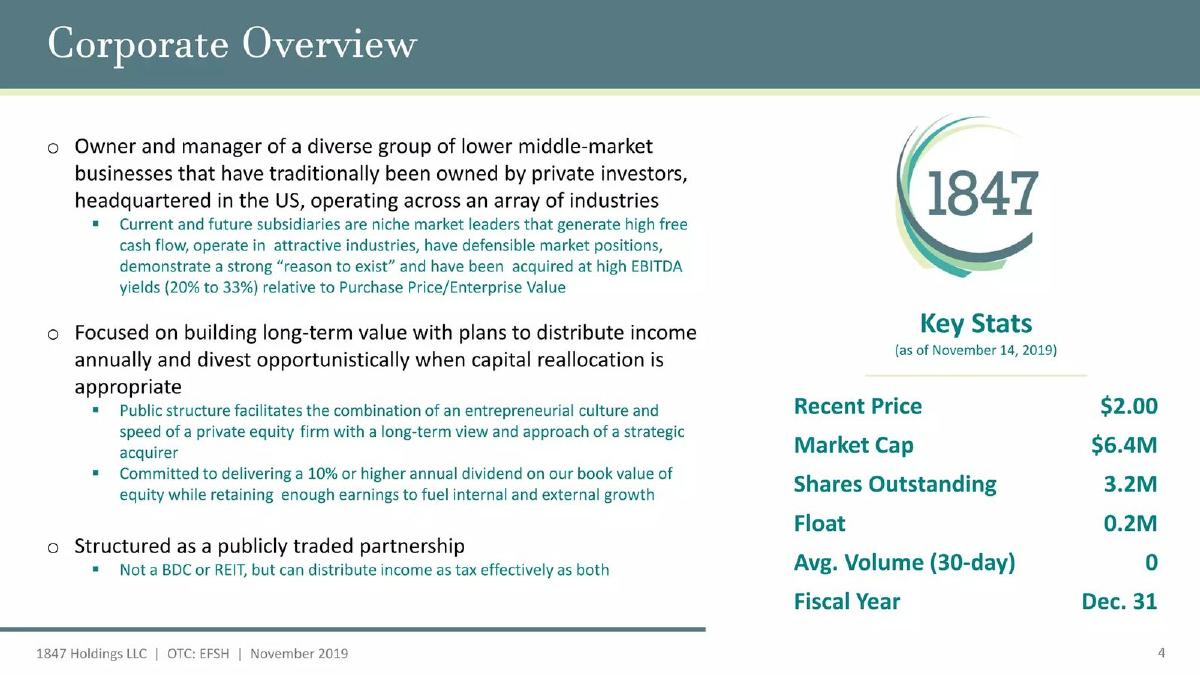
1847 Holdings operates as a publicly traded holding company (OTC: EFSH) that acquires 'mundane' lower middle-market businesses with positive EBITDA under $2 million. Their November 2019 deck outlines a Reg A+ offering seeking up to $8 million in Series A preferred shares with a 12% annual dividend. The company focuses on control buyouts with enterprise values between $5 million and $10 million, utilizing seller financing and asset-based leverage to minimize upfront equity. At the time of this deck, the portfolio consisted of two primary subsidiaries: Neese Inc. (agricultural services) and Goe…
Key takeaways
- The company targets niche businesses with positive EBITDA of $2.0 million or less (Slide 5).
- At the time of the deck, 1847 Holdings had two completed acquisitions generating ~$64.18MM in TTM revenue (Slide 5).
- The acquisition strategy focuses on enterprise values between $5 million and $10 million (Slide 7).
- Financing relies heavily on seller financing and asset-based leverage to limit upfront equity investment (Slide 7).
- The Reg A+ offering sought a minimum of $1M and a maximum of $8M at $25.00 per share (Slide 17).
- Series A preferred shares offered a 12% annual dividend, increasing to 14% if payments are missed for four quarters (Slide 17).
- The portfolio includes Neese Inc., an agricultural service provider, and Goedeker’s, an appliance retailer with 90%+ e-commerce sales (Slide 9).
- The company maintains a network of approximately 980 intermediaries across the U.S. to drive deal flow (Slide 11).
Introduction and Investment Philosophy
Slide 1: Title Slide
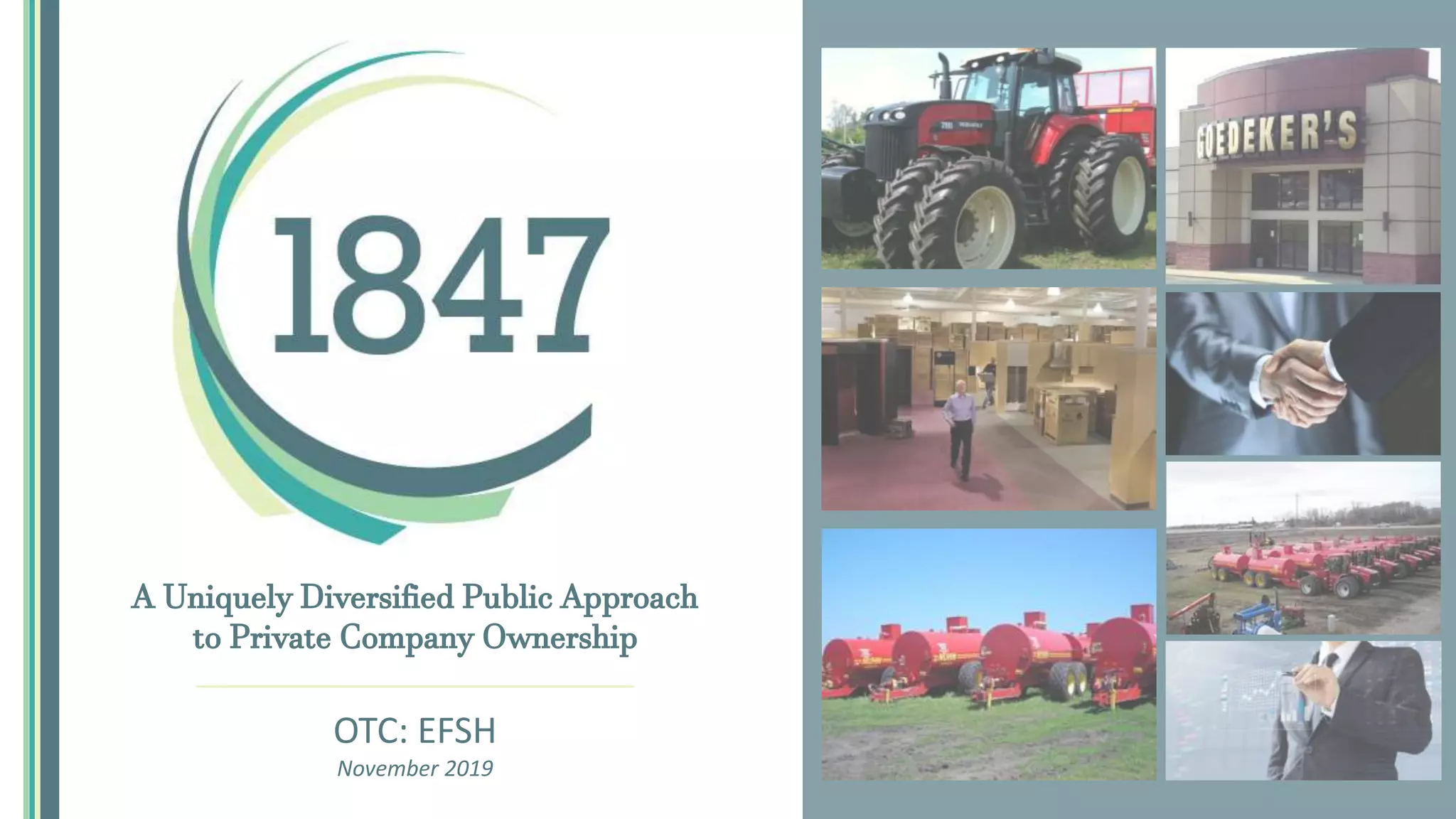
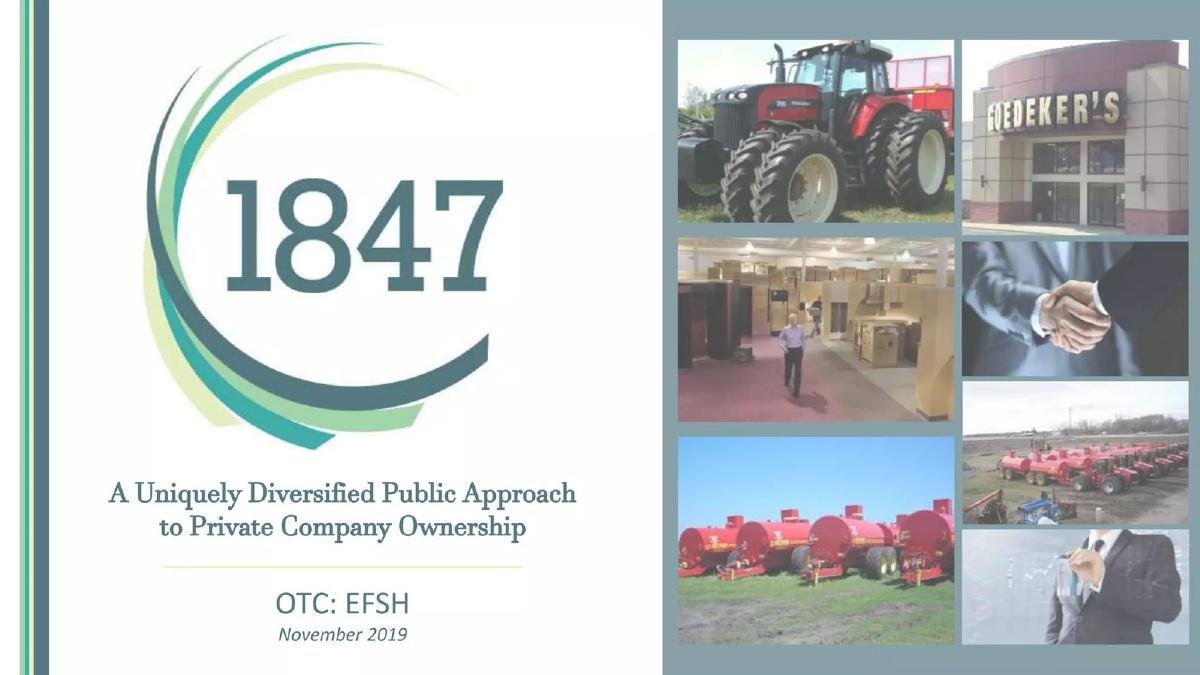
The deck opens with the 1847 Holdings logo and the subtitle "A Uniquely Diversified Public Approach to Private Company Ownership." It identifies the company's ticker as OTC: EFSH and dates the presentation to November 2019. The right side of the slide features a collage of industrial and retail imagery: a tractor, a Goedeker’s storefront, a warehouse, and a handshake, signaling a focus on tangible, traditional businesses.
Slide 3: The Philosophy Quote
This slide features a quote attributed to John Neff (channeled by 1847): "It's not always easy to do what's unpopular, but that's where you generate above average returns. Buy businesses that look mundane to narrow-minded investors and hang on until their real value is recognized." This sets the stage for a value-investing approach focused on the "unpopular" or "mundane" lower middle-market sector.
The Investment Case
Slide 5: Investment Highlights
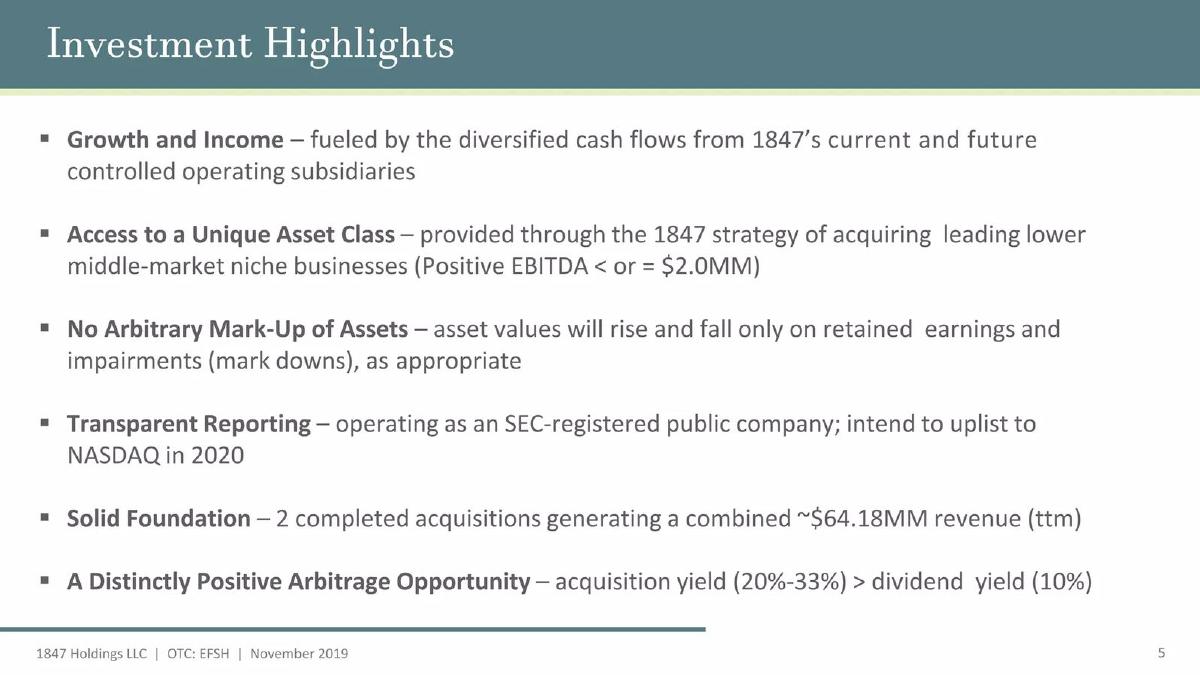
1847 Holdings outlines six key highlights for investors. First is "Growth and Income," fueled by cash flows from subsidiaries. Second is "Access to a Unique Asset Class," specifically lower middle-market niche businesses with positive EBITDA of $2.0MM or less. Third, they promise "No Arbitrary Mark-Up of Assets," stating values will only change based on retained earnings or impairments. Fourth, they highlight "Transparent Reporting" as an SEC-registered company with plans to uplist to NASDAQ in 2020. Fifth, they cite a "Solid Foundation" of two completed acquisitions generating ~$64.18MM in TTM revenue. Finally, they point to a "Distinctly Positive Arbitrage Opportunity," where acquisition yields (20%-33%) exceed their dividend yield (10%).
Slide 7: Acquisition Strategy & Philosophy
The company defines its mission as being the "preferred partner for today’s 'nano-cap' companies in the U.S." The objective is to acquire stable businesses at prices accretive to book value with limited risk of technological disintermediation. They target control buyouts of companies with enterprise values between $5 million and $10 million. A key tactical detail is the use of seller financing and asset-based leverage to limit upfront equity. Their management philosophy emphasizes partnering with existing management and creating value through operations rather than financial engineering.
Portfolio and Operations
Slide 9: Current Subsidiaries
This slide provides details on the two companies in the portfolio as of November 2019. Neese Inc. , based in Grand Junction, Iowa, has operated for over 28 years in the agricultural industry, focusing on waste disposal and land application services. Goedeker’s , based in St. Louis, Missouri, is described as a top 30 appliance retailer. Notably, the slide states that 90%+ of Goedeker’s sales are generated through its e-commerce platform, despite maintaining a physical showroom.
Slide 11: Nationwide Geographic Coverage
1847 Holdings illustrates its deal-sourcing reach with a map of the U.S. divided into regions. The map claims a network of approximately 980 intermediaries (e.g., ~250 on the West Coast, ~225 in NY/NJ). It also marks the locations of 1847 offices (represented by stars), portfolio companies (dots), and targets under contract (circles). This slide is intended to demonstrate a robust pipeline for future acquisitions.
Slide 13: Portfolio Company Management
This slide lists the tactical ways 1847 interacts with its subsidiaries. This includes weekly dialogue with management, quarterly board meetings, active involvement of operating partners, and the development of sales and financial reporting packages. They also mention establishing "authority matrices" and monitoring portfolio diversification, suggesting a structured, hands-on governance model.
Slide 15: Value Creation
The value creation process is broken into four steps: Drive Deal Flow (investigating everything without bias), Buy Right (acquiring stable businesses at attractive prices), Build to Own in Perpetuity (introducing resources and processes while rewarding shareholders with dividends), and Be Ready to Sell (successfully selling subsidiaries at a profit when the time is right).
The Offering Terms
Slide 17: Reg A+ Offering
This is the "Ask" slide, detailing the specific terms of the capital raise. The company sought to sell a minimum of 40,000 and a maximum of 320,000 Series A preferred shares at $25.00 per share, aiming for gross proceeds of $1M to $8M. Key terms include:
Ranking: Senior to common shares. · Distributions: Mandatory 12% annual dividend, paid quarterly. If unpaid for four quarters, the rate increases to 14%. · Liquidation Preference: $25.00 per share plus unpaid distributions. · Optional Redemption: The company can redeem shares after one year at $25.00 plus unpaid distributions. · Voting Rights: Generally no voting rights. · Conversion: Non-convertible.
The placement agent is identified as Craft Capital Management LLC. The use of proceeds is specified for acquiring senior secured indebtedness of subsidiaries and for working capital.
Slide 19: Contact Information
The final slide provides the corporate headquarters address in New York and contact details for Craig Brelsford at RedChip Companies for investor relations. It repeats the industrial/retail imagery from the cover slide.
What 1847 Holdings Does Well
The deck is exceptionally clear about its financial mechanics. Unlike many startup decks that remain vague about how they will make money, 1847 Holdings explicitly defines its "Arbitrage Opportunity" on Slide 5. By stating that they buy at 20-33% yields and pay out 10-12%, they provide a clear mathematical thesis for the investment. Furthermore, the inclusion of specific terms for the Reg A+ offering (Slide 17) makes this a functional transactional document rather than just a marketing presentation. The geographic map of intermediaries (Slide 11) also does a good job of quantifying their "top of funnel" for acquisitions, which is a critical metric for a holding company.
What is Missing from the Deck
The most significant omission in the provided slides is a detailed breakdown of the management team's track record. While Slide 13 mentions "operating partners," there are no biographies or names of the individuals responsible for selecting and managing these acquisitions. For a holding company, the "jockey" is often as important as the "horse." Additionally, while Slide 5 mentions ~$64.18MM in TTM revenue, there is no slide showing the historical EBITDA or net income of the subsidiaries. Given that their strategy relies on "Positive EBITDA Founders of holding companies or investment vehicles should take note of Slide 7's clarity on "Acquisition Size and Structure." By defining exactly what they look for (EV of $5M-$10M, EBITDA < $2M), they save time for both themselves and potential sellers. Another takeaway is the use of a "Philosophy" slide. While often seen as fluff, Slide 3 successfully frames 1847 as a contrarian value investor, which helps justify why they are buying "mundane" businesses like appliance retailers and manure haulers rather than high-growth tech firms. This framing is essential for managing investor expectations regarding growth versus income.
Frequently asked questions
- What is the core business model of 1847 Holdings?
- 1847 Holdings acts as a public holding company that acquires controlling interests in small, stable, 'lower middle-market' companies. They target businesses that are often overlooked by larger private equity firms, specifically those with EBITDA under $2 million. Their goal is to provide public investors with access to private equity-style returns through dividends and long-term capital appreciation from these subsidiaries.
- How does the company finance its acquisitions?
- According to slide 7, the company uses a combination of seller financing and asset-based leverage. By minimizing the amount of upfront equity invested, they aim to align interests with the sellers and maximize the return on equity for their own shareholders. They target enterprise values in the $5 million to $10 million range for these transactions.
- What were the terms of the Reg A+ offering in this deck?
- The offering sought to raise between $1 million and $8 million by selling Series A preferred shares at $25.00 each. These shares carried a 12% mandatory annual dividend, paid quarterly. The shares were non-convertible and included an optional redemption clause allowing the company to buy them back after one year at the original price plus unpaid dividends.
- What industries does 1847 Holdings invest in?
- The deck shows a diversified approach. Slide 9 highlights Neese Inc., which serves the agricultural industry through waste disposal and land application, and Goedeker’s, a top 30 appliance retailer. Slide 7 notes they look for businesses with limited risk of technological disintermediation, suggesting a preference for 'old economy' or service-based industries rather than high-tech startups.
- What is the 'arbitrage opportunity' mentioned in the deck?
- Slide 5 defines the arbitrage as the gap between their acquisition yield and their dividend yield. They aim to acquire companies at yields of 20% to 33%, while paying out a dividend yield of approximately 10% (later specified as 12% for the Series A preferred). This spread is intended to cover corporate overhead and fund future growth.