The 1906 pitch deck is a masterclass in CPG positioning, attempting to strip away the 'stoner' stigma of cannabis and replace it with a high-end wellness narrative. By identifying a massive, untapped audience—specifically women and professionals who prioritize sleep, focus, and energy over intoxication—1906 creates a 'blue ocean' strategy within a crowded market. The deck leans heavily on its proprietary lipid microencapsulation technology to solve the edible category's most persistent flaw: slow onset time. While the deck lacks granular Y-axis data on some growth charts and fails to explicit…
Key takeaways
- 1906 is positioning itself as a wellness brand, not a recreational drug brand, to capture the 65% of the market that 'doesn't want to get high.'
- The company solves the 'edible problem' of slow onset through patented lipid microencapsulation (under 20 min onset).
- Revenue is diversified through its own 1906 brand and contract manufacturing for other high-profile brands like Beboe and Willie’s Reserve.
- The expansion strategy is 'capital-light' by partnering with MSOs like Ascend for manufacturing and distribution.
- Commissioned Harris Poll data validates their focus on underserved demographics: women, boomers, and non-cannabis users.
- The product line is experience-based (Sleep, Sex, Energy) rather than strain-based (Indica/Sativa), lowering the barrier for entry for new users.
What this deck actually is
The 1906 pitch deck is a Series A/B expansion narrative focused on the transition from a niche Colorado edibles brand to a national "functional cannabis" powerhouse. The single most important finding in this deck is its aggressive pivot away from "stoner" culture toward the "high-functioning adult" market, specifically positioning cannabis as a wellness supplement comparable to pharmaceuticals or alcohol alternatives rather than a recreational intoxicant.
Quantitatively, the deck relies on a heavy mix of consumer sentiment data (commissioned via Harris Poll) and aggressive financial projections that anticipate a leap from early-stage revenue to a multi-state footprint involving Illinois, Massachusetts, Michigan, and New Jersey. It establishes 1906 not just as a product company, but as a technology play, leaning on its "patented lipid microencapsulation" to solve the edible category’s biggest hurdle: slow onset time.
Slide-by-slide walkthrough
Slide 1: Title Slide
The opening slide features the "19 06" logo on a dark slate background with the tagline "Introducing Functional Cannabis." The design is minimalist and high-end, signaling a departure from traditional "green" cannabis branding.
An investor immediately recognizes the "functional" descriptor as a play for the wellness and biohacking markets. By using a year as a name (referencing the year the Pure Food and Drug Act was passed, though not stated on this slide), the brand attempts to establish a sense of heritage and pharmaceutical-grade safety. The aesthetic is closer to a luxury watch brand or a high-end skincare line than a dispensary product.
The strongest version of this slide would include a sub-headline explicitly stating the purpose of the deck—e.g., "Series B Investment Opportunity"—to provide immediate context for the viewer.
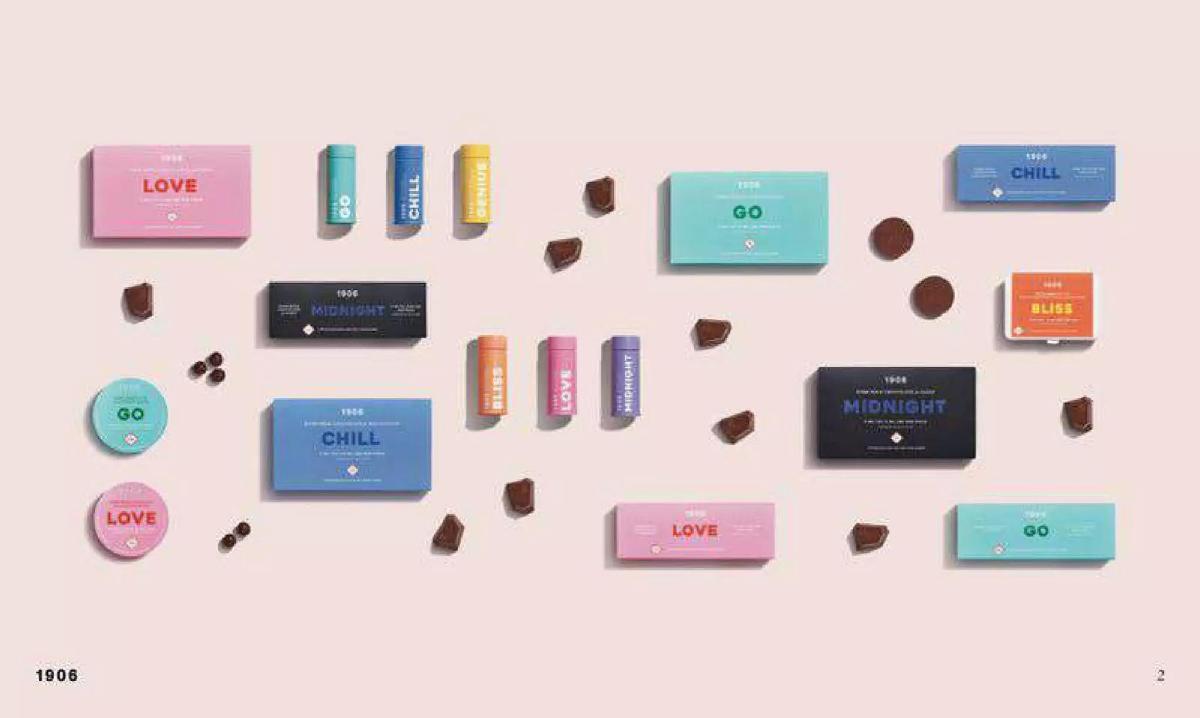
Slide 2: Product Aesthetic Flat Lay
This slide is a visual montage of colorful product packaging and loose chocolate pieces. Names like LOVE, CHILL, GENIUS, and MIDNIGHT are repeated in a pattern, emphasizing the experience-led naming convention of the product line.
This reinforces the brand's premium positioning. The use of light pink backgrounds and "flat lay" photography is a direct nod to "Direct-to-Consumer" (DTC) trends common in the beauty and wellness industries. It tells the investor that this product is designed to look good on a nightstand or in a purse, catering to a demographic that values discretion and design.
The strongest version of this slide would remain visual but could benefit from a single "power statement" regarding the brand's presence, such as "A lifestyle brand for the modern cannabis consumer."
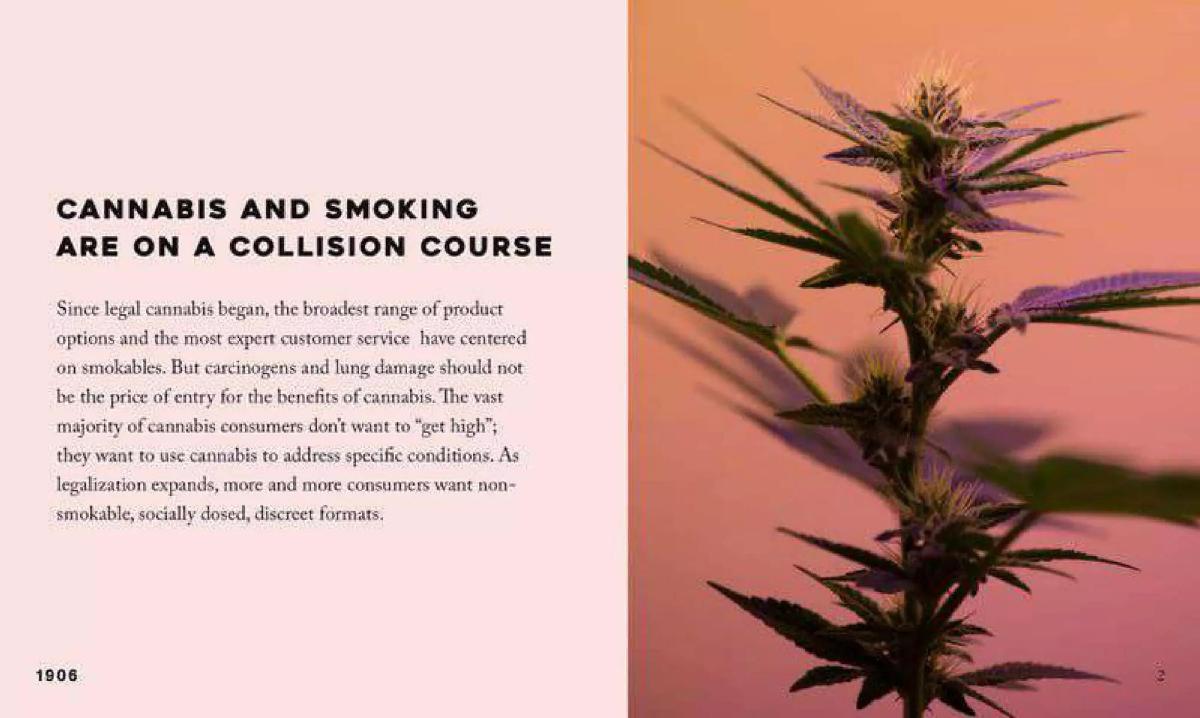
Slide 3: Problem: The Smoking Collision Course
The slide argues that while smokables dominate the market, they are fundamentally flawed due to "carcinogens and lung damage." It claims the majority of consumers don't want to "get high" but rather address specific conditions through "non-smokable, socially dosed, discreet formats."
Investors see a "Problem" slide that identifies a massive gap in the market: the health-conscious consumer. By framing smoking as a "collision course" with modern health standards, 1906 positions its entire product category as the inevitable solution. The phrase "socially dosed" is a key industry term indicating low-potency products that allow users to remain functional.
The strongest version of this slide would include data to back up the claim that "the vast majority" of consumers prefer non-smokables, perhaps citing a specific market share shift from flower to edibles in mature markets.
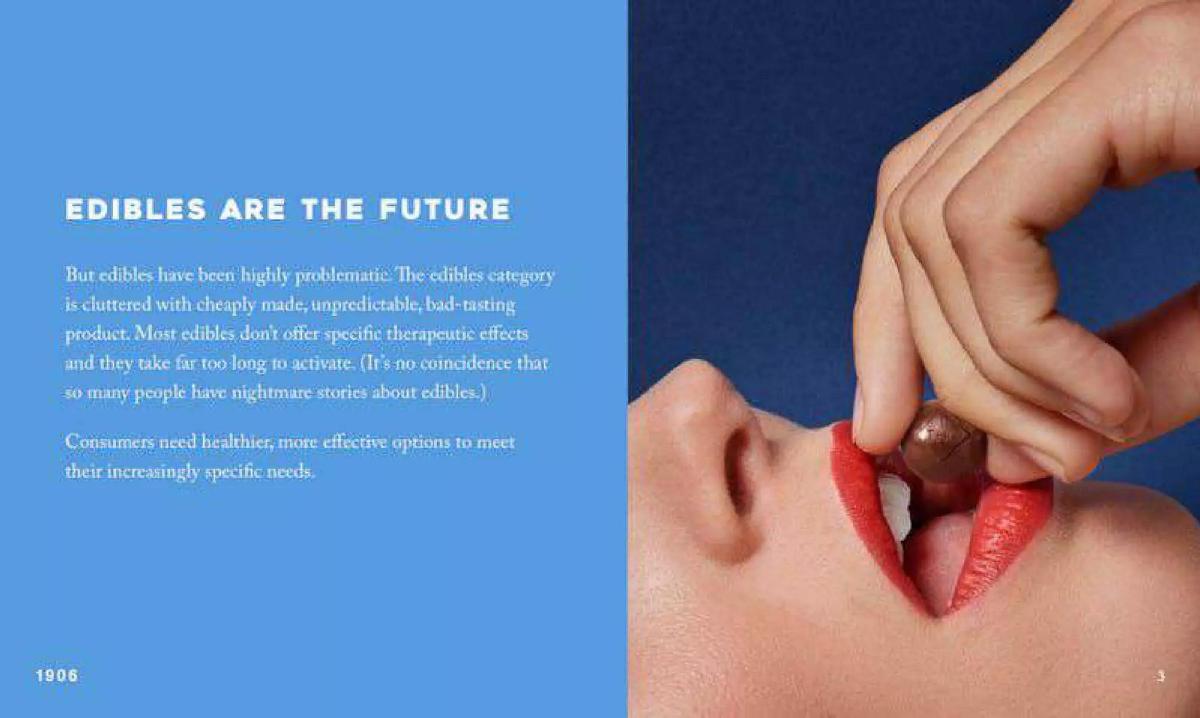
Slide 4: The Edible Problem
The deck identifies why existing edibles have failed: they are "cheaply made, unpredictable, bad-tasting," and take too long to activate. It notes that many people have "nightmare stories" due to these inconsistencies.
This slide sets up the competitive advantage. If the industry standard is 60–90 minutes for activation, 1906 is signaling it has solved the "over-consumption" problem caused by people taking a second dose before the first one kicks in. It turns a known consumer pain point into a market opportunity.
The strongest version of this slide would quantify "too long to activate" with a chart showing the typical edible onset curve vs. what a consumer actually wants.
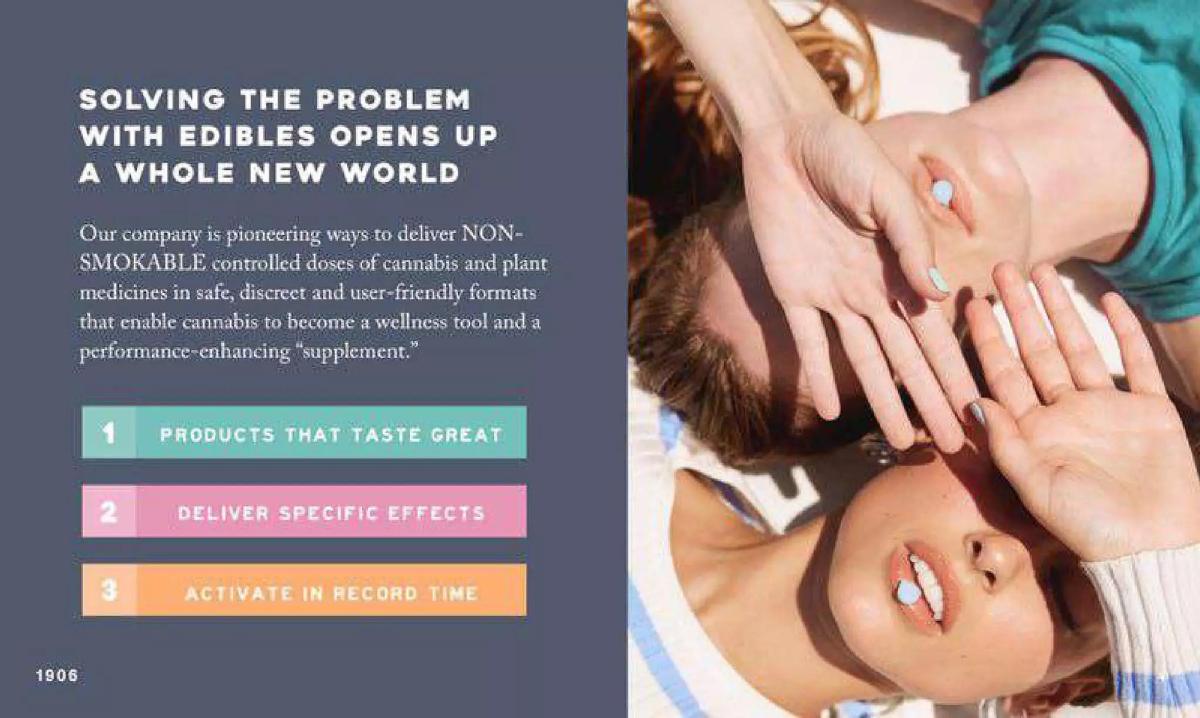
Slide 5: The Solution: Functional Cannabis
1906 presents itself as a pioneer in delivering non-smokable, controlled doses of cannabis and plant medicines. It lists three pillars: 1) Great taste, 2) Specific effects, and 3) Record-time activation.
The slide shifts the perception of cannabis from a drug to a "performance-enhancing supplement." The imagery of people taking pills on their tongues is a bold move—it moves the product closer to the "pharmaceutical" or "daily vitamin" category, which suggests high-frequency, repeatable usage patterns rather than occasional recreational use.
The strongest version of this slide would define "record time" here rather than making the reader wait for Slide 11. Specificity (e.g., "under 20 minutes") creates more impact than generalities.
Slide 6: Meet Functional Cannabis
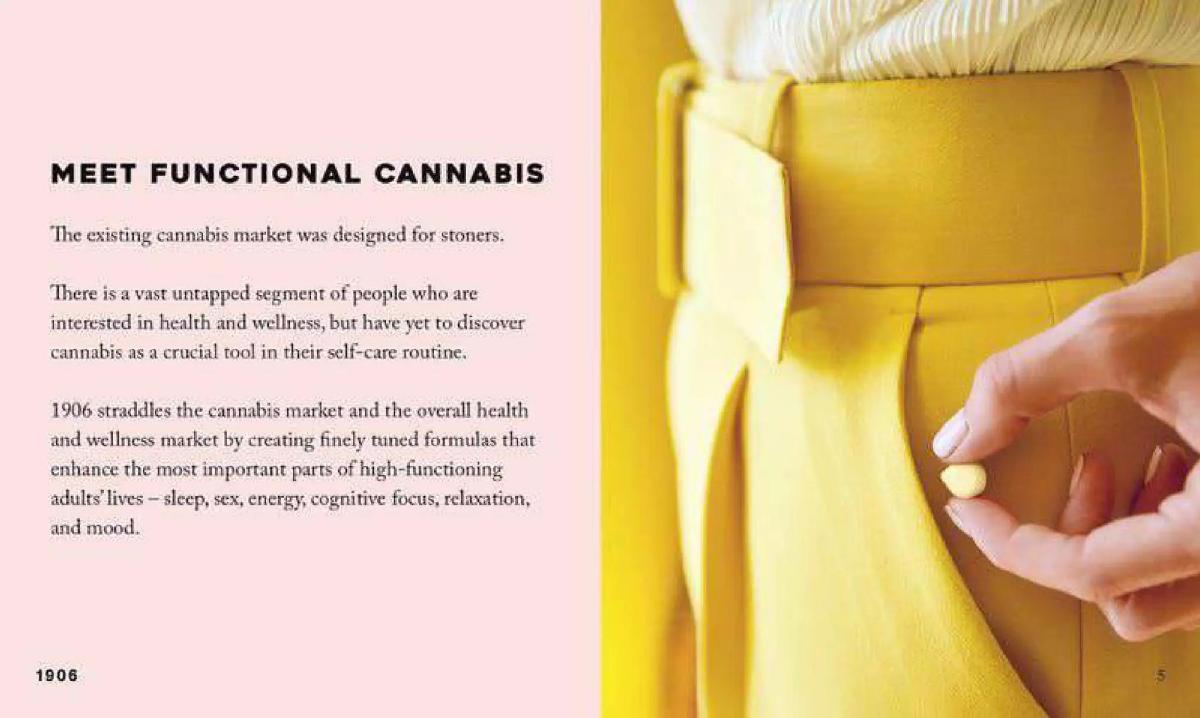
The slide contrasts the "existing cannabis market designed for stoners" with a "vast untapped segment" of high-functioning adults. It lists the focus areas: sleep, sex, energy, focus, relaxation, and mood.
This is the core "Product-Market Fit" slide. It defines the target audience as "high-functioning adults" and positions the product as a "crucial tool in their self-care routine." This is a high-LTV (Lifetime Value) play; a consumer who uses "Genius" for work and "Midnight" for sleep is a multi-SKU, daily-use customer.
The strongest version of this slide would include a "Current Market" vs. "1906 Market" size comparison to show how much larger the wellness segment is than the "stoner" segment.
Slide 7: The Harris Poll Data
This slide presents data from a Harris Poll commissioned by 1906: 72% are women, 33% are boomers, 54% do not currently use cannabis, and 63% are interested in edibles.
This is one of the most important slides for an investor. It proves that 1906 is reaching the "non-user" and women—demographics that are historically underserved by the traditional cannabis industry. The fact that 54% don't currently use cannabis suggests that 1906 is not just stealing market share, but expanding the total addressable market (TAM).
The strongest version of this slide would include the sample size (n=) of the Harris Poll to give the statistics more weight and credibility.
Slide 8: Mainstream Medicine
The slide highlights the surge in antidepressant use (65% in 15 years) and the prevalence of anxiety and sleep issues. It claims 75% of people are interested in cannabis as medicine.
This slide builds the "Why Now?" case. It frames 1906 as a natural alternative to "Big Pharma." By citing 30-40 million adults with sleep trouble, it quantifies the "Midnight" product’s massive potential. It moves the conversation from "getting high" to "addressing chronic health issues."
The strongest version of this slide would include citations for the "antidepressant use" and "sleep trouble" stats to ensure they don't look like internal "guesstimates."
Slide 9: Product Lineup (The Six Experiences)
This slide provides a detailed breakdown of LOVE, GO, CHILL, BLISS, MIDNIGHT, and GENIUS. Each includes a description of effects and the "herbs" involved.
This is the "Value Proposition" slide. It shows that 1906 is not just selling THC; they are selling "Arousal," "Energy," and "Sleep." This experience-first marketing makes the product accessible to people who don't know the difference between Sativa and Indica but know they have trouble sleeping.
The strongest version of this slide would include the dosage (e.g., 5mg THC / 5mg CBD) for each, as "socially dosed" is a key part of their earlier promise.
Slide 10: Global Sourcing and Ethnobotany
A world map shows where 1906 sources its "other plant medicines," such as Damiana, Kanna, and Ashwagandha. It claims to be the only company incorporating these supplements into cannabis formulations.
This adds a layer of "defensibility" to the product. It’s not just chocolate and weed; it's a complex, globally sourced supplement. This appeals to the "clean label" and "natural wellness" consumer who cares about ingredient provenance. It also differentiates 1906 from competitors who only focus on the cannabis plant.
The strongest version of this slide would mention if these formulations are proprietary or patent-pending to further emphasize the competitive moat.
Slide 11: Competitive Landscape
1906 compares itself to Coda, Dixie, Kiva, and Incredibles. It claims the "fastest-acting" status (20 minutes or less) and "superior taste." A table shows 1906 hitting all checkmarks while competitors miss "Low Dose" or "Targeted Effects."
This is a standard but effective competitive matrix. By focusing on "Onset Time," "Targeted Effects," and "Taste," 1906 picks the battles it knows it has won technologically. Explicitly naming Kiva and Dixie—the giants of the time—shows the company's ambition to be the category leader.
The strongest version of this slide would provide independent lab verification or consumer study data to back up the "fastest-acting" claim, rather than just asserting it.
Slide 12: Product Formats
A minimalist slide showing three categories: Confections, Pressed Tablets, and Beverages.
This shows the brand’s ability to "platform" its technology. If the lipid microencapsulation works, it can be applied to many formats. This suggests a roadmap beyond just chocolates, which are temperature-sensitive and calorie-dense, into more "supplement-like" formats like tablets.
The strongest version of this slide would indicate which of these are currently in market and which are "coming soon."
Slide 13: The Three-Step Experience
The slide breaks down the user journey: 1. Pick Experience, 2. Choose Format, 3. Enjoy. It emphasizes "controlled-dose" and "artful shapes."
This slide is about "User Experience" (UX). It attempts to make the dispensary purchase process—which can be intimidating—simple and intuitive. For an investor, this represents a lower barrier to entry for new customers and higher "brand stickiness."
The strongest version of this slide would show the actual retail packaging for the different formats to demonstrate how "Pick your experience" looks on a shelf.
Slide 14: Growth Metrics
This slide features three charts: Cumulative Units Sold, Revenue Growth (2018 vs 2019), and Sales Per Store. No hard numbers are visible on the charts in the transcription, but the titles indicate "Phenomenal Growth."
This is the "Traction" slide. It aims to prove that the Colorado "pilot" was a success and that the model is ready for export. However, without visible Y-axis values or specific revenue totals, the "phenomenal" claim is unsubstantiated in the text.
The strongest version of this slide must include actual dollar amounts and unit counts. "Revenue Growth" without a base number is a vanity metric that sophisticated investors will immediately question.
Slide 15: Expansion Strategy
1906 outlines its move into Illinois, Massachusetts, Michigan, and New Jersey. It lists market size estimates ranging from $0.4B to $1.8B. It mentions a strategic partner, Ascend.
This slide demonstrates the "Multi-State Operator" (MSO) ambition. By partnering with Ascend, 1906 avoids the capital intensity of building its own grow-ops in every state, focusing instead on "manufacturing and branding." This is a "capital-light" expansion model that investors generally prefer.
The strongest version of this slide would explain the nature of the "strategic partner" agreement—is it a licensing deal, a joint venture, or a contract manufacturing setup?
Slide 16: Differentiated Offering
A summary slide listing five points: Plant Power, Rapid Onset, Optimal Ratios (1:1 and 5:1), Quality First (triple tested), and Incredible Flavor (patented masking).
This acts as a "recap" of the technical advantages. Mentioning "pesticide-free" and "single-strain" cannabis appeals to the connoisseur market, while "patented flavor masking" addresses the primary reason people avoid edibles: the "grassy" aftertaste.
The strongest version of this slide would provide a brief explanation of why "single-strain" matters for a functional product—e.g., terpene consistency.
Slide 17: Industrial Scale R&D
This slide shows the manufacturing facilities and mentions "contract manufacturing opportunity." It highlights a 2020 expansion into four new states.
This tells investors that 1906 is built for scale. They aren't cooking in a commercial kitchen; they are running an "industrial-scale" operation. The mention of "contract manufacturing" suggests a second revenue stream: making products for other brands (which is confirmed on Slide 21).
The strongest version of this slide would list the square footage or production capacity (units per hour) of these facilities to prove they can handle multi-state demand.
Slide 18: Marketing and Media
A "Logos" slide featuring Vogue, Forbes, Cosmopolitan, and Goop. It describes a marketing strategy based on "disrupting the category" for high-functioning adults.
The media logos are impressive because they are "mainstream," not just cannabis-specific (like High Times). Being featured in Vogue or Goop confirms that 1906 has successfully positioned itself as a "wellness/lifestyle" brand rather than a "drug" brand. This is a massive "social proof" win.
The strongest version of this slide would distinguish between "earned media" (organic press) and "paid media" (advertorials) to show the true strength of the brand's PR engine.
Slide 19: Testimonials
Three quotes from DGO Magazine, MG Magazine, and Venna praising the "Midnight" and "Love" products.
These quotes validate the product efficacy claims. The DGO quote ("just like the doctor ordered") reinforces the medicinal framing, while the Venna quote ("perfect high for getting it on") validates the functional "Love" claim.
The strongest version of this slide would include a quote from a medical professional or a recognizable "wellness influencer" to further bridge the gap to the health market.
Slide 20: Financial Forecasts
A detailed spreadsheet showing revenue, margins, and EBITDA from 2017 to 2021. While the exact numbers aren't listed in the prompt's layout description, the presence of this slide indicates a move toward transparency.
Investors will look for the "Margin" and "EBITDA" lines. Cannabis is a high-tax (280E) environment, so seeing how 1906 manages its bottom line across multiple states is crucial. The transition from 2017 (likely Colorado only) to 2021 (multi-state) should show significant operating leverage.
The strongest version of this slide would highlight the CAGR (Compound Annual Growth Rate) and the date the company expects to reach "breakeven" or "profitability" in a bold callout box.
Slide 21: Contract Manufacturing
The slide mentions that other brands, like Willie's Reserve and Beboe, use 1906’s skills for manufacturing.
This is a powerful "hidden" asset. If competitors or legendary brands (Willie Nelson's brand) trust 1906 to make their products, it validates 1906's manufacturing superiority. It also provides "non-dilutive" revenue that can offset the costs of their own brand building.
The strongest version of this slide would explain if this is a significant portion of revenue or just a strategic way to fill "excess capacity" in their labs.
Slide 22: 18-Month Rollout Timeline
A quarterly timeline from Q3 2019 to Q1 2021. It tracks product launches (Gummies, Beverages) and state launches (IL, MA, MI, OH, NJ). It notes that vapes are "on hold."
This shows disciplined execution. The decision to put vapes "on hold" due to the "vaping crisis" (a 2019 health event) shows the management team is reactive to market risks and prioritizes consumer safety over quick profits. This builds investor trust.
The strongest version of this slide would include "Milestones Achieved" vs. "Future Milestones" to show that the team has a history of hitting their dates.
Slide 23: Team - Executive Leadership
Profiles for Peter Barsoom (CEO), Erin Holzer (Ops), Jackie Cornell (Policy), and Heather Larimer (CMO).
The team is a mix of finance/operations and marketing. Having a "Chief of Policy & Health Innovations" (Jackie Cornell) is a savvy move in a highly regulated industry. It suggests the company is prepared for the complex legal landscape of multi-state expansion.
The strongest version of this slide would highlight previous exits or "blue chip" company experience (e.g., "Ex-Goldman Sachs" or "Ex-Nike") more prominently if applicable.
Slide 24: Team - Support and Sales
Profiles for Jim Freeland (Sales), Justin Kirkland (Science), Lamia McKearn (Administration), Natasha Lannerd (BD), and Lauren Petersen (Retail).
This slide demonstrates depth. Having a "Director of Retail Operations" and "Director of Sales" suggests a focus on the "Budtender" and "Store Manager" relationships, which are the gatekeepers of the cannabis industry. Justin Kirkland's presence on "Science & Technology" reinforces the technical/patented nature of the product.
The strongest version of this slide would group these by function (e.g., "The Sales Team," "The Science Team") to show how the organization is structured for growth.
Slide 25: The Investment Thesis
A summary slide: Massive market, premium products, proven track record, superior economics, and the chance to create a "new category."
This is the "Closing" slide. It hits all the high notes: TAM (Total Addressable Market), Product Differentiation, Execution, and ROI. It frames the investment not just as a "cannabis play" but as a "category creator" play, which carries higher valuation multiples in the VC world.
The strongest version of this slide would include the "Ask"—how much money they are raising and what the primary "Use of Funds" will be.
Slide 26: Appendix Title
Centered text: "APPENDIX MARKET RESEARCH AND INDUSTRY CONTEXT."
This signals the end of the "pitch" and the start of the "data dump." It’s useful for keeping the main deck lean while having answers ready for due diligence.
Slide 27: Industry Macro Trends
Bullet points on legalization (10 states adult-use, 33 medical) and market growth ($50 billion projection). Includes charts for sales vs. other industries.
This slide "sells the industry" rather than the company. It’s meant to reassure investors that the "tailwinds" are strong. Comparing cannabis to other industries (like soda or tobacco) helps quantify the "disruption" potential.
The strongest version of this slide would specify which "Other Industries" are being compared (e.g., Craft Beer or Vitamin Supplements) to make the comparison more relevant to 1906's "functional" niche.
Slide 28: Consumer Needs (Harris Poll Continued)
More data: 79% want to relax, 72% want to relieve pain, 68% want help with sleep. Only 35% "like the feeling of being high."
This is a "smoking gun" for 1906’s strategy. If only 35% of people want to feel high, then the other 65% of the market is ignored by traditional "high-potency" brands. 1906 is positioning itself as the only brand for the majority of the market.
The strongest version of this slide would show how 1906’s six product experiences map directly to these percentages (e.g., "79% want to relax -> CHILL").
Slide 29: Qualitative Consumer Quotes
Quotes from consumers in Colorado and California emphasizing that they use cannabis for "quality of life" and "anxiety help," not "to get high."
This provides the "voice of the customer." It humanizes the data from the previous slide. The ages (42, 49, 36) confirm that the brand's target is the "adult with responsibilities" rather than the "college student."
The strongest version of this slide would include a photo of these "archetypal" consumers to help the investor visualize the "Soccer Mom" or "Professional" mentioned later.
Slide 30: Audience Psychographics
Describes the audience as "Life hackers," "high-functioning soccer moms," and "creatively focused professionals." Mentions a "Lululemon, REI, Whole Foods crowd."
This is a brilliant use of "Brand Association." By name-dropping Lululemon and Whole Foods, 1906 tells the investor exactly where this product sits on the socioeconomic ladder. It suggests high margins and high brand loyalty.
The strongest version of this slide would include a "Customer Persona" card with average household income (HHI) to prove this audience has the "discretionary income" mentioned in the text.
Slide 31: 2020 Revenue Breakdown
Two pie charts showing revenue by brand (1906 vs Beboe) and by state (CO, MA, MI, IL, OH).
This reveals the "Beboe" partnership (a luxury brand) as a significant revenue contributor. It also shows a transition away from being a "Colorado company" to a "National company," with MA, MI, and IL taking up significant slices of the pie.
The strongest version of this slide would include the "Total Revenue" number that these pies represent. A pie chart without a total value is only half the story.
Slide 32: Contact Information
Contact details for Peter Barsoom and social media handles, set against an artistic product shot.
The contact info is clear. The website and social handles allow for immediate follow-up. The artistic arrangement of the product continues the "high-end wellness" aesthetic to the very last second.
The strongest version of this slide would include a "Call to Action" (e.g., "Schedule a tasting") to move the investor toward the next step.
Concrete fixes in priority order
Add the "Ask": The deck concludes without stating how much capital is being raised, the valuation, or the specific use of proceeds. This is the most critical missing piece for a fundraising document. · Quantify the "Phenomenal" Traction: Slide 14 and Slide 20 need actual dollar amounts. Showing "Growth" without "Scale" makes it impossible for an investor to determine if this is a $1M business or a $100M business. · Back the Technology Claims: The "20-minute onset" is the company's primary competitive advantage. The deck should include a summary of clinical data or a white paper reference in the appendix to prove this isn't just marketing "puffery." · Clarify Strategic Partnerships: The relationship with Ascend and the manufacturing for Beboe/Willie’s Reserve are major proof points. Clarifying the economics of these deals would show the robustness of the business model. · Define the Unit Economics: For a physical goods business, investors need to see Gross Margin per unit and Customer Acquisition Cost (CAC) vs. Lifetime Value (LTV). This is currently absent.
Frequently asked questions
- What is the technology behind 1906's "fast-acting" claim?
- 1906 utilizes a patented lipid microencapsulation technology that the deck claims delivers an onset time of 20 minutes or less, significantly faster than the industry standard of 60-90 minutes.
- Who is the primary target consumer for 1906?
- The brand targets "high-functioning adults," specifically non-users, women, and boomers who are interested in wellness and performance rather than a recreational high. They compare their audience to the "Lululemon, REI, and Whole Foods crowd."
- What are the six "functional" experiences 1906 offers?
- 1906 offers six distinct experiences: LOVE (Arousal), GO (Energy), CHILL (Relaxation), BLISS (Euphoria), MIDNIGHT (Sleep), and GENIUS (Cognitive Focus).
- How does 1906 define "Functional Cannabis"?
- According to the deck, 1906 products are formulated with socially dosed cannabis (often 1:1 or 5:1 CBD to THC ratios) combined with specific plant medicines like Ashwagandha, Damiana, and Muira Puama.
- Which states is 1906 expanding into?
- The deck outlines a move from Colorado into Illinois, Massachusetts, Michigan, Ohio, and New Jersey through a partnership with Ascend and other local entities.