KangaDo was a 2014 Bay Area app pitched as "Uber for After School," helping parents find carpools, rides and childcare. Its emailed seed deck runs 13 slides plus a 3-page appendix and leads with genuinely strong assets: 40+ partnered school districts, 24,000 in-app requests and 40% organic distribution. But it never states an ask, never prices its business model, and — in a business built on handing your child to someone else — never explains background checks, insurance or liability anywhere in 16 pages.
Key takeaways
- KangaDo's 2014 seed deck positions the company as "Uber for After School," a mobile app helping busy parents find trustworthy carpools, rides and childcare, across 13 slides plus a 3-page appendix.
- The deck contains no ask: no raise amount, no round type, no use of funds and no valuation appear anywhere in its 16 pages, which is the costliest omission in a deck built to be emailed.
- KangaDo's strongest asset is institutional distribution — 40+ partnered schools and school districts including SFUSD, San Mateo, Alameda County and Marin, claiming reach of 150,000+ families.
- The traction slide reports 24,000 in-app requests and 5,054 neighborhoods with no time period, no growth rate and no chart, so an investor cannot tell whether those numbers cover a month or two years.
- A childcare and kids-transportation marketplace deck that uses the words trusted, trustworthy and safe on four slides never explains background checks, driver verification, insurance or liability once.
- The business model slide lists monthly subscription, per-transaction fee and on-demand services without a single price, take rate or dollar of revenue attached to any of them.
- The deck's best evidence — named endorsements from SFUSD and Menlo Park City School District praising parent privacy, plus screenshots of real parent requests — sits in the appendix after the closing slide.
- Reporting that 40% of distribution was organic via friend invites and shared requests is the deck's most investable fact, and it appears as an unexplained bullet rather than a growth slide.
What this deck actually is
This is a real investor deck, emailed rather than presented. The file itself says so: the PDF was produced from PowerPoint on a Mac on 11 November 2014, the document author is Sara Schaer — KangaDo's CEO — and the filename that circulated is a deck built for email delivery. Sixteen pages: thirteen slides, an appendix divider, and two appendix pages. Every single page carries the same footer strip — angel.co/kangado | www.kangadoapp.com | founders@kangadoapp.com — which is the tell of a deck designed to be forwarded between investors without a founder in the room.
KangaDo was a San Francisco Bay Area mobile app positioned as "Uber for After School": a service to help busy parents find trustworthy help with their kids, primarily carpools and rides to and from school, with childcare scheduling layered on top. The deck is from late 2014, which places it in the middle of the on-demand marketplace boom, when "Uber for X" was still a credential rather than a punchline.
It is a short, visually confident, photograph-led deck. It is also a deck about trusting strangers with your children that never once explains how strangers are vetted. That single absence defines the entire teardown.
Slide-by-slide walkthrough
Slide 1 — Cover
A full-bleed photograph of children with the KangaDo wordmark, plus the footer contact strip. No tagline, no stage, no ask, no date. For an emailed deck this is a missed slot: the cover is the only page guaranteed to be seen, and it is doing nothing except establishing that this is a company about kids. A single line of positioning on the cover would have paid for itself on every forward.
Slide 2 — Positioning
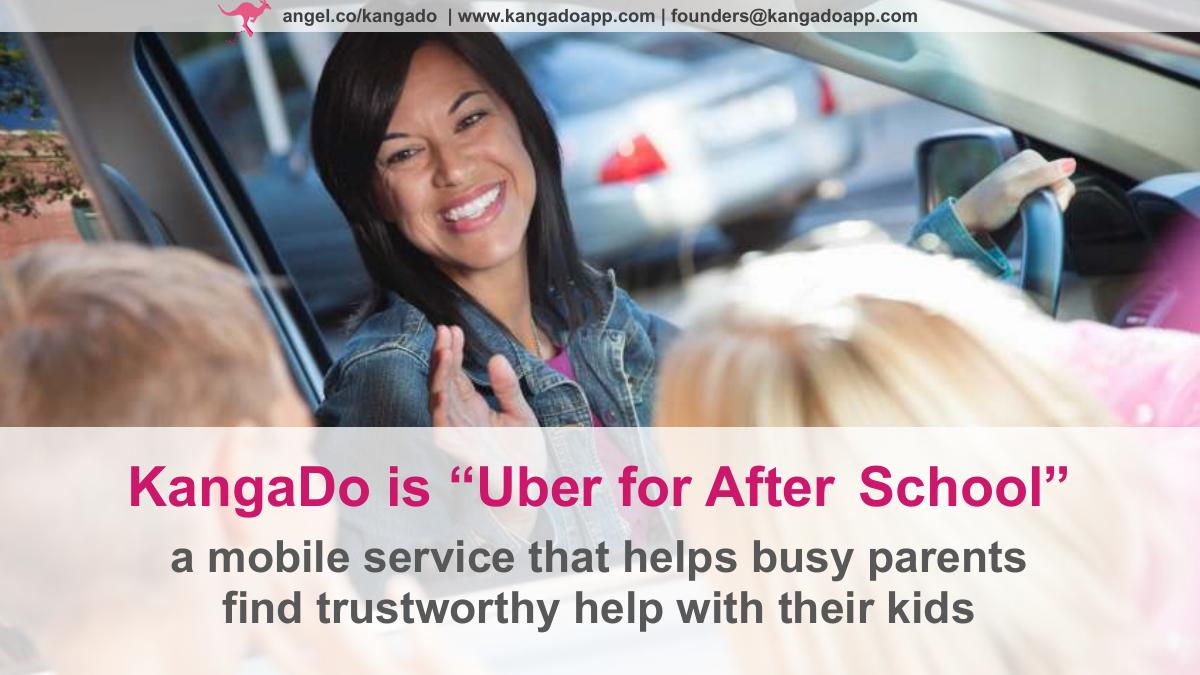
"KangaDo is 'Uber for After School' — a mobile service that helps busy parents find trustworthy help with their kids."
This is the best-constructed sentence in the deck. It has an analogy that instantly conveys the mechanic (on-demand, mobile, matching), a named customer (busy parents), a named job (help with their kids), and a named value (trustworthy). In 2014, an investor read that and immediately understood the shape of the business. The word "trustworthy" is also the promise the remaining fourteen pages never pay off.
Slide 3 — Market, first cut
"40 MILLION MOMS with kids under 18 need help every day. Transportation and Childcare are biggest pain points."
A population count presented as a market. Forty million mothers is a demographic fact, not a demand signal, and the deck offers no source for it and no bridge from "need help every day" to "will pay for an app." It also quietly narrows the customer to mothers, which both shrinks the stated market and dates the framing — fathers, grandparents, nannies and au pairs are all users of exactly this product.
Slide 4 — Market, second cut
"23 MILLION KIDS in grades K-12 get to and from school by car."
This is the strongest market number in the deck because it describes a behaviour rather than a population. Twenty-three million children being driven to school every weekday is a real, repeating, high-frequency event, and frequency is what makes a marketplace work. The deck states it and moves on without doing the obvious arithmetic: twenty-three million kids times roughly 180 school days is billions of trips a year. That multiplication was free and the deck left it on the table.
Slide 5 — Market, third cut
"$43 BILLION CHILD CARE MARKET. But it's hard to find trusted childcare."
Three consecutive market slides, each with one enormous number in display type. The $43B figure is unsourced and, more importantly, is a market KangaDo was not actually selling into in 2014 — it was matching parents for school carpools. The "but it's hard to find trusted childcare" line is the real content on the page and it is set in the smallest type on the slide. The problem statement is buried underneath the number that matters least.
Slide 6 — Product
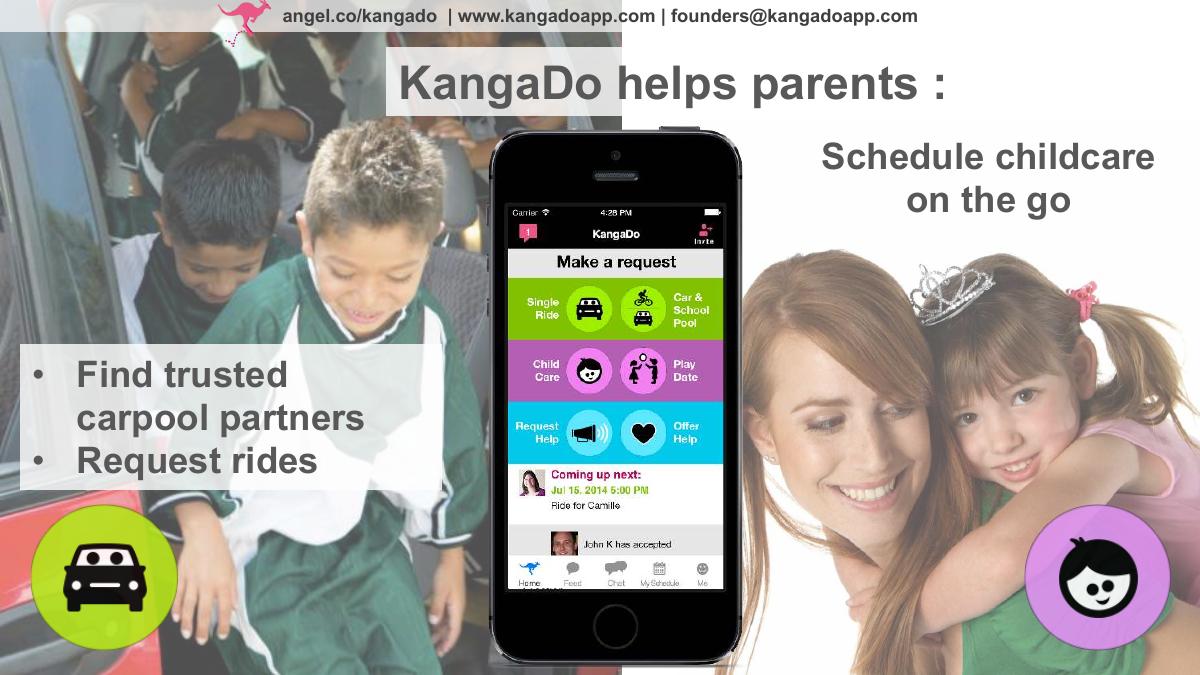
"KangaDo helps parents: Schedule childcare on the go • Find trusted carpool partners • Request rides."
Clear and correctly scoped: three verbs, three jobs, no feature list. Note the ordering — childcare scheduling is listed first, but the traction, the partnerships and the appendix are all about rides and carpools. The deck's product slide and the deck's evidence describe two different companies, and the product slide leads with the weaker one.
Slide 7 — How it works
"It's quick and easy!" — a three-step flow with real app screenshots: make a request, friend accepts request, thank friend.
This is a genuinely good slide and one most 2014 marketplace decks got wrong. It shows the actual interface, names the loop in three steps, and — critically — the loop is friend accepts, not stranger accepts. That is a strategically important detail: KangaDo's early graph was existing school communities, not an open driver pool. The deck never says this out loud, and it should have, because it is the answer to the safety objection the rest of the deck ignores.
Slide 8 — Partnerships
"40+ Schools and School Districts partnered with KangaDo starting Fall 2014 = Reach of 150K+ families!" with logos including SFUSD, San Mateo County Office of Education, Alameda County and the County of Marin.
This is the most valuable slide in the deck and it is placed correctly, right after the product. Institutional distribution into forty-plus districts is hard to replicate, hard to buy, and directly solves the trust problem a consumer app in this category otherwise faces. The weakness is the word "Reach." 150K+ families is a ceiling, not an audience — the deck never says how many of those families were reached, activated, or retained, so the number reads as potential dressed as achievement.
Slide 9 — Traction
"5,054 neighborhoods using KangaDo. 24K requests made in the app."
Two numbers, no time period, no growth curve, no comparison. 24,000 requests is a real usage number and the most credible evidence in the deck — but 24,000 since launch and 24,000 last month are different companies, and the deck does not say which. "5,054 neighborhoods" is a geography count, not a user count; a neighbourhood with one user counts the same as one with two hundred. The precision of "5,054" implies rigour the metric does not have. Nowhere in sixteen pages is there a monthly active user number, a repeat rate, or a chart with a time axis.
Slide 10 — Business model
"Beta Service in SF: Paid Rides and Childcare • Monthly Subscription • Fee per Transaction • On Demand and Scheduled Services."
Three revenue mechanics listed, zero prices. No subscription price, no take rate, no average transaction value, no revenue to date, no conversion from free carpool user to paid rider. An investor reading this cannot compute anything. The word "Beta" is also doing a lot of quiet work — it signals that monetisation was unproven at the time of the raise, which is fine at seed, but the deck should have owned that explicitly with a stated hypothesis and a test plan rather than letting a bullet list imply a business.
Slide 11 — Distribution
"Distribution to date: 40% Organic (via friend invites, shared requests, etc) • Free distribution via schools and other groups • Experiments with paid acquisition (e.g. Facebook mobile install ads)."
Forty percent organic is a strong number and the deck treats it as a bullet. This is the single most investable fact on the page: it says the product has a built-in referral loop, because you cannot carpool alone — every request is an invitation. The deck never names that mechanic. It also never gives a CAC for the paid experiments, never says what the other 60% cost, and never quantifies what "free distribution via schools" actually delivered in installs.
Slide 12 — Team
Sara Schaer (CEO), Siva Kaliyuga (CTO), Ruth Kaplan (Design), Teresa Fok (Marketing), with company logos beneath: Snapfish, Google, Accenture, Sun Microsystems and Adobe.
A complete four-person founding team covering product, engineering, design and marketing, with consumer-scale pedigree — three of the four coming out of Snapfish, a consumer photo business, is directly relevant to a consumer parenting app. The omission is the same one most 2014 team slides make: logos but no roles, no tenure, no shipped outcomes. "Snapfish" tells an investor where someone worked; it does not say whether they ran the mobile team or the print operation.
Slide 13 — Close
"KangaDo — Your Kids, Safe and Sound," with angel.co and email contacts.
A brand line, not an ask. There is no raise amount, no round type, no use of funds, no milestones the money buys, and no valuation or instrument anywhere in the deck. For an emailed deck this is the costliest single omission, because the recipient has to write back to learn the most basic qualifying fact. The tagline is also the second time the deck promises safety and the second time it does not explain how it is delivered.
Slide 14 — Appendix divider
A single word. Its existence is a small positive: it tells the reader the main narrative ended at slide 13 and everything after is supporting material, which is the correct structure for a deck sent by email.
Slide 15 — Endorsements (appendix)
Two quotes from partner districts. SFUSD: "SFUSD is excited to work with KangaDo to promote school pools throughout our District… The app makes it easy for parents to set up walking school buses, bike trains, and traditional carpools. By facilitating connections between parents we hope to reduce congestion and pollution around schools…" Menlo Park City School District: "The parents in our school district find the KangaDo mobile app convenient. We are happy with how the app manages parent privacy and makes our families comfortable with searching for carpools."
These are named, attributable, institutional quotes from public school districts, and they are the strongest trust evidence in the entire document. The Menlo Park quote explicitly addresses parent privacy and family comfort — the exact objection the main deck never answers. Both are sitting in the appendix, behind a divider, after the close. This is the deck's biggest sequencing error.
Slide 16 — Real requests (appendix)
Screenshots of genuine in-app requests: "My kid needs to get to soccer practice and back home." "Looking to share or pay for someone to take my child to school." "I live near San Maddox and Caldwell. We usually leave around 7:20, if anyone ever needs help getting your kid(s) to school." "Please let me know where I need to pick girls up at. If it's at school tell them I have a silver Honda CRV."
Raw, unpolished customer voice showing both sides of the marketplace — people asking for help and people offering it, unprompted, in their own words. That last detail matters enormously: supply appearing organically is the hardest thing to fake in a two-sided marketplace, and here it is, in the appendix, on the final page.
What this deck does better than most startup pitch decks
The positioning sentence is genuinely excellent. "Uber for After School — a mobile service that helps busy parents find trustworthy help with their kids" carries the mechanic, the customer, the job and the value in one line. Most decks need three slides to do less. · It shows the real product. Slide 7 uses actual app screenshots in a three-step loop instead of an abstract diagram. A reader knows exactly what the thing does after eight seconds. · Institutional distribution is on slide 8, not slide 18. Forty-plus school districts is the moat, and the deck surfaces it early rather than burying it in a partnerships appendix. · It has real usage evidence. 24,000 in-app requests is an actual behavioural number, not a signup count or a waitlist. · It reports a distribution mix honestly. Saying "40% organic" and admitting the rest is experiments with paid acquisition is more candid than the "viral growth" claims that filled 2014 decks. · The team is complete and relevant. Four people covering CEO, CTO, design and marketing, out of consumer companies, for a consumer product. · The appendix is a real appendix. Divider page, supporting evidence behind it, main story ending at slide 13. Correct structure for a deck that will be read alone.
Where this deck would fail in an investor meeting
There is no ask. Sixteen pages, no raise amount, no round type, no use of funds, no milestones. An emailed deck without an ask forces the investor to do work before they can even decide whether they are the right size of cheque. · There is no safety or trust slide. This is a company whose entire promise is putting your child in someone else's car, and the deck never mentions background checks, driver verification, identity checks, insurance, liability, or what happens when something goes wrong. The word "trusted" appears repeatedly as a claim and never once as a mechanism. In late 2014 — the exact moment consumer ride-sharing safety was under national scrutiny — this is the first question any investor asks, and the deck has no page for it. · Three market slides, no bottom-up model. 40 million moms, 23 million kids, $43 billion market — all top-down, all unsourced, none converted into serviceable demand or a revenue estimate. · Metrics with no time axis. 24K requests and 5,054 neighbourhoods over what period? There is not a single chart, growth rate, or month-over-month comparison anywhere in the deck. · The business model has no numbers. Subscription plus transaction fee plus on-demand, and not one price, take rate, or dollar of revenue. · No competition slide. In 2014 this space contained Care.com, Sittercity, Urban Sitter, Zum's predecessors, plus every school district's own carpool spreadsheet and the Facebook parent group that costs nothing. The deck never names one. · No unit economics. No CAC, no LTV, no payback, despite the deck explicitly saying paid acquisition was being tested — which means the numbers existed and were left out. · The best evidence is in the appendix. Named school district endorsements and real user requests are the two pages that prove trust and demand, and both sit after the closing slide, where a scanning reader will never reach them. · "Reach of 150K+ families" is a ceiling, not traction. Presented with an exclamation mark, it invites the follow-up question the deck cannot answer: how many of those families actually used the app?
Emailed deck vs. presented deck: what changes
Cover Photo and logo only Company, one-line positioning, stage, date
The ask Absent entirely Amount, instrument, use of funds — by slide 3 or the close
Traction framing Two bare numbers, no period Numbers with a time axis and a growth rate
Objection handling Left to the conversation that never happens Answered on the page, because there is no live Q&A
Proof placement District quotes and user requests in the appendix Strongest third-party proof inside the main narrative
Business model Three mechanics, zero prices Price, take rate, and current revenue or an explicit "pre-revenue"
Length 13 slides plus appendix Correct — the structure was right, the content was thin
How you would rebuild this deck today
Put the ask on the cover. "KangaDo — Uber for After School. Raising $1.5M seed." One line converts a forwarded PDF into a qualified conversation. · Add a trust and safety slide at position four. Identity verification, background check policy, insurance coverage, the closed school-community graph, incident process. For a childcare marketplace this is not a compliance slide, it is the product slide. · Collapse three market slides into one. Keep the 23 million kids driven to school, multiply by school days to get annual trips, apply a realistic serviceable share and a price, and show the resulting revenue pool. One slide, bottom-up, sourced. · Move the school district endorsements to slide 6. Named public institutions vouching for parent privacy is the highest-credibility asset in the document and it is currently on page 15. · Rebuild the traction slide as a chart. Monthly requests over time, active families, repeat rate per family, requests per active family per month. 24,000 requests with a rising curve behind it is worth ten times 24,000 requests alone. · Price the business model. Subscription price, per-transaction take rate, current beta revenue, and the conversion rate from free carpool user to paying rider — even if all four numbers are small. · Turn "40% organic" into the growth slide. Name the loop: every carpool request is an invitation to another parent, so acquisition is a by-product of usage. Show invites sent per request and the resulting viral coefficient. · Add a competition slide with an honest axis. Care.com and Sittercity on one side, free Facebook parent groups on the other, and KangaDo's actual wedge — school-district distribution — in the middle. · Move two real user requests into the main deck. "I have a silver Honda CRV" is more persuasive than any market number in the document, and it costs one slide.
The transferable lesson
KangaDo's deck fails at the exact point where its business is strongest. The company had forty-plus school districts, named endorsements from public institutions praising its privacy handling, real parents posting real requests, and 40% organic growth from a genuine referral loop. Every one of those assets is either buried in an appendix, stated without a number, or left unnamed. Meanwhile the three loudest pages in the deck are unsourced market statistics that any investor could have looked up themselves.
The deeper failure is that the deck asserts trust instead of proving it. "Trustworthy," "trusted," "safe and sound" appear as adjectives on four different slides, and not once does the deck explain the mechanism behind them. In a category where the product is literally handing over your child, an unanswered safety question does not become an objection in a meeting — it becomes a deck that never gets a meeting.
Check your own deck for the same pattern. Find the three claims you make in adjectives, then find the slide that proves each one with a mechanism, a number or a named third party. If any of those slides is missing — or worse, if it exists and is sitting in your appendix — you are asking investors to take on faith the thing you already have evidence for.
Frequently asked questions
- What is KangaDo?
- KangaDo was a San Francisco Bay Area mobile app founded by Sara Schaer that positioned itself as "Uber for After School." It helped busy parents schedule childcare on the go, find trusted carpool partners and request rides for their children, and by Fall 2014 it had partnered with more than 40 schools and school districts across the Bay Area.
- Is the KangaDo deck a real investor pitch deck?
- Yes. The PDF was created from PowerPoint in November 2014 with KangaDo's CEO listed as the document author, and every page carries an AngelList link and a founders@ email address in the footer. Its structure — 13 narrative slides plus an appendix divider and two appendix pages — is typical of a seed deck built to be sent by email rather than presented live.
- How much did KangaDo raise with this deck?
- The deck never says. There is no ask slide, no raise amount, no round type, no use of funds and no valuation anywhere in the 16 pages. The closing slide is a brand line — "Your Kids, Safe and Sound" — followed by contact details, which means any investor reading the deck had to email the founders just to learn what was being raised.
- What traction does the KangaDo pitch deck show?
- Three things: 24,000 requests made in the app, 5,054 neighborhoods with users, and 40+ partnered schools and school districts representing a stated reach of 150,000+ families. None of the numbers carries a time period or a growth rate, and the 150,000 figure is a distribution ceiling rather than an active-user count.
- What is the biggest weakness in the KangaDo deck?
- The absence of a trust and safety slide. KangaDo's product involved parents arranging for other people to transport their children, and the deck describes that as "trusted" and "safe" on four separate slides without ever explaining background checks, identity verification, insurance or incident handling. In late 2014, when ride-sharing safety was under national scrutiny, that was the first question any investor would ask.
- Which KangaDo slides should founders copy?
- Slide 2's positioning sentence, which packs the mechanic, customer, job and value into one line; slide 7's three-step product walkthrough using real app screenshots; and slide 8's school district partnership page, which puts hard-to-replicate institutional distribution early in the narrative instead of hiding it in an appendix.