Storiaverse used this 16-slide deck to secure $2.5M in pre-seed funding in 2023. The company positions itself as a matchmaker for writers and animators, creating a proprietary 'read-watch' format designed for mobile consumption. The deck leans heavily into market validation, citing massive engagement figures for reading and animation on TikTok and Instagram to prove demand. While the visual presentation is high-quality and the product vision is clear, the deck is notably light on business model specifics, unit economics, and team backgrounds. It relies on the macro trend of 'Artisan Creators'…
Key takeaways
- The company defines a new category called 'read-watch' to differentiate from standard e-books or video platforms (Slide 2).
- The global manga market is used as a primary proxy for demand, valued at $12.15 billion in 2023 (Slide 7).
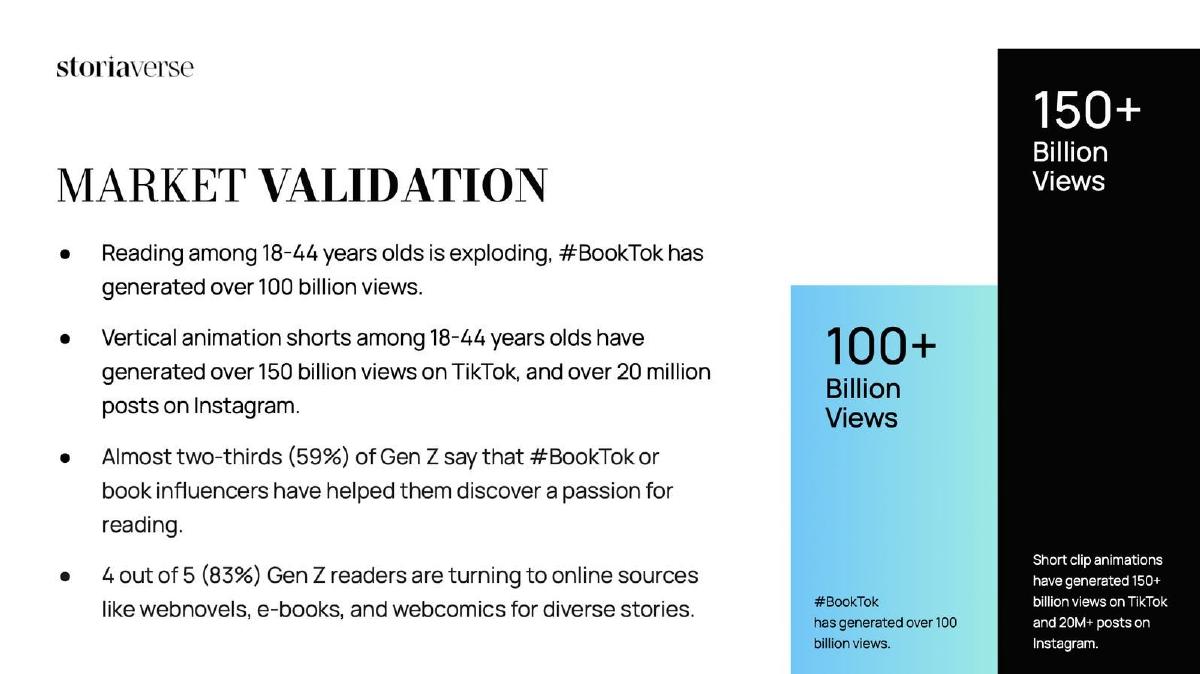
- Market validation relies on social media scale, citing 100+ billion views for #BookTok and 150+ billion views for vertical animation (Slide 9).
- The platform targets two distinct pain points: animators lacking monetization and writers buried in 'archaic' journals (Slide 3).
- Revenue strategy is diversified across product placements and merchandising rather than just user fees (Slide 16).
- The deck emphasizes IP ownership as a core pillar of the product and creator community (Slide 11).
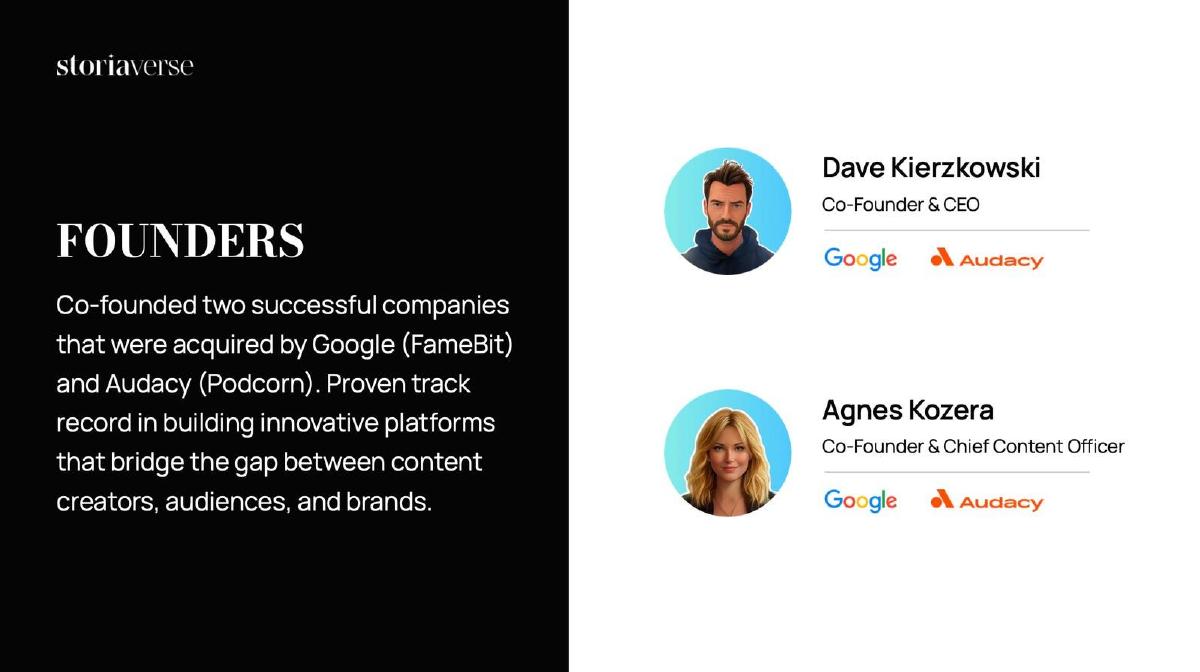
- There is a total absence of a team slide in the provided materials, which is unusual for a pre-seed raise.
- The deck lacks a specific 'Ask' slide detailing how the $2.5M will be allocated across engineering, content, or marketing.
Introduction: The Creator Economy's New Frontier
Storiaverse entered the market in 2023 with a $2.5M pre-seed round, aiming to capitalize on the convergence of digital publishing and short-form animation. The deck is a masterclass in visual storytelling, utilizing dark themes and high-fidelity product mockups to convey a premium 'Netflix-for-short-stories' vibe. However, as a fundraising analyst, the most striking aspect of this deck is what it chooses to emphasize: market trends and creator pain points over traditional financial projections.
Slide 1: The Hook
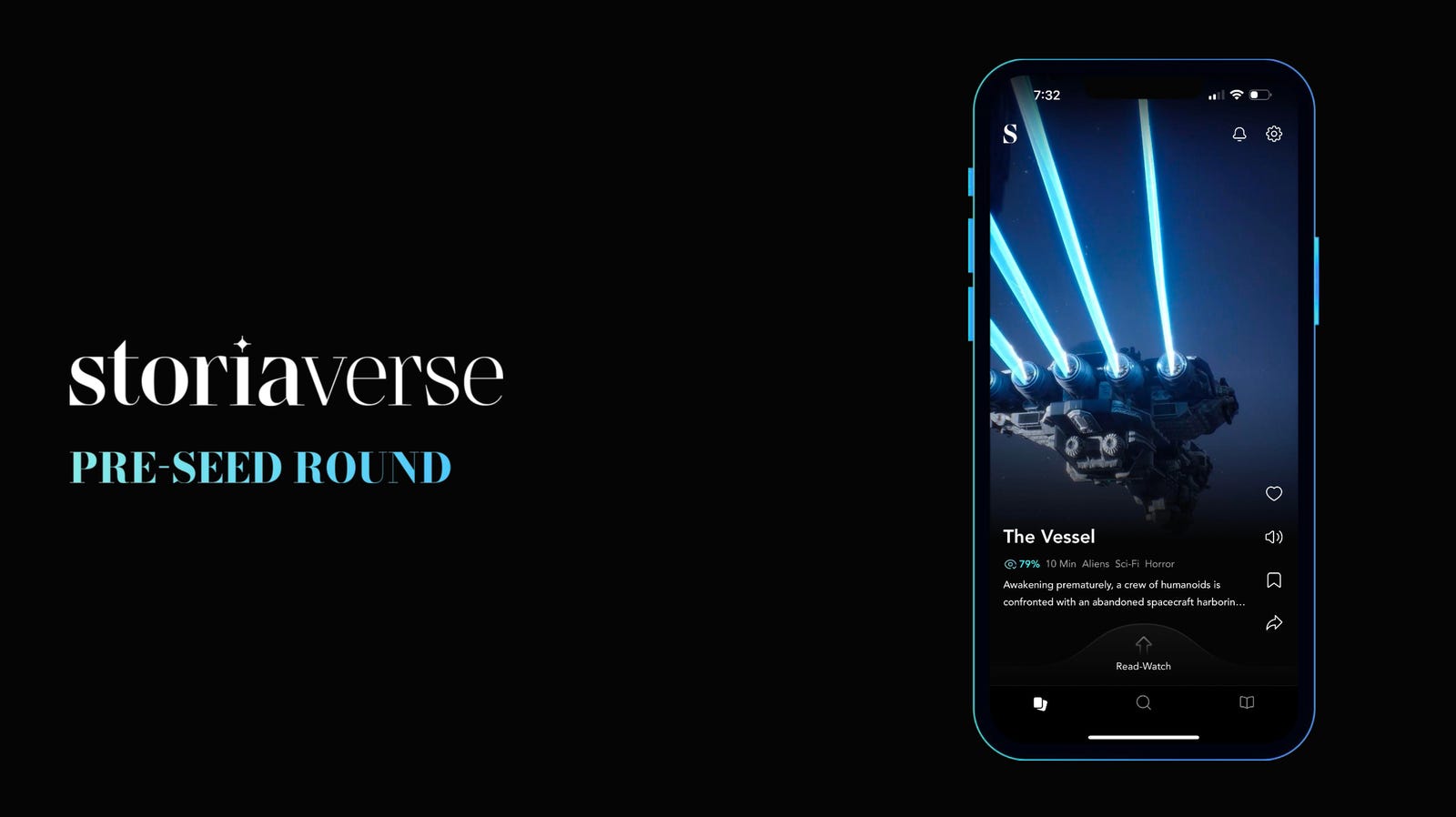
The title slide is minimalist, featuring the Storiaverse logo and the 'PRE-SEED ROUND' designation. The primary focus is a high-quality mobile mockup showing a story titled 'The Vessel.' It immediately establishes the aesthetic: dark, cinematic, and mobile-first. By showing a sci-fi horror theme with a '79%' rating and a '10 Min' read time, the slide subtly communicates the platform's user interface and content density without needing a single bullet point.
Slide 2: Defining the Category
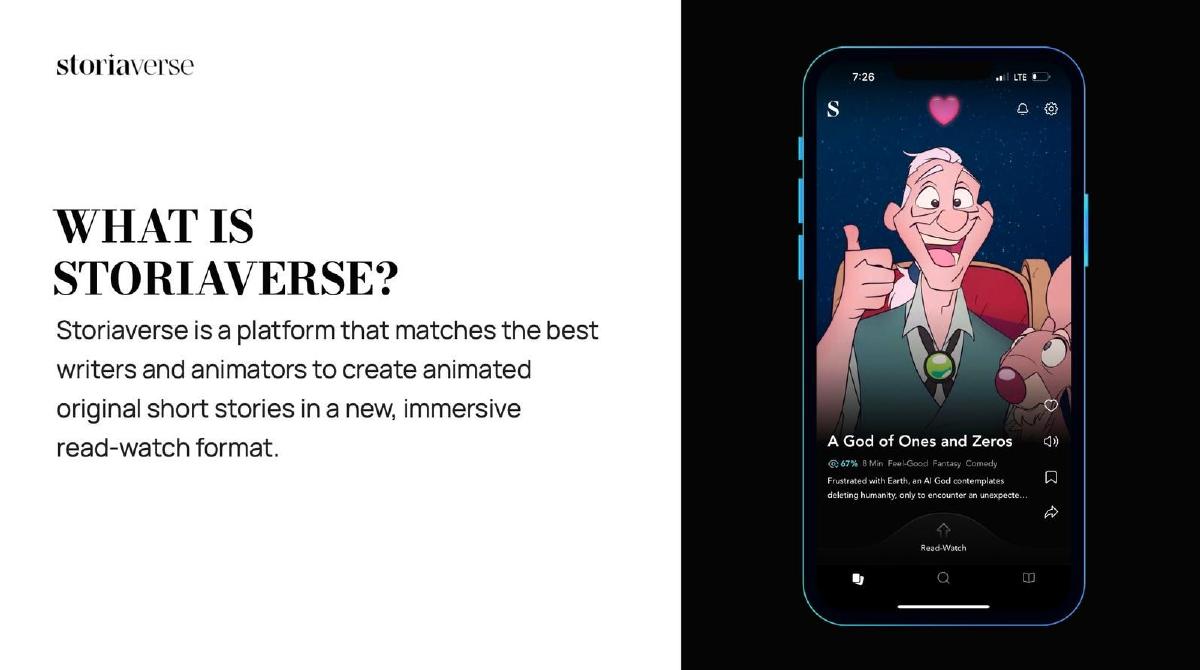
Slide 2 answers the fundamental question: 'WHAT IS STORIAVERSE?' The definition is concise: 'a platform that matches the best writers and animators to create animated original short stories in a new, immersive read-watch format.' This is a critical strategic move. By coining the term 'read-watch,' the founders are attempting to own a new category rather than being compared directly to Kindle (reading) or YouTube (watching). The mockup on this slide features a different genre—fantasy comedy—demonstrating the platform's versatility.
Slide 3: The Dual-Sided Marketplace Problem
Titled 'THE RISE OF THE ARTISAN CREATORS,' this slide identifies the two pillars of the marketplace. For animators, the problem is a lack of a platform to profit from their work despite the democratization of tools. For writers, the problem is 'archaic and unengaging formats' in obscure journals. This slide justifies the existence of the platform as a necessary bridge. The use of a collage of creator headshots on the right side humanizes the problem, suggesting a ready and waiting supply of talent.
Slide 7: The Proxy Market
Slide 7, 'CONSUMERS LOVE VISUAL READING,' uses the manga market as a proxy for Storiaverse's potential. It cites a projected value of '$12.15 billion USD in 2023.' This is a standard venture capital tactic: find a massive, adjacent market that is already proven and argue that your new, tech-enabled version will capture a slice of it. The growth of graphic novels serves as the 'Why Now?' for a digital-first hybrid format.
Slide 9: Social Proof and Market Validation
This is the 'heavy lifter' slide of the deck. It uses massive social media metrics to prove that the target demographic (18-44 year olds) is already consuming this type of content. Key figures include:
BookTok has generated over 100 billion views. · Vertical animation shorts have generated over 150 billion views on TikTok. · 20M+ posts on Instagram for short clip animations. · 83% of Gen Z readers turn to online sources like webnovels and e-books.
By citing these figures, Storiaverse isn't just saying people might like their product; they are saying people are already obsessed with the components of their product.
Slide 11: The Value of Intellectual Property
Slide 11 introduces 'IP: PRODUCT & CREATOR COMMUNITY.' While the text is sparse, the inclusion of 'IP' (Intellectual Property) is a signal to investors that Storiaverse intends to own the rights to the content created on its platform. In the media world, IP is the ultimate value driver. This suggests the company isn't just a service provider but a future media powerhouse that could option these stories for film or television.
Slide 14 & 16: The Revenue Model
Slide 14 acts as a transition, while Slide 16 gets into the specifics of 'WAYS WE CAN GENERATE REVENUE.' Interestingly, the deck ignores the standard 'subscription vs. ad-supported' debate and focuses on 'PRODUCT PLACEMENTS' and 'MERCHANDISING.' This indicates a strategy built around high engagement and brand affinity. The slide argues that animations offer a unique opportunity for brands to capture attention, and characters offer a path to 'long-term audience loyalty' through physical goods. This is a high-upside, high-risk strategy that relies on creating 'hits.'
What Works in the Storiaverse Deck
Visual Consistency: The deck looks like the product. The use of dark backgrounds and neon accents mirrors the app's UI, creating a seamless transition from the pitch to the demo. This builds confidence in the founders' design sensibilities, which is crucial for a consumer media app.
Trend Alignment: The deck perfectly captures the 'BookTok' zeitgeist. By linking their success to the massive organic growth of reading communities on social media, they make the investment feel like a bet on an inevitable cultural shift rather than a niche product.
Clear Value Proposition for Creators: Most platforms focus only on the consumer. Storiaverse clearly articulates why a creator would bother using their tool: monetization and visibility. In a two-sided marketplace, solving the supply side is often the harder task, and this deck addresses it early.
What is Missing from the Storiaverse Deck
The Team: In the provided slides, there is no mention of the founders' backgrounds. For a pre-seed round, the team is usually 70% of the investment decision. Without knowing if these founders come from Disney, Wattpad, or a tech background, it is hard to assess their ability to execute this complex vision.
Unit Economics and The Ask: There is no slide detailing how much they are raising (though we know from reports it was $2.5M) or how they will spend it. Furthermore, there is no mention of the cost to produce these 'read-watch' stories. If the production cost is high, the merchandising and placement revenue needs to be astronomical to achieve profitability.
The Tech Stack: Is there a proprietary tool that helps writers and animators collaborate? Or is Storiaverse just a hosting platform? The deck mentions 'matching' creators, but doesn't explain if this is a manual process or a scalable AI-driven marketplace.
Founder's Playbook: Lessons to Copy
Use Proxy Markets Wisely: If you are building something new, don't just say 'there is no competition.' Instead, do what Storiaverse did on Slide 7: find a multi-billion dollar market (Manga) that shares DNA with your product and use its success to validate your own.
Leverage Social Media Macro-Trends: Don't just show your own (likely small) user numbers. Show the massive numbers of the platforms where your future users currently hang out. Citing '150 billion views' on TikTok (Slide 9) makes the market feel infinite and the opportunity urgent.
Define Your Own Category: Instead of being a 'better e-book,' Storiaverse became a 'read-watch' platform. This allows you to set the rules for how your product is evaluated and helps you stand out in a crowded inbox of pitch decks.
Frequently asked questions
- What is the 'read-watch' format mentioned in the deck?
- As described on Slide 2, the 'read-watch' format is an immersive medium that blends text-based storytelling with original animation. The goal is to provide a more engaging experience than traditional e-books while maintaining the narrative depth of a short story, specifically designed for mobile devices.
- How does Storiaverse plan to make money?
- Slide 16 outlines a multi-pronged revenue strategy focusing on brand integration. This includes product placements within the animations and merchandising based on original story characters. The deck suggests these methods will capture viewer attention and build long-term audience loyalty, though it does not detail subscription or ad-supported tiers.
- Who is the target audience for this platform?
- The deck specifically targets Gen Z and young millennials. Slide 9 highlights that reading among 18-44 year olds is 'exploding' and notes that 59% of Gen Z discover a passion for reading through social media influencers, positioning Storiaverse as the destination for this demographic's content consumption.
- What problem does Storiaverse solve for creators?
- According to Slide 3, the platform addresses the 'democratization of animation tools' which has left independent animators without a way to profit. For writers, it solves the problem of being 'buried in obscure journals' by providing a modern, engaging format that is easier to monetize and distribute.
- Is there any mention of competition in the deck?
- The provided slides do not include a formal competitive landscape or 'magic quadrant.' Instead, it references the broader manga and webcomic markets as validation (Slide 7 and 9), implying that Storiaverse is competing for the time and attention currently spent on platforms like Webtoon or social media apps.