The battleface pitch deck is an anomaly in the Series A landscape, consisting of only nine slides and omitting nearly all standard financial metrics, unit economics, and competitive analysis. Instead, the deck leans heavily on social proof—citing an ITIJ Award and Trustpilot ratings—and a clear explanation of its three-pronged distribution strategy: B2B2C, Direct, and Groups. The presentation positions the company as a timely solution to global shifts like Brexit and COVID-19. While the design is clean and the team is geographically diverse, the total absence of a funding ask or revenue data…
Key takeaways
- The deck leads with social proof, featuring a 'Rated Excellent' Trustpilot badge and an ITIJ Awards 2020 Winner logo on slide 1.
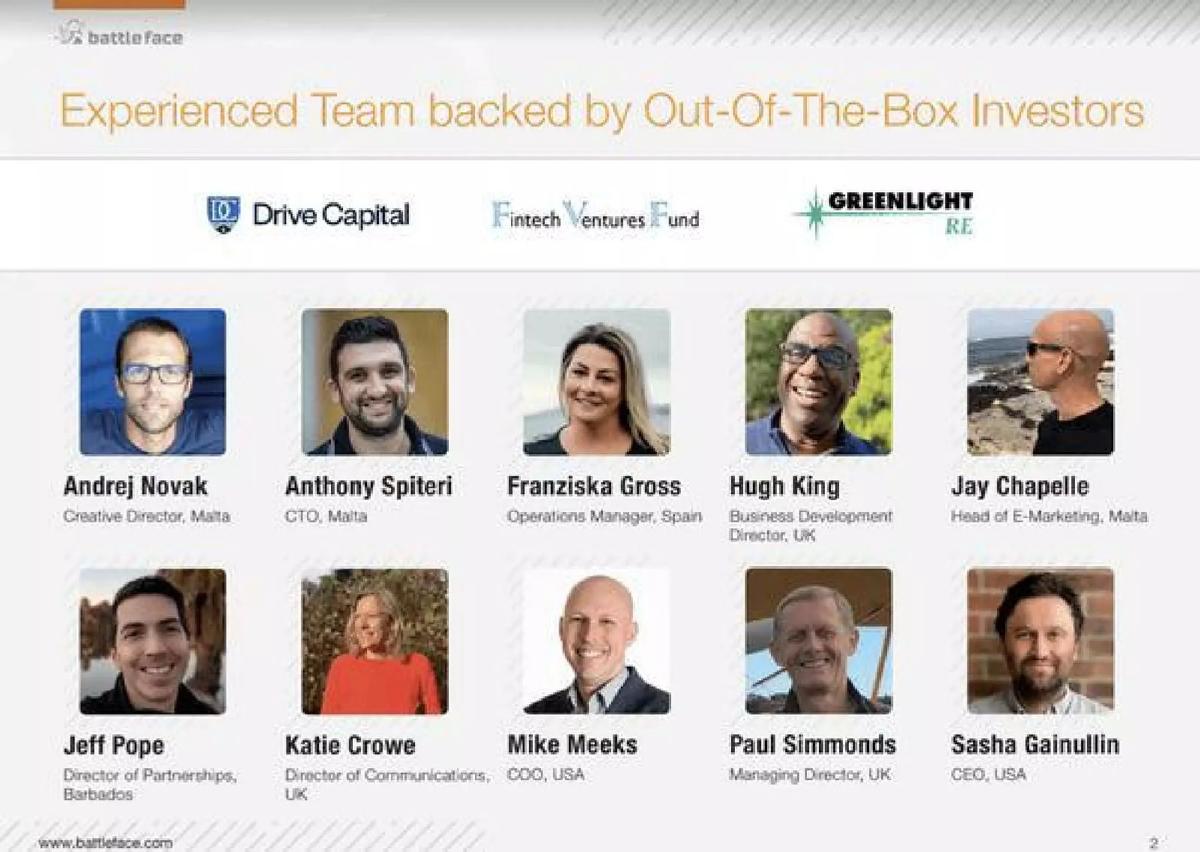
- The team is highly distributed, with members located in Malta, Spain, the UK, the USA, and Barbados, as shown on slide 2.
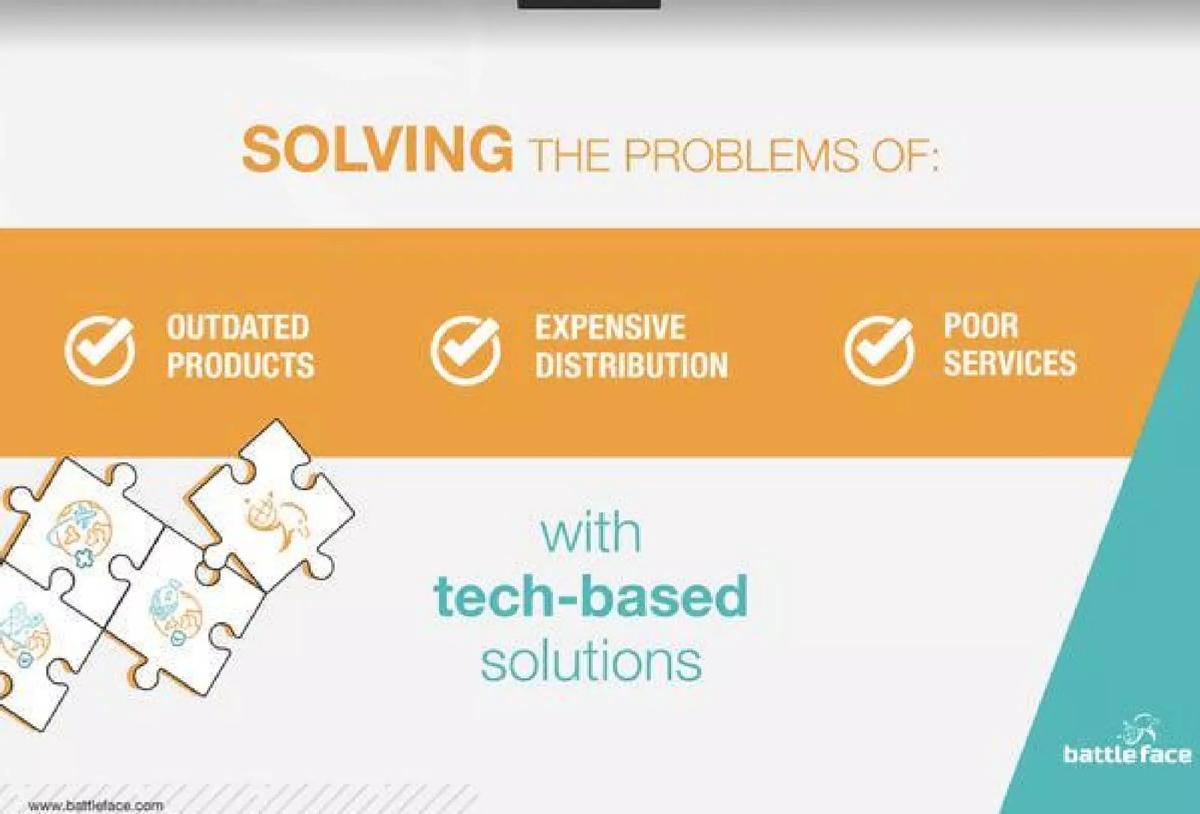
- The company identifies three core industry problems: outdated products, expensive distribution, and poor services on slide 3.
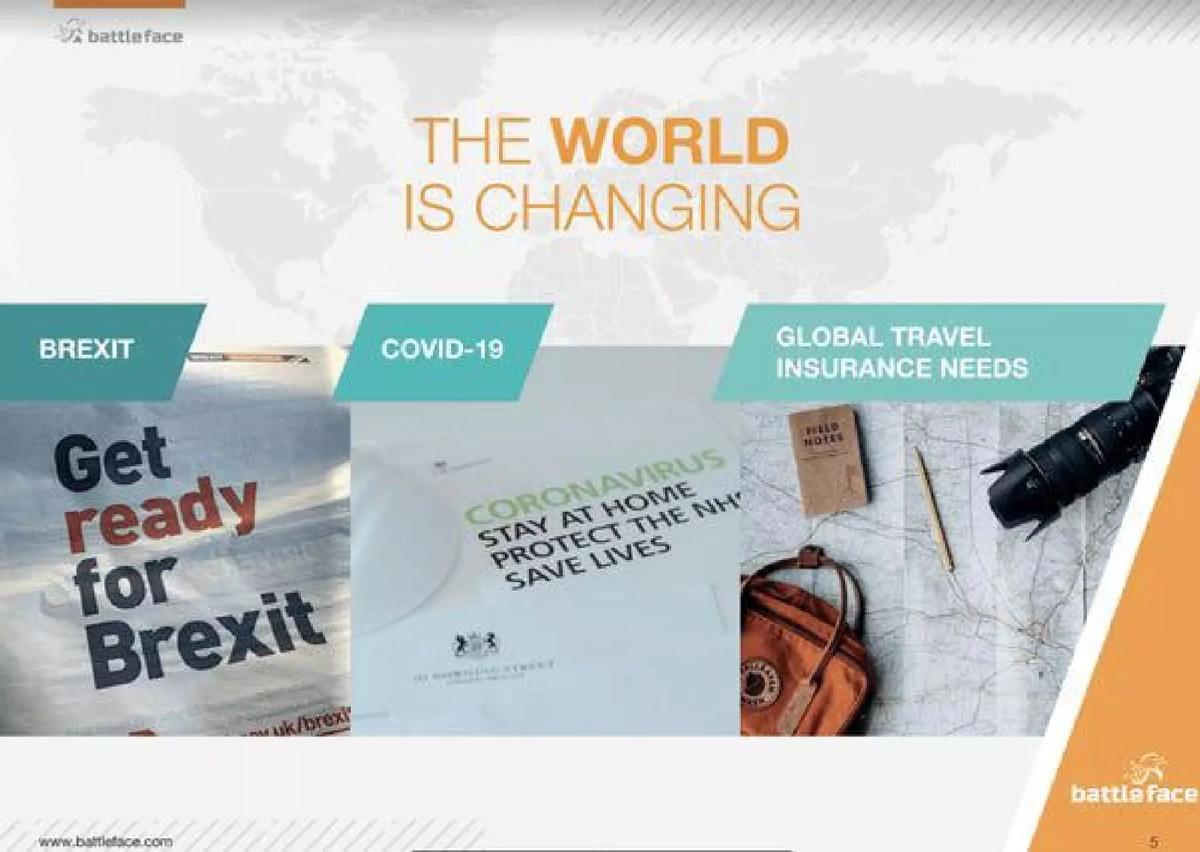
- Market timing is tied to specific geopolitical and global health events, namely Brexit and COVID-19, on slide 5.
- The distribution model is broken down into three distinct channels: B2B2C (slide 6), Direct (slide 7), and Groups (slide 8).
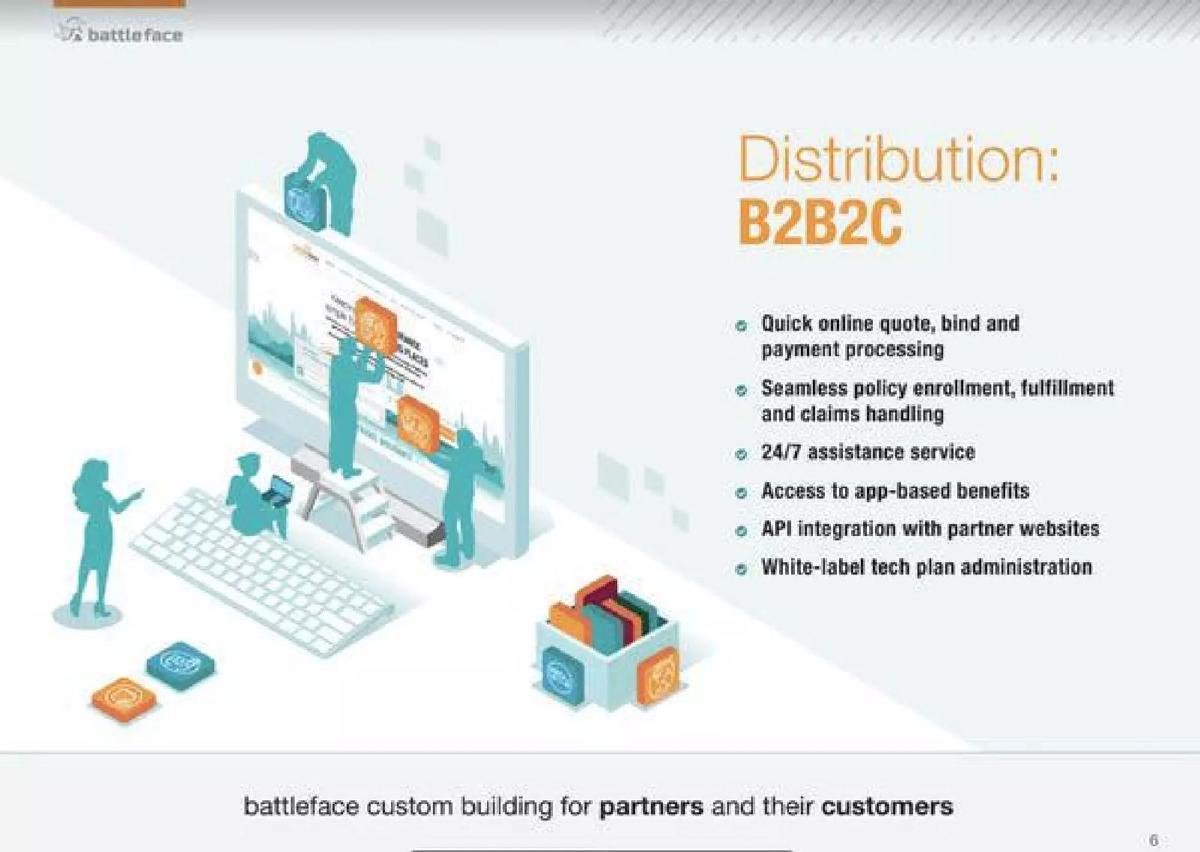
- The B2B2C strategy emphasizes white-label tech plan administration and API integration on slide 6.
- The 'Groups' slide highlights customization for specific humanitarian or business needs in regions like Nairobi and Bangladesh on slide 8.
- There is no mention of current revenue, user growth, or specific financial targets anywhere in the 9-slide deck.
The battleface Pitch Deck: A Minimalist Approach to Insurtech
The battleface pitch deck is a study in brevity. At only nine slides, it skips many of the traditional components expected in a Series A presentation, such as deep-dive financials, market sizing (TAM/SAM/SOM), and a formal funding ask. Instead, it focuses on the 'who' and the 'how'—the experienced team and the multi-channel distribution strategy. The deck is visually driven, using clean illustrations and minimal text to convey a modern, tech-forward alternative to legacy travel insurance providers.
Slide 1: Title and Social Proof
The cover slide sets a high bar for credibility. Rather than just a logo and a tagline, battleface includes two significant trust signals: a 'Rated Excellent' badge from Trustpilot and the 'ITIJ Awards 2020 Winner' seal for International Travel & Health Insurer of the Year. The central image is a laptop showing the battleface interface, reinforcing the 'tech-based' nature of the product. The tagline 'Travel Insurance Beyond the Ordinary' is vague but supported by the immediate visual evidence of industry recognition.
Slide 2: The Distributed Team
Slide 2, titled 'Experienced Team backed by Out-Of-The-Box Investors,' serves two purposes. First, it validates the company through its backers: Drive Capital, Fintech Ventures Fund, and Greenlight Re. Second, it introduces a 10-person leadership team. A notable detail here is the geographic diversity; team members are listed in Malta, Spain, UK, USA, and Barbados. This distribution aligns with the company's mission as a 'global' insurance provider, suggesting they have boots on the ground in multiple regulatory environments.
Slide 3: The Problem Statement
The problem slide is remarkably simple. It identifies three pain points: 'Outdated Products,' 'Expensive Distribution,' and 'Poor Services.' These are presented as checkboxes, which the slide claims are solved 'with tech-based solutions.' While the slide identifies the 'what,' it lacks the 'why' or the 'how much'—there are no data points illustrating how expensive distribution currently is or specific examples of how services are failing customers.
Slide 4: The Product Interface
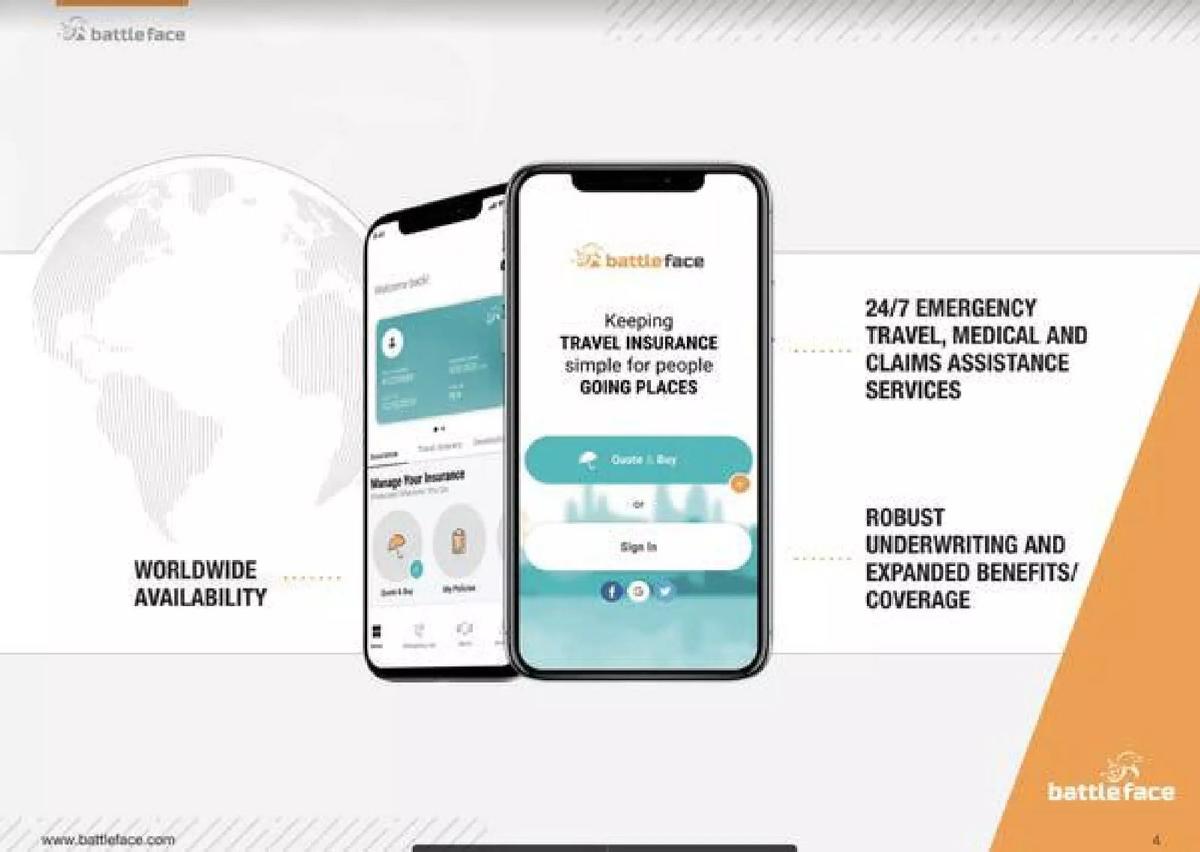
Slide 4 focuses on the mobile experience. It highlights '24/7 Emergency Travel, Medical and Claims Assistance Services' and 'Robust Underwriting and Expanded Benefits/Coverage.' The use of smartphone mockups emphasizes that this is a digital-first product, contrasting with the 'outdated products' mentioned in the previous slide. The mention of 'worldwide availability' next to a globe graphic reinforces the global scale mentioned in the team slide.
Slide 5: Market Catalysts
Titled 'The World is Changing,' this slide addresses the macro environment. It specifically cites Brexit and COVID-19 as drivers for new 'Global Travel Insurance Needs.' This is a 'Why Now' slide. By showing a 'Get ready for Brexit' flyer and a 'Coronavirus: Stay at Home' notice, the deck argues that the complexity of travel has increased, making flexible, tech-driven insurance more relevant than ever.
Slide 6: B2B2C Distribution
The deck then spends three slides on distribution. Slide 6 covers the B2B2C model. Key features listed include 'API integration with partner websites' and 'White-label tech plan administration.' The illustration shows figures 'building' a digital platform, suggesting that battleface acts as the infrastructure for other companies to offer insurance to their own customers.
Slide 7: Direct Distribution
Slide 7 focuses on the Direct-to-Consumer (DTC) channel. This slide is heavily visual, showing various travel personas (hikers, divers, surfers) and a mobile interface. It also includes a snippet of Trustpilot reviews, emphasizing that their direct relationship with the customer is built on a foundation of positive user feedback and 'Excellent' ratings.
Slide 8: Group Distribution
The final content slide explains the 'Groups' model. It highlights the ability to customize plans so groups don't pay for 'coverage they don't [need].' It provides specific examples, such as humanitarian activities in Nairobi versus business projects in Bangladesh. This slide demonstrates the flexibility of their underwriting and their ability to handle niche, high-risk, or specific professional travel requirements that standard policies might ignore.
Slide 9: Contact Information
The deck ends with a simple landscape illustration and contact details. There is no 'Ask' slide, no roadmap, and no summary of the investment opportunity. The final slide includes an email address, website, and social media icons, but leaves the financial conclusion entirely to the subsequent conversation.
What Works in the battleface Deck
The primary strength of this deck is its clarity of distribution . Many startups struggle to explain exactly how they get to market; battleface dedicates one-third of its deck to showing three distinct, viable paths (B2B2C, Direct, and Groups). This gives investors a clear picture of the revenue engine.
The social proof is also exceptionally strong. By placing the ITIJ Award and Trustpilot rating on the very first slide, battleface pre-emptively answers the question of whether their 'tech-based' solution actually works in the real world. For a Series A company, having an 'Insurer of the Year' award is a significant differentiator against other insurtech startups that may only have a beta product.
Finally, the geographic distribution of the team is a subtle but effective way to signal market readiness. For a global travel insurance company, having directors in Malta, the UK, and the USA suggests they have already navigated the complex licensing and regulatory hurdles required to operate in those regions.
What is Missing from the battleface Deck
The most glaring omission is financial data . There is no mention of Gross Written Premium (GWP), revenue, loss ratios, or customer acquisition costs (CAC). For a Series A deck, investors typically expect to see a 'Traction' slide that proves the business model is scaling. Without these numbers, it is impossible to judge the health of the business from the deck alone.
There is also a complete lack of competitive analysis . The deck assumes that 'outdated products' are the only competition, ignoring other well-funded insurtech players like Lemonade (in other sectors) or specialized travel competitors. A slide showing where battleface sits in the landscape would have helped define their unique value proposition more sharply.
Lastly, the absence of an 'Ask' slide is highly unusual. A pitch deck is a tool to raise capital, yet this deck does not state how much money is being sought or what milestones that money will help the company achieve. This makes the deck feel more like a general capabilities presentation than a fundraising document.
What a Founder Should Copy
Founders should emulate the clean, consistent visual language of this deck. The color palette is professional, the illustrations are modern without being distracting, and the text is kept to a minimum. It is a deck designed to be talked over, not read in silence.
The 'Why Now' slide (Slide 5) is also a great example of using current events to create urgency. By linking their product to Brexit and COVID-19, battleface makes their solution feel like a necessity for the current moment rather than a 'nice-to-have' luxury. Founders should always look for these macro-economic or geopolitical 'tailwinds' to justify their timing.
Finally, the segmentation of the business model on slides 6, 7, and 8 is a best practice. Instead of saying 'we sell to everyone,' battleface shows they have specific strategies for partners, individuals, and groups. This level of granularity helps investors understand the different levers the company can pull to drive growth.
Frequently asked questions
- How much did battleface raise with this deck?
- According to catalogue facts from pitchdeckhunt.com, battleface raised $1,140,000,000 in 2017. However, it is important to note that the deck itself mentions the 'ITIJ Awards 2020,' suggesting the version of the deck provided was updated significantly after the 2017 Series A date listed in the catalogue, or represents a later iteration of their collateral.
- What is the primary business model described?
- The deck outlines a multi-channel distribution strategy. This includes B2B2C through API integrations and white-labeling for partners (slide 6), a Direct-to-consumer model supported by high Trustpilot ratings (slide 7), and a customized 'Groups' model for international workers and humanitarian organizations (slide 8).
- Does the deck include a competitive landscape?
- No. The deck does not name any competitors or include a 'magic quadrant' or feature-comparison matrix. It relies on the premise that the general industry suffers from 'outdated products' and 'expensive distribution' (slide 3) without identifying who the incumbent laggards are.
- What is the 'World is Changing' slide referring to?
- Slide 5 uses Brexit and COVID-19 as catalysts for change in the travel insurance industry. By highlighting these events, battleface positions its 'tech-based solutions' as necessary tools for navigating a more complex and volatile global travel environment that traditional insurers may struggle to address.
- Who are the investors mentioned in the deck?
- Slide 2 lists three 'Out-Of-The-Box Investors': Drive Capital, Fintech Ventures Fund, and Greenlight Re. These logos are placed prominently above the team photos to establish institutional credibility early in the presentation.