BarFresh Food Group's deck outlines a compelling case for a B2B food technology solution that simplifies smoothie production for large-scale quick-service restaurants (QSRs). By providing pre-portioned, 'ready to blend' ingredient packs, the company addresses the operational complexities of fresh beverage service. The presentation leans heavily on its established relationship with Subway, moving from a 5-store trial in Australia to a potential 25,000-store rollout in the US. With projected profits of $20 million to $30 million per annum from a full Subway US rollout, the deck focuses on the s…
Key takeaways
- The company utilizes a patented two-part frozen pack system that requires only the addition of water and blending, as noted in the 2005 milestones on Slide 2.
- BarFresh achieved significant early traction in Australia, completing a 25-store operations test with Subway that exceeded expectations, according to Slide 2.
- The product is distributed in over 2,000 outlets globally, including markets in New Zealand, Singapore, and the Middle East, as shown on Slide 3.
- A full US rollout to 25,000 Subway stores is projected to generate 130 million units per annum, per Slide 6.
- Moving manufacturing in-house is estimated to add $5 million to $10 million in annual profit compared to contract manufacturing, according to Slide 6.
- The company is exploring a joint venture with Oregon Ice Cream to target Jamba Juice's 750 US locations, as detailed on Slide 7.
- BarFresh is seeking $3 million to $5 million in funding to establish US infrastructure and manufacturing equipment, as stated on Slides 8 and 9.
- The investment ask represents approximately 10% of BarFresh USA for each $1 million invested, according to Slide 9.
Executive Summary: The Industrialization of Fresh Smoothies
BarFresh Food Group PTY LTD presents a case for the global scaling of a proprietary beverage system. The deck, while visually dated, provides a clear narrative of a product moving from concept (2004) to international validation. The core value proposition is operational efficiency for the foodservice industry, specifically targeting the 'smoothie' category which is traditionally labor-intensive and prone to waste. By the time this deck was produced, the company had already moved beyond the 'idea' phase, boasting distribution in over 2,000 outlets and a burgeoning relationship with one of the world's largest fast-food chains, Subway.
Slide 1: Title and Branding
The cover slide introduces the company as BarFresh Food Group PTY LTD and features the 'Smoo Smoothies' branding. The imagery is consumer-focused, showing a young woman enjoying the product alongside fresh berries. While the 'Investor Group' placeholder suggests a generic presentation, the presence of the Australian 'PTY LTD' designation establishes the company's origins.
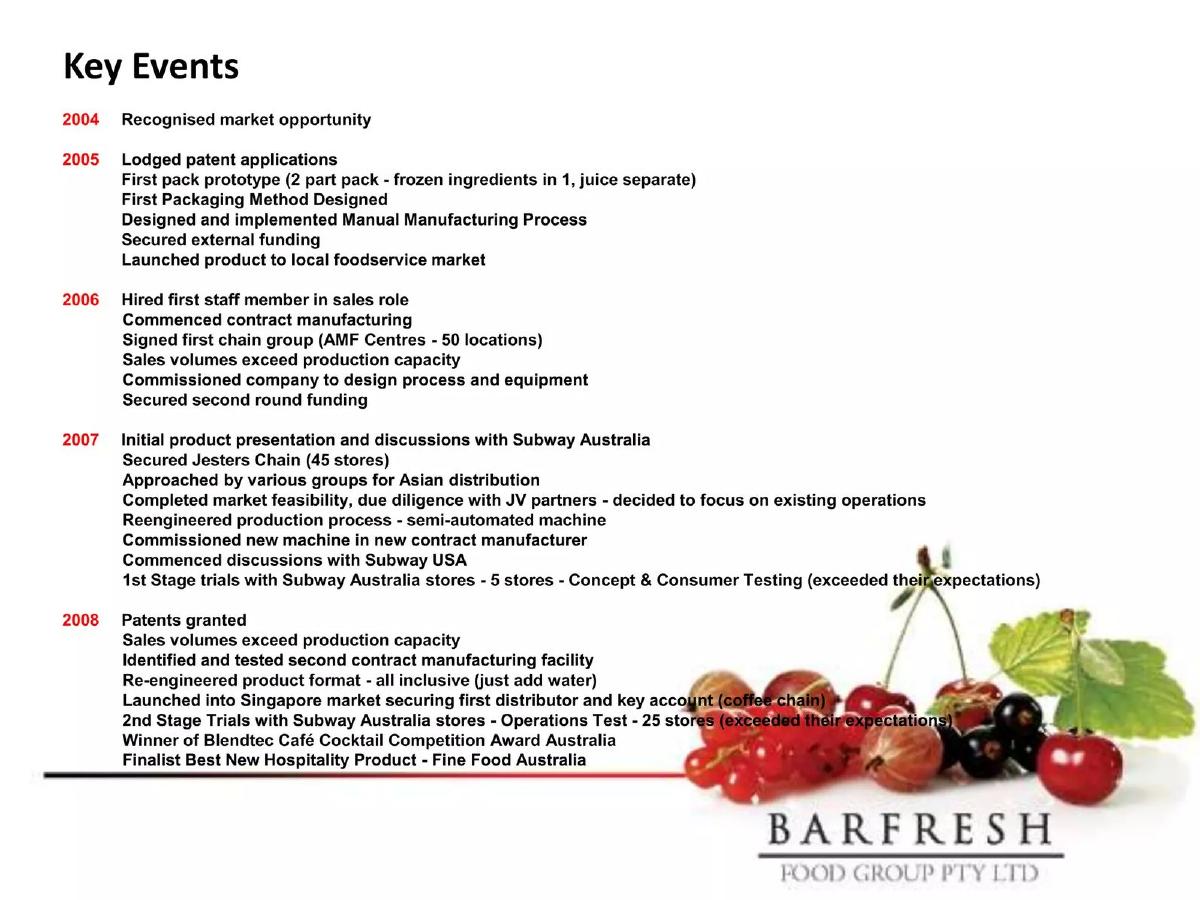
Slide 2: Key Events and Milestones
This slide provides a chronological history of the company from 2004 to 2008. It tracks the evolution from recognizing a market opportunity to securing patents and launching trials. Notable milestones include:
2005: Lodged patent applications for a 2-part pack system and secured external funding. · 2006: Signed the first chain group (AMF Centres - 50 locations) and noted that sales volumes exceeded production capacity. · 2007: Initiated discussions with Subway Australia and Subway USA, and reengineered the production process for semi-automation. · 2008: Patents granted; launched into the Singapore market; and completed a 25-store operations test with Subway Australia that 'exceeded their expectations.'
Slide 3: Product Definition and Distribution
Slide 3 defines 'Smoo Smoothies' as 'Ready to Blend' ingredient packs. The product includes fruit, juice, ice, and a dairy or sorbet base. The slide emphasizes that the products are 99% fat-free and have won multiple awards, including 'Cafe Cocktail of the Year.' The distribution footprint is listed as over 2,000 outlets with exports to New Zealand, Singapore, the Middle East, and the USA. Key accounts mentioned include Subway, AMF Bowling Centres, Jesters Pies, and Event Cinemas.
Slide 4: Product Variety
This slide is a visual catalog of the product line. It displays packaging for eight flavors: Mixed Berry, Mango, Banana, Tropical, Caribbean, Mango Delight, Strawberry, and Cookies & Cream. A footnote indicates that Peach, Passionfruit, and Watermelon are also available. The packaging clearly highlights the 'Just Add Water' and '99% Fat Free' selling points, reinforcing the brand's health and convenience positioning.
Slide 5: Regional Market Position (ANZ & Middle East)
The presentation shifts to regional specifics. In Australia, Subway had rolled out to 840 stores with 200 remaining. In New Zealand, the rollout to 218 stores was complete. The slide also lists other key customers like AHL Group (Rydges Hotels and Greater Union Cinemas) and the Jesters Pie chain. A critical strategic note is mentioned here: the establishment of a manufacturing and storage facility to bring production in-house, which is intended to increase margins and competitiveness.
Slide 6: The US Opportunity - Subway
This is the 'big bet' slide. It uses a sensitivity analysis to project the US Subway opportunity:
Assumption: 100 units sold per store, per week. · 100% Rollout (25,000 stores): 130 million units per annum. · 75% Rollout (18,750 stores): 98 million units per annum. · 50% Rollout (12,500 stores): 65 million units per annum.
The slide estimates annual profit at $20 million to $30 million via contract manufacturing, with an additional $5 million to $10 million in profit if manufactured in-house. It also mentions a 'Free On Loan' equipment strategy to drive higher rollout percentages, though this requires more capital.
Slide 7: The US Opportunity - Jamba Juice
BarFresh identifies Jamba Juice as a second major US target. Through a joint venture with Oregon Ice Cream, the company is exploring opportunities across Jamba's 750 stores. The slide identifies four specific avenues: Jamba Express stores, limited-time promotions, high-volume production for best-selling lines, and revamping existing retail products. The goal is to grow the 'Express' concept to thousands of outlets.
Slide 8: Capital Raising - Use of Funds
The company outlines its requirements for US expansion. The primary uses of capital are:
New manufacturing equipment for US supply. · Building stock and providing equipment for customer trials. · Hiring key personnel. · Branding, marketing, and infrastructure setup. · Continued development of an automated product delivery system.
Slide 9: Investment Proposition
The final slide quantifies the ask. BarFresh is looking to raise between $3 million and $5 million in the US. The terms offered are approximately 10% of BarFresh USA for each $1 million invested. The slide reiterates the potential of the Subway relationship, suggesting it could be '26 times larger than Australia' and generate circa $100 million in revenue. It also name-drops other potential targets like Taco Bell, Dunkin', and Starbucks, suggesting a total addressable market in excess of $500 million.
What BarFresh Does Well
The deck excels at demonstrating traction and validation . By showing a clear progression from a 5-store trial to a 25-store test and then a near-complete national rollout in Australia, the founders prove that the product works in a real-world QSR environment. The use of Subway as a primary case study is highly effective; it provides a recognizable benchmark for scale that any investor can understand. Furthermore, the deck clearly identifies the operational pain point (complexity of smoothie making) and offers a patented solution that simplifies the process to 'just add water.'
What Is Missing from the Deck
The most glaring omission is a Team Slide . There is no mention of the founders, their backgrounds, or the management team responsible for executing this global expansion. In early-stage or growth-stage investing, the 'who' is often as important as the 'what.' Additionally, the deck lacks detailed unit economics . While it provides high-level profit projections, it does not break down the cost per unit, wholesale price, or the specific margins at the store level. Finally, there is no competitive analysis . The deck assumes a vacuum, failing to mention other pre-portioned smoothie competitors or how they defend against large syrup and base providers already entrenched in the QSR supply chain.
Founder's Playbook: What to Copy
Founders should emulate the milestone-based narrative found on Slide 2. It shows a disciplined approach to growth, moving from IP protection to manufacturing to sales. The sensitivity analysis on Slide 6 is also a best practice; instead of providing a single 'hockey stick' projection, it shows how the business performs at different levels of market penetration (50%, 75%, 100%). This transparency helps build credibility with investors. Lastly, the clear 'Use of Funds' on Slide 8 avoids vague generalities, specifically linking the capital to tangible assets like 'manufacturing equipment' and 'stock build,' which reduces the perceived risk of the investment.
Frequently asked questions
- What is the core product offering of BarFresh?
- BarFresh produces 'Smoo Smoothies,' which are pre-portioned, ready-to-blend ingredient packs. These packs contain fruit, juice, ice, and a base of yogurt, sorbet, or ice cream. The operational advantage is that the end-user only needs to add water and blend, eliminating the need for complex ingredient measuring and reducing waste in a high-volume foodservice environment.
- How does the company plan to use the requested $3M-$5M investment?
- The funds are earmarked for accelerating US expansion. Specific uses include purchasing new manufacturing equipment for US supply, building stock for customer trials, hiring key personnel, branding and marketing, and setting up the necessary infrastructure to support large-scale US distribution.
- What is the status of their partnership with Subway?
- As of the deck's publication, BarFresh had completed a rollout to 840 stores in Australia and 218 stores in New Zealand. In the US, they were positioned for a potential rollout to 25,000 stores, with pricing structured to help Subway achieve 'gold status' for their cost of goods.
- What are the projected financials for the US market?
- Based on an assumption of 100 units sold per store per week, a 100% rollout to Subway US (25,000 stores) would result in 130 million units per year. The company expects $20 million to $30 million in annual profit using contract manufacturing, with an additional $5 million to $10 million if manufacturing is brought in-house.
- Does the deck mention any intellectual property protection?
- Yes, Slide 2 notes that the company lodged patent applications in 2005 for its two-part pack (frozen ingredients in one, juice separate) and the associated packaging method. The slide further confirms that patents were officially granted in 2008.