Banyan Ventures' 24-page deck for AI Fund I is a masterclass in positioning a solo GP as a high-value operator rather than just a financier. Sam Awrabi leverages his background as the first Head of Sales at Comet.ml and first revenue hire at MissingLink.ai to promise LPs access to 'AI-Native' infrastructure deals. The deck claims Banyan's prior pre-seed and seed investments have already booked over $490M in revenue (Slide 2). By focusing on a 'five-step framework' for 'Escape Velocity Investing' (Slide 4) and providing a specific GTM playbook for founders (Slide 10), Banyan differentiates its…
Key takeaways
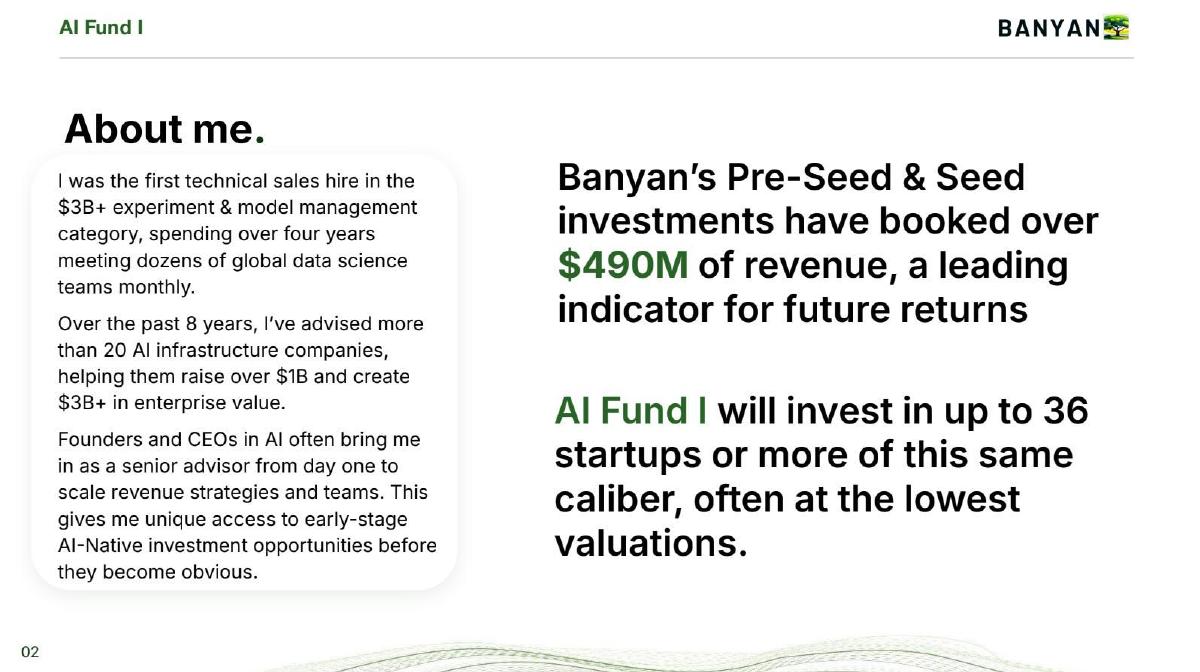
- Banyan claims its existing pre-seed and seed investments have booked over $490M in revenue as a leading indicator for Fund I (Slide 2).
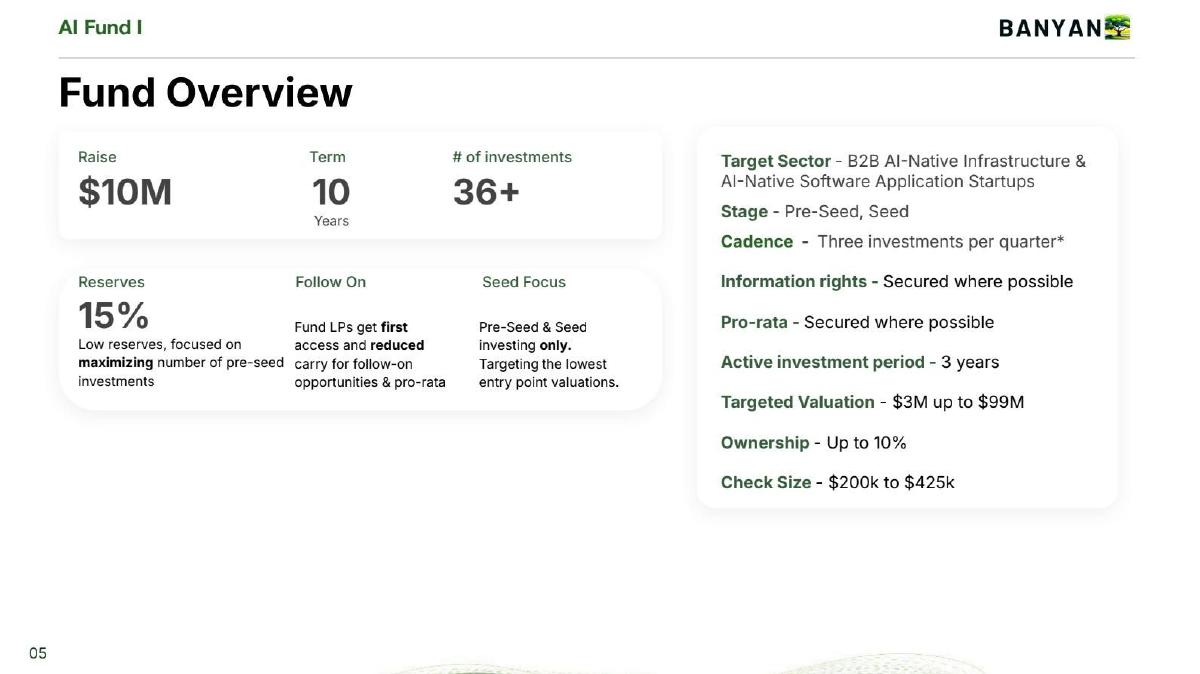
- The fund targets up to 36 startups, focusing on AI-Native infrastructure and application software (Slide 2).
- GP Sam Awrabi highlights his role in scaling Comet.ml from seed to Series B, closing over 150 customers including Uber and Zappos (Slide 7).
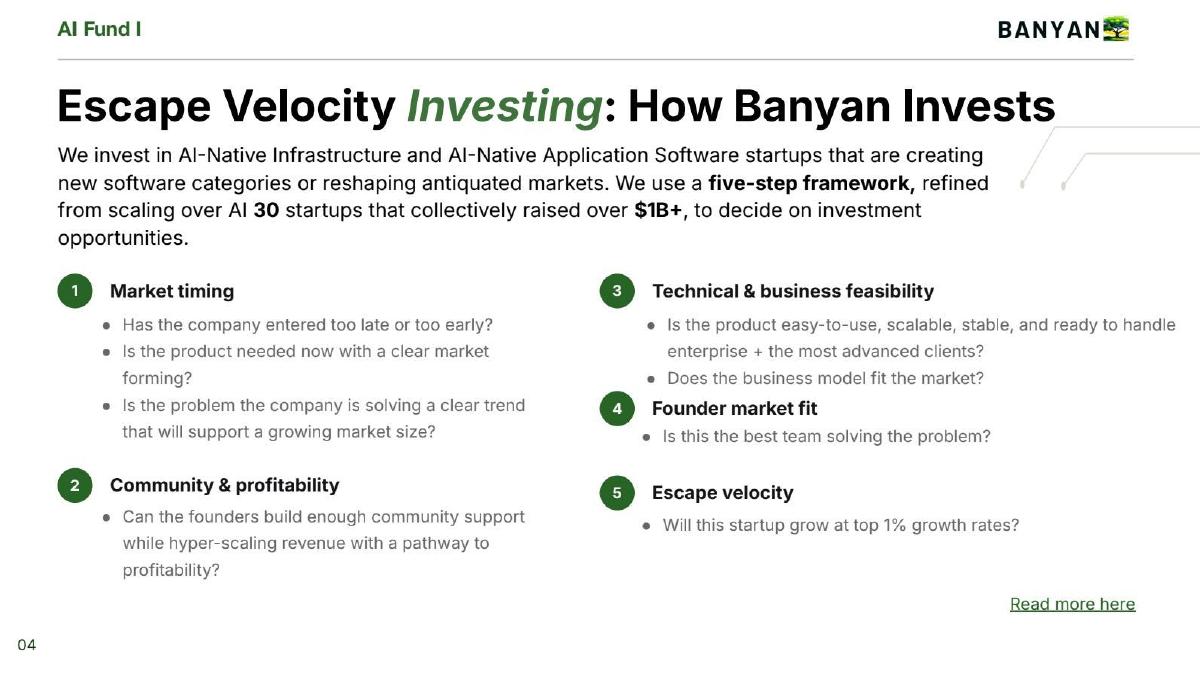
- The deck introduces a 'five-step framework' for selection: Market timing, Community & profitability, Technical & business feasibility, Founder market fit, and Escape velocity (Slide 4).
- Banyan offers a tangible 'GTM support infrastructure' including executive coaching, office hours, and a plug-and-play GTM playbook (Slide 10).
- The GP demonstrates co-investment history alongside high-profile angels and funds, including founders from GitHub, Apple, and Replit (Slide 13).
- Banyan explicitly targets the 'pre-product, pre-revenue, and pre-traction' stage where founder quality is the primary metric (Slide 22).
- The deck uses a 'flywheel' sourcing model to argue for unique, vetted, and diverse deal flow in the AI space (Slide 8).
Banyan AI Fund I: The Operator’s Edge in Infrastructure
Banyan Ventures entered the market in 2024 with a clear, narrow thesis: AI-native infrastructure is the most significant technical revolution in history, and technical founders in this space are often ill-equipped to handle the Go-To-Market (GTM) hurdles of enterprise sales. The deck for AI Fund I, which successfully raised $10M as reported by Business Insider, is a targeted pitch to LPs who value operating experience over pure financial engineering.
Slide 1: Title and GP Introduction
The deck opens with a high-resolution image of a Banyan tree, reinforcing the brand name. It introduces Sam Awrabi as the Founder and General Partner. The simplicity of the cover slide sets a professional, minimalist tone common in modern venture capital decks.
Slide 2: The Performance Hook
Slide 2 serves as the executive summary and traction proof. It states that Banyan's previous pre-seed and seed investments have booked over $490M of revenue. This is a bold claim for an emerging manager, used here as a "leading indicator for future returns." The slide also defines the fund's capacity: investing in up to 36 startups, focusing on early entry at low valuations.
Slide 3 & 4: Escape Velocity Investing
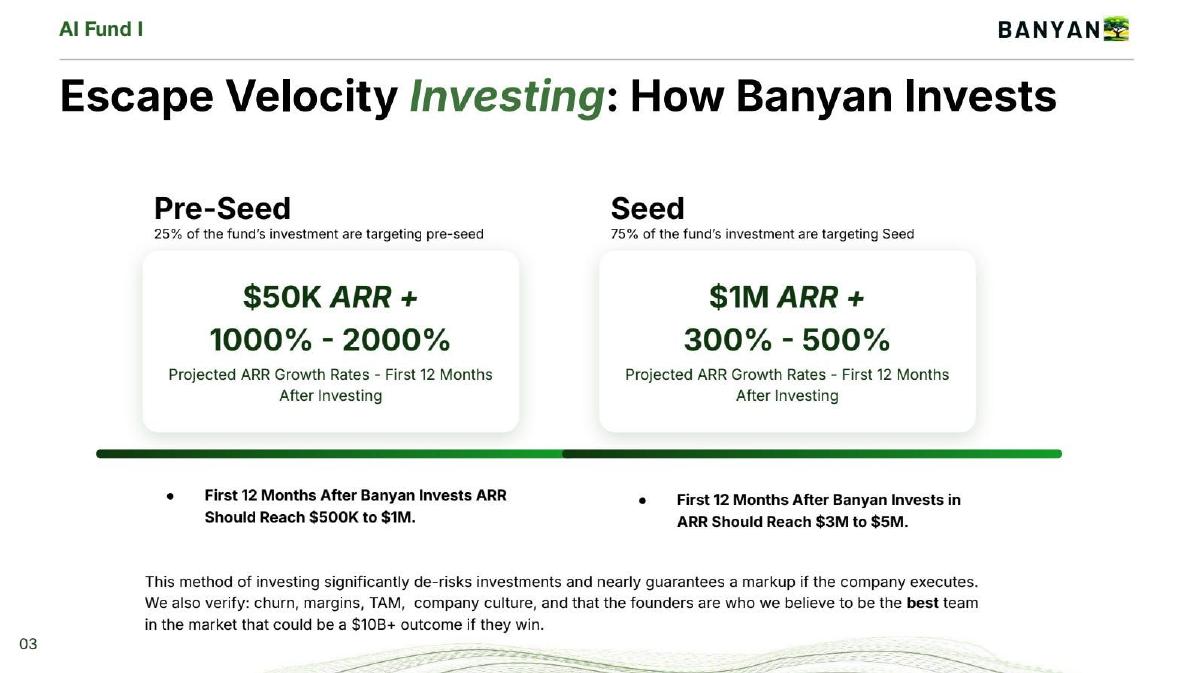
These slides introduce Banyan’s proprietary investment methodology. Slide 4 breaks down the "five-step framework" used to decide on opportunities. The criteria include Market Timing, Community & Profitability, Technical & Business Feasibility, Founder Market Fit, and Escape Velocity. By quantifying the decision-making process, Banyan attempts to de-risk the perceived volatility of pre-seed AI investing for LPs.
Slide 5 & 6: Fund Overview and Thesis
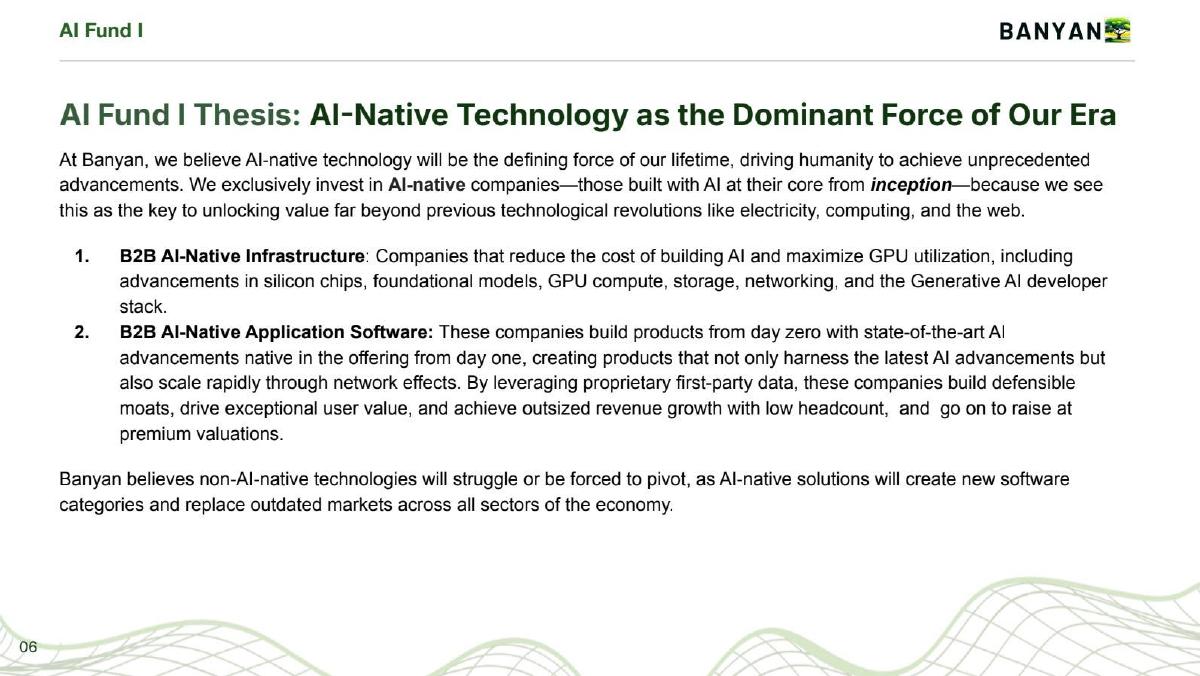
The thesis is explicitly stated on Slide 6: "AI-Native Technology as the Dominant Force of Our Era." The fund positions itself not just as an AI fund, but as an "AI-Native" fund, implying a deeper level of integration and understanding of the technology than generalist firms that have recently pivoted to AI.
Slide 7: The GP Journey
This is arguably the most important slide in the deck. It provides a timeline of Sam Awrabi’s career, highlighting his roles at MissingLink.ai and Comet.ml. Key metrics include closing 150+ customers (Uber, Zappos, Etsy) and helping raise $70M in Series A and B rounds. The slide also mentions Awrabi Consulting, where clients reportedly raised $1B+ and created $3B in valuation. This establishes Awrabi as a practitioner who has seen the "inside" of successful AI scale-ups.
Slide 8 & 9: Sourcing and Selection
Slide 8 describes a "three-step flywheel" for sourcing unique, vetted, and diverse pre-seed deal flow. Slide 9 elaborates on the methodical approach to selection. For an LP, these slides answer the question: "How will you find deals that Sequoia and Andreessen Horowitz haven't already found?"
Slide 10: GTM Support Infrastructure
Banyan leans heavily into its value-add proposition here. The slide lists four pillars: Executive Coaching, Office Hours, GTM Playbook, and Fundraise Support. Awrabi explicitly mentions his experience scaling from $0 to $5M ARR. This is a direct appeal to the "technical founder" persona who may have a great product but lacks a sales engine.
Slide 11 & 12: Trust and Rationale
These slides focus on why founders choose Banyan and why the specific timing for AI Fund I is optimal. The narrative emphasizes that in a crowded AI market, founders need partners who have "done it before" at the infrastructure level.
Slide 13: The Co-Investor Social Proof
Slide 13 is a "logo slide" of individuals, not just firms. It shows Awrabi has invested alongside figures like Tom Preston-Werner (GitHub), Luca Maestri (Apple), and Amjad Masad (Replit). This demonstrates that despite being a new fund, Banyan has the network to access top-tier rounds.
Slide 14, 15 & 16: Market Dynamics
Slide 16 presents a compelling statistic: only three funds have invested in more than 3% of unicorns at the seed stage from 2013-2023. Banyan predicts this percentage will be even lower in the AI era, suggesting that specialized micro-funds (like Banyan) are better positioned to capture these outliers than bloated multi-stage firms.
Slide 17: Potential Fund Scenarios
This slide likely contains financial modeling or return profiles (though the specific numbers are not detailed in the text provided). It serves to show LPs the mathematical path to a 5x or 10x return based on the 36-startup portfolio construction.
Slide 18 & 19: Operating Experience and Testimonials
Slide 19 features testimonials from executives at Kitov.ai, Samsung NEXT, and Nielsen. These quotes validate Awrabi’s reputation as a "strategic partner" and "exceptional enterprise sales professional." For LPs, this is the "due diligence" slide that proves the GP isn't just inflating his resume.
Slide 20 & 21: Seed Performance and Infrastructure Focus
These slides double down on why seed-stage investing is the best place to be and why infrastructure (the "picks and shovels") is a safer, more scalable bet than application-layer AI, which may face higher churn or lower moats.
Slide 22: Founder Criteria
Slide 22 outlines what Banyan looks for: Founders First, Leadership, Operational Excellence, Clarity, Outliers, and Strength vs. Lack of Weakness. The note that "most infra startups take ten years to build and require $300M+ in funding" shows a realistic understanding of the sector's capital intensity.
Slide 23 & 24: The Banyan Advantage and Disclaimers
The deck concludes by summarizing the "deep roots in AI" and providing the necessary legal disclaimers. The final impression is one of a highly specialized, operationally-focused fund that knows exactly which niche it intends to dominate.
What Banyan Ventures Does Well
Specificity of Value-Add: Most funds claim to help with "hiring and strategy." Banyan is much more specific, offering a "GTM Playbook" and citing a specific ARR range ($0 to $5M) where they provide the most value. This makes the fund highly attractive to technical founders who are often the ones building AI infrastructure.
Operator Credibility: The GP doesn't just list titles; he lists outcomes. Mentioning specific customers like Uber and Zappos and specific revenue milestones ($490M booked) provides a level of proof that is hard to ignore. The transition from operator to consultant to investor is mapped out logically.
Market Timing Argument: By citing the difficulty of picking unicorns in the AI era (Slide 16), Banyan creates a sense of urgency. They argue that the old way of investing won't work for this new platform shift, positioning themselves as the necessary new breed of investor.
What Is Missing from the Banyan Ventures Deck
Portfolio Construction Details: While Slide 2 mentions "up to 36 startups," the deck lacks a detailed breakdown of check sizes, follow-on reserves, and target ownership percentages. LPs typically want to see how the $10M will be recycled or deployed across those 36 slots.
Team Depth: The deck is very focused on Sam Awrabi as a solo GP. There is no mention of venture partners, associates, or a back-office team. While common for a Fund I, LPs often look for signs of institutionalization or a plan to scale the team as the portfolio grows to 36+ companies.
Exit Strategy: The deck discusses "Escape Velocity" and "Unicorns," but it doesn't touch on the current M&A landscape for AI infrastructure. Given the high capital requirements mentioned on Slide 22 ($300M+), a discussion on how these companies exit (IPO vs. strategic acquisition) would have strengthened the financial case.
What Other Founders (and GPs) Should Copy
The 'Journey' Slide: Slide 7 is a perfect example of how to present a career path. It uses a clean timeline and highlights the most impressive logos and metrics. It tells a story of increasing responsibility and success that leads naturally to the creation of a fund.
The Methodology Slide: Slide 4 (Escape Velocity Investing) is a great way to show that your investment process isn't just "gut feeling." Even if the criteria are somewhat standard, naming the framework and listing the sub-bullets makes the GP look disciplined and professional.
Testimonials as Proof: Including quotes from former clients and colleagues (Slide 19) is a powerful way to build trust. It moves the GP's claims from "self-promotion" to "verified fact." Founders raising capital should similarly include testimonials from early customers or pilot partners.
Frequently asked questions
- What is Banyan Ventures' specific investment focus?
- Banyan Ventures focuses on AI-Native infrastructure and AI-Native application software. According to Slide 4, they target startups creating new software categories or reshaping antiquated markets. They specifically look for companies that can achieve 'top 1% growth rates' through a methodical five-step selection process.
- How does the GP justify his ability to pick winners in AI?
- The GP, Sam Awrabi, relies on his operating history. Slide 7 details his journey as the first revenue hire at MissingLink.ai (acquired by Samsung) and first Head of Sales at Comet.ml. He claims his consulting clients have raised over $1B and created $3B in valuation, providing him with a unique vantage point to vet technical infrastructure.
- What value-add does Banyan promise to its portfolio companies?
- Banyan promises a 'GTM support infrastructure' to help founders scale from $0 to $5M ARR. As shown on Slide 10, this includes 1:1 office hours, executive coaching, and an 'in-depth end-to-end GTM playbook' refined by working with over 30 AI and ML startups.
- What are the 'Escape Velocity Investing' criteria?
- Slide 4 outlines five criteria: 1) Market timing (is the market forming now?), 2) Community & profitability (can they hyper-scale revenue?), 3) Technical/business feasibility (is the product enterprise-ready?), 4) Founder market fit (is this the best team?), and 5) Escape velocity (top 1% growth potential).
- How many investments does Banyan AI Fund I plan to make?
- According to Slide 2, AI Fund I intends to invest in up to 36 startups or more. The strategy emphasizes entering at the 'lowest valuations' during the pre-seed and seed stages to maximize potential returns as these companies scale.