Bakulbakul is an Indonesian agritech startup aiming to bridge the gap between farmers and end consumers through a technology-enabled distribution network. Their 9-slide deck outlines a dual-sided problem: farmers suffer from low prices and confusing distribution, while consumers face high prices and unreliable supply. The proposed solution involves a 'BakulApp' ecosystem supported by 'BakulRiders,' 'BakulTrucks,' and 'BakulKios.' The core technical differentiator is an Adaptive Margin Pricing model and route optimization system powered by reinforcement learning. While the deck identifies a si…
Key takeaways
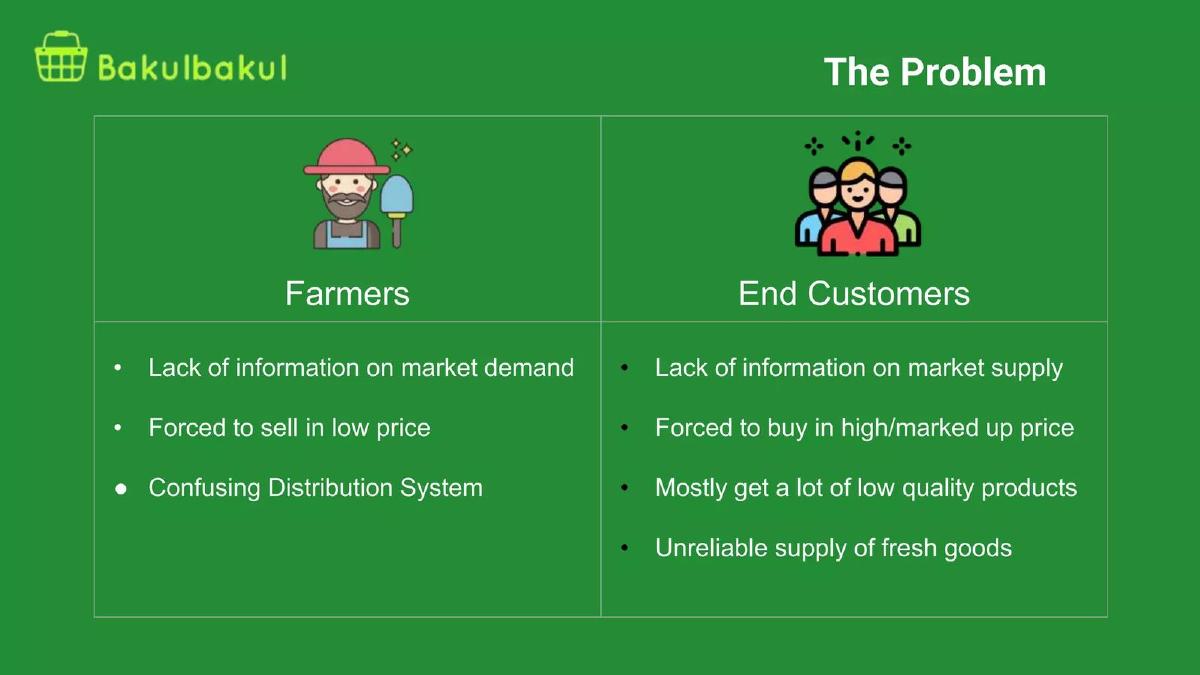
- The deck identifies three primary pain points for farmers: lack of demand information, low sell prices, and confusing distribution (Slide 2).
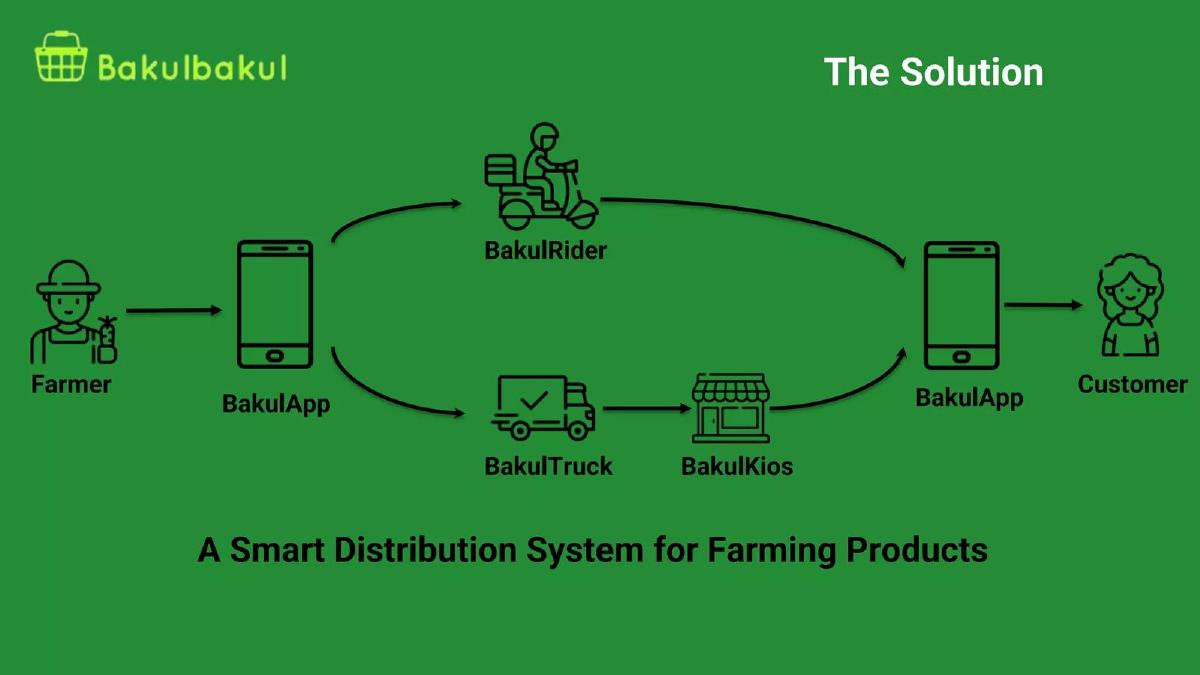
- The solution ecosystem consists of four physical and digital components: BakulApp, BakulRider, BakulTruck, and BakulKios (Slide 3).
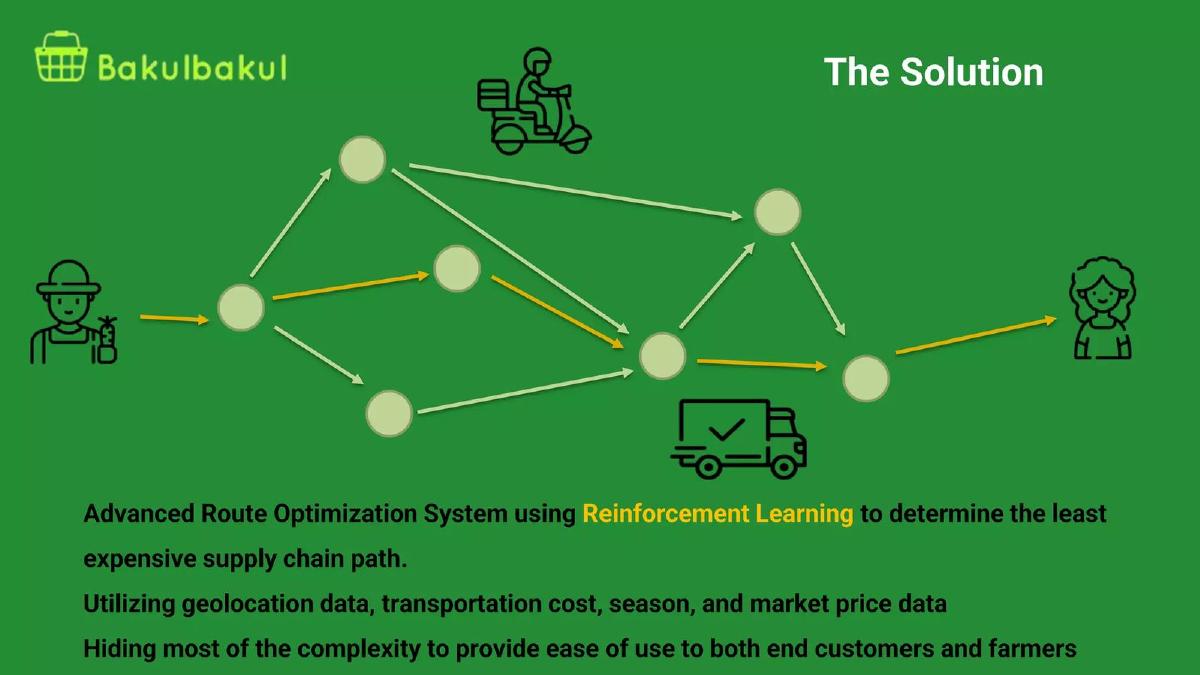
- Bakulbakul utilizes reinforcement learning to optimize supply chain paths based on geolocation, cost, season, and market price (Slide 4).
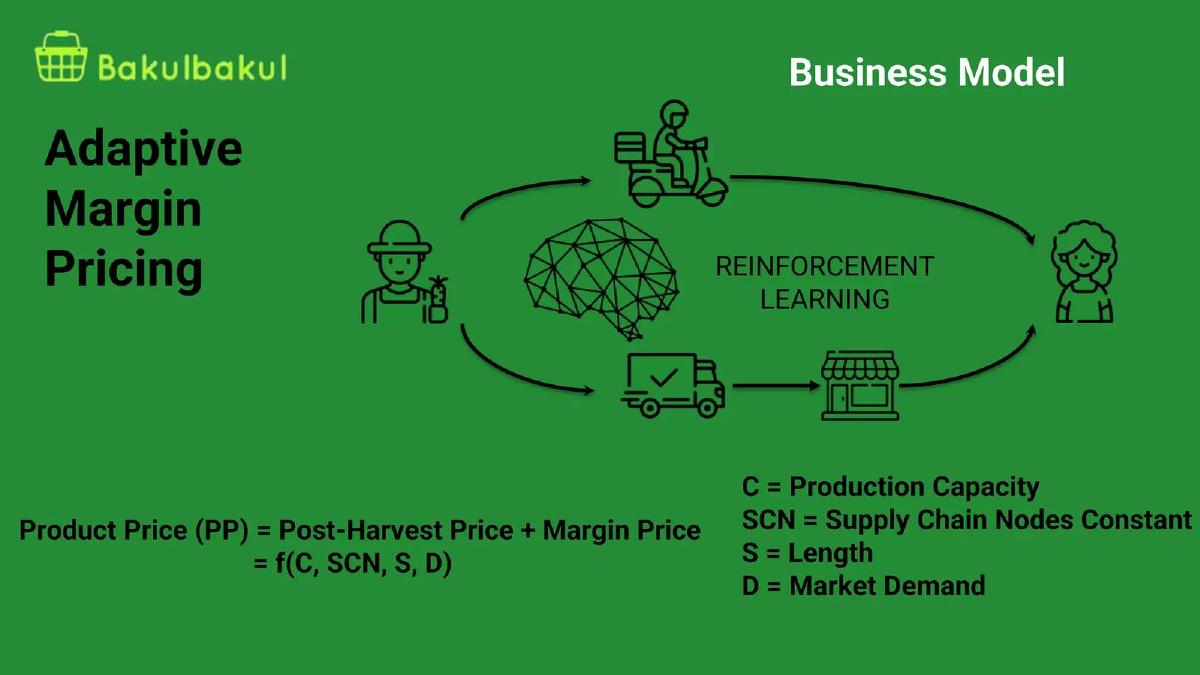
- The business model relies on 'Adaptive Margin Pricing,' where product price is a function of production capacity, supply chain nodes, length, and market demand (Slide 6).
- The Total Available Market is cited at 88 Trillion IDR in 2021, projected to reach 130 Trillion IDR by 2025 (Slide 7).
- The founding team includes a CEO with food research experience, a COO with organic farming expertise, and a CTO with a background in AI research (Slide 8).
- An early-stage MVP was hosted on Heroku, described as a 'neighbourly marketplace community' for buying, selling, and swapping produce (Slide 9).
- The deck completely omits a financial ask, use of funds, current traction figures, or a competitive landscape analysis.
Bakulbakul Pitch Deck Analysis
Bakulbakul presents a concise, 9-slide deck that focuses heavily on the technical and logistical architecture of an agritech platform. The deck is visually consistent, utilizing a green color palette that aligns with the agricultural sector, but it leans more toward a product walkthrough than a comprehensive business case. It identifies a clear inefficiency in the Indonesian food supply chain and proposes a high-tech solution to solve it.
Slide 1: Title Slide
The deck opens with the Bakulbakul logo—a stylized shopping basket—and the tagline: "Delivering fresh food right to your dining table." It is a standard, clean opening that establishes the company's focus on the food delivery and supply chain sector.
Slide 2: The Problem
Slide 2 bifurcates the problem into two categories: Farmers and End Customers. For farmers, the deck lists a lack of information on market demand, being forced to sell at low prices, and a "Confusing Distribution System." For customers, it highlights a lack of supply information, high marked-up prices, low-quality products, and unreliable supply. This slide effectively establishes the "middleman" problem common in emerging market agriculture, though it lacks specific data points to quantify these pains.
Slide 3: The Solution (Infrastructure)
This slide introduces the "Smart Distribution System for Farming Products." It uses a flowchart to show the flow of goods from Farmer to Customer via the "BakulApp." The infrastructure is broken down into three physical components: BakulRider, BakulTruck, and BakulKios. This indicates that Bakulbakul is not just a software layer but intends to manage or coordinate a physical logistics network.
Slide 4: The Solution (Technology)
Slide 4 dives into the technical differentiator. It claims to use an "Advanced Route Optimization System using Reinforcement Learning." The goal is to determine the "least expensive supply chain path" by utilizing geolocation, transportation costs, seasonality, and market price data. The slide emphasizes "hiding most of the complexity" to ensure ease of use for the end-users. This is a high-level technical claim that would require significant validation during due diligence.
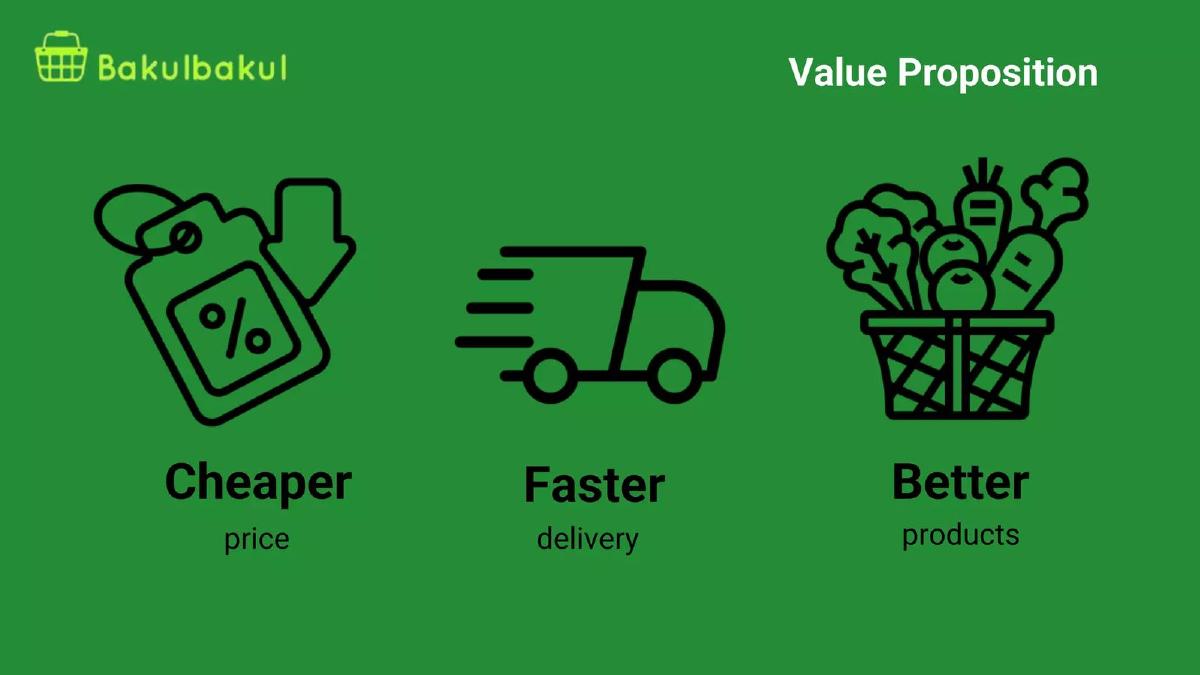
Slide 5: Value Proposition
This slide summarizes the benefits into three pillars: "Cheaper price," "Faster delivery," and "Better products." While these are standard goals for any logistics startup, the slide lacks the "how" or the specific metrics (e.g., % cheaper or hours faster) that would make the claim compelling to an investor.
Slide 6: Business Model
The business model is described as "Adaptive Margin Pricing." The slide provides a formula: Product Price (PP) = Post-Harvest Price + Margin Price. The Margin Price is defined as a function of Production Capacity (C), Supply Chain Nodes Constant (SCN), Length (S), and Market Demand (D). This suggests the company intends to generate revenue through a dynamic spread on the products sold through the platform, rather than a flat transaction fee or subscription.
Slide 7: Market Size
Using data from Statistics Indonesia, this slide presents the Total Available Market. It shows a jump from 88 Trillion IDR in 2021 to 130 Trillion IDR in 2025, representing an 8% CAGR. While the numbers are large, the deck does not narrow this down to a Serviceable Addressable Market (SAM), leaving the investor to wonder what portion of this massive market Bakulbakul can realistically capture.
Slide 8: The Team
The team slide features three founders. Dwi Viani Ulfah (CEO) is credited as a food researcher and sociopreneur. Istajib Sulton Hakim (COO) is an organic farming practitioner. Ahmad Badawi K (CTO) brings software engineering and AI research experience. The team appears to have a balanced mix of domain expertise (farming/food) and technical skill (AI/software), which is critical for the proposed solution.
Slide 9: MVP #1
The final slide shows a screenshot of a functional MVP hosted on Heroku. The messaging here shifts slightly toward a "neighbourly marketplace community" for swapping and selling produce within "bike riding distance." This suggests the initial entry point is hyper-local and C2C (consumer-to-consumer) or smallholder-to-consumer, which contrasts slightly with the "BakulTruck" and "BakulKios" industrial-scale infrastructure mentioned earlier in the deck.
What Bakulbakul Does Well
Clear Problem Identification: The deck does a good job of explaining why both ends of the supply chain (farmers and consumers) are currently underserved. By framing the problem as a lack of information and a confusing distribution system, they set the stage for a technological intervention.
Technical Specificity: Unlike many early-stage decks that vaguely mention "AI," Bakulbakul specifies "Reinforcement Learning" and provides a basic formula for their adaptive pricing. This gives the impression of a thought-out technical roadmap.
What is Missing from the Bakulbakul Deck
The Ask: The most significant omission is the lack of a funding ask. There is no mention of how much capital the company is seeking, the valuation, or the specific milestones they intend to reach with the investment.
Traction Metrics: While an MVP is shown on Slide 9, there are no data points regarding its performance. Investors need to see number of users, transaction volume, GMV (Gross Merchandise Volume), or growth rates to validate that the MVP is actually being used.
Competitive Analysis: The Indonesian agritech space is crowded with players like TaniHub and Sayurbox. The deck fails to mention any competitors or explain why their reinforcement learning approach is superior to existing solutions.
Unit Economics: While the business model slide explains how they price, it doesn't explain the margins. There is no information on the cost of customer acquisition (CAC), lifetime value (LTV), or the operational costs of maintaining a fleet of riders and trucks.
What a Founder Should Copy
Visual Consistency: The deck uses a simple, clean design with a consistent color palette. It doesn't distract the reader with over-designed elements, allowing the content to remain the focus.
Logical Flow: The progression from Problem to Solution to Technology to Market is logical and follows the standard pitch deck narrative that most investors expect.
Defining the "Black Box": Slide 4's attempt to visualize the supply chain nodes and explain that the software "hides the complexity" is a good way to communicate a complex technical product to a non-technical audience.
Frequently asked questions
- What is the core technology behind Bakulbakul?
- Bakulbakul claims to use Reinforcement Learning (RL) for two primary functions: route optimization and pricing. According to Slide 4, the RL system determines the 'least expensive supply chain path' by analyzing geolocation, transportation costs, seasonal variables, and market prices. Slide 6 further explains that this AI drives an 'Adaptive Margin Pricing' model to dynamically set prices based on supply and demand.
- How does the company plan to handle physical logistics?
- The deck outlines a multi-tiered logistics strategy on Slide 3. This includes 'BakulRiders' for smaller-scale or last-mile delivery, 'BakulTrucks' for larger transport, and 'BakulKios' which likely serve as physical distribution or collection points. This suggests a hybrid model combining digital marketplace features with physical infrastructure management.
- What is the market size for this venture?
- Citing Statistics Indonesia as a source, Slide 7 values the Total Available Market at 88 Trillion IDR in 2021. The company projects an 8% Compound Annual Growth Rate (CAGR), leading to a projected market size of 130 Trillion IDR by 2025. The deck does not specify the Serviceable Obtainable Market (SOM).
- Who are the founders of Bakulbakul?
- The team consists of three members shown on Slide 8: Dwi Viani Ulfah (CEO), a food and health researcher; Istajib Sulton Hakim (COO), an organic food farming practitioner; and Ahmad Badawi K (CTO), a software engineer and AI researcher who previously served as CTO at PT Terraversity Edukasi Utama.
- Is there evidence of a working product?
- Slide 9 shows a screenshot of 'MVP #1,' a web-based marketplace located at bakulbakul.herokuapp.com. The interface allows users to 'find produce' or 'share produce.' The slide describes it as a community for buying, selling, and swapping locally grown goods within bike-riding distance, though no user metrics or transaction volumes are provided.