Bag Speak and Bagito operate as a dual-entity organization based in Santa Cruz, CA, combining a 501(c)(3) non-profit (BagSpeak) with a reusable product brand (Bagito). Their 10-slide pitch deck outlines a mission to reduce plastic waste through K-12 education and the sale of recycled-fiber shopping bags. The deck highlights a diversified revenue stream where 50% of income is projected to come from product sales, with the remainder split between sponsorships and grants. Seeking $65,000 for expansion, the founders emphasize their existing presence in major retailers like Whole Foods and Walgree…
Key takeaways
- The organization operates as a registered 501(c)(3) non-profit where 100% of net proceeds from Bagito products fund the BagSpeak project (Slide 1).
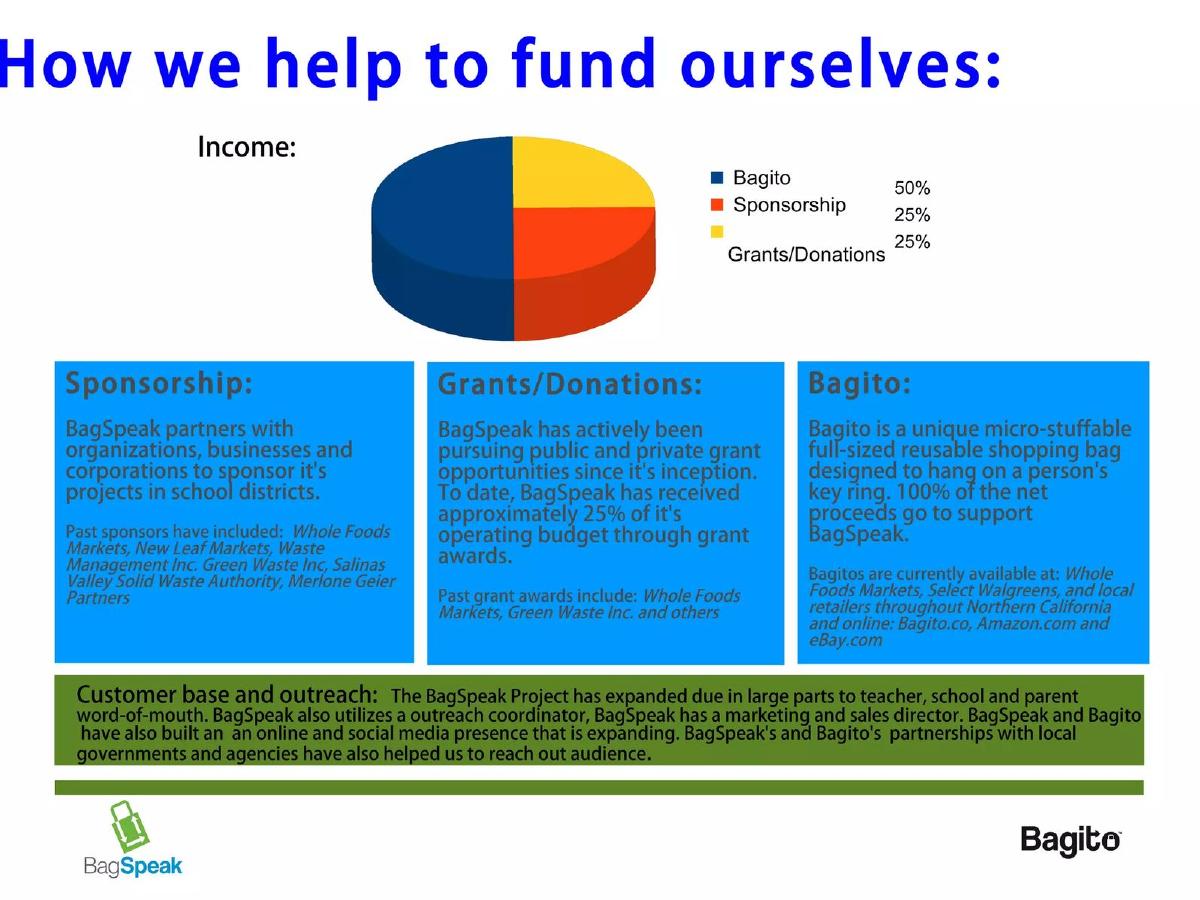
- Revenue is diversified across three channels: Bagito sales (50%), Sponsorships (25%), and Grants/Donations (25%) (Slide 3).
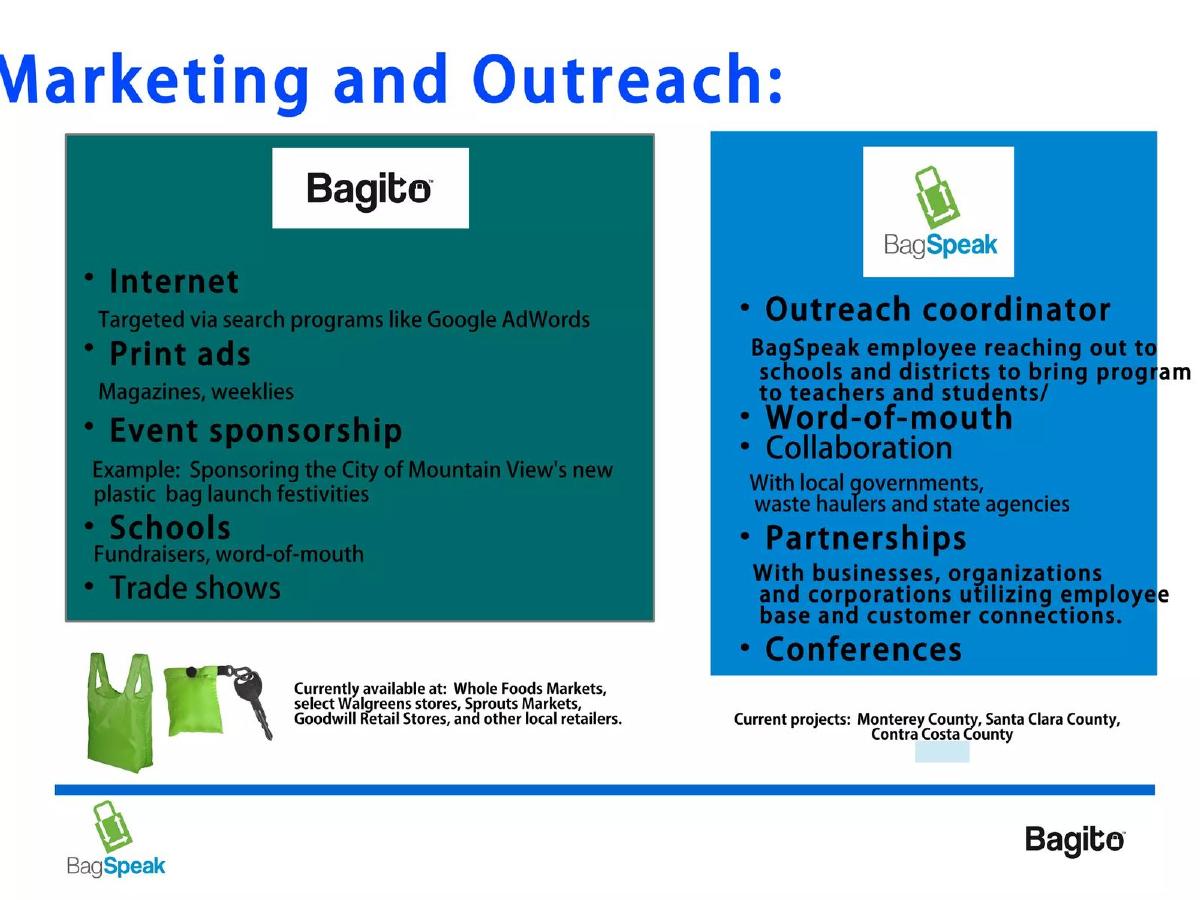
- Bagito products are already stocked in major retail chains including Whole Foods Markets and select Walgreens (Slide 3).
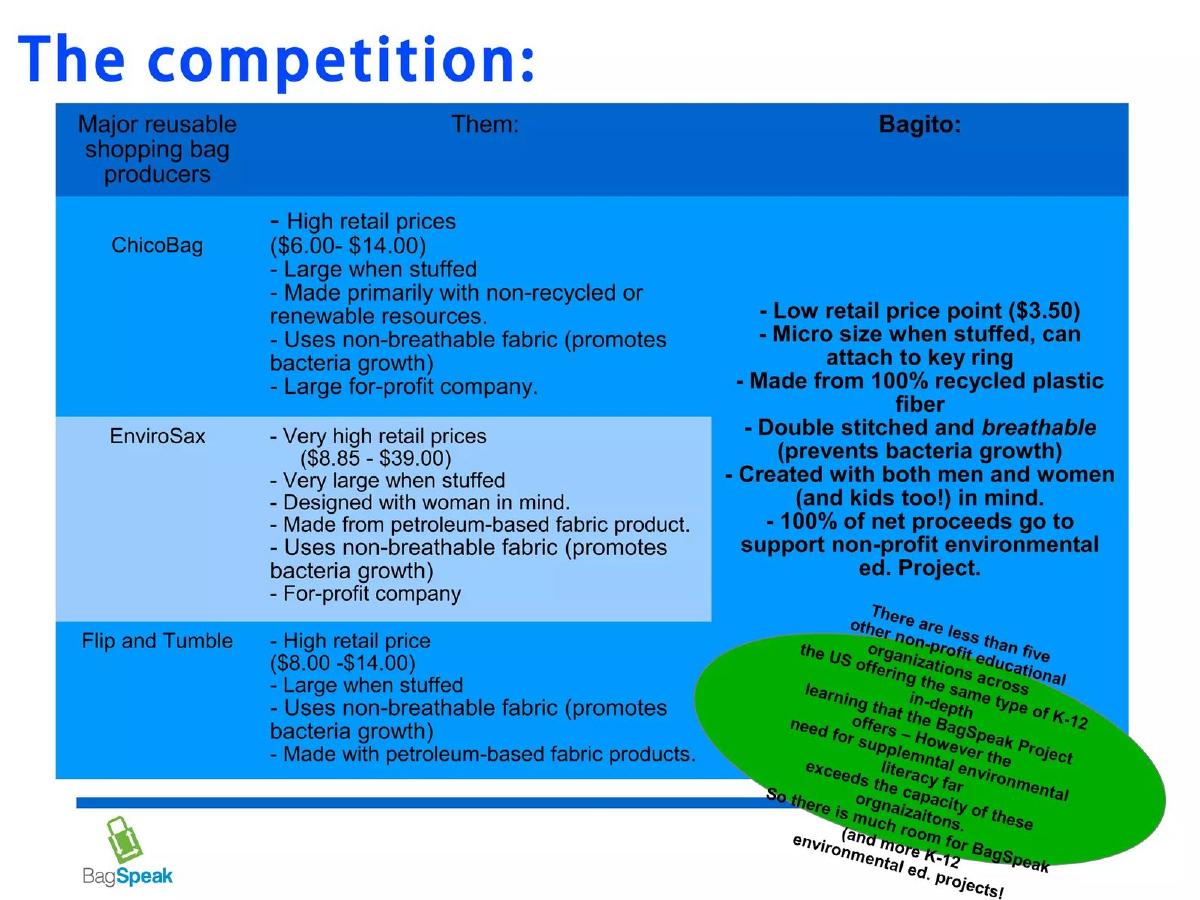
- The company positions itself as a low-cost competitor with a $3.50 retail price point, significantly lower than competitors like ChicoBag ($6.00-$14.00) (Slide 6).
- The team is led by Mitch Barlas, a former school principal with over 20 years of experience in education and instructional technology (Slide 7).
- Financial projections target a growth from $45,781 in Year 1 to $565,000 in Year 5 (Slide 8).
- The specific fundraising goal is $65,000, intended to cover program and business expansion starting in May 2013 (Slide 8).
- The organization has demonstrated international reach through a partnership with the U.S. Department of State in Mauritania, Africa (Slide 10).
Executive Summary: The Hybrid Social Enterprise
The pitch deck for Bag Speak and Bagito presents a social enterprise model that blends retail commerce with environmental advocacy. Based in Santa Cruz, California, the organization leverages the sale of recycled-material shopping bags to fund K-12 environmental education. This teardown examines the 10-slide presentation, which serves as a hybrid between a non-profit grant application and a business expansion pitch.
Slide 1: Title and Organization Structure
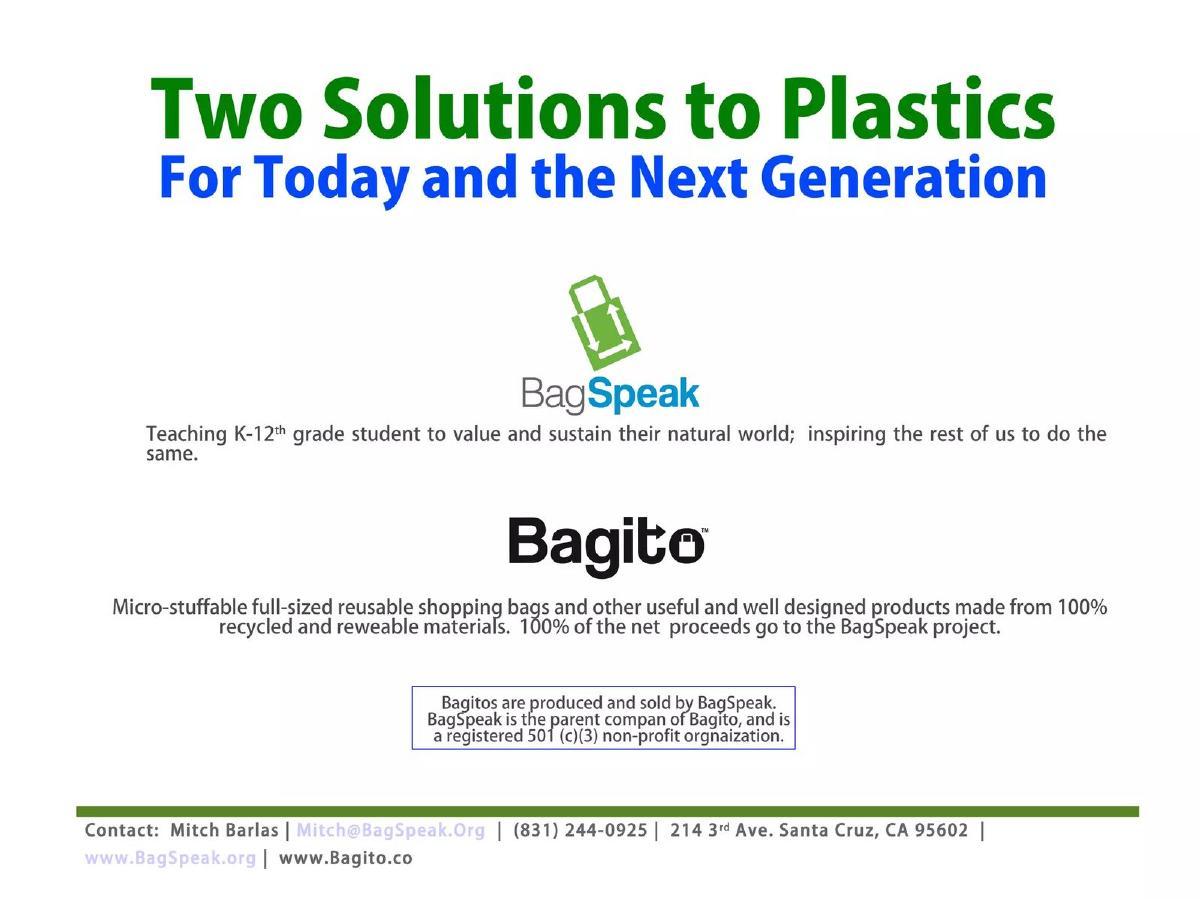
The cover slide introduces the two brands: BagSpeak and Bagito . It establishes the mission immediately: "Teaching K-12th grade student to value and sustain their natural world." Crucially, a text box at the bottom clarifies the legal and financial structure: BagSpeak is a registered 501(c)(3) non-profit and the parent company of Bagito. The slide also notes that 100% of net proceeds from Bagito products go to the BagSpeak project. Contact information for founder Mitch Barlas is provided, including a physical address in Santa Cruz, CA.
Slide 2: The Problem (Issues)
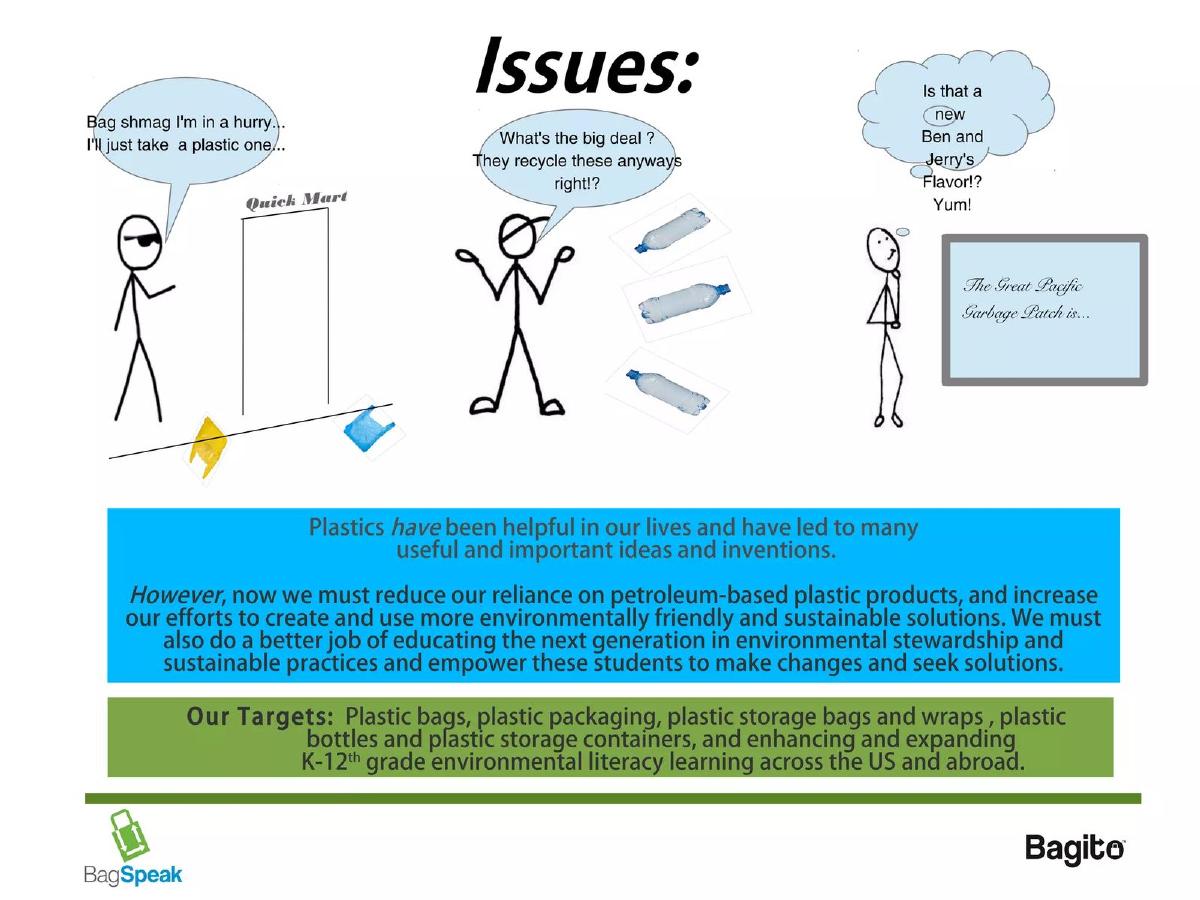
Using a simple stick-figure comic format, Slide 2 illustrates the psychological barriers to sustainable behavior. It depicts common excuses such as being in a hurry, the misconception that all plastics are recycled, and general apathy toward the Great Pacific Garbage Patch. The slide transitions into a formal problem statement, noting the need to reduce reliance on petroleum-based plastics and the necessity of educating the next generation. The "Targets" listed include plastic bags, packaging, and storage containers, alongside K-12 environmental literacy.
Slide 3: Revenue Model and Funding
This slide is critical for understanding the business's viability. A 3D pie chart breaks down income into three categories: Bagito (50%) , Sponsorship (25%) , and Grants/Donations (25%) . The slide lists past sponsors and grantors, including Whole Foods Markets and Waste Management Inc. It also details the current retail footprint for Bagito products, mentioning availability at Whole Foods, select Walgreens, and online platforms like Amazon and eBay. The bottom section emphasizes that growth has been driven by word-of-mouth among teachers and parents.
Slide 4: Technology and Materials
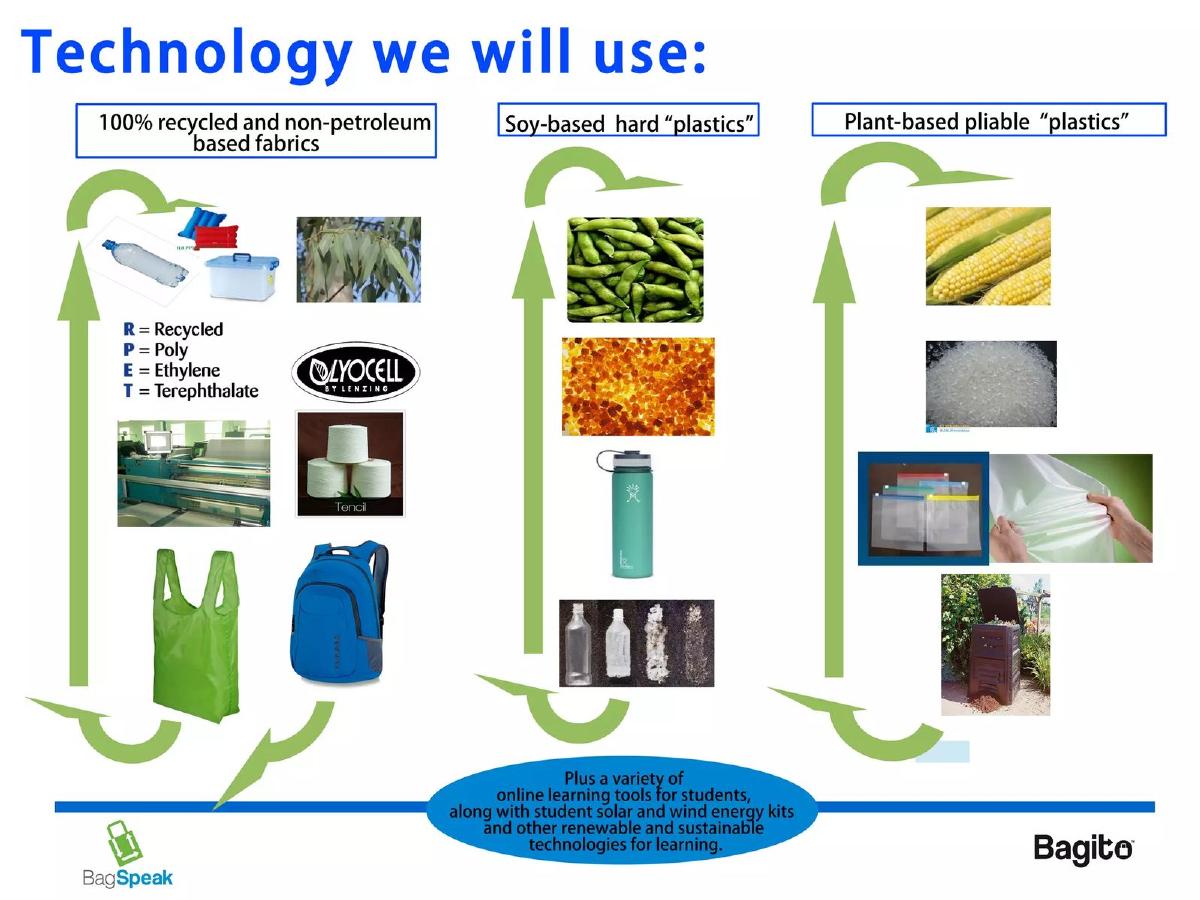
Slide 4 focuses on the supply chain and material science. It categorizes the "Technology we will use" into three buckets: 100% recycled and non-petroleum based fabrics (using RPET and Lyocell/Tencel), soy-based hard plastics, and plant-based pliable plastics. Visual aids show the lifecycle of these materials, from raw inputs like corn and soybeans to finished products like water bottles and storage bags. The slide also mentions "online learning tools" and "student solar and wind energy kits" as part of their educational technology offering.
Slide 5: Marketing and Outreach
The marketing strategy is split between the two entities. For Bagito , the focus is on digital (Google AdWords), print ads, event sponsorships (e.g., City of Mountain View), and trade shows. For BagSpeak , the strategy relies on an outreach coordinator, word-of-mouth, and collaborations with local governments and waste haulers. The slide lists current projects in Monterey, Santa Clara, and Contra Costa counties, indicating a strong regional focus in Northern California.
Slide 6: Competitive Landscape
Slide 6 provides a direct comparison between Bagito and three major competitors: ChicoBag, EnviroSax, and Flip and Tumble. The organization differentiates itself on four main points: Price ($3.50 vs. $6.00-$39.00), Size (micro-stuffable for key rings), Material (100% recycled fiber and breathable fabric), and Purpose (non-profit vs. for-profit). A green oval at the bottom argues that there is significant room for growth because fewer than five non-profit organizations in the US offer similar K-12 environmental literacy programs.
Slide 7: The Team
The team slide leads with Founder and Director Mitch Barlas, ME.D. , highlighting his 20+ years as a school principal and environmental educator. The Board of Directors includes professionals from real estate (Merlone/Geier), environmental studies (UCSC), and healthcare. Additionally, a "Science Advisory Panel" is listed, featuring representatives from the Seymour Long Marine Discovery Center, Stanford University, and NOAA. The slide mentions the support of "15 awesome interns."
Slide 8: Financials and The Ask
This slide presents a table of historical data (Year 1) and projections (Years 3 and 5). Revenue is projected to grow from $45,781 to $565,000 over five years. Impact metrics are also tracked: the number of students reached is projected to grow from 5,100 to 60,000. The slide contains the specific fundraising goal: $65,000 by September 2013 . It notes that capital is needed to increase staff, fund development projects, and increase inventory to meet the demands of a "major national retailer."
Slide 9: Sustainability Commitments
Slide 9 reinforces the organization's internal commitment to sustainability. For Bagito, this includes ethical factory production, carbon offset programs, and a 75% office waste diversion rate. For BagSpeak, it involves empowering students to solve environmental problems and helping schools establish "Zero Waste Lunch" programs. This slide serves as a "walk the talk" proof point for potential social impact investors.
Slide 10: Current Traction (Today)
The final slide lists recent achievements to demonstrate momentum. Key points include reaching over 6,000 students, securing consistent reorder rates from 60 retailers, and receiving recognition from the New York City Council and the California Coastal Commission. Most notably, it mentions an international partnership with the U.S. Department of State in Mauritania, Africa, reaching 700 children in a country that has banned plastic bags.
What Works in This Deck
Clear Hybrid Structure: The founders do an excellent job of explaining how the non-profit and for-profit arms interact. The statement that "100% of net proceeds go to the BagSpeak project" (Slide 1) is a powerful value proposition for both consumers and donors.
Retail Validation: Mentioning established retail partners like Whole Foods and Walgreens (Slide 3) provides immediate credibility. It proves that the product is commercially viable and meets the quality standards of major national chains.
Competitive Pricing: The price comparison on Slide 6 is a strong selling point. By positioning the product at $3.50—significantly lower than the $8.00+ price point of competitors—they demonstrate a clear path to mass-market adoption.
Founder-Market Fit: Mitch Barlas’s background as a school principal (Slide 7) is perfectly aligned with a business that targets K-12 schools. His experience provides the necessary "in" with school districts that a typical entrepreneur might lack.
What Is Missing or Weak
Unit Economics: While the deck provides total revenue projections, it lacks a breakdown of unit economics. There is no information on the cost of goods sold (COGS), shipping costs, or the specific margins on the $3.50 bags. This makes it difficult to assess how much "net proceeds" actually remain to fund the non-profit.
Visual Design: The deck uses a dated aesthetic with stick-figure drawings (Slide 2) and basic clip-art-style graphics. While functional, it lacks the professional polish typically expected in high-stakes fundraising environments.
Scalability Details: The deck mentions needing capital to meet the needs of a "major national retailer" (Slide 8) but does not name the retailer or explain the logistics of scaling production to meet that demand. Moving from 60 local retailers to a national rollout requires significant supply chain infrastructure that isn't detailed here.
Exit Strategy: Because the parent company is a 501(c)(3), there is no traditional "exit" for investors in the form of an acquisition or IPO. The deck does not clarify if the $65,000 is a donation, a low-interest loan, or some other form of social impact investment, which may confuse traditional venture capitalists.
Founder's Guide: What to Copy
The Diversified Revenue Slide: Slide 3 is a model for social enterprises. Showing that you aren't 100% dependent on grants or 100% dependent on sales reduces the perceived risk for both donors and investors. It shows a balanced, resilient financial engine.
The Impact-to-Revenue Table: Slide 8 does a great job of pairing financial growth with social impact growth. By showing "Number of Students Reached" alongside "Revenue," the founders remind the reader that every dollar earned translates directly into a measurable social outcome.
Specific Competitive Critiques: Rather than just saying they are better than competitors, Slide 6 identifies specific product flaws in rival brands, such as "non-breathable fabric (promotes bacteria growth)." This level of specificity shows deep product knowledge and a focus on user health.
Advisory Board Depth: The Science Advisory Panel on Slide 7 is exceptionally strong for a small organization. Including experts from Stanford, NOAA, and UCSC provides a "halo effect" of scientific authority that is crucial for an environmental mission.
Frequently asked questions
- What is the relationship between Bag Speak and Bagito?
- According to Slide 1, BagSpeak is the parent company and a registered 501(c)(3) non-profit organization. Bagito is the brand name for the physical products (reusable bags) produced and sold by BagSpeak. The deck specifies that 100% of the net proceeds from Bagito sales are used to fund the BagSpeak educational project, which focuses on K-12 environmental literacy.
- How does Bagito differentiate its product from competitors?
- Slide 6 outlines several key differentiators. Bagito bags are priced at $3.50, which is lower than competitors like ChicoBag, EnviroSax, and Flip and Tumble. The product is described as 'micro-stuffable' and capable of attaching to a key ring. Material-wise, it uses 100% recycled plastic fiber and features a 'breathable' double-stitched design to prevent bacteria growth, a specific critique leveled at competitors.
- What are the primary revenue drivers for the organization?
- The organization relies on a three-pillar income model shown on Slide 3. Product sales through Bagito account for 50% of income. Corporate sponsorships from entities like Waste Management Inc. and Whole Foods contribute 25%. The final 25% comes from public and private grants and donations. This hybrid approach is designed to make the non-profit arm more self-sustaining than traditional charity models.
- What is the specific 'Ask' in this pitch deck?
- Slide 8 explicitly states a fundraising goal of $65,000. This capital is intended for 'program and business expansion' and was scheduled to begin in May 2013. The deck notes that while no startup capital was needed at the time of the presentation, expansion capital is 'critical' to meet the demand from schools and retailers.
- Who is the target audience for the BagSpeak educational program?
- The primary target is K-12 students across the US and abroad. Slide 8 shows growth projections for this segment, aiming to move from 5,100 students reached in Year 1 to 60,000 students by Year 5. The program also targets teachers and school districts, with a goal of partnering with 480 schools by the fifth year of operation.