Checkstep’s deck is a concise, product-centric presentation that leans heavily into the regulatory 'stick' and the operational 'carrot.' By highlighting specific legislation like the Online Safety Bill and the Digital Service Act, the company positions itself as a necessary compliance layer for any platform hosting user-generated content. The deck claims significant efficiency gains, including flagging 80% of breaching content before it is seen and doubling moderation efficiency. However, the deck is notably incomplete by traditional standards: it lacks a team slide, a formal financial ask, a…
Key takeaways
- The deck identifies a specific regulatory tailwind, citing the Online Safety Bill and Digital Service Act as primary market drivers (Slide 3).
- Checkstep claims their AI flags 80% of breaching content before it is ever seen by a user (Slide 4).
- The platform promises a 2x reduction in moderation costs through its 'Human In The Loop' design (Slide 4).
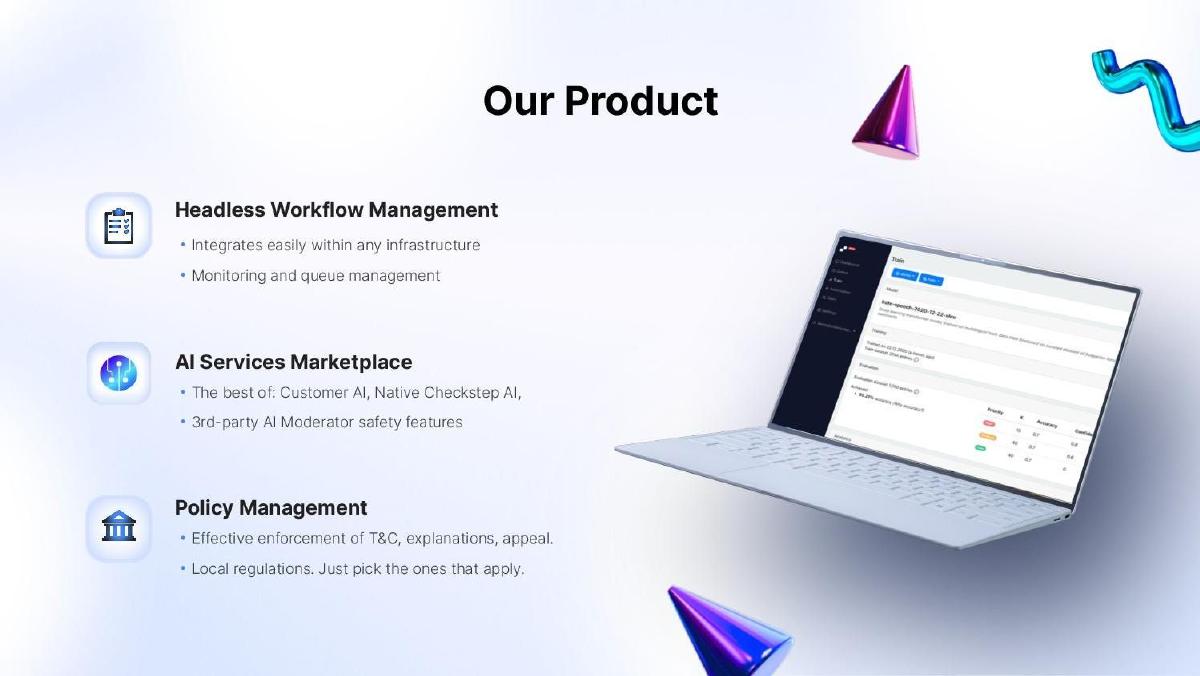
- The product architecture is described as 'Headless Workflow Management,' allowing for integration into existing infrastructure (Slide 5).
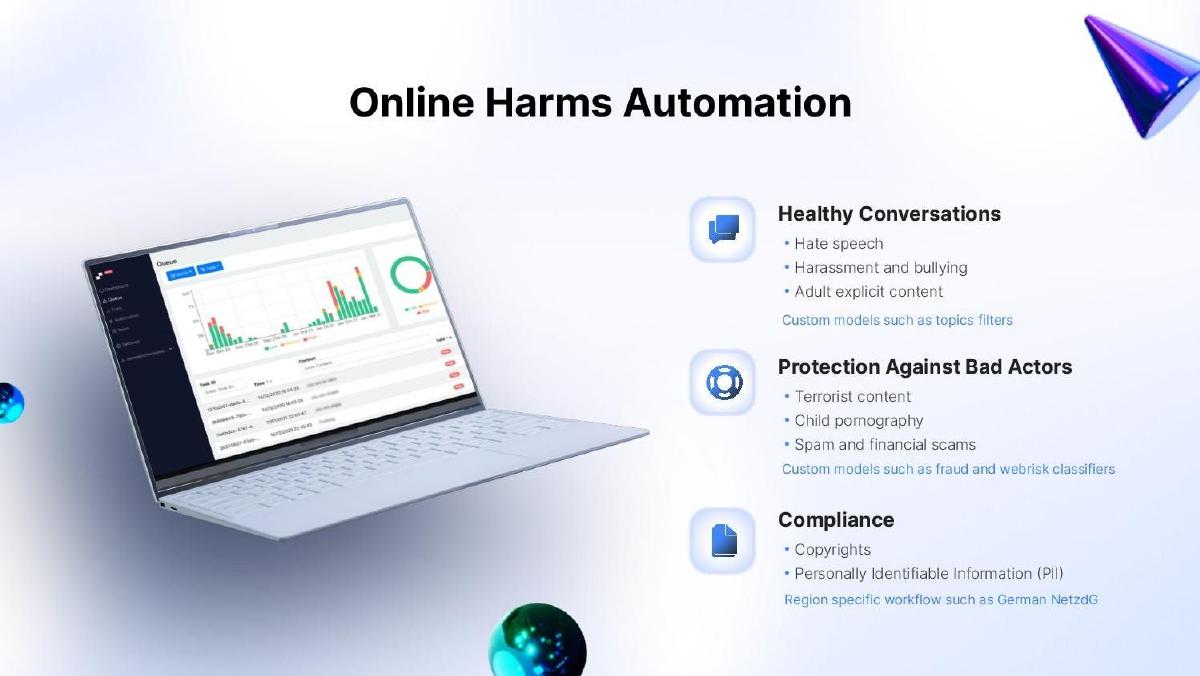
- The deck lists specific categories of 'Online Harms' it automates, including terrorist content, child pornography, and financial scams (Slide 6).
- Customer proof points are presented as anonymized case studies, such as a Global Streaming Platform with 2M uploads per month (Slide 7).
- The deck completely omits a team slide, failing to highlight the founders' expertise in AI or safety.
- There is no 'Ask' slide or financial projection, suggesting this may be a teaser deck or part of a larger presentation (Slide 7).
The 7-Slide Compliance Play: Checkstep's Seed Deck
Checkstep, a London-based AI startup, raised $5M in 2024 to tackle the growing crisis of content moderation. Their pitch deck is a masterclass in brevity, focusing almost exclusively on the problem-solution fit within a highly regulated environment. While most decks aim for 12-15 slides, Checkstep manages to convey a complex technical product in just seven. This teardown examines how they used regulatory pressure and operational efficiency to secure their Seed funding.
Slide 1: Title and Vision
The cover slide is minimalist, featuring the Checkstep logo and the tagline "GROWING HEALTHY ONLINE COMMUNITIES." It includes the company URL and a date of May 2022. The branding is clean, using 3D geometric shapes that suggest a modern, tech-forward aesthetic. It sets a professional tone without over-promising on the cover.
Slide 2: The Value of User-Generated Content
Slide 2 establishes the market context with the headline "User-generated Content is Gold." It frames the opportunity around the idea that "User content drives revenue." However, it immediately introduces the friction point: the "Need for a unified platform to structure, manage, and monetize user-generated content." By starting with the value of the content rather than the 'evil' of the content, Checkstep aligns itself with the business goals of its potential clients (social platforms and forums).
Slide 3: The Cost of Mismanagement
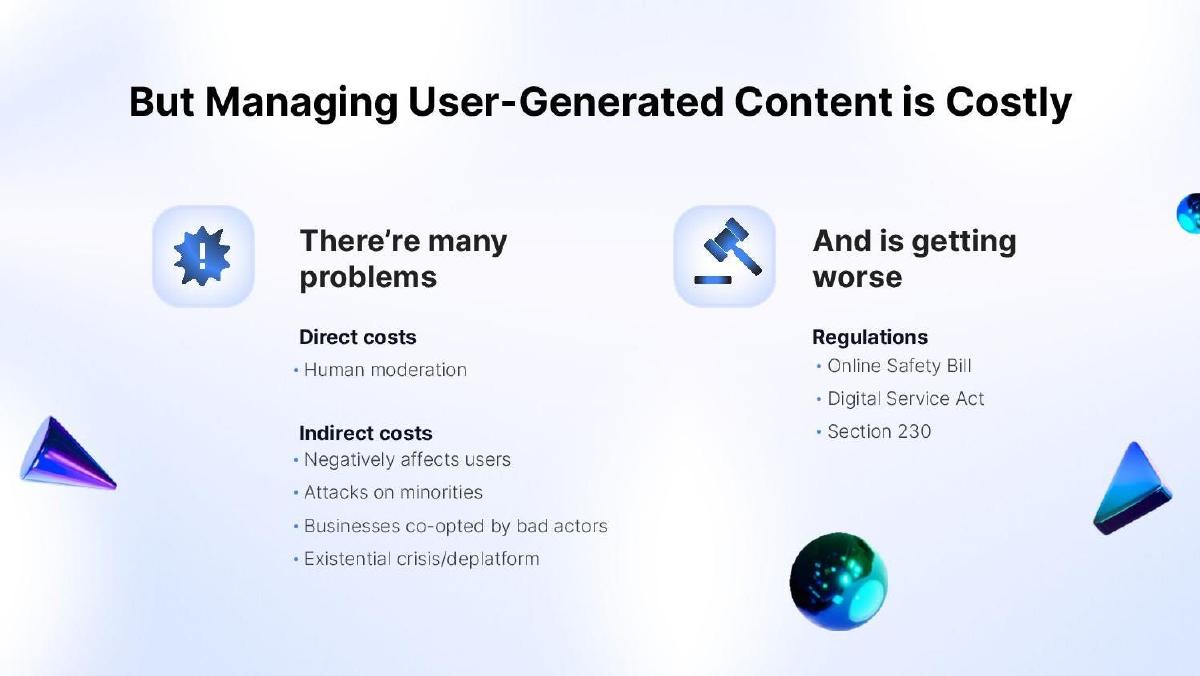
This is the 'Problem' slide, titled "But Managing User-Generated Content is Costly." It breaks the problem into three distinct categories:
Direct costs: Specifically human moderation. · Indirect costs: Negative user impact, attacks on minorities, and the 'existential crisis' of being deplatformed. · Regulatory pressure: This is the most critical section, citing the Online Safety Bill, Digital Service Act, and Section 230.
By citing specific laws, Checkstep moves the product from a 'nice-to-have' to a 'must-have' for legal compliance.
Slide 4: The AI-First Solution
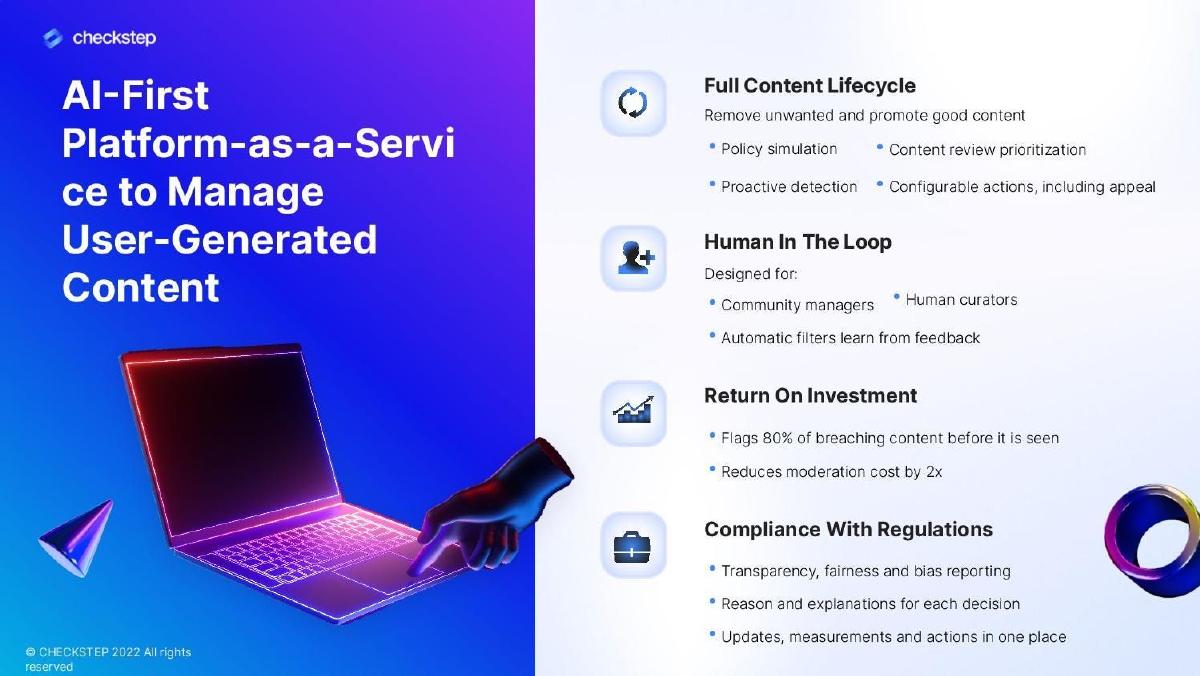
Slide 4 introduces the product as an "AI-First Platform-as-a-Service to Manage User-Generated Content." This slide is the meat of the deck, offering four key value pillars:
Full Content Lifecycle: Policy simulation and proactive detection. · Human In The Loop: Tools for community managers where filters learn from human feedback. · Return On Investment: The slide claims the system "Flags 80% of breaching content before it is seen" and "Reduces moderation cost by 2x." · Compliance: Transparency, fairness, and bias reporting.
The inclusion of the "2x" cost reduction is a powerful hook for Seed-stage investors looking for clear unit economic improvements.
Slide 5: Product Architecture
Titled "Our Product," this slide gets into the technical implementation. It highlights "Headless Workflow Management," suggesting that Checkstep can be integrated into any existing infrastructure via API rather than requiring a total platform overhaul. It also mentions an "AI Services Marketplace," which allows customers to mix native Checkstep AI with 3rd-party safety features. This modularity is a strong selling point for enterprise clients who may already have some legacy tools in place.
Slide 6: Online Harms Automation
Slide 6 provides a granular look at what the AI actually does. It categorizes 'harms' into:
Healthy Conversations: Hate speech, harassment, and adult content. · Protection Against Bad Actors: Terrorist content, child pornography, and scams. · Compliance: Copyrights and PII (Personally Identifiable Information).
It also reiterates the regulatory angle by mentioning the "German NetzDG" workflow. This slide serves as a checklist for a Head of Trust & Safety, proving the tool covers the full spectrum of modern moderation needs.
Slide 7: Social Proof and Case Studies
The final slide, "They Trust Checkstep," uses five anonymized case studies to demonstrate market traction:
Large UK Forum: Focus on T&C enforcement. · Global Streaming Platform: Handling 2M video uploads per month across 10 policy breaches. · Classified Ad Website: Filtering inappropriate ads for an expat community. · Large European Forum: 2M active users, filtering hate speech. · Wellbeing Platform: 10K members in a large Asian country.
While the names are hidden, the scale (2M uploads/users) provides the necessary evidence that the technology can handle high-volume enterprise traffic.
What Checkstep Does Exceptionally Well
Checkstep excels at quantifying the value proposition. Many AI startups speak in vague terms about 'better algorithms.' Checkstep gives investors two hard numbers to latch onto: 80% proactive detection and a 2x reduction in cost (Slide 4). These metrics turn a technical product into a financial instrument for potential customers.
Furthermore, the regulatory alignment is perfectly timed. By listing the Online Safety Bill and Digital Service Act (Slide 3), they are not just selling a tool; they are selling 'insurance' against massive government fines. For investors, a product tied to mandatory compliance is often more attractive than a discretionary marketing tool.
What is Missing from the Checkstep Deck
The most glaring omission is a Team Slide. In a Seed round, investors are primarily betting on the founders' ability to execute. There is no mention of the founders' backgrounds, their previous exits, or their specific expertise in machine learning or trust and safety. This is highly unusual for a successful $5M raise and suggests that this deck might have been a follow-up to a more personal introductory meeting.
Additionally, there is no 'Ask' or 'Use of Funds' slide. We don't know how much they were seeking (though we know the outcome was $5M) or what they planned to do with the capital—whether that was hiring more engineers, expanding into the US market, or building out the AI marketplace mentioned on Slide 5.
Finally, the deck lacks a Competitive Landscape. The content moderation space is crowded, with players like Hive, ActiveFence, and Spectrum Labs. Checkstep does not explain why their 'headless' approach or 'marketplace' model is superior to these established competitors.
Founder's Playbook: What to Copy
Founders should emulate Checkstep’s modular product breakdown. Slide 5 and Slide 6 do a great job of explaining a complex AI backend by breaking it into 'Headless Workflow,' 'Marketplace,' and 'Policy Management.' This makes the product feel like a tangible suite of tools rather than a 'black box' algorithm.
Another takeaway is the use of anonymized but specific traction. If you cannot name your clients due to NDAs, follow Checkstep’s lead on Slide 7: provide the industry, the region, and a specific scale metric (e.g., "2M active users"). This builds credibility without breaching confidentiality. Lastly, if your industry is facing new regulations, put the names of those laws in bold. It creates a sense of urgency that helps close rounds faster.
Frequently asked questions
- How much did Checkstep raise with this deck?
- According to publisher reports from Business Insider, Checkstep raised $5M in a Seed round in 2024. The deck itself does not state the amount raised or the valuation.
- What specific regulations does Checkstep help companies comply with?
- Slide 3 explicitly mentions the Online Safety Bill, the Digital Service Act, and Section 230. Slide 6 also notes region-specific workflows, specifically citing the German NetzDG law.
- Does Checkstep replace human moderators entirely?
- No. Slide 4 highlights a 'Human In The Loop' approach, stating the platform is designed for community managers and human curators, using automatic filters that learn from their feedback.
- What are the primary ROI metrics claimed in the deck?
- On Slide 4, the company claims to reduce moderation costs by 2x and proactively flag 80% of breaching content before it is viewed by the public.
- Is there a competitive analysis in the Checkstep deck?
- No. The 7-slide deck does not include a competitor matrix or a 'Why Us' slide comparing Checkstep to other AI moderation tools like Bespoke or Unitary.