ChattingCat’s 14-slide deck from 2012 is a masterclass in minimalist storytelling, focusing heavily on the friction of 'broken English' in professional settings. The company positions itself as a real-time correction service, bridging the gap between non-native speakers and native-level fluency. The deck is light on technical architecture but heavy on traction, showcasing a 20% month-over-month growth rate and a network of over 700 native speakers. By the time the deck was produced, the startup had already reached $100,000 in Annual Recurring Revenue (ARR) and served over 2,800 unique paying…
Key takeaways
- The startup addresses a massive market where 70% of business communication is conducted in English (Slide 6).
- ChattingCat claims that 95% of English speakers globally are non-native, creating a large potential user base (Slide 7).
- The platform boasts a network of 700+ native speakers to handle correction requests (Slide 9).
- Operational efficiency is highlighted by a 3-minute average response time for corrections (Slide 9).
- The company achieved a 5x increase in correction requests over a 12-month period (Slide 10).
- Traction is evidenced by 2,800+ unique paying customers at the time of the pitch (Slide 11).
- Financial performance shows 20% Month-over-Month growth and a $100K ARR (Slide 12).
- The founding team includes alumni from Kellogg, IBM, Line, KakaoTalk, and HP (Slide 13).
Introduction: The Human-in-the-Loop Correction Engine
ChattingCat emerged in 2012 with a specific mission: to provide real-time, human-powered English corrections for the global workforce. In an era before LLMs like ChatGPT made instant grammar correction a commodity, ChattingCat relied on a crowdsourced network of native speakers to provide nuance that automated tools of the time often missed. This teardown examines their 14-slide pitch deck, which leans heavily on market size and early revenue traction.
Slides 1-3: Defining the Friction
Slide 1 is a standard title slide featuring the company logo—a red cat head—and the name of the Founder & CEO, April Kim. The background is a blurred dictionary entry for 'English,' immediately setting the thematic stage.
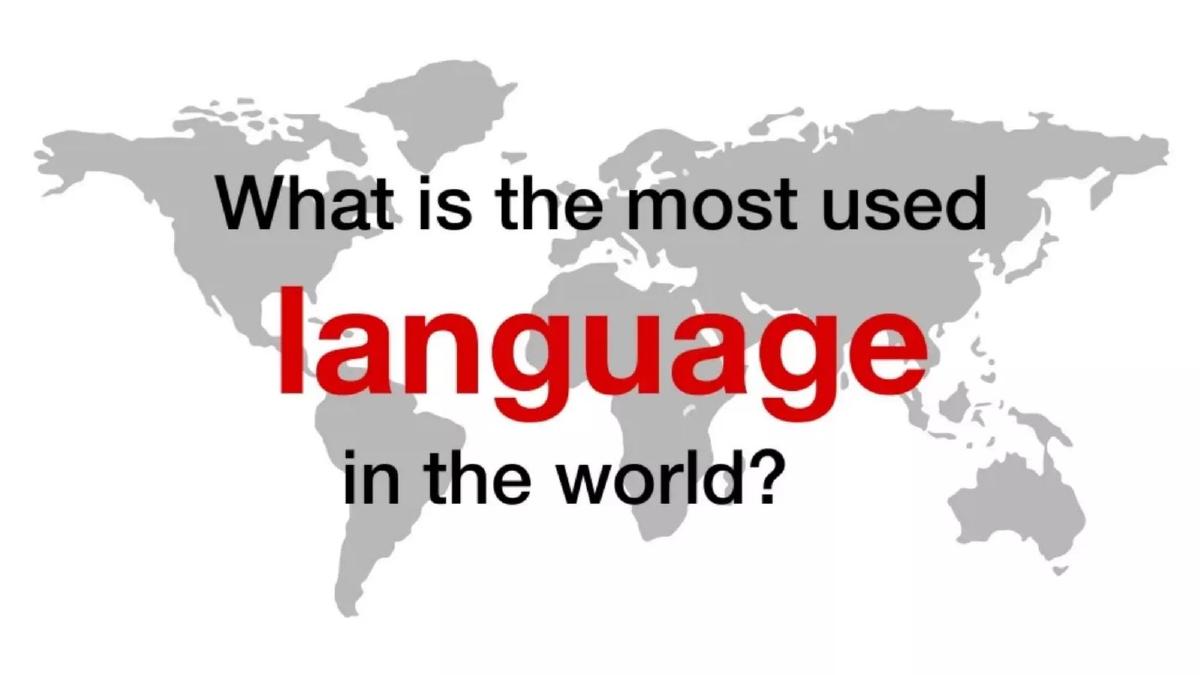
Slide 2 asks a rhetorical question: 'What is the most used language in the world?' overlaid on a world map. This is a classic 'Problem' slide setup, designed to lead the investor toward the scale of the opportunity.
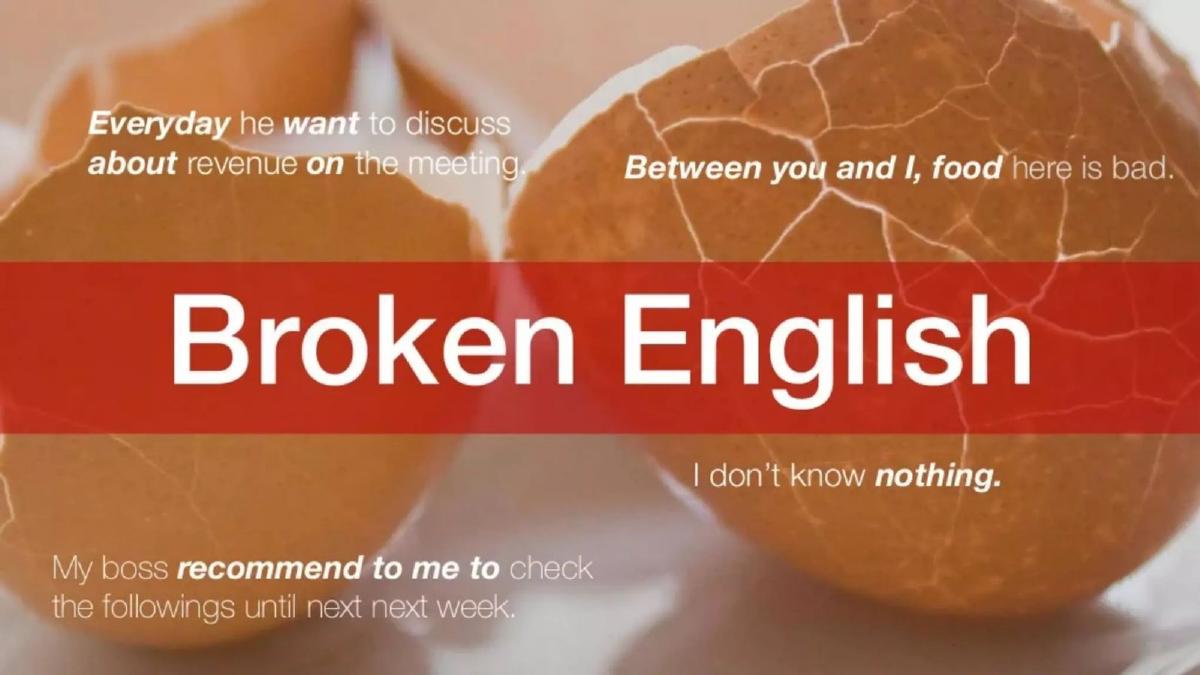
Slide 3 introduces the concept of 'Broken English.' It uses an image of a cracked eggshell as a metaphor for fractured communication. The slide lists four examples of common errors: 'Everyday he want to discuss about revenue on the meeting,' 'Between you and I, food here is bad,' 'I don't know nothing,' and 'My boss recommend to me to check the followings until next next week.' By showing these specific examples, the deck grounds the abstract problem in relatable, everyday professional frustrations.
Slides 4-5: The Product Demonstration
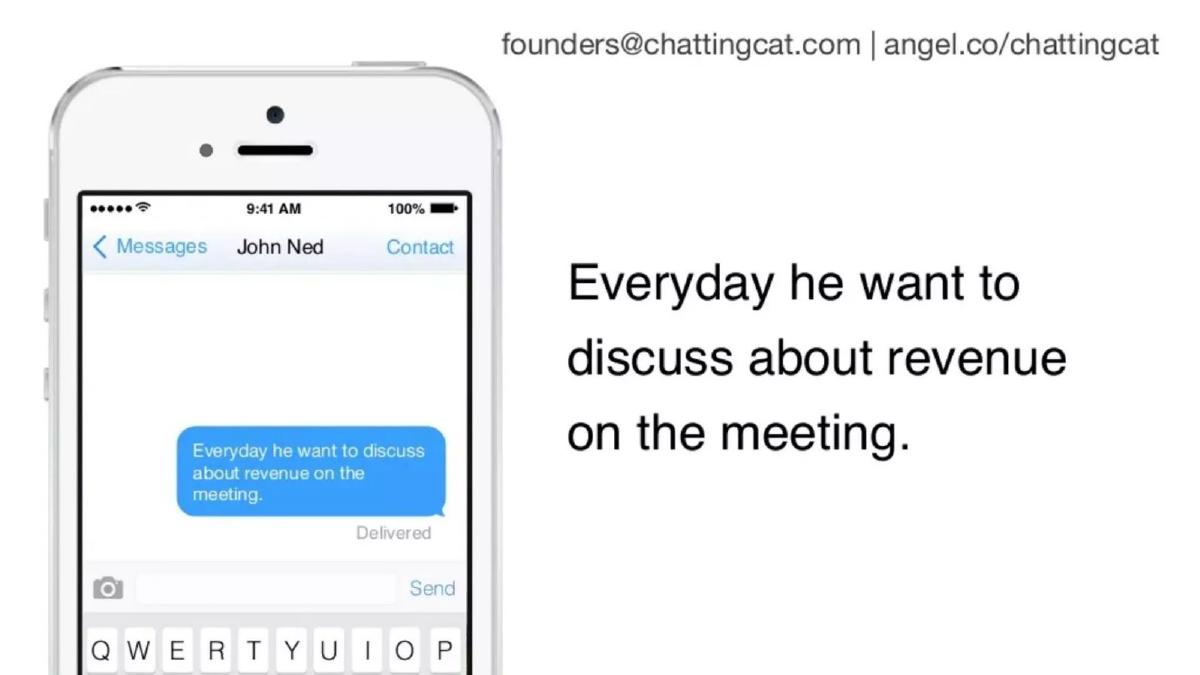
Slide 4 shows a mobile interface (an iPhone 4/5 era mockup) with a message sent to 'John Ned.' The message contains the error: 'Everyday he want to discuss about revenue on the meeting.' The slide includes contact info for the founders and an AngelList link in the header, which persists through much of the deck.
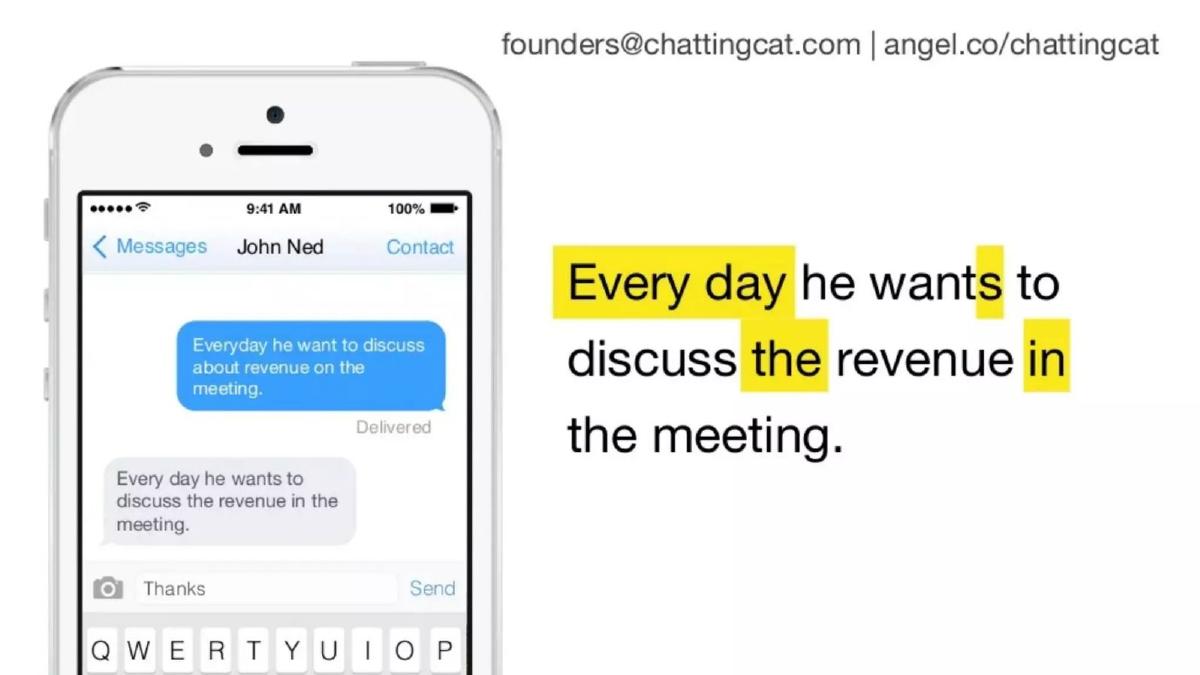
Slide 5 provides the 'After' state. The message is corrected to: 'Every day he wants to discuss the revenue in the meeting.' The corrections are highlighted in yellow, demonstrating that the service isn't just a silent editor but a tool for learning. This 'Before and After' sequence is an effective way to show product value without needing a live demo.
Slides 6-7: Market Opportunity and Scale
Slide 6 presents a significant market stat: '70% Business Communication in English.' This slide uses a stock photo of diverse professionals, reinforcing that this is a B2B or 'Prosumer' play rather than just a casual student tool.
Slide 7 follows up with a staggering figure: '95% Non-Native English Speakers.' The background is a grid of diverse faces, suggesting a global user base. By combining these two slides, the founders argue that the vast majority of people conducting business in the world's primary business language are doing so in their second or third language, creating a massive addressable market for a correction service.
Slides 8-9: The Solution and Operational Speed
Slide 8 officially introduces the brand promise: 'ChattingCat turns broken English into native English.' It shows the product across desktop and mobile devices, emphasizing accessibility 'anytime and anywhere,' as noted in the company's self-description. The UI appears clean, focusing on the text input and the corrected output.
Slide 9 addresses the 'How' and the 'How Fast.' It claims a network of '700+ Native Speakers' and a '3min Response Time.' For a human-in-the-loop service, a three-minute turnaround is the critical metric. It moves the service from 'asynchronous tutoring' to 'near-real-time utility.' The use of an hourglass graphic reinforces the focus on speed.
Slides 10-12: Traction and Revenue
Slide 10 shows a bar chart representing 'Correction Requests.' While the Y-axis doesn't have every month labeled, it shows a clear upward trend from July to the following July, noting a '5x' increase in volume. The peak of the chart reaches approximately 12,000 requests per month.
Slide 11 highlights customer acquisition: '2800+ Unique Paying Customers.' This is a vital slide because it proves that users are willing to pay for the service, moving the conversation from 'cool utility' to 'viable business.'
Slide 12 is the 'Money Slide.' It features a line graph showing monthly revenue growth. The deck claims '20% MoM over 12 months' and an 'ARR $100K.' The graph shows revenue starting near $1,000 and ending above $8,000 per month. This level of growth and transparency regarding revenue is usually very attractive to seed-stage investors.
Slides 13-14: Team and Closing
Slide 13 introduces the leadership. April Kim (CEO) is backed by Kellogg and IBM. Taeuk Han (CTO) brings technical pedigree from Line and KakaoTalk—two of the largest messaging apps in Asia, which is highly relevant for a text-based service. John Neeley (COO) rounds out the team with experience from Michigan Ross and HP. The team appears balanced between business strategy and technical execution.
Slide 14 is the closing slide, repeating the tagline: 'ChattingCat turns broken English into native English,' and providing contact information for the CEO.
What Works in This Deck
Clarity of Purpose: The deck never wanders. From the first slide to the last, it is about one thing: fixing broken English. The 'Before and After' slides (4 and 5) are particularly effective at showing exactly what the customer gets for their money.
Operational Proof: For a service that relies on humans, the '700+ speakers' and '3-minute response time' metrics are essential. They prove the company has solved the supply-side problem of the marketplace, which is often the hardest part of a human-in-the-loop startup.
Traction Transparency: Many early-stage decks hide behind 'cumulative users' or 'percentage growth' without base numbers. ChattingCat explicitly states their ARR ($100K) and their unique paying customer count (2,800+). This builds immediate trust with an analyst.
What is Missing
The Ask: This is the most glaring omission. There is no slide stating how much money the company is looking to raise, what the valuation expectations are, or what the milestones for the next 18 months look like. An investor finishes the deck knowing the company is doing well but not knowing what the company wants from them.
Unit Economics: While we see revenue and customer counts, we don't see the margins. How much of that $100K ARR goes to the 700+ native speakers? Without understanding the payout structure, it's impossible to know if the business scales profitably or if it's a 'dollars for quarters' situation.
Competitive Landscape: In 2012, tools like Grammarly were already gaining traction, and traditional tutoring services were moving online. The deck doesn't explain why a human-in-the-loop model is superior to the emerging algorithmic corrections of the time.
What a Founder Should Copy
The 'Before and After' Slide: If your product improves a state (makes something faster, cleaner, or more accurate), show the change visually. Slides 4 and 5 are the most memorable parts of this deck because they provide a tangible example of the value proposition.
Consistent Branding: The red cat logo and the red/white/black color palette are used consistently throughout. It makes the deck feel professional and cohesive, even though the layout is quite simple.
Growth Benchmarking: Using a '5x' callout on a traction chart (Slide 10) is a great way to give context to a graph. It tells the investor exactly what the takeaway should be so they don't have to do the math themselves.
Conclusion
ChattingCat’s deck is a strong example of a 'Traction-First' pitch. By 2012 standards, reaching $100K ARR with a small team and a clear growth trajectory was a significant achievement. While the deck lacks the financial depth required for a Series A, it serves as an excellent Seed or Bridge round document that focuses on product-market fit and the ability to execute on a complex operational model.
Frequently asked questions
- What is the core problem ChattingCat is solving?
- ChattingCat targets the professional and social friction caused by 'broken English.' Slide 3 illustrates this with common grammatical errors like 'I don't know nothing.' The deck argues that since 70% of business communication is in English and 95% of speakers are non-native, there is a critical need for instant, native-level corrections to ensure professional credibility.
- How does the product actually work according to the deck?
- The deck shows a mobile and web interface (Slide 8) where users submit text. A network of over 700 native speakers (Slide 9) provides corrections. Slides 4 and 5 demonstrate a 'before and after' scenario in a messaging app, showing how a clunky sentence is transformed into natural English with highlighted changes for the user to learn from.
- What are the key growth metrics mentioned?
- The startup highlights three main traction points: a 5x growth in correction requests over one year (Slide 10), a base of over 2,800 unique paying customers (Slide 11), and a financial milestone of $100,000 ARR with consistent 20% month-over-month growth (Slide 12).
- Who is behind ChattingCat?
- The team consists of April Kim (CEO), an alumna of Kellogg and IBM; Taeuk Han (CTO), who has experience at major messaging platforms Line and KakaoTalk; and John Neeley (COO), who brings experience from HP and the Michigan Ross School of Business (Slide 13).
- What is missing from this pitch deck?
- The deck is notably missing a 'The Ask' slide, meaning it does not specify how much money is being raised or the terms of the round. It also lacks a competitor analysis, a detailed marketing strategy, and specific unit economics like Customer Acquisition Cost (CAC) or Lifetime Value (LTV).