Charta Health's 12-slide seed deck is a study in efficiency, mirroring the product it sells. By targeting the $85 billion annual cost of manual medical chart reviews, the company presents a clear 'pure upside' value proposition. The deck highlights that while 100% of providers review charts, less than 2% are actually reviewed due to costs reaching $275 per chart. Charta uses LLMs to perform pre-bill reviews, claiming an average revenue increase of 11% and a 70% reduction in claim denials. The strength of this raise, which secured $8.1M from top-tier investors like Bain Capital Ventures and SV…
Key takeaways
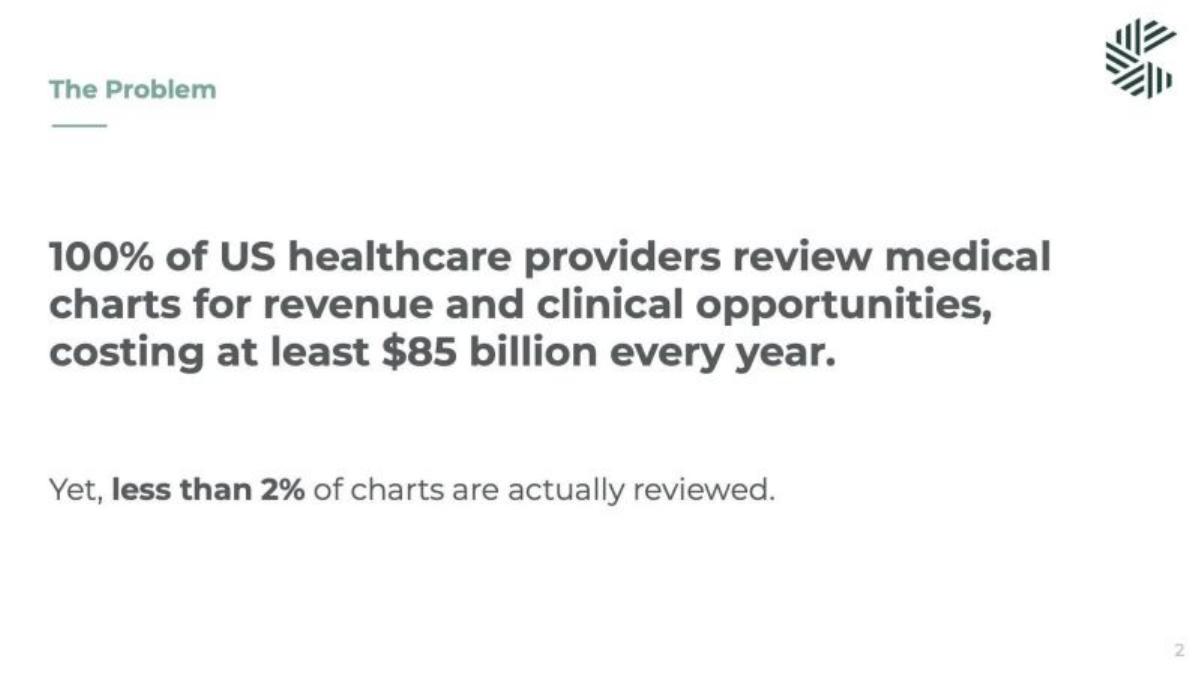
- The problem is quantified as an $85 billion annual cost for US healthcare providers, yet less than 2% of charts are currently reviewed (Slide 2).
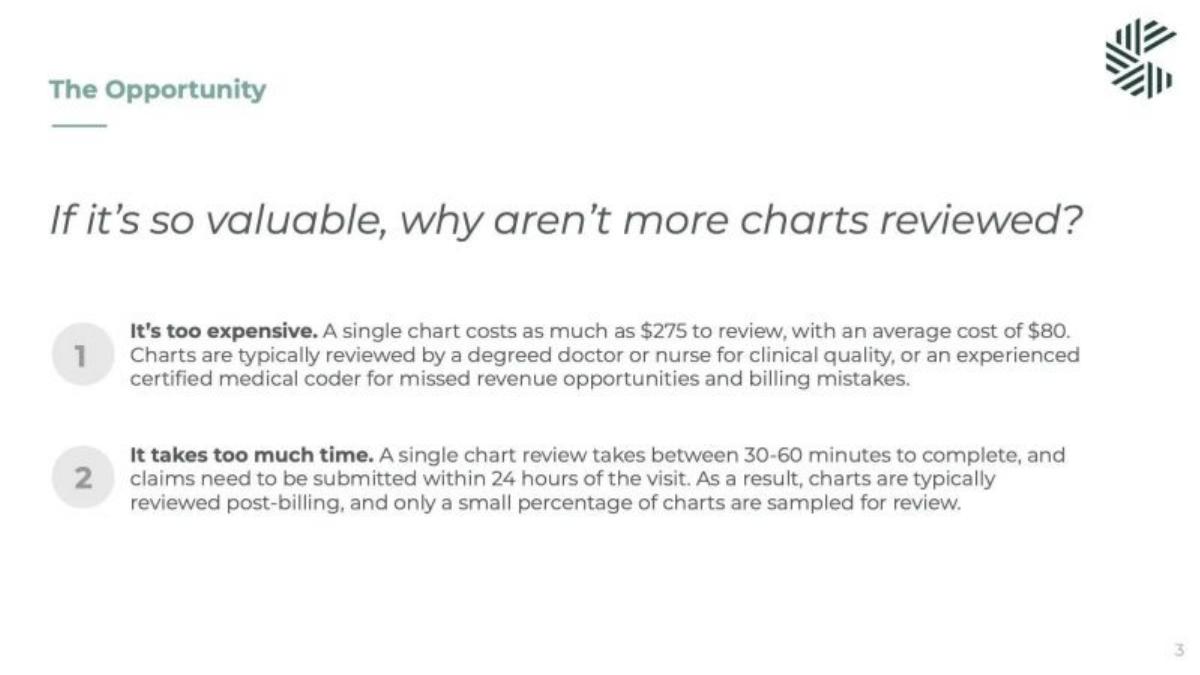
- Manual chart review is prohibitively expensive, costing an average of $80 and up to $275 per single chart (Slide 3).
- The solution leverages Large Language Models (LLMs) to perform fully autonomous pre-bill reviews of every chart (Slide 4).
- Charta claims to increase provider revenue by an average of 11% through missed coding discovery (Slide 6).
- The platform identifies and prevents over 70% of insurance denials before they occur (Slide 6).
- The company reports a 100% close rate from proof-of-concept (POC) to signed contract (Slide 7).
- Case studies show specific outcomes, including a $1.1M annual revenue capture for a primary care provider with 100+ facilities (Slide 8).
- The leadership team includes the founding engineer of Rockset and the former CMO of Carbon Health (Slide 9).
The Lean Approach to Healthcare Fintech
Charta Health’s pitch deck is a masterclass in brevity. In just 12 slides, the company secured $8.1M in seed funding from some of the most prestigious names in venture capital. The deck doesn't rely on complex diagrams or futuristic visions; instead, it focuses on a massive, expensive inefficiency in the US healthcare system and offers a direct, AI-powered solution to fix it. By framing their product as a 'pure upside' tool, Charta removes the friction typically associated with healthcare enterprise sales.
Slide 1: Title Slide
The deck opens with a clean, professional title slide featuring the company logo and the tagline: "Intelligent Revenue Capture with AI Chart Review." The imagery is a soft-focus lifestyle shot of a healthcare professional, signaling a focus on the human element of the industry despite the technical nature of the product. The branding is minimalist, using a muted green palette that suggests stability and growth.
Slide 2: The Problem
Slide 2 identifies a staggering inefficiency. It states that "100% of US healthcare providers review medical charts for revenue and clinical opportunities," a process that costs "at least $85 billion every year." The 'hook' is the final line: "Yet, less than 2% of charts are actually reviewed." This creates an immediate gap between what providers want to do (review all charts) and what they can afford to do, setting the stage for an automated solution.
Slide 3: The Opportunity
This slide digs into the 'why' behind the problem. It lists two primary barriers: cost and time. According to Slide 3, a single chart review can cost as much as "$275 to review, with an average cost of $80." Furthermore, the process takes "30-60 minutes to complete," which is incompatible with the 24-hour window required for claim submissions. This slide effectively argues that the current manual process is fundamentally unscalable.
Slide 4: The Solution
The solution is presented in a single, bold sentence: "Charta leverages LLMs to perform a fully autonomous pre-bill review of every chart for revenue and clinical opportunities." By specifying 'pre-bill,' Charta positions itself at the most critical point in the revenue cycle—before the money is lost or the claim is denied. The mention of LLMs (Large Language Models) anchors the company in the current AI wave without over-explaining the tech.
Slide 5: Product Demo
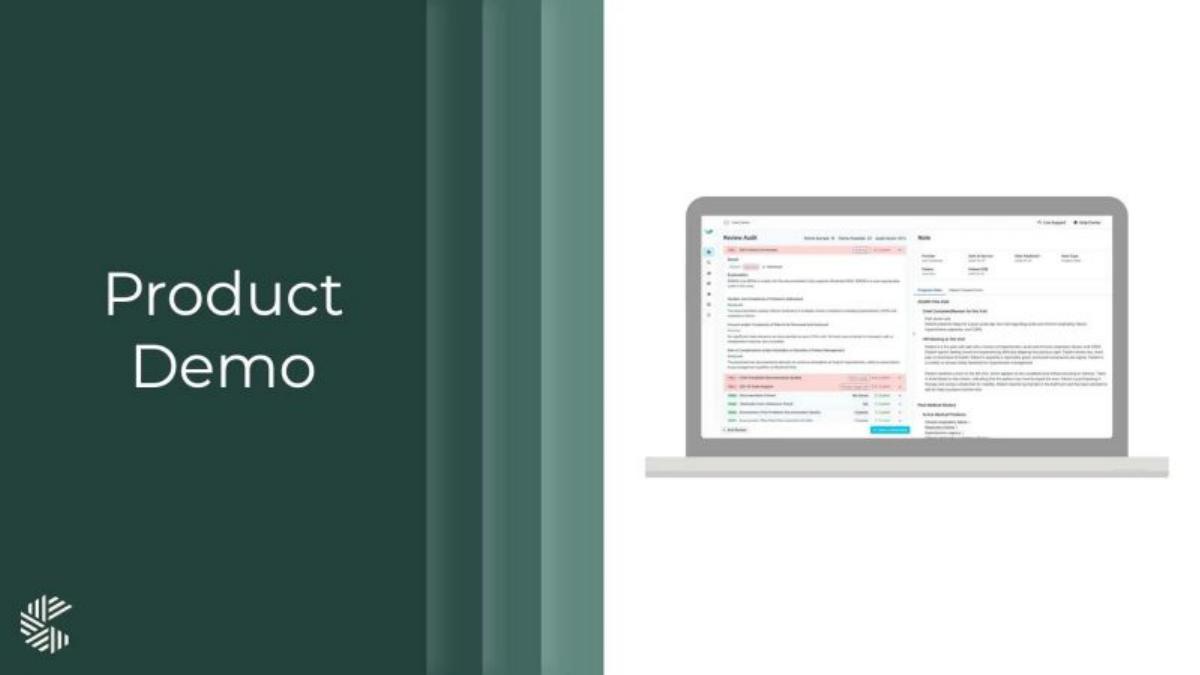
Slide 5 is a placeholder for a product demo, showing a laptop mockup with a dense, data-rich interface. The UI appears to show a 'Review Audit' screen with color-coded alerts (red and green) and a detailed 'Note' section. This suggests a high level of transparency, allowing human users to see exactly why the AI flagged a specific chart or code.
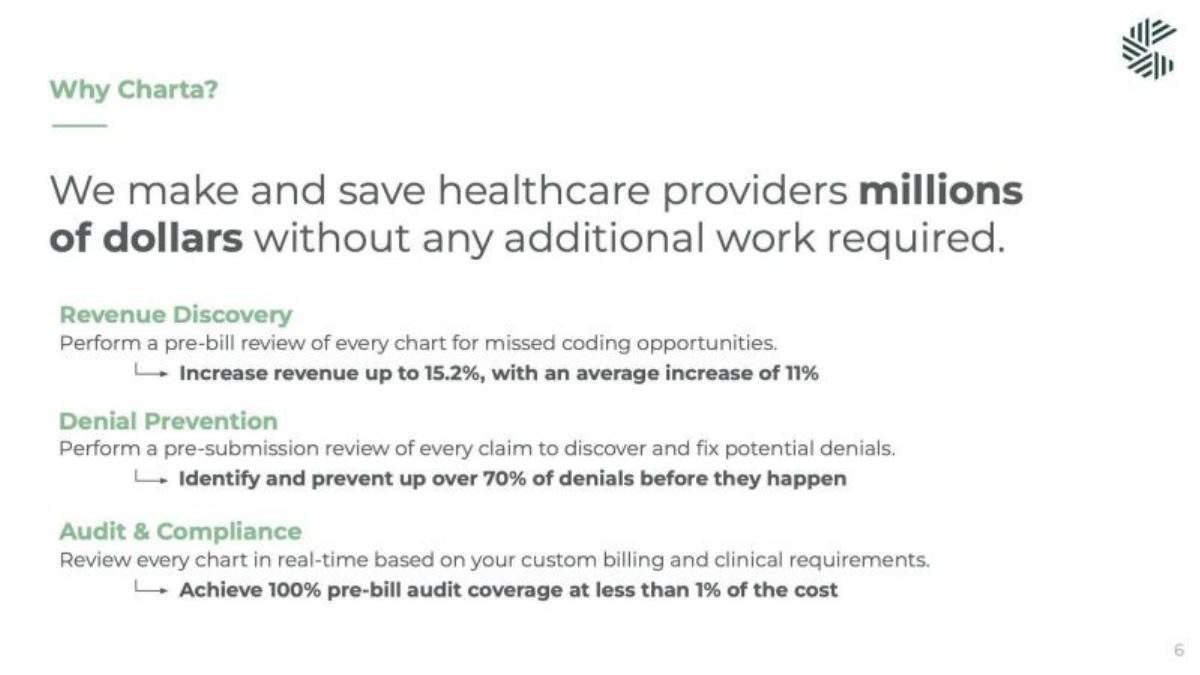
Slide 6: Why Charta?
This is the 'Value Proposition' slide, and it is the strongest in the deck. It breaks down the benefits into three categories:
Revenue Discovery: Increase revenue up to 15.2% , with an average increase of 11% . · Denial Prevention: Identify and prevent over 70% of denials before they happen. · Audit & Compliance: Achieve 100% pre-bill audit coverage at less than 1% of the cost.
These are hard, quantifiable numbers that appeal directly to the CFO of a healthcare system.
Slide 7: Insights and Sales Momentum
Slide 7 addresses the 'Go-To-Market' strategy by highlighting their early success. The headline claims a "100% close rate from proof-of-concept to signed contract." They attribute this to a 'white-glove' design that delivers a POC within days and a positioning strategy as a "pure upside, ROI-guaranteed solution." This slide is designed to de-risk the investment by showing that the market is already biting.
Slide 8: Case Studies
To back up the claims on Slide 6, Slide 8 provides three specific case studies:
A national telehealth provider saw a 12.6% increase in primary care revenue. · A leading national provider with 100+ facilities captured $1.1M in annual revenue . · A remote patient monitoring provider achieved 100% audit coverage at less than 1% cost.
The use of 'National' and 'Leading' as descriptors for these clients suggests that Charta is already playing at the enterprise level.
Slide 9: Leadership Team
The team slide is a heavy hitter. Justin Liu (CEO) and Scott Morris (CTO) both come from Rockset , a data infrastructure company acquired by OpenAI . Liu also has a background at Google, and Morris was a founding engineer at Rockset. They are joined by Dr. Caesar Djavaherian (CMO) , co-founder of Carbon Health , and Tam Pham (VP Healthcare Solutions) , who has three decades of experience at major health plans like SCAN Health Plan and Agilon Health . This mix of high-end AI engineering and deep clinical/insurance expertise is likely what secured the $8.1M round.
Slide 10-12: Closing and Legal
Slide 10 is a simple 'Questions?' slide, Slide 11 is a standard legal disclaimer, and Slide 12 is a promotional slide for the deck source. Notably, there is no 'Ask' slide. In high-demand seed rounds, founders often omit the specific dollar amount and terms from the deck to maintain flexibility in negotiations or because the round is already oversubscribed by the time the deck is widely circulated.
What Makes This Deck Work
The Charta Health deck works because it treats AI as a utility, not a miracle. Instead of promising to 'revolutionize healthcare,' it promises to find the 11% of revenue that providers are already entitled to but are too busy to claim. The focus on 'pre-bill' review is a genius tactical choice; it turns the product into a profit center rather than a cost center. Furthermore, the team slide perfectly balances technical 'builders' (the Rockset/OpenAI connection) with industry 'insiders' (the Carbon Health/Agilon connection), which is the exact profile investors look for in the 'AI for X' category.
What Is Missing
For a seed deck, there are several standard omissions that might have been intentional: 1. TAM/SAM/SOM: There is no slide showing the total addressable market. While the $85B problem is mentioned on Slide 2, a traditional market sizing slide is absent. 2. Competition: The deck does not mention competitors like Fathom or other AI medical coding startups. This suggests the founders believe their 'pre-bill audit' niche is distinct enough to stand alone. 3. The Ask: As mentioned, the lack of an 'Ask' slide is common in rounds led by top-tier firms like Bain Capital Ventures, where the deal terms are often settled before the final deck is polished. 4. Unit Economics: There is no mention of CAC (Customer Acquisition Cost) or LTV (Lifetime Value), though this is expected at the Seed stage where the focus is on early traction and POC-to-contract conversion rates.
Founder's Playbook: What to Copy
1. The 'Pure Upside' Frame: If your product saves money or finds lost revenue, lead with that. Slide 7’s mention of 'ROI-guaranteed' is a powerful way to shorten sales cycles. 2. Pedigree Alignment: If your team has a 'win' (like the Rockset acquisition by OpenAI), put it front and center. It validates that the team can build at scale. 3. Quantified Case Studies: Don't just say you helped a client; say you increased their revenue by 12.6% or saved them $1.1M. Specificity creates credibility. 4. Focus on Friction: Slide 7 explicitly mentions that they don't require 'adoption of new workflows.' In healthcare, where change management is the biggest hurdle, this is a massive selling point. Founders should always highlight how their product fits into existing systems rather than disrupting them.
Frequently asked questions
- What is the primary business model for Charta Health?
- Based on the catalogue listing and slide content, Charta Health operates as a B2B SaaS company. They provide an AI-driven platform that integrates into healthcare provider workflows to perform pre-bill audits. While specific pricing tiers aren't listed, Slide 7 mentions an 'ROI-guaranteed solution,' suggesting a value-based or subscription-based revenue model tied to the millions of dollars they save or capture for providers.
- How does Charta Health justify the use of AI in a sensitive clinical environment?
- Charta positions its AI as a 'pre-bill review' tool rather than a replacement for clinical judgment. Slide 3 notes that manual reviews are often skipped because they take 30-60 minutes per chart. By using LLMs to handle the bulk of the 'audit and compliance' (Slide 6), they achieve 100% coverage at less than 1% of the manual cost, acting as a safety net for human coders.
- Who were the lead investors in this $8.1M Seed round?
- The round was led by Bain Capital Ventures. Other notable participants included SV Angel, South Park Commons, SpringRock Ventures, and Refract Ventures, along with strategic angel investors. This high-profile cap table for a seed round reflects the strength of the founding team's pedigree in AI and healthcare operations.
- What specific metrics does the deck use to prove product-market fit?
- The deck relies heavily on two types of proof: sales velocity and clinical outcomes. Slide 7 highlights a '100% close rate' from POC to contract and the ability to deliver a POC within days. Slide 8 provides hard numbers from case studies, such as a 12.6% increase in primary care revenue and 100% audit coverage for a provider with 2.5M+ annual sessions.
- What is missing from the Charta Health pitch deck?
- The deck is remarkably lean at 12 slides. It lacks a 'Market Size' slide (TAM/SAM/SOM), a 'Competition' slide, and a 'Financial Projections' slide. Most notably, there is no 'Ask' slide detailing how the $8.1M will be spent. This suggests the deck was likely used as a supporting document for a high-momentum round where the founders' reputations preceded the formal presentation.