Change Heroes presents a seed-stage pitch for a fundraising platform that digitizes personal, video-based asks to scale charitable giving. The deck highlights a dual-track business model targeting both nonprofit organizations and Fortune 500 companies for employee engagement. By positioning itself as a white-label solution, the company aims to bridge the gap between profit-seeking investors and impact-focused nonprofits. The presentation relies heavily on social proof through 'Victories'—case studies of successful campaigns—and a clear breakdown of a three-pronged revenue model involving upfr…
Key takeaways
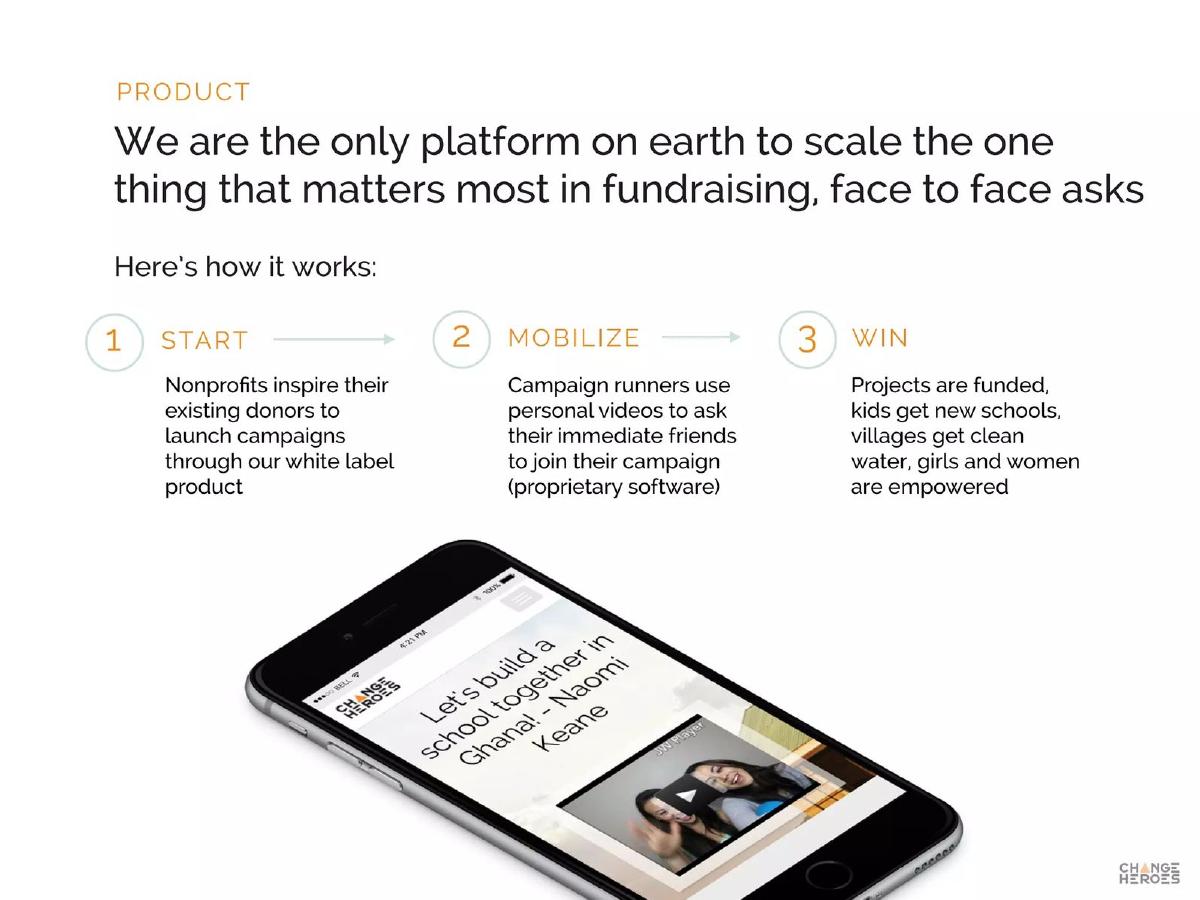
- The platform focuses on scaling 'face to face asks' through personal videos and proprietary software (Slide 2).
- Change Heroes operates as a white-label product for nonprofits to inspire existing donors to launch their own campaigns (Slide 2).
- Campaigns have demonstrated significant traction, such as a Chilean campaign raising $25,000 in 7 days (Slide 3).
- The company targets Fortune 500 companies, listing RBC, Morgan Stanley, and Disney's Club Penguin as current clients (Slide 4).
- Revenue is generated through a $10,000+ upfront charge, a 5-10% cut of donations, and ongoing SaaS fees (Slide 5).
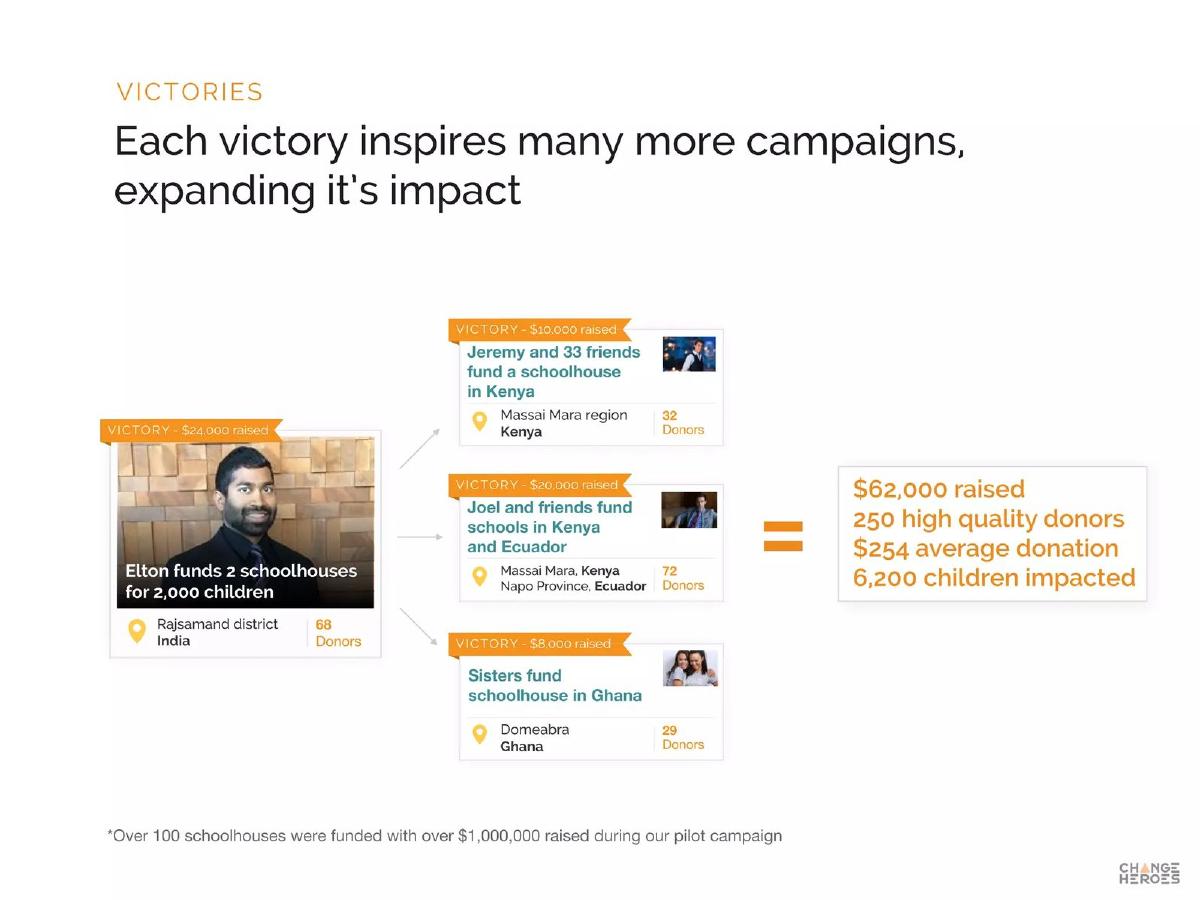
- The platform claims a higher average donation of $254 compared to the industry standard of $60 (Slide 6).
- Approximately 3% of donors convert into campaign runners, raising an average of $5,000+ each (Slide 6).
- The company identifies a $1.3B cause marketing market in the US as of 2012 (Slide 7).
Change Heroes: Scaling the Personal Ask
The Change Heroes seed deck focuses on a specific psychological lever in fundraising: the personal, face-to-face ask. By digitizing this process through video, the company attempts to solve the scalability issues inherent in traditional non-profit outreach. The deck is structured to move from the emotional 'why' and 'how' to the hard metrics of donor value and corporate market size.
Slide 1: Title Slide
The title slide is minimalist, featuring the Change Heroes logo against a solid orange background with the word 'SEED' positioned below the brand name. It establishes a clean, modern visual identity but provides no immediate context regarding the industry or value proposition.
Slide 2: Product and Process
Slide 2 introduces the core product thesis: 'We are the only platform on earth to scale the one thing that matters most in fundraising, face to face asks.' The slide breaks the user journey into three steps: Start (nonprofits inspire donors), Mobilize (campaign runners use personal videos to ask friends), and Win (projects are funded). A mobile mockup shows the interface, emphasizing a 'personal video' approach. The mention of 'proprietary software' and 'white label product' suggests a B2B focus rather than a consumer-facing portal.
Slide 3: Victories and Social Proof
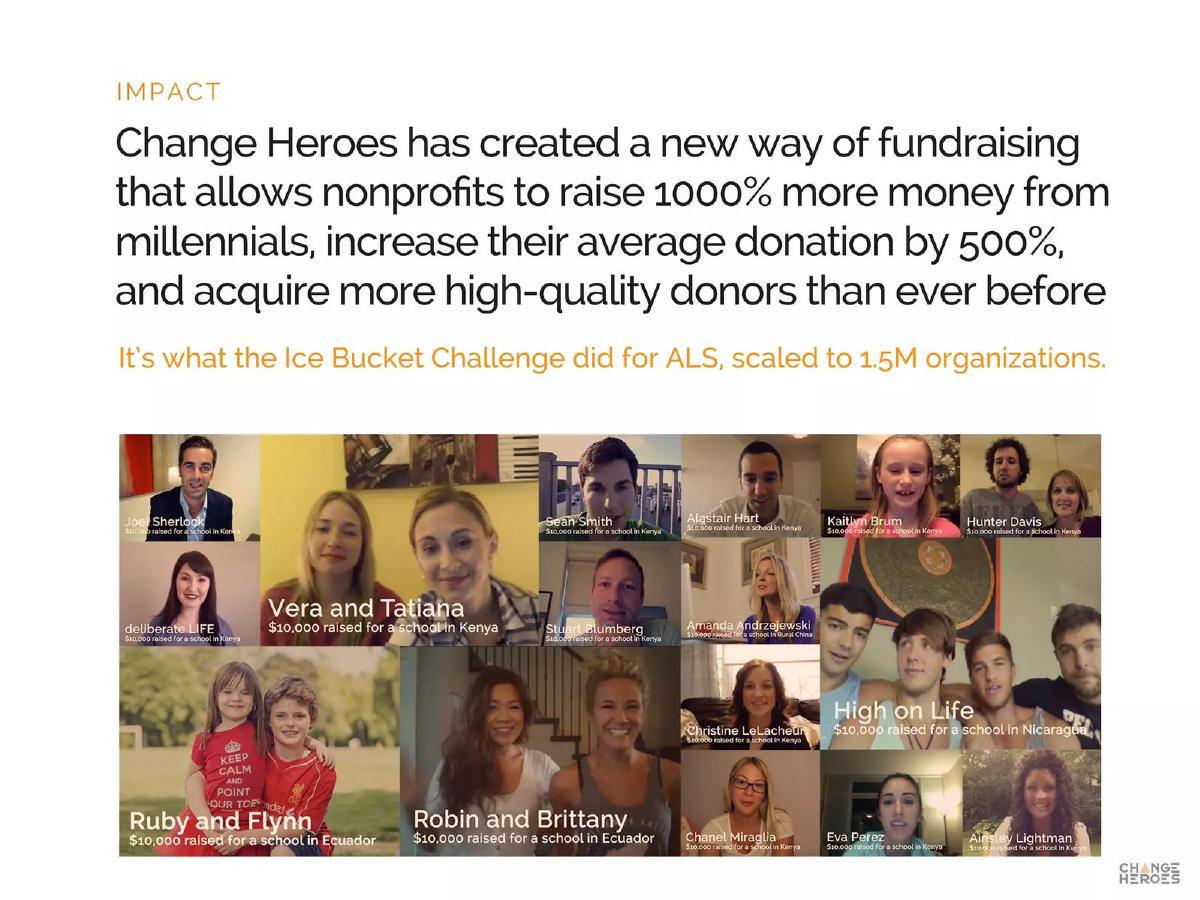
This slide serves as a gallery of case studies. It highlights diverse successes: $11,000 for a schoolhouse in Ecuador, $17,000 for medical kits in Sierra Leone, and $15,000 for sex trafficking survivors. Notably, it includes a celebrity endorsement (Jeffrey Wright) and international reach (Chile and Vietnam). By listing clients like 'Free The Children' and 'Ebola Survival Fund,' the deck establishes immediate credibility through association with established NGOs.
Slide 4: Corporate Campaigns
Change Heroes pivots here to the B2B employee engagement market. The slide claims the platform is an 'engagement tool' for Fortune 500 companies, citing 'millennial expertise' as a differentiator. It lists logos for RBC, Morgan Stanley, Club Penguin, Telus, Wanderlust, and Zanerobe. The three-step process for corporates focuses on 'friendly competition' and 'cause marketing,' positioning the tool as a way for companies to boost their brand image through employee-led giving.
Slide 5: The Revenue Model
Slide 5 provides a transparent look at the company's monetization strategy. Revenue is categorized into three sources: Nonprofits ($10,000+ upfront, 5-10% of donations, SaaS revenue), Companies (identical structure to nonprofits), and Customization Fees . This multi-layered approach suggests the company is not just a payment processor but a software provider with high-touch service capabilities.
Slide 6: Donor Quality Metrics
This is perhaps the most data-dense slide in the deck. It argues that Change Heroes donors are 'higher quality' than average donors. It cites a specific metric: an average donation of $254 compared to a $60 industry average. It also highlights the viral loop of the product, noting that 3% of donors go on to launch their own campaigns, which raise an average of $5,000+. This slide is crucial for justifying the 5-10% transaction fee mentioned previously.
Slide 7: Market Opportunity and Pipeline
Focusing on 'Revenue Corporate,' this slide cites a 2012 statistic that companies spent $1.3B on cause marketing in the US. It positions the platform as a way to access 'found money'—tapping into employee networks rather than just the corporate treasury. The slide also includes a 'Sample of companies in our pipeline,' featuring Lululemon, Goldman Sachs, JetBlue, Life is Good, Kenneth Cole, and Smucker’s. This indicates an active sales effort targeting diverse industries.
Slide 8: The Vision for Profit and Impact
The final slide in this set uses a Venn diagram to show the intersection of 'Profit' and 'Impact.' It explicitly states the goal of providing a 'market rate return to our investors' while addressing social challenges. This is a standard 'social enterprise' pitch designed to reassure traditional VCs that the company is not a non-profit itself, but a scalable, profit-seeking technology firm.
What Works in This Deck
Clear Revenue Streams: Unlike many social impact decks that are vague about monetization, Change Heroes explicitly lists their upfront fees and percentage cuts. · Comparative Metrics: Comparing their $254 average donation to the $60 industry standard provides a clear 'reason to buy' for nonprofit partners. · Viral Loop Identification: Stating that 3% of donors become campaign runners (raising $5k each) shows an understanding of growth mechanics and unit economics. · High-Quality Social Proof: The 'Victories' slide uses real faces, real names, and specific dollar amounts, which builds trust.
What Is Missing
Team Slide: In the provided selection, there is no information about the founders or their technical/non-profit background. At the seed stage, the team is often the most important factor. · The Ask: The deck does not state how much money is being raised, the valuation, or the specific milestones the funding will help achieve. · Competitive Landscape: There is no mention of other peer-to-peer platforms like GoFundMe, Classy, or JustGiving, and how Change Heroes differentiates itself beyond 'video.' · Technology Deep-Dive: While 'proprietary software' is mentioned, there is no detail on what makes their video delivery or tracking unique compared to standard social media tools.
Founder Lessons
Founders should take note of how Change Heroes uses specific case studies to ground their abstract technology. Instead of just saying 'we help people raise money,' they show exactly who raised what for which cause. This makes the product tangible. Additionally, the breakdown of the revenue model on Slide 5 is an excellent example of how to present a multi-faceted business model clearly. Finally, the use of 'Pipeline' logos on Slide 7 is a smart way to show forward momentum, even if those deals haven't closed yet, provided the distinction between 'Current Clients' and 'Pipeline' is kept honest as it is here.
Frequently asked questions
- What is the primary product of Change Heroes?
- Change Heroes is a white-label, video-based peer-to-peer fundraising platform. It allows nonprofits and corporations to mobilize individuals to create personal video appeals to their immediate social circles. The goal is to replicate the effectiveness of face-to-face fundraising at a digital scale, using proprietary software to track results and facilitate donations.
- How does Change Heroes make money?
- The company employs a three-stream revenue model. First, it charges nonprofits and corporations an upfront fee of $10,000 or more. Second, it takes a commission of 5-10% on all donations processed through the platform. Third, it generates recurring SaaS revenue and charges additional fees for customization of the white-label product.
- What evidence of market traction does the deck provide?
- The deck showcases several 'Victories' or case studies, including a $17,000 raise for the Ebola Survival Fund by actor Jeffrey Wright and $11,000 raised by children for a schoolhouse in Ecuador. It also lists high-profile corporate clients like Morgan Stanley and Telus, and a pipeline including Lululemon and Goldman Sachs.
- How does Change Heroes justify its value to nonprofits?
- Beyond just raising money, the platform claims to acquire 'higher quality' donors. According to Slide 6, these donors give an average of $254 (vs. $60 elsewhere), provide rich demographic data via Facebook integration, and have a 3% conversion rate into becoming new campaign organizers themselves.
- What information is missing from this seed deck?
- The provided slides omit a dedicated team slide, which is critical for a seed-stage investment to evaluate founder-market fit. Additionally, there is no explicit 'Ask' slide detailing how much capital is being raised or the intended use of funds, nor is there a detailed competitive landscape analysis.