10KC (Ten Thousand Coffees) raised $56M in 2024 to scale its enterprise talent experience platform. The deck is a masterclass in demonstrating product-market fit through high-tier social proof and technical integration. By highlighting a 96% recommendation rate and specific case studies with firms like PwC, 10KC shifts the narrative from a 'nice-to-have' networking tool to an essential HR infrastructure component. The deck successfully bridges the gap between a diversity-founded mission and the cold requirements of enterprise software, such as HRIS and LMS integrations. While it lacks a tradi…
Key takeaways
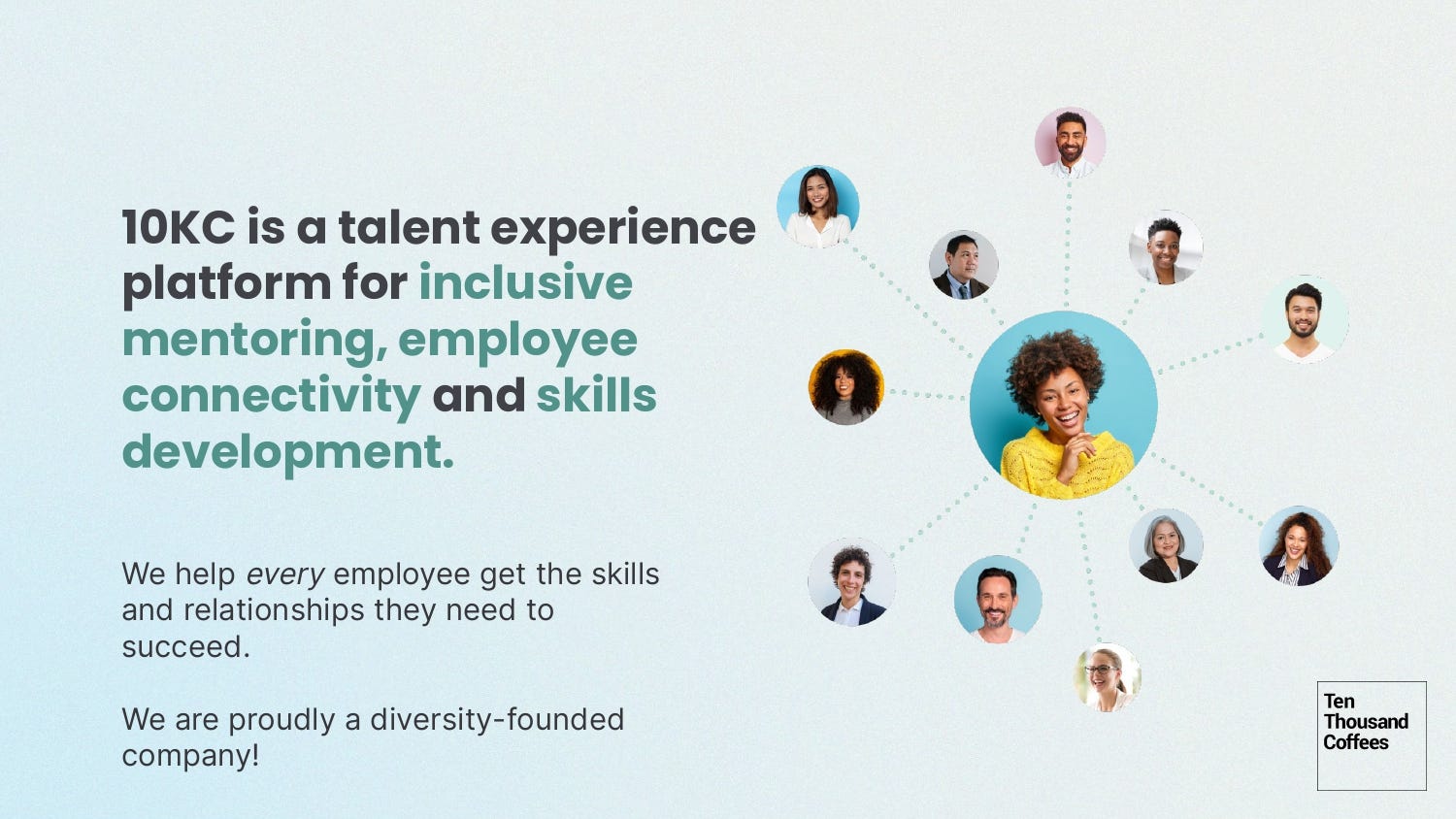
- The company rebranded from Ten Thousand Coffees to 10KC, positioning itself as a 'talent experience platform' rather than just a networking tool (Slide 1).
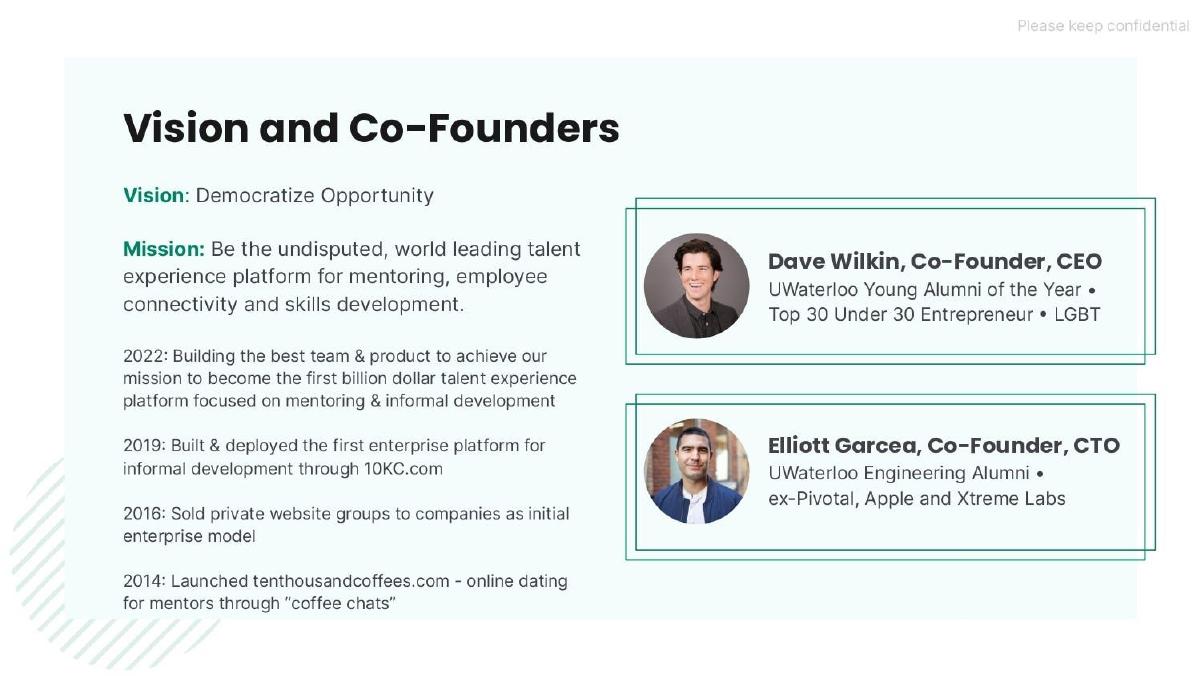
- The founders have a long history with the product, starting as a mentor dating site in 2014 before pivoting to enterprise in 2016 (Slide 2).
- Technical defensibility is demonstrated through deep integrations with HRIS (Workday), LMS, and communication tools like Teams and Slack (Slide 3).
- User engagement metrics are exceptionally high, with a 96% recommendation rate and a 98% quality score for matches (Slide 4).
- The platform achieved significant scale prior to this round, facilitating over 1 million smart matches in 2021 (Slide 4).
- Product functionality is split into three core pillars: Mentoring Programs, Group Matching, and 1:1 Smart Match Networking (Slide 5).
- A dedicated PwC case study shows tangible ROI, including 70% of colleagues identifying cross-team collaboration opportunities (Slide 6).
- The $56M raise is earmarked for global expansion and further product integrations, transitioning the company from 'bootstrapped to global scale-up' (Slide 7).
The 10KC Pitch Deck Analysis
10KC, formerly known as Ten Thousand Coffees, represents a significant evolution in the HR tech space. While many startups in this category struggle to move beyond 'engagement' as a metric, 10KC’s growth deck for their $56M round (as reported by Business Insider) focuses on the structural integration of networking into the enterprise stack. This teardown examines how the company used 14 slides to prove they are no longer a niche tool, but a global scale-up infrastructure.
Slide 1: The Vision Statement
The deck opens with a clear, high-level definition: 10KC is a "talent experience platform for inclusive mentoring, employee connectivity and skills development." By using the term "talent experience platform," they align themselves with a broader, high-budget category of HR software rather than just "mentoring software." The slide also highlights that they are a diversity-founded company, which serves as a thematic bridge to their core product offering of inclusive networking.
Slide 2: Vision and Co-Founders
Slide 2 provides a timeline that is crucial for a growth-stage raise. It shows a decade of persistence: starting in 2014 as a "dating site for mentors," moving to an enterprise model in 2016, and deploying a full enterprise platform by 2019. This history suggests a deep understanding of the problem space. The founder profiles for Dave Wilkin (CEO) and Elliott Garcea (CTO) balance entrepreneurial accolades with hard engineering experience at firms like Apple and Pivotal.
Slide 3: The Ecosystem Integration
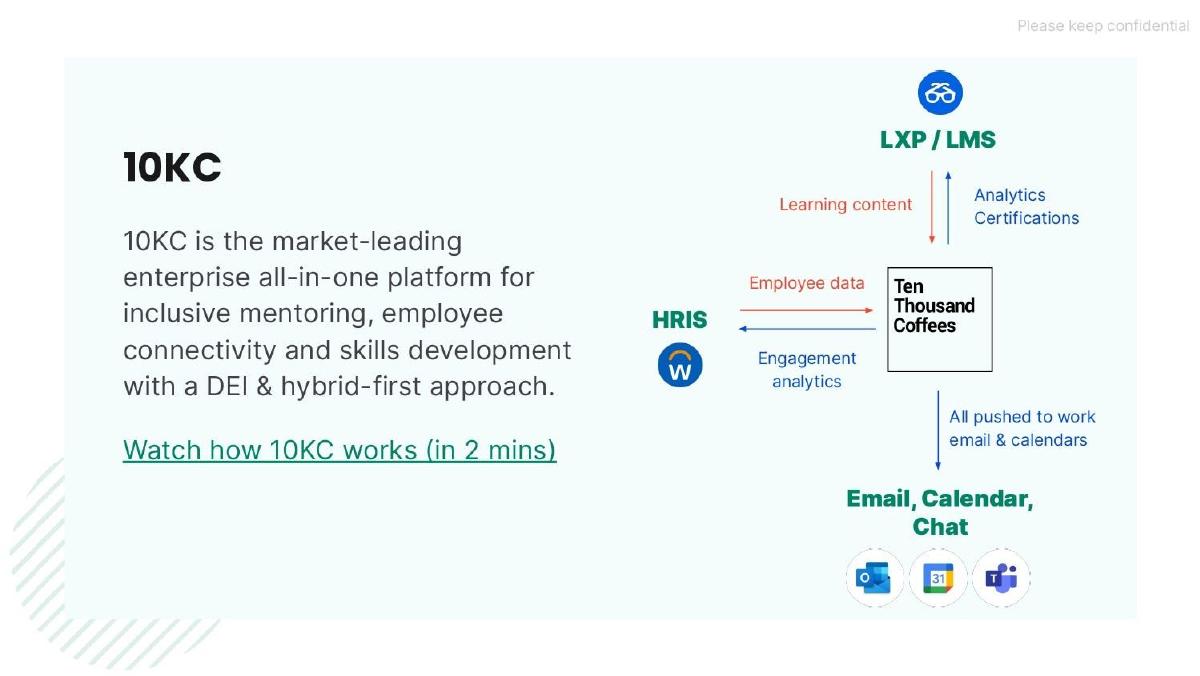
This is perhaps the most important slide for an enterprise SaaS investor. It shows 10KC as the connective tissue between three major silos: HRIS (Workday), LXP/LMS (Learning Management Systems), and the communication layer (Teams, Slack, Outlook). By showing that they push interactions directly to the user's calendar and email, they address the biggest hurdle in HR tech: adoption. If a tool requires a separate login, it dies; 10KC claims to live where the work happens.
Slide 4: Traction and User Sentiment
Slide 4 moves from theory to proof. The metrics are impressive: 96% of users would recommend the platform, and 95% say they made a valuable connection. The "Notes" section at the bottom provides the scale: 200+ paying installs in over 20 countries and 1 million smart matches made in 2021. The 200% year-over-year growth in leader-led group conversations indicates that the platform is successfully engaging senior management, not just entry-level employees.
Slide 5: Product Functionality
The "How it Works" slide breaks the product into three distinct modules: Mentoring Programs, Group Matching, and 1:1 Smart Match Networking. The visual aids show a clean UI that mimics modern social apps but remains professional. This slide clarifies that 10KC isn't just a random matching engine; it supports structured goal-setting and time management within its mentoring tracks.
Slide 6: The PwC Case Study
Dedicated case study slides are a hallmark of successful growth decks. By focusing on PwC, a global leader in professional services, 10KC proves it can handle the complexity of a massive, siloed organization. The results are specific: 99% match quality and 70% of colleagues identifying cross-team collaboration opportunities. The quote from the "Deals People Leader" emphasizes the data-driven nature of the tool, allowing management to see who is—and isn't—connecting.
Slide 7: The Ask and Future Roadmap
The final slide in this set, "Why We’re Raising," outlines five pillars of growth. The mention of transitioning from "bootstrapped to a global scale-up" is a strong signal to investors that the company has already proven its unit economics and is now looking for fuel to accelerate. The placeholder for the $56M USD investment marks the culmination of this narrative: a proven product with blue-chip clients ready to dominate the global market.
What 10KC Does Exceptionally Well
The 10KC deck excels at category positioning . By framing themselves as a "Talent Experience Platform," they move away from the crowded and often lower-priority "wellness" or "perks" budgets and move toward the "talent development" and "retention" budgets, which are typically more resilient. Social proof is another major strength; the inclusion of a detailed PwC case study with specific percentage-based outcomes (Slide 6) provides a level of credibility that generic testimonials cannot match.
Furthermore, the technical architecture slide (Slide 3) is a masterclass in reducing perceived friction. For enterprise buyers, the biggest fear is a long implementation cycle. By showing bi-directional data flow with Workday and Microsoft Teams, 10KC signals that they are a "plug-and-play" solution for the modern hybrid workforce.
What Is Missing from the 10KC Deck
Despite its strengths, the deck has notable omissions common in growth-stage presentations. There is no competitive landscape slide . While their traction suggests they are winning, investors would likely want to see how they differentiate from platforms like Chronus, Guider, or even internal tools built by LinkedIn. Unit economics (CAC, LTV, Payback Period) are also absent from these slides, though these were likely covered in a separate financial model or data room.
The deck also lacks a detailed product roadmap . While they mention "launching additional product integrations," they don't specify which ones or what new features (such as AI-driven matching improvements) are on the horizon. Finally, there is no market sizing (TAM/SAM/SOM) slide, which is usually expected to justify a $56M check size by showing a multi-billion dollar opportunity.
Lessons for Founders
Lead with the 'Where': If you are building enterprise software, show exactly where your product sits in the existing tech stack. Slide 3 is the most valuable slide for proving you won't be ignored by employees. · Quantify the 'Soft' Benefits: Networking and mentoring are often seen as 'soft' benefits. 10KC turns them into 'hard' data by measuring match quality (99%) and cross-team collaboration (70%). · Show the Evolution: If you've been around for a while, don't hide it. 10KC's timeline (Slide 2) shows they have survived pivots and market shifts, which builds investor confidence in the team's resilience. · Use 'Anchor' Clients: One deep-dive case study with a recognizable brand (Slide 6) is worth more than ten slides of logos. It shows you understand the specific pain points of a large-scale buyer. · Mission Matters: 10KC weaves their "diversity-founded" status and "inclusive mentoring" focus throughout the deck without letting it overshadow the business metrics. This aligns the company with current ESG and DEI corporate mandates.
Frequently asked questions
- What is the core value proposition of 10KC?
- 10KC positions itself as a talent experience platform that focuses on inclusive mentoring, employee connectivity, and skills development. According to Slide 1, the goal is to help every employee obtain the skills and relationships needed to succeed, specifically utilizing a DEI and hybrid-first approach to workplace networking.
- How does 10KC integrate with existing enterprise software?
- Slide 3 illustrates a central hub model where 10KC sits between the HRIS (like Workday), the LXP/LMS, and daily communication tools (Email, Calendar, Chat). It pulls employee data and learning content to facilitate matches, then pushes those interactions directly into the employee's existing workflow via Outlook, Google Calendar, or Microsoft Teams.
- What evidence of product-market fit is provided?
- The deck provides heavy quantitative and qualitative proof. Slide 4 notes 200+ paying installs across 20 countries and 1 million smart matches in 2021. Furthermore, Slide 6 features a case study with PwC, reporting a 99% match quality score and that 80% of matches involved a member of an inclusion network.
- Who are the founders and what is their background?
- As shown on Slide 2, the company was co-founded by CEO Dave Wilkin and CTO Elliott Garcea. Wilkin is a 'Top 30 Under 30' entrepreneur, while Garcea brings technical pedigree from previous roles at Apple, Pivotal, and Xtreme Labs. Both are alumni of the University of Waterloo.
- What is the primary use of the $56M investment?
- According to Slide 7, the funds are intended to transition the company from a bootstrapped operation to a 'global scale-up.' Specific goals include global expansion, launching additional product integrations (HRIS/LMS), forming new ESG partnerships, and investing in talent acquisition to attract the 'best and brightest.'