Medal.tv’s Series C deck is a masterclass in brevity, relying on high-level engagement metrics and product demonstrations rather than dense financial modeling. Raising $45M in 2021, the company focused on its ability to 'capture the digital world' through a cross-platform approach spanning PC, mobile, and console. The deck highlights a massive 400% year-over-year growth in daily video captures and an impressive 70+ moments per user per month. While the version analyzed contains several redacted data points regarding retention and DAU/MAU ratios, the narrative remains clear: Medal is building…
Key takeaways
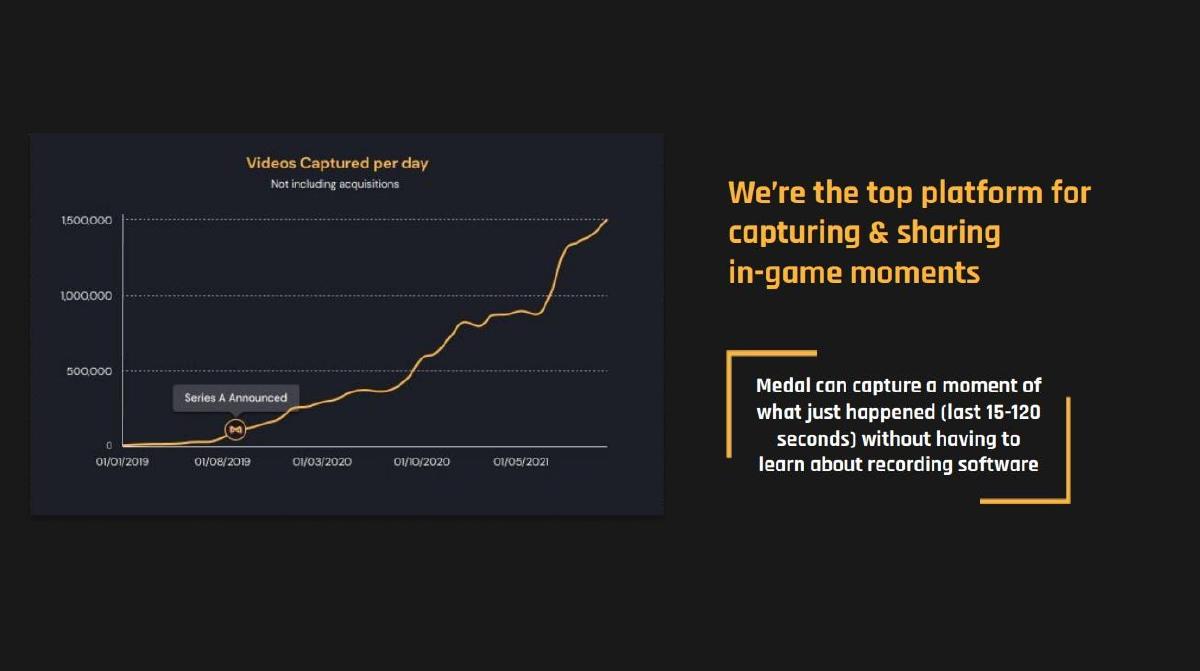
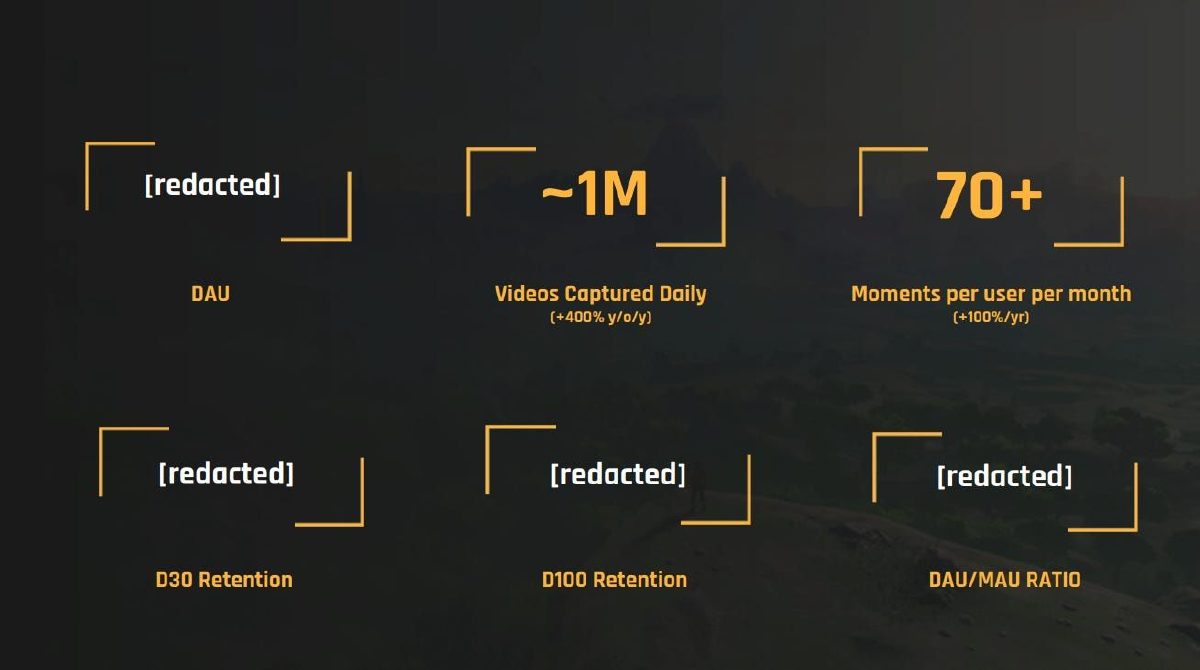
- The deck highlights a significant growth metric of ~1M videos captured daily, representing a 400% year-over-year increase (Slide 3).
- User engagement is exceptionally high, with the platform reporting 70+ 'moments' per user per month, a 100% increase year-over-year (Slide 3).
- Medal.tv positions itself as a cross-platform solution, offering native support for PC and Mobile while supporting consoles via integrations (Slide 2).
- The company utilizes an SDK to support capture across Windows, Mac OS, Android, and iOS, facilitating rapid community growth (Slide 5).
- A 'Product Runthrough' slide indicates the use of video or interactive elements to demonstrate the UI, focusing on the 'Welcome to Medal' experience (Slide 6).
- The deck omits traditional slides such as Team, Competition, Business Model, and the specific Financial Ask, likely due to its late-stage nature (Series C).
- Growth is visualized through a stacked area chart showing moments captured per week by community, with data extending to February 2021 (Slide 5).
- The vision statement focuses on digital identity, claiming that 'Moments are how gamers express identity, connect & create memories' (Slide 4).
The Series C Narrative: Scale Over Mechanics
Medal.tv’s pitch deck for its $45M Series C round in 2021 is a lean, 11-slide presentation that prioritizes momentum and product experience over granular business mechanics. At this stage of fundraising, the 'why' and 'how' are often established; the deck serves to prove that the 'what' is scaling at an uncontrollable rate. The deck leans heavily on the concept of 'Moments'—short-form gameplay clips—as the new currency of social interaction for the gaming generation.
Slide 1: The Multi-Device Ecosystem
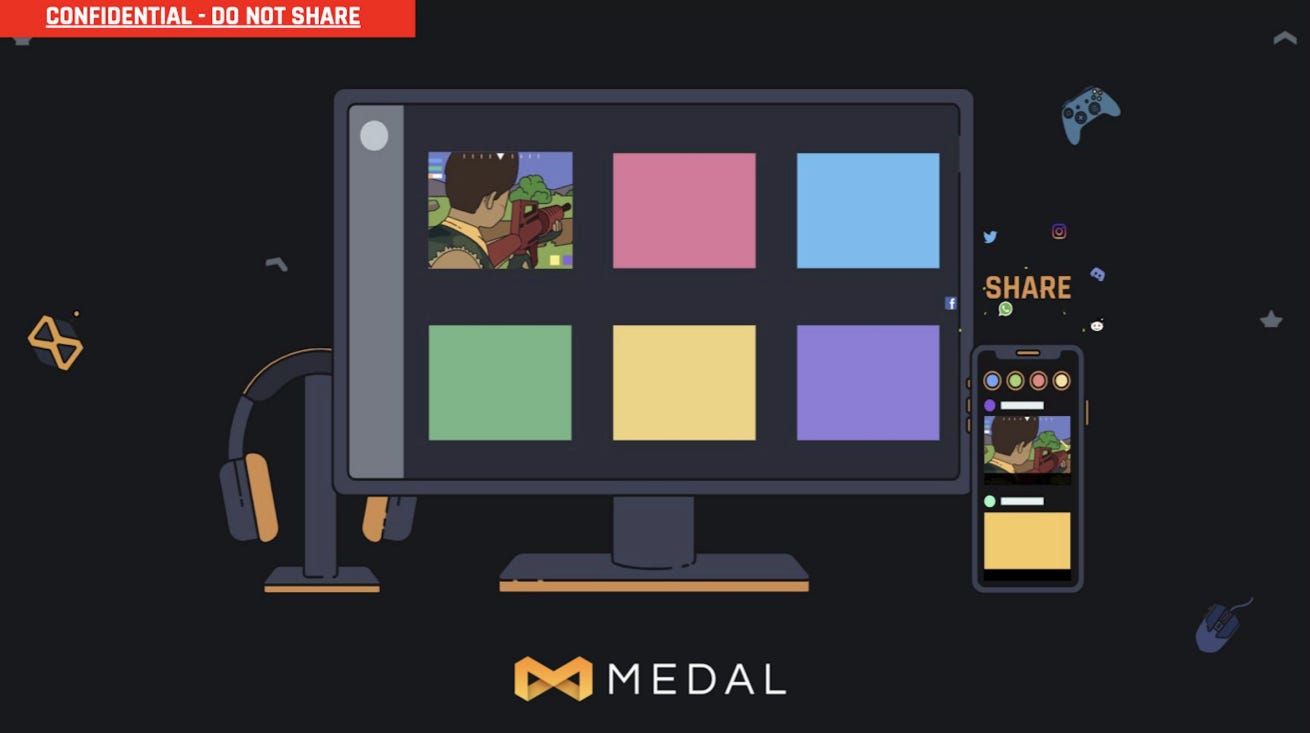
The title slide (Slide 1) sets the stage with a clean illustration of the Medal ecosystem. It features a desktop monitor showing a grid of clips, a smartphone displaying the mobile app, and a headset. Crucially, it includes a 'SHARE' callout with icons for Twitter, Instagram, Discord, WhatsApp, and Reddit. This immediately identifies Medal not just as a storage tool, but as a distribution engine. The 'CONFIDENTIAL - DO NOT SHARE' banner at the top adds a layer of exclusivity common in high-stakes fundraising.
Slide 2: Capturing the Digital World
Slide 2 introduces the company's ambitious vision: 'We will capture the digital world as much, if not more than the real one with Medal.' This is a bold claim that positions the company within the 'Metaverse' or 'Digital Identity' trend that was prevalent in 2021. The slide highlights the technical versatility of the product, stating it is 'Native on PC & Mobile with unmatched performance,' while console support is handled via integrations. The imagery of a Nintendo Switch, PlayStation 5 controller, and Xbox controller reinforces the platform-agnostic nature of the service.
Slide 3: The Engagement Engine
Slide 3 is the 'Money Slide' for growth investors, even with the redactions. It presents six key KPIs. While DAU, D30 Retention, D100 Retention, and the DAU/MAU ratio are marked as '[redacted]', the visible metrics are staggering. The platform reports '~1M Videos Captured Daily,' which is a 400% year-over-year increase. Even more impressive is the engagement depth: '70+ Moments per user per month,' growing at 100% year-over-year. This suggests that the average active user is creating more than two pieces of content every single day, a level of engagement that rivals top-tier social networks like TikTok or Snapchat.
Slide 4: Social Identity and Connection
Slide 4 pivots from hard metrics to the emotional and social utility of the platform. It introduces 'tagging' as a way for gamers to express identity and create memories. The text claims, 'We’re connecting people in a new way, and introducing people who would have never met otherwise.' This is a critical transition for a utility app; by moving from a 'recorder' to a 'connector,' Medal justifies a social media valuation rather than a software utility valuation.
Slide 5: Cross-Platform Growth Visualization
Slide 5 provides a visual representation of growth using a stacked area chart titled 'Moments captured per week by community - Data until Feb 2021.' The chart shows an exponential curve, with specific game icons (like PUBG and Fortnite) indicating which communities are driving the most volume. The slide reiterates the technical moat: 'Medal supports capture across Windows, Mac OS, Android, and iOS via our SDK.' The mention of an SDK (Software Development Kit) is a hint at their B2B strategy, allowing game developers to bake Medal’s functionality directly into their titles.
Slide 6: Product Runthrough
Slide 6 is a placeholder for a 'Product Runthrough.' The visual shows a dark-mode interface with a video player, social feeds, and a list of 'Rising Games.' The caption 'Welcome to Medal' suggests this was likely a video demo or a live walkthrough during the pitch. For a Series C, showing the maturity of the UI/UX is vital to prove that the product can handle mass-market adoption without significant technical debt or design overhauls.
What Medal.tv Does Well
The deck excels at metric-driven storytelling . By highlighting that users create 70+ moments a month, they effectively silence concerns about user churn or lack of utility. If a user creates two clips a day, they are deeply embedded in the ecosystem. Furthermore, the focus on cross-platform ubiquity (Slide 2 and Slide 5) addresses the fragmented nature of gaming. Investors hate platform risk; by proving they work on everything from a Mac to a PS5, Medal positions itself as the universal layer for gaming content.
The visual hierarchy is also strong. The slides are not cluttered with text. They use large, bold headers and clear callouts to ensure that even a distracted investor can grasp the core message: 'We are growing fast, and our users are obsessed.'
What is Missing from the Deck
As an 11-slide deck, there are significant omissions that would typically be found in a standard pitch. There is no Team slide , which is unusual, though in a Series C, the founders are usually well-known to the lead investors. There is also no Competition slide . Medal competes with heavyweights like Twitch (clips feature), YouTube, and built-in tools like Nvidia ShadowPlay or Xbox Game Bar. Omitting this suggests they are positioning themselves as a unique category creator rather than a competitor to existing tools.
Most notably, there is no Business Model or Financials slide . While the publisher reports a $45M raise, the deck doesn't explain how they plan to monetize the 1 million daily videos. Whether through advertising, subscriptions (Medal Premium), or data, the path to revenue is left to the imagination or the data room. Finally, there is no 'The Ask' slide , which is common in decks leaked to the press but would have been present in the original version to specify the round size and use of funds.
Founder's Guide: What to Copy
Founders should emulate the 'Engagement First' approach seen on Slide 3. If you have a metric that shows your users are 'power users' (like the 70+ moments per month), make it the centerpiece of your deck. It is much more convincing than a vague 'total registered users' number.
Additionally, the use of community-specific data (Slide 5) is a great way to show market penetration. Instead of just saying 'we are growing,' showing which specific communities (Fortnite, PUBG) are adopting the tool provides a roadmap for future expansion. It shows you understand your sub-segments and can replicate success across different niches.
Lastly, the bold vision statement on Slide 2 is a good example of how to frame a technical product. Medal isn't just 'screen recording software'; it is 'capturing the digital world.' Founders should always look for the higher-level philosophical impact of their technology to attract visionary investors.
Frequently asked questions
- Why are so many metrics redacted in this deck?
- For late-stage rounds like a Series C, decks shared publicly or via secondary sources often have sensitive competitive data removed. Redacting DAU, retention, and DAU/MAU ratios (Slide 3) protects proprietary growth loops while still showing investors the categories of data the company tracks to prove product-market fit.
- How does Medal.tv differentiate itself from built-in console sharing?
- Slide 2 explicitly mentions that while they are native on PC and Mobile, they support consoles via integrations. Their value proposition lies in being the central hub where all clips—regardless of platform—can be edited, tagged, and shared to external social networks like Twitter, Instagram, and Discord (Slide 1).
- What is the significance of the '70+ moments per user' metric?
- This metric (Slide 3) is a powerful indicator of 'stickiness.' In social media, high frequency of creation usually leads to higher retention. By showing that users create more than two clips per day on average, Medal proves it has moved from a niche tool to a daily habit for its core user base.
- Is there a business model or revenue slide in the deck?
- No. The 11-slide deck focuses entirely on product, vision, and user growth. At the Series C stage, revenue models are often discussed in a separate, more detailed data room or supplemental financial deck, rather than the high-level narrative pitch.
- What role does the SDK play in their growth strategy?
- Slide 5 notes that the SDK allows Medal to support capture across Windows, Mac, Android, and iOS. This suggests a B2B2C growth lever where game developers can integrate Medal's technology directly into their games, making clip sharing a native feature and lowering the friction for user acquisition.