MeCloud is a Vietnamese online video platform whose 14-slide 2015 investor deck contains unusually strong operating traction: 362,762,913 ad displays and 43,976,769 views in August 2015 across thirteen named Vietnamese publishers. The deck buries that evidence on slides 9 and 10, opens with the line 'I help people earn a very high revenue from monetize videos', never states a revenue figure or names a founder, and closes a use-of-funds slide with no amount on it. The business was more investable than the deck presenting it.
Key takeaways
- MeCloud was a Ho Chi Minh City-based hosted video and monetisation platform; its 14-slide investor deck was printed on 8 October 2015 and published in November 2015.
- The deck's strongest slide reports 362,762,913 ad displays, 79,083,680 adtag impressions and 43,976,769 views for August 2015 across thirteen named Vietnamese publisher domains.
- That traction sits on slide 10 of 14, while slide 2 describes the company as 'I help people earn a very high revenue from monetize videos' — an adjective where a number was available.
- No revenue figure appears anywhere in the deck: 79 million monetised adtag impressions are shown with no eCPM, take rate or monthly revenue attached.
- The use-of-funds slide lists 'new hires' and 'sales & marketing' with no amount raised, no round type, no valuation, no runway and no milestones.
- The team slide shows headcount by function with a few first names and no bios, and never identifies a CEO or founder.
- The financial chart names 'Revenue from Netlink (Reseller)' as a separate line, disclosing revenue concentration without ever sizing it.
- The two-page competition matrix shows real domain depth but wins nearly every row, and never argues the geographic moat — local publisher relationships and Vietnamese ad demand — that was the actual defensibility.
What this deck actually is
This is a 14-slide investor pitch deck for MeCloud, a Vietnamese online video platform based at 179 Ly Chinh Thang, District 3, Ho Chi Minh City. The PDF was printed on 8 October 2015 through a Foxit Reader PDF printer and published publicly the following month, which places it squarely in the middle of the 2015 online-video land grab — the year LiveRail was inside Facebook, Brightcove and Ooyala were the enterprise defaults, and every regional market was asking who would own its publisher video stack.
It is not a product brochure and not a credentials deck. It has a market slide, a problem slide, a solution slide, a business model slide, two competition slides, two traction slides, a financial projection, a team slide and a use-of-funds slide. That is the canonical investor sequence, and MeCloud followed it. It is also, unusually for a deck at this stage, backed by real operating numbers: the traction slides carry screenshots of a live analytics dashboard showing over 362 million ad displays and nearly 44 million video views in a single month.
So the interesting question is not whether MeCloud had a business. It clearly did. The interesting question is why a deck with 44 million monthly views ends without ever telling the investor how much money it wants, how much money it makes in a currency the investor uses, or who is running the company.
Slide-by-slide walkthrough
Slide 1 — Cover
"MeCloud Pitch Deck Presentation," with the tagline "The No.1 All-in-one Online Video Platform," a street address in District 3, Ho Chi Minh City, a website, a support email and a mobile number.
Two problems in the first four lines. First, "The No.1 All-in-one Online Video Platform" is an unsupported superlative on the cover of a deck that never defines the category it is number one in. Number one in Vietnam by ad impressions served? By publisher count? The deck later shows numbers that could partially support a Vietnam-specific claim, but the cover claims it globally and unqualified, which trains an investor to discount everything that follows.
Second, the contact block is a support email and a mobile number with no name attached. An investor deck's cover should carry the founder's name and the founder's email. Routing a term-sheet conversation into a support inbox is a small thing that signals the deck was assembled from marketing collateral rather than written for investors.
Slide 2 — What is MeCloud?
One sentence, set in large type: "I help people earn A VERY HIGH REVENUE from monetize videos."
This is the deck's weakest slide, and it is slide two — the position where an investor decides how much attention to pay to the rest. Three separate failures are stacked in nine words. The first person singular ("I help") in a deck that later shows a nine-person team. "A VERY HIGH REVENUE" is a qualitative claim where the deck's own data could have supplied a quantitative one. And the sentence does not say what MeCloud is — a hosted video platform with an integrated ad stack — only what it supposedly does for someone.
The fix is mechanical: "MeCloud is a hosted video platform that lets Vietnamese publishers host, play and monetise video without building an ad stack. Our publishers served 362 million ad impressions in August 2015." Same slide, same position, and it now carries a fact instead of an adjective.
Slide 3 — Market Opportunity
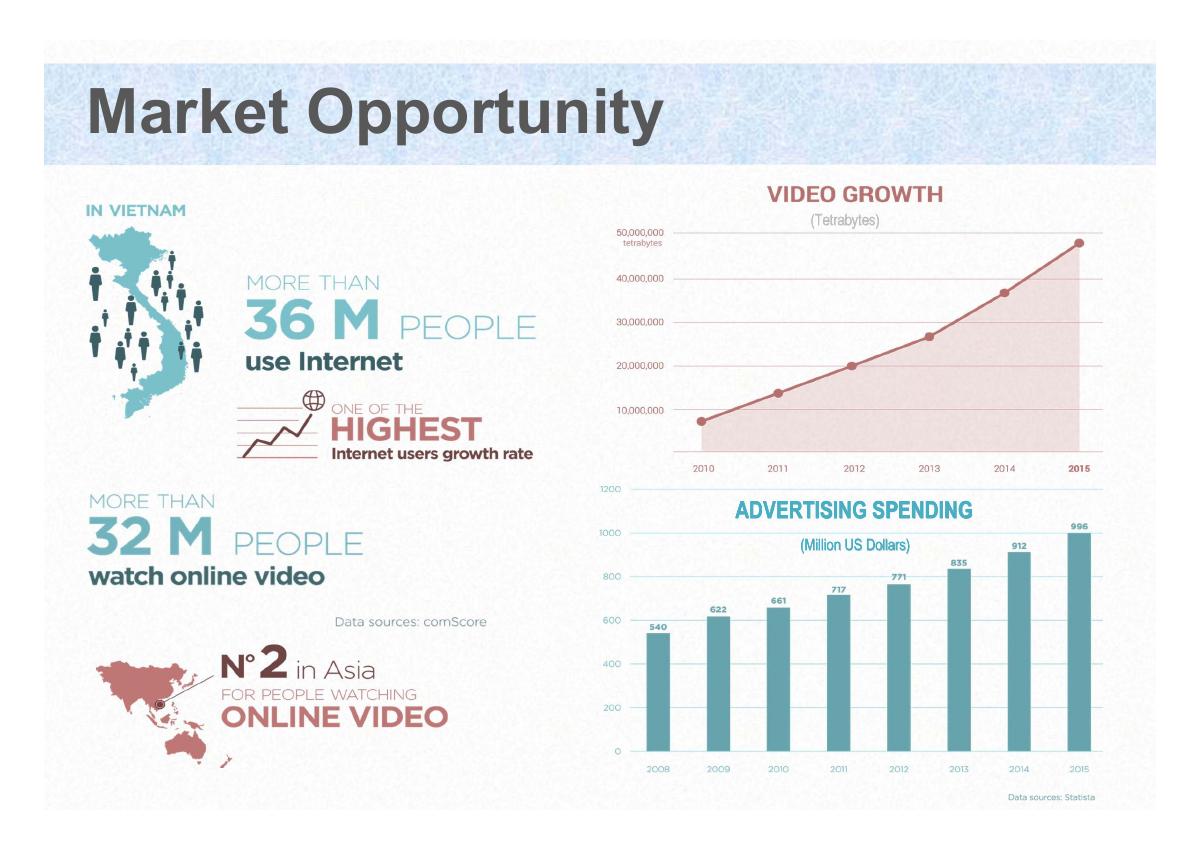
Four claims plus two charts. More than 36 million people in Vietnam use the internet; Vietnam has one of the highest internet-user growth rates; more than 32 million people watch online video; Vietnam is number two in Asia for people watching online video, sourced to comScore. A left-hand chart shows video traffic growth in terabytes from 2010 to 2015; a right-hand chart shows advertising spending in millions of US dollars rising toward 651, sourced to Statista.
This is a competent market slide by 2015 standards and better than most. It is local, it cites sources, and it pairs an audience metric with a spend metric — audience without spend is a vanity market. The gap is the one nearly every market slide has: it never narrows from "advertising spending in Vietnam" to "the portion of that spending that can flow through a platform like MeCloud." A $651M advertising market is not MeCloud's market. Online video advertising inventory that independent publishers control, times the platform's take rate, is MeCloud's market — and the deck already had the data to compute it, because slide 10 shows exactly how many impressions its own publishers serve.
Slide 4 — The Problem…
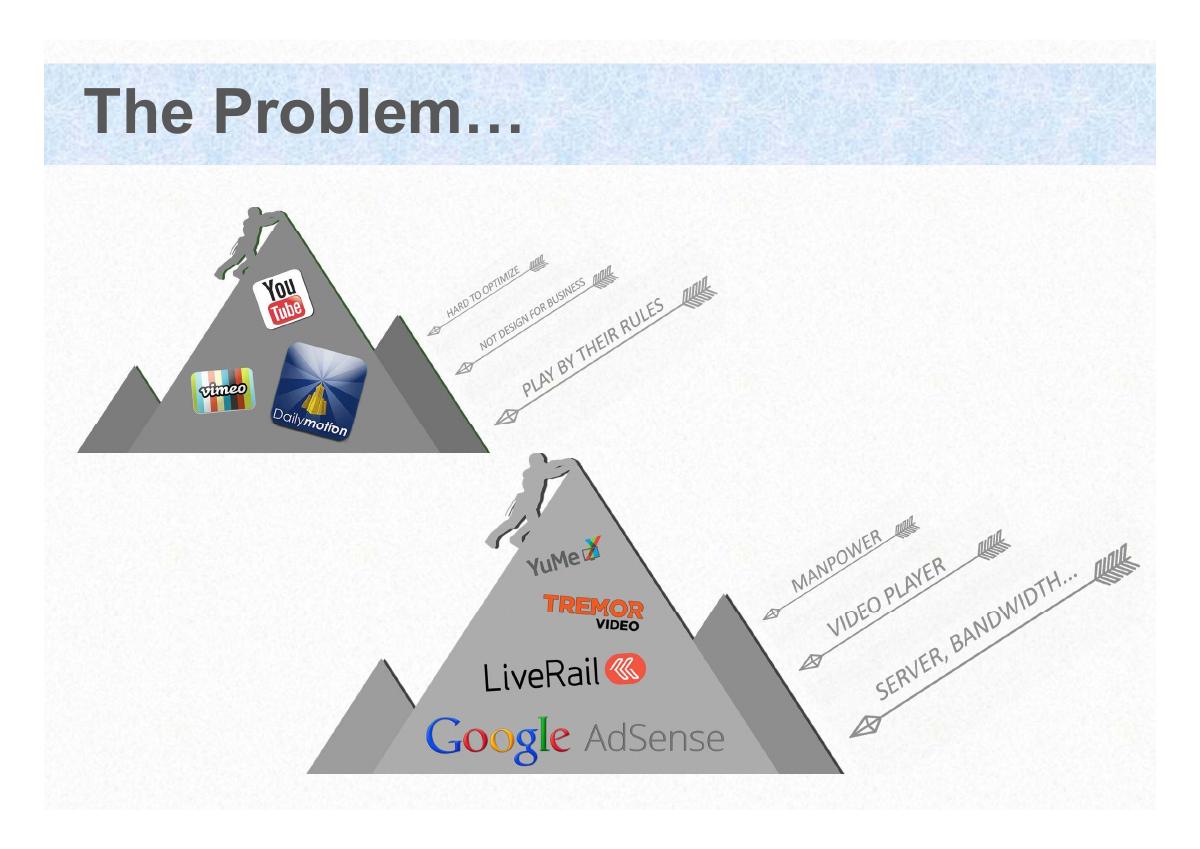
Two mountains, each with a climber. The upper mountain carries the YouTube, Vimeo and Dailymotion logos with three arrows: "hard to optimize," "not designed for business," "play by their rules." The lower mountain carries YuMe, Tremor Video, LiveRail and Google AdSense with three more: "manpower," "video player," "server, bandwidth."
The framing is genuinely good and it is the most strategically sharp thing in the deck. It says a publisher has two bad options: give your video to a consumer platform and lose control of the rules and the economics, or build your own and take on the ad-tech integration, the player and the infrastructure. MeCloud sits in the gap. That is a real wedge, and it was a correct read of the 2015 market.
What it lacks is a person. There is no named publisher, no quote, no "one of our publishers spent six months and two engineers building a player before switching." A problem slide with logos is a hypothesis; a problem slide with a customer's own words is evidence. MeCloud had thirteen publishers listed two slides later and quoted none of them.
Slide 5 — We Solve it all!
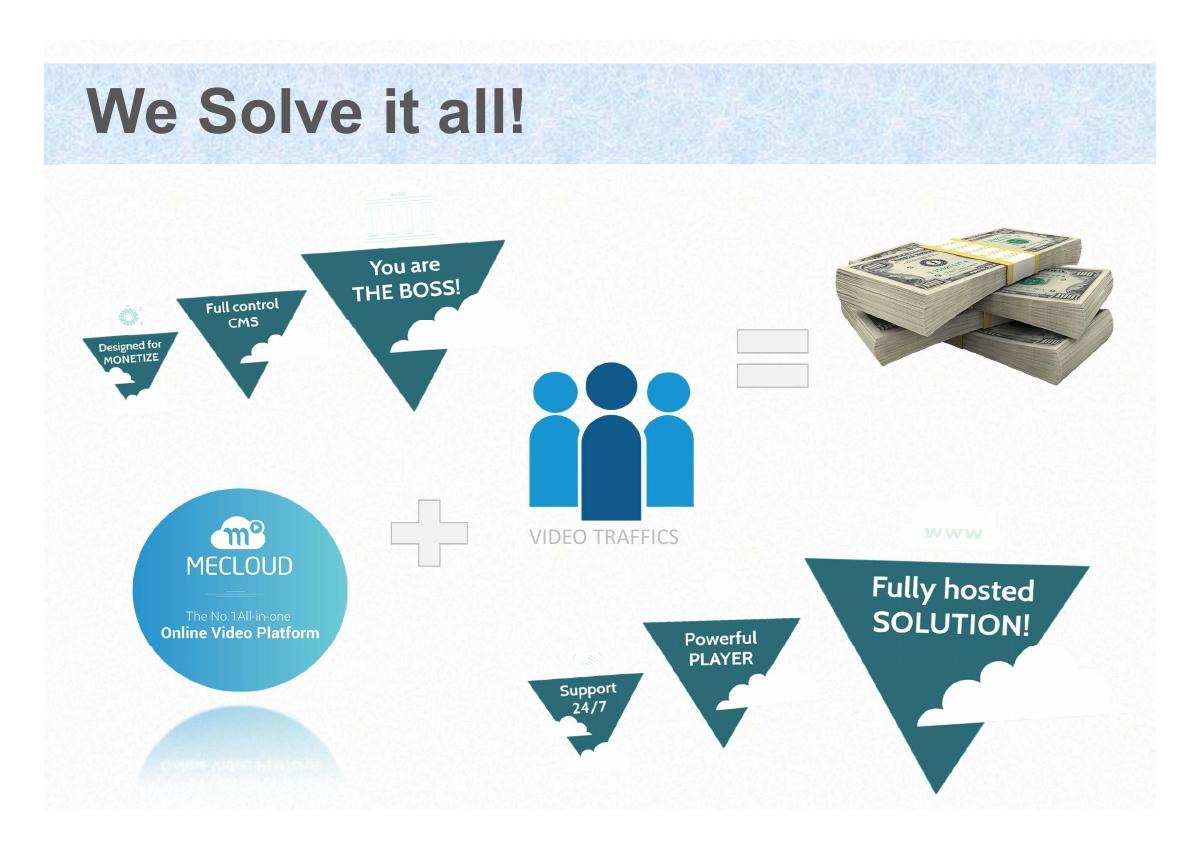
Five badges around the logo: "You are THE BOSS!", "MONETIZE," "Fully hosted SOLUTION!", "Powerful PLAYER," "Support 24/7."
Each of the five maps to one of the six arrows on the problem slide, which is more discipline than most solution slides show. But they are marketing badges, not capabilities. "Powerful PLAYER" tells an investor nothing; "HTML5 player with Google IMA integration and VAST/VPAID ad support, sub-two-second start time" tells them something — and the deck proves it can speak that way, because the very next competition slides are written in exactly that vocabulary. The solution slide was written by the marketing team and the competition slide by the product team, and the deck never reconciled them.
Slide 6 — Business Model
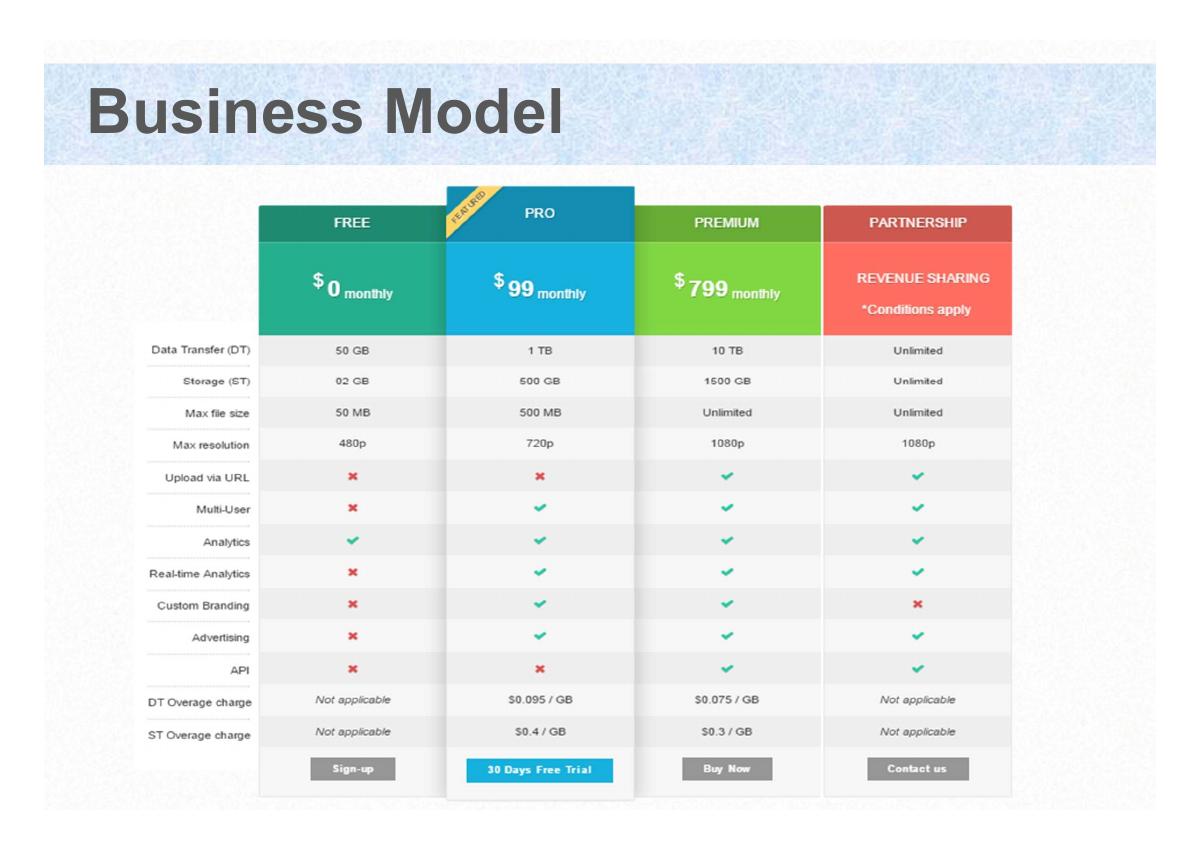
Two revenue lines and a four-tier pricing table. The lines are "Premium Partnership / Revenue Sharing" and a subscription topping out at "$799 monthly" with a "conditions apply" asterisk. The table compares a free tier and three paid tiers across data transfer, storage (2GB, 500GB, 1500GB, unlimited), max file size (50MB, 500MB, unlimited, unlimited), max resolution (480p, 720p, 1080p, 1080p), upload via URL, multi-user, analytics, realtime analytics, custom branding, advertising, API, and overage charges of $0.095/GB and $0.075/GB for transfer, $0.4/GB and $0.3/GB for storage.
The tiering itself is well-built — it gates on the axes that actually correlate with a publisher's willingness to pay, and the overage pricing shows someone had modelled bandwidth cost. Three things are missing, and they are the three an investor asks about immediately.
How many customers are on each tier? The deck never says. What is the revenue split on the "revenue sharing" line — 70/30, 50/50? Never stated, and it is almost certainly the larger revenue line given the impression volumes on slide 10. And which of the two models is the business? A subscription business and an ad-revenue-share business have different gross margins, different sales cycles and different valuation multiples. Presenting both as equal peers, with no revenue attributed to either, leaves the investor unable to model the company at all.
There is also a currency mismatch that runs through the whole deck: pricing is quoted in US dollars, and the financials on slide 11 are in Vietnamese dong, with no conversion offered anywhere.
Slides 7 and 8 — Competition
A two-page feature matrix comparing MeCloud against eight competitors, including Ooyala, Brightcove, Vimeo, Vidyard and Dailymotion, across roughly twenty-six rows: free account, revenue sharing, HTML5 + Flash player, multi-quality, custom category, custom branding, Google IMA integration, VAST/VPAID support, adtag management, ads operation mode, ads auto-backfill, realtime analytics, advanced analytics, adtag analytics, Google Analytics, realtime notification, turning ads off on a single video, content approval, multi-user, user permission assignment, activity tracking, upload by YouTube, upload by Facebook, upload by URL, WordPress plugin, and API.
This is real work, and the domain knowledge is obvious — the rows are the ones a monetising publisher actually cares about, not the rows a marketer would invent. Two structural problems, though.
MeCloud checks nearly every box in the matrix, and its competitors check far fewer. A grid where you win almost every row is not read by investors as a strong product; it is read as a grid whose rows were chosen after the answer was known. The credibility fix is counter-intuitive: lose deliberately on three rows. Brightcove wins on enterprise SLAs, Vimeo wins on brand, Ooyala wins on global CDN reach. Conceding those makes the twenty-three rows you win believable.
The deeper problem is that the matrix argues features when the actual moat is geographic and relational. MeCloud's real defensibility in 2015 was local publisher relationships, local ad demand, local billing and Vietnamese-language support — none of which appear as a row. Every feature in that grid is copyable within two quarters; the publisher relationships on slide 10 are not. The deck spends two pages on the copyable half of its advantage and zero on the durable half.
Slide 9 — Traction (platform)
A screenshot of MeCloud's own realtime dashboard, timestamped 18/09 at 10:15:43, showing 1,120,494 videos on the platform, a top-videos list with percentage breakdowns, and website analytics naming publisher domains including yeah1.com.
Showing the live product dashboard rather than a redrawn chart is a real credibility move — it is harder to fake and it demonstrates the analytics product at the same time as the traction. But the screenshot is used raw, at native resolution, with no annotation. There is no headline stating the takeaway, so the investor has to squint at a UI to find the number 1,120,494 and then work out on their own whether a million hosted videos is impressive.
Every traction screenshot needs one sentence above it in large type. Here that sentence writes itself: "1.1 million videos hosted, growing X% month over month." The deck supplies the screenshot and withholds the sentence.
Slide 10 — Traction (monetisation)
The strongest slide in the deck, and the one that should have been slide three. For the period 1–31 August 2015: 362,762,913 total displays, 79,083,680 total adtag impressions, 43,976,769 views and 43,966,234 unique views, plus a channel-analytics panel listing publisher domains — nguoiduatin.vn, tienphong.vn, bongdaclip.com, doisongphapluat.com, bongda.com.vn, thethao247.vn, tinnhanh360.net, kenhngoisao.vn, saoonline.vn, showbiz247.net, haiivl.com, haynhucnhoi.tv, chatvl.com.
Those are not test accounts. Several are among the largest news and entertainment properties in Vietnam. A platform serving 362 million ad displays a month across that publisher list is a real business with real distribution, and it is a stronger proof point than anything on the market, problem or solution slides.
And yet the slide contains no money. Not one revenue figure, no eCPM, no revenue per thousand impressions, no take rate. An investor looking at 79 million monetised adtag impressions has exactly one question — what did those impressions earn? — and the deck answers it nowhere. There is also no trend: a single month with no prior months means the investor cannot tell whether 362 million is a peak, a plateau or a ramp. One month of data is a photograph; investors fund a film.
Slide 11 — Financials
A line chart in Vietnamese dong running from July 2015 to August 2016, scaled to 1.2 billion VND with a negative region below the axis. Nine series: total cash in, total cash out, revenue from others, server, human resources, revenue from Netlink (reseller), profit, other fee, administration.
Nine series on one chart is unreadable, and this one is unreadable. But the bigger issue is what the series names disclose. One revenue line is "Revenue from Netlink (Reseller)" and the other is "Revenue from Others" — which is a concentration disclosure the deck makes accidentally and never addresses. If a single reseller is the named revenue line and everything else is an "others" bucket, an investor's first diligence question is what percentage of revenue Netlink represents and what the contract term is. Naming the dependency without sizing it is the worst of both worlds: it raises the flag and withholds the answer.
The chart is also, on its own axis, small. At 2015 exchange rates 1.2 billion VND is roughly US$53,000 — a monthly, not annual, figure by the look of the series, but the deck never labels the period, never converts the currency, and never states a single number in text. There are no assumptions, no unit economics, no revenue per publisher, no cost per gigabyte served against the $0.095/GB it charges. A projection with no stated assumptions is not a forecast; it is a drawing.
Slide 12 — Team
Roles arranged around the logo: tech leader (1) Nam Pham, developers (4), designer (1) Tanh Nguyen, accounting and HR, tech advisor (1), sales and marketing with Kevin Vu.
Nine or so people, headcount by function, with photos. What is missing is the entire reason a team slide exists. There is no CEO or founder identified. There are no bios — not one line about where anyone worked before, what they built, or why this specific group is the right one to build video infrastructure. The tech advisor is a role with no name and no affiliation, which is the least useful way to present an advisor: an unnamed advisor adds nothing, and a named one from a recognisable publisher or ad network would have transferred credibility directly.
At seed stage the team slide is frequently the slide the investment decision turns on, because the product will change. A headcount org chart tells an investor how many salaries they are funding. It does not tell them who they are backing.
Slide 13 — Needs money for…
Two illustrations with two labels: "NEW HIRES" and "SALES & MARKETING."
There is no amount. No total raise, no round type, no valuation, no allocation percentages, no runway, no milestones the money buys. This is a use-of-funds slide with neither funds nor use — "new hires" does not say how many, in which functions, or to what end.
It is the single most damaging omission in the deck, and it is damaging precisely because slide 10 is so strong. An investor who reaches slide 13 impressed by 362 million monthly impressions now has no instrument to act with. Are they being asked for $200,000 or $2 million? The deck makes them ask, and in practice a meaningful share of readers simply stop rather than write the email.
Slide 14 — Thank you
A closing slide with no contact details repeated, no next step and no ask restated. The last slide of a deck is the one left on screen during the Q&A that follows; it is prime real estate for the ask, the round status and a named email address. This one uses it for a courtesy.
What this deck does better than most startup pitch decks
The problem slide identifies a real structural gap. "Consumer platforms take your control; ad-tech stacks take your engineers" was an accurate read of what independent publishers faced in 2015, and it positions MeCloud between two named alternatives rather than in a vacuum. · The traction is operating data, not vanity data. Ad displays, adtag impressions, views and unique views for a specific named month, screenshotted from the live product. Most decks at this stage show signups. · The publisher list is the proof. Thirteen named Vietnamese domains, several of them major news and entertainment properties, is distribution evidence that cannot be manufactured. · The market slide is local and sourced. comScore and Statista attributions on a Vietnam-specific audience and ad-spend picture, rather than a global "online video is a $X billion market" cliché. · The pricing table is properly constructed. Four tiers gated on storage, transfer, file size, resolution and feature access, with explicit overage rates — evidence that someone modelled the cost of serving. · The competition matrix shows genuine domain depth. Rows like ad auto-backfill, adtag analytics and IMA integration are what a monetising publisher evaluates on. Nobody writes those rows without having sold to publishers.
Where this deck would fail in an investor meeting
There is no ask. No amount, no round, no valuation, no runway, no milestones. The deck ends on "new hires" and "sales and marketing." · There is no revenue figure anywhere in text. 362 million ad displays are shown and never converted into money — no eCPM, no take rate, no monthly revenue, no ARR. · No founder or CEO is identified. Nine roles, a few first names, zero bios, and an unnamed tech advisor. · Traction is a single month. August 2015 in isolation, with no trend line, so growth rate — the thing being priced — is unknowable. · Revenue concentration is disclosed but not sized. "Revenue from Netlink (Reseller)" is named as a line item and never quantified or explained. · Currency and period are inconsistent. Pricing in USD, financials in VND, no conversion, no labelled period on the projection. · Nine series on one chart. The financial slide is unreadable at presentation size and contains no stated assumptions. · "The No.1 All-in-one Online Video Platform" is an unqualified superlative on the cover, which discounts the credible claims that follow. · The value proposition is in the first person singular. "I help people earn a very high revenue" reads as a freelancer, not a nine-person infrastructure company. · The competition matrix wins nearly every row, which reads as selection bias, and it never argues the geographic moat that was MeCloud's actual defensibility.
Traction-rich versus investable: the same deck, two readings
Question an investor asks What the MeCloud deck provides What an investable deck provides
What does the company do? "I help people earn a very high revenue from monetize videos" One sentence naming the product, the customer and the mechanism
Is anyone using it? 362M displays, 44M views, 13 named publishers — strong Same, plus a month-over-month trend
Does it make money? Pricing tiers and a VND chart; no revenue figure stated Monthly revenue, growth rate, gross margin, ARPU
How does it make money per unit? Two models presented, neither sized eCPM, take rate, revenue per publisher, cost to serve
Who is running it? Headcount by function, first names, no bios Founders with named prior work and why-us evidence
What is the risk? Reseller dependency named, never sized Concentration stated as a percentage with a mitigation plan
What do you want? "New hires. Sales & marketing." Amount, round, use of funds by percentage, milestones, runway
What happens next? "Thank you" Named contact, round status, close date
How you would rebuild this deck without changing the business
Move slide 10 to slide 2. Open on 362,762,913 ad displays and thirteen named publishers. Everything else in the deck is more believable after that number, and nothing else in the deck competes with it. · Add the money line. One sentence with monthly revenue, the growth rate over the last six months, and the split between subscription and revenue share. This is the single highest-value addition available. · Turn one month into six. March through August 2015 as a bar chart of displays and views. The absolute number is impressive; the slope is what gets funded. · Write a real ask slide. Amount, round type, use of funds split by percentage across engineering, sales and infrastructure, the runway it buys, and the two or three milestones it reaches. · Rewrite slide 2 in the third person with a fact in it. "MeCloud is a hosted video platform for publishers who want to monetise without building an ad stack. Our publishers served 362 million impressions last month." · Name the founders and give three lines each. Prior company, what they built, why this problem. Name the advisor or remove the slot. · Size the Netlink dependency. State the percentage of revenue, the contract length, and the plan to bring direct publishers above 50%. Investors forgive concentration that is disclosed and planned for; they punish concentration they discover. · Cut the financial chart to three series. Revenue, cost, profit — in one currency, over a labelled period, with the four assumptions driving them listed beside it. · Compress competition to one slide with eight rows, lose three of them honestly, and add a row for the thing nobody can copy: Vietnamese publisher relationships and local ad demand. · Replace "Thank you" with a close. Founder name, direct email, amount, and how much of the round is already committed.
The transferable lesson
MeCloud's deck is a specific and common failure mode: a company with genuinely strong evidence that buries it in the ninth and tenth position, describes itself in adjectives on the second, and never states what it wants on the thirteenth. The business was more investable than the deck. That gap is entirely a communication gap, and it is the most expensive kind, because nobody in the meeting tells you it exists — the meeting just ends politely.
Two checks are worth running on your own deck right now. First: what is the single strongest verifiable fact you have, and what slide number is it on? If the answer is anything above three, your deck is spending its opening attention on claims that your own evidence could be making instead. Second: read your last three slides as though you were a stranger, and see whether you can state the amount being raised and what it buys. If you cannot, no reader can either, and the deck's job — getting a specific next action out of a specific person — has not been done.
Investors read for facts, sequence and a clear ask. Those three things are checkable before you send anything, which is what the scoring tool on this page is for: it reads your deck the way an investor's first pass does and tells you where your strongest evidence is sitting, and whether your ask survives being read by someone who owes you nothing.
Frequently asked questions
- What is MeCloud?
- MeCloud was an all-in-one online video platform based in District 3, Ho Chi Minh City, Vietnam. It offered publishers hosted video, an HTML5 and Flash player, ad-tag management and analytics, monetised through a tiered subscription topping out at 99 per month plus a revenue-sharing partnership model.
- Is the MeCloud deck a real investor pitch deck?
- Yes. The 14-slide deck follows the standard investor sequence — market, problem, solution, business model, competition, traction, financials, team, use of funds — and was printed on 8 October 2015. It is an investor deck rather than a sales brochure, though it omits the ask amount an investor deck normally ends with.
- How much traction did MeCloud show in its deck?
- For August 2015 the deck reports 362,762,913 total ad displays, 79,083,680 adtag impressions, 43,976,769 views and 43,966,234 unique views, plus 1,120,494 hosted videos. Thirteen Vietnamese publisher domains are named, including nguoiduatin.vn, tienphong.vn, doisongphapluat.com and thethao247.vn.
- How much money was MeCloud raising?
- The deck never says. Slide 13 is titled "Needs money for…" and lists only "new hires" and "sales & marketing" as illustrations. There is no amount, round type, valuation, runway or milestone set anywhere in the deck, which is its single most damaging omission.
- Which MeCloud slides should founders copy?
- The problem slide, which frames two named bad alternatives — consumer platforms that take your control, ad stacks that take your engineers — and places the product in the gap. And the monetisation traction slide, which uses a live product dashboard with a specific month and named customers rather than a redrawn chart.
- What is the biggest lesson from the MeCloud pitch deck?
- Put your strongest verifiable fact in the first three slides and state your ask in numbers. MeCloud had 362 million monthly ad displays on slide 10 and an adjective on slide 2, then closed without an amount. The business was more investable than the deck communicating it.