MedCrypt's 13-slide Series A deck focuses heavily on the 'why now' by highlighting specific FDA regulatory changes from April 2022. The company positions its cybersecurity-as-a-service platform as the essential bridge for medical device manufacturers (MDMs) to avoid regulatory rejection and costly recalls. With a total addressable market cited at $521B across modalities like diagnostic imaging and surgical robotics, the deck emphasizes a modular product strategy—Heimdall, Canary, and Guardian—to address vulnerability tracking, behavior monitoring, and cryptography. The narrative is anchored b…
Key takeaways
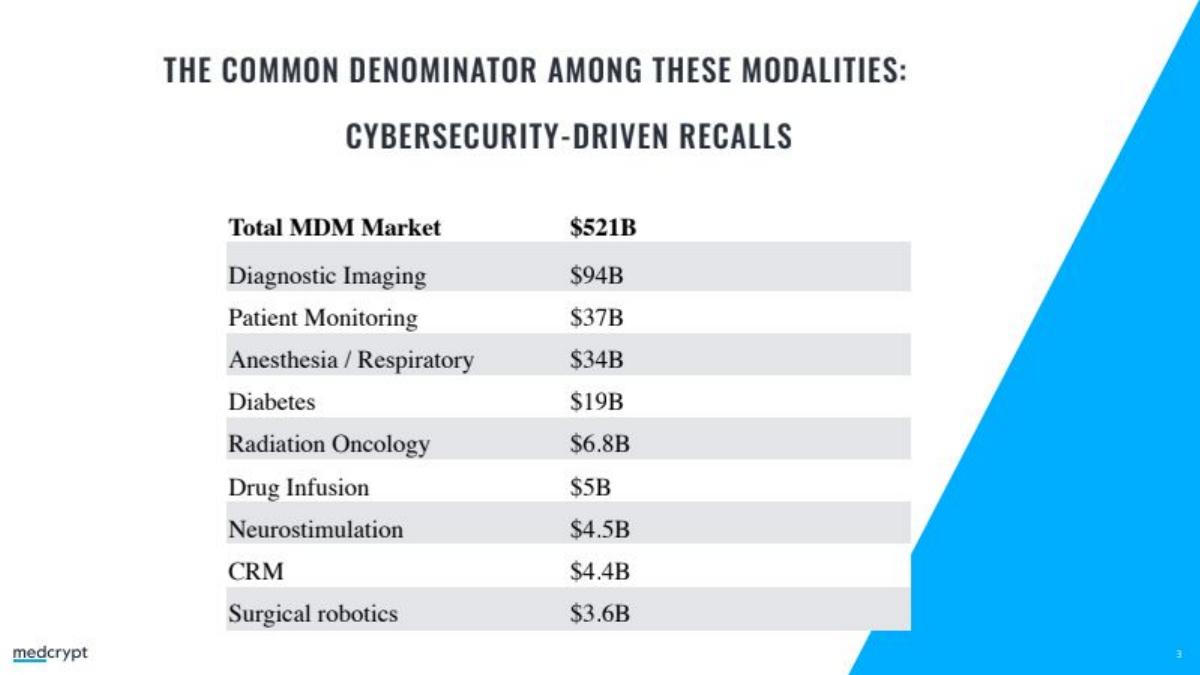
- The deck identifies a $521B total market for medical device manufacturers, broken down by specific modalities such as Diagnostic Imaging ($94B) and Patient Monitoring ($37B) on slide 3.
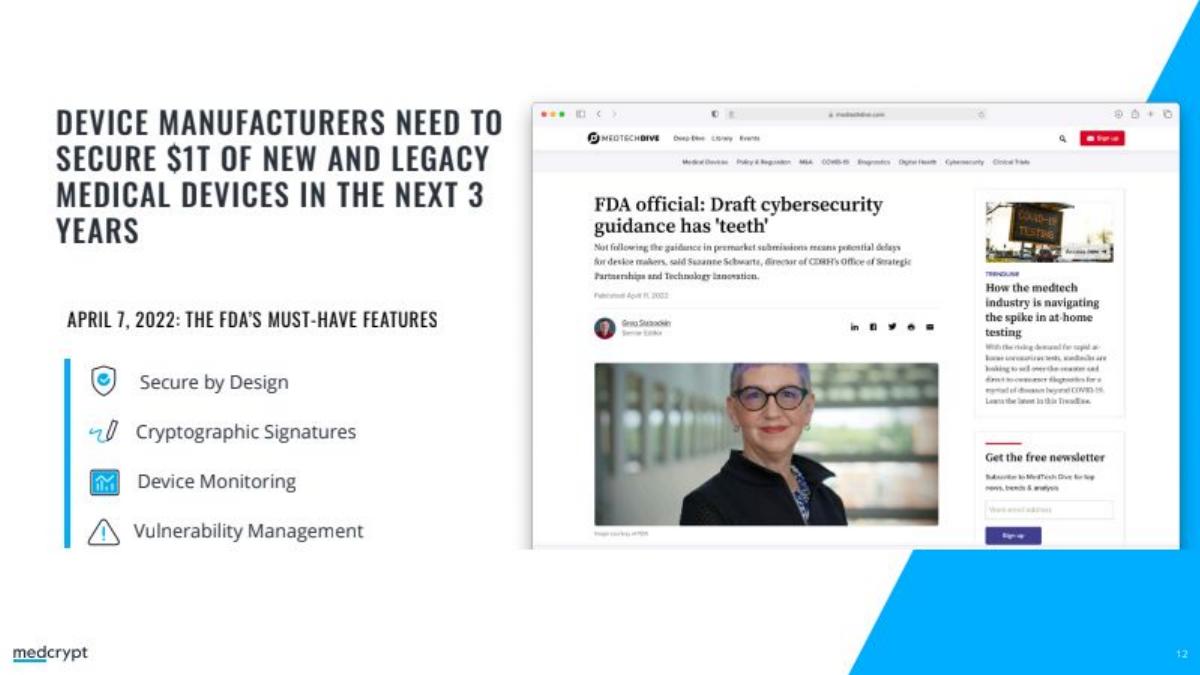
- A critical 'Why Now' catalyst is established on slide 4, citing April 7, 2022, FDA guidance that requires features like 'Secure by Design' and 'Vulnerability Management'.
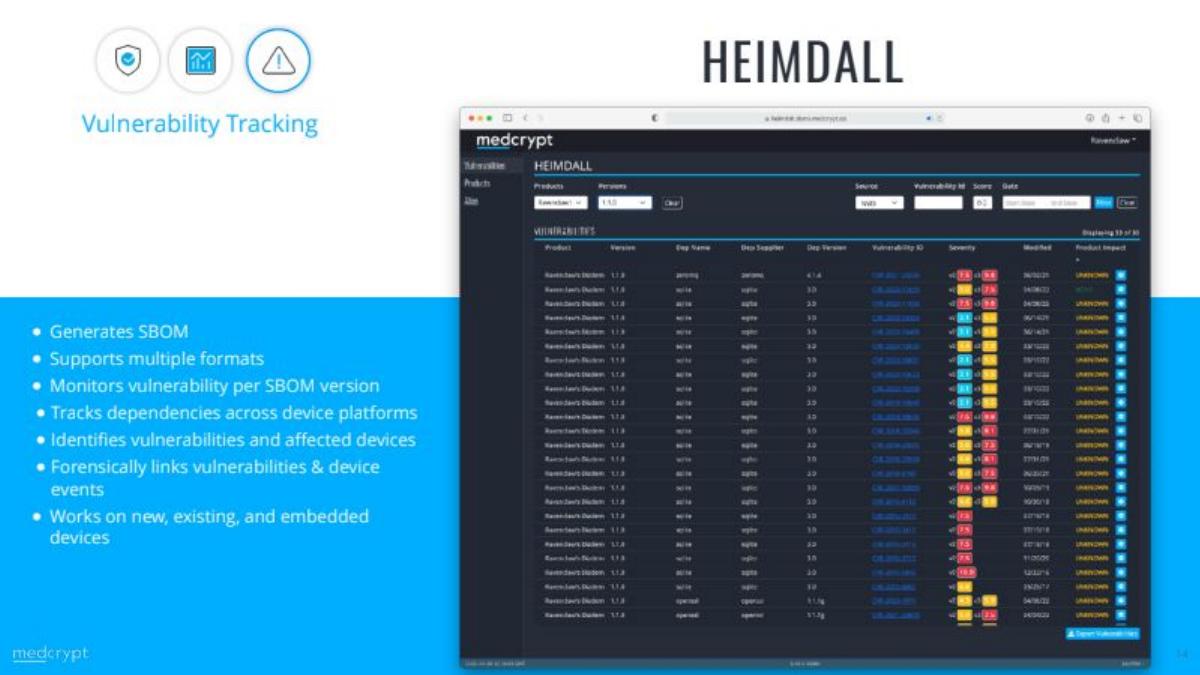
- The product is presented as a modular suite: Heimdall for vulnerability tracking (slide 6), Canary for behavior monitoring (slide 7), and Guardian for cryptography (slide 8).
- MedCrypt utilizes a strategic sales funnel through MediSAO, the only MDM-focused Information Sharing and Analysis Organization, which slide 9 claims provides a 'tremendous sales pipeline'.
- The team slide (slide 10) emphasizes domain-specific credibility, featuring former leads from FDA cybersecurity and Symantec healthcare.
- Traction is quantified on slide 11, noting 55 customers and the inclusion of three of the top five medical device manufacturers.
- The deck highlights a total of $14M raised to date from notable investors including Section 32, Johnson & Johnson, and Y Combinator (slide 11).
- There is a notable absence of a specific 'Ask' slide detailing the exact use of funds for the $10M Series A mentioned in the catalogue listing.
Executive Summary: The Regulatory Imperative
MedCrypt’s Series A pitch deck is a clinical example of how to sell into a highly regulated industry. Rather than focusing on the abstract fear of 'hackers,' the deck focuses on the concrete fear of 'regulators.' By framing cybersecurity as a prerequisite for FDA approval, MedCrypt transforms its software from an optional security layer into a mandatory business requirement for medical device manufacturers (MDMs).
Slides 1-2: The Problem of Rejection
The deck opens with a clear, high-contrast title slide stating their mission: helping manufacturers build devices that are 'secure by design.' Slide 2 immediately introduces the stakes: 'Medical device manufacturers are being rejected by the FDA and hospitals for cybersecurity failures.' This is a powerful opening because it identifies a specific, catastrophic business outcome—regulatory rejection—rather than just a technical vulnerability.
Slide 3: Quantifying the Market by Modality
MedCrypt provides a detailed breakdown of the Total MDM Market, valued at $521B . They categorize the market into specific sub-sectors, which helps investors understand the breadth of the application:
Diagnostic Imaging: $94B · Patient Monitoring: $37B · Anesthesia / Respiratory: $34B · Diabetes: $19B · Radiation Oncology: $6.8B · Drug Infusion: $5B · Neurostimulation: $4.5B · CRM: $4.4B · Surgical Robotics: $3.6B
By listing these, MedCrypt demonstrates that their solution is not a niche tool for one type of device, but a horizontal platform for the entire medical hardware industry.
Slide 4: The 'Why Now'—FDA Teeth
Slide 4 is perhaps the most important slide in the deck. It cites a specific date—April 7, 2022—and a headline stating that 'FDA official: Draft cybersecurity guidance has "teeth".' It lists the FDA's 'must-have' features: Secure by Design, Cryptographic Signatures, Device Monitoring, and Vulnerability Management. This creates an immediate sense of urgency. For an MDM, not having these features means they cannot sell their product. MedCrypt positions itself as the fastest way to check these boxes.
Slides 5-8: The Product Suite
Slide 5 serves as a transition, reiterating that MedCrypt allows manufacturers to build devices that are secure by design. The following slides break down the product into three distinct modules: Heimdall (Slide 6): Focused on Vulnerability Tracking. It generates Software Bill of Materials (SBOM), monitors vulnerabilities per SBOM version, and identifies affected devices. The screenshot shows a dashboard with CVE (Common Vulnerabilities and Exposures) scores, demonstrating technical depth. Canary (Slide 7): Focused on Behavior Monitoring. This is a post-market solution that captures security event data and device metadata to determine if a vulnerability is being exploited in the wild. Guardian (Slide 8): Focused on Cryptography. This slide shows actual code snippets, emphasizing an 'Easy to use API' for sending and receiving data securely. It highlights unique device key pairs and wide platform support, including embedded devices.
Slide 9: MediSAO—The Strategic Moat
MedCrypt introduces MediSAO, a 'Med Device Information Sharing Organization.' This is a brilliant strategic move. By creating and leading the only MDM-focused ISAO, MedCrypt positions itself as a thought leader and a central hub for the industry. The slide explicitly states that this 'Provides MedCrypt tremendous sales pipeline,' showing investors how they lower their Customer Acquisition Cost (CAC) through community building and regulatory alignment.
Slide 10: The Team of Insiders
Mike Kijewski and Eric Pancoast: Founders of Gamma Basics (sold to Varian). · Vidya Murthy: Former Becton Dickinson Cybersecurity. · Seth Carmody: Former FDA Cybersecurity Lead. · Axel Wirth: Former Symantec Healthcare Lead. · Shannon Lantzy: Former Booz Allen Hamilton.
Hiring the former FDA Cybersecurity Lead is a significant signal to investors that MedCrypt understands the regulatory hurdle better than anyone else.
Slide 11: Traction and Summary
The summary slide provides the hard metrics investors look for in a Series A:
55 customers, including 3 of the top 5 MDMs. · Raised $14M to date from Section 32, Johnson & Johnson, Y Combinator, and Eniac. · Reiteration of the April 2022 FDA rules as the primary market driver.
The mention of '3 of the top 5 MDMs' is a critical validation point, suggesting that the largest players in the industry have already vetted and adopted the technology.
What MedCrypt Does Well
Regulatory Alignment: The deck is perfectly timed to a specific regulatory shift. By mapping their product features directly to FDA requirements, they move the purchase decision from the 'IT budget' to the 'Regulatory/Compliance budget,' which is often less price-sensitive and more urgent. Product Modularity: Breaking the platform into Heimdall, Canary, and Guardian makes a complex cybersecurity offering easier to digest. It allows a customer to start with one (e.g., SBOM management) and expand into others. Social Proof: The team slide and the mention of top-tier MDM customers provide the 'trust' necessary for a startup to sell into the healthcare space, where 'no one ever got fired for buying IBM' (or in this case, a company filled with former FDA leads).
What is Missing
Financials and Unit Economics: The deck contains no mention of revenue growth, ACV (Annual Contract Value), or churn rates. While the customer count is 55, the lack of financial data makes it hard to assess the efficiency of the business model. The Ask: There is no slide detailing how much they are raising in this specific round or how they plan to spend the money. While the catalogue listing mentions a $10M Series A, the deck itself leaves this out, which is common in 'teaser' decks but unusual for a full Series A presentation. Competitive Landscape: The deck assumes MedCrypt is the only solution. It does not address how MDMs currently solve this (e.g., building in-house) or other cybersecurity firms attempting to pivot into the medical device space.
Founder Takeaways
Weaponize Regulation: If your industry is facing new mandates, make those mandates the centerpiece of your 'Why Now' slide. Don't just mention them; quote the specific guidance and show how your product is the 'Easy Button' for compliance. Build a Community Funnel: MedCrypt’s use of MediSAO is a masterclass in top-of-funnel strategy. If you can create an industry-standard organization or certification, you don't just find leads; you own the environment where leads are generated. Show, Don't Just Tell, Technical Depth: Including a code snippet (Slide 8) and a vulnerability dashboard (Slide 6) proves the product is real and built for developers/engineers, not just a marketing shell. This is vital for Series A technical due diligence.
Frequently asked questions
- What is MedCrypt's primary value proposition?
- MedCrypt provides cybersecurity-as-a-service specifically for medical device OEMs. Their platform helps manufacturers meet stringent FDA requirements, thereby avoiding product rejections and recalls. By offering pre-built modules for cryptography, monitoring, and vulnerability tracking, they allow manufacturers to focus on clinical features while ensuring their devices are 'secure by design' as mandated by new regulations.
- How does MedCrypt address the regulatory environment?
- The deck leans heavily on the regulatory landscape, specifically citing the FDA's April 2022 draft guidance. Slide 4 explicitly lists 'must-have' features required by the FDA, such as cryptographic signatures and device monitoring. MedCrypt positions its products as the direct solution to these mandates, turning a compliance burden into a streamlined implementation process for their customers.
- What are the core products in the MedCrypt suite?
- MedCrypt offers three main technical products: Heimdall, which generates Software Bill of Materials (SBOM) and tracks vulnerabilities; Canary, which enables post-market behavior monitoring and security event analysis; and Guardian, an API-based cryptography solution for secure data transmission. Additionally, they operate MediSAO, an information-sharing organization that serves as both a community resource and a sales pipeline.
- Who are MedCrypt's target customers and current traction?
- The target customers are Medical Device Manufacturers (MDMs) across various sectors, including diagnostic imaging, drug infusion, and surgical robotics. As of the deck's publication, MedCrypt reported 55 customers, which includes three of the top five largest MDMs in the world. This high-level enterprise penetration suggests strong product-market fit within the medical OEM sector.
- What is missing from the MedCrypt Series A deck?
- The deck lacks detailed financial projections, unit economics, and a specific breakdown of the 'Ask' for the Series A round. While it mentions raising $14M to date, it does not specify how the new capital will be allocated between R&D, sales, or international expansion. It also omits a traditional competitor slide, choosing instead to focus on the regulatory necessity of their specific niche.