Cybersecurity Product Slides: 8 Real Pitch Deck Examples
How security startups show their product: a real dashboard with the findings it produces, a phone screen with labelled features, named product modules.
Cybersecurity Product Slides: Real Pitch Deck Examples
Eight product slides from security decks (medical device security, a security buying marketplace, fraud detection, consumer VPN and privacy tools, physical locks, bot traffic filtering, developer security and supply-chain risk), shown in full. Security buyers are sceptical and security products are often invisible, so investors look for proof that something real exists: a screen, a report, a named module. The stronger slides show that; the weaker ones list adjectives in boxes.
TL;DR
A cybersecurity product slide should show what the security team actually sees and gets. MedCrypt puts a real screenshot of its vulnerability tracker beside seven things it does. CyberPal shows its app screen with six numbered features around it. Neuro-ID names three products (a dashboard and two APIs) under one sentence on what they detect. Nord shows its portfolio of ten brands with two press quotes. Nu-Set photographs its physical locks with a caption under each. Quarantyne lists three parts of its product (classifier, API, dashboard) next to a stock image. Snyk's early deck lists five bullets and a one-line analogy. iSecureCyber puts five feature names in boxes with no screen, the weaker example here.
Cybersecurity product slides
Each example shows the exact stored slide above its analysis and links to the full teardown. Stronger examples first. Claims and figures are as shown on the slides; we have not verified them.
MedCrypt product slide — slide 6
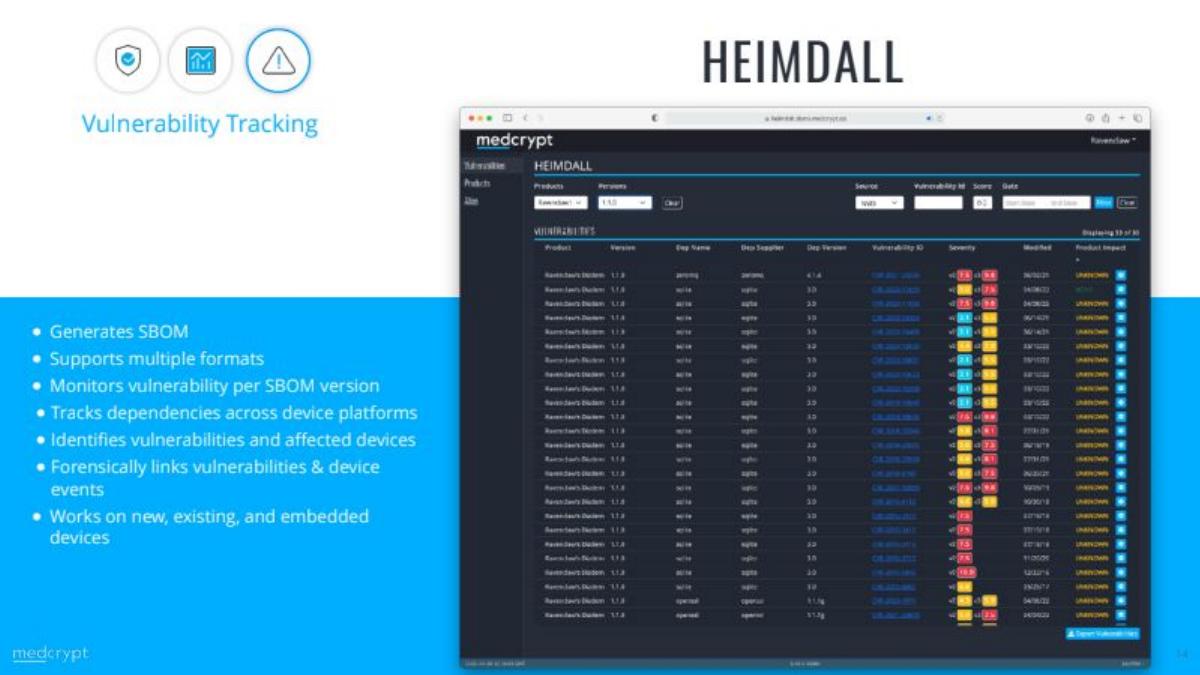
Series A (recorded). Security for medical device makers. A real screenshot of one product.
MedCrypt deck, slide 6. Exact stored slide matched to this analysis.
Our analysis: The clearest example here: the investor sees the list of vulnerabilities a device maker would work through, not a description of it.
Evidence and limitation: A real product screen and seven functions; no customer or usage figures on this slide.
What a founder can adapt: Put a screenshot of your main view (alerts, findings, report) next to a short list of what it does.
Supporting analysis
What the deck claims: "HEIMDALL." "Vulnerability Tracking." "Generates SBOM." "Supports multiple formats." "Monitors vulnerability per SBOM version." "Tracks dependencies across device platforms." "Identifies vulnerabilities and affected devices." "Forensically links vulnerabilities & device events." "Works on new, existing, and embedded devices." A screenshot of the Heimdall table listing components, versions, vulnerability IDs and colour-coded severity.
Presentation choice: Security buyers trust what they can see. A table of real findings shows the product exists and what it outputs.
When it does not fit: The table text is too small to read on a slide; zoom into three rows or add a callout on one finding.
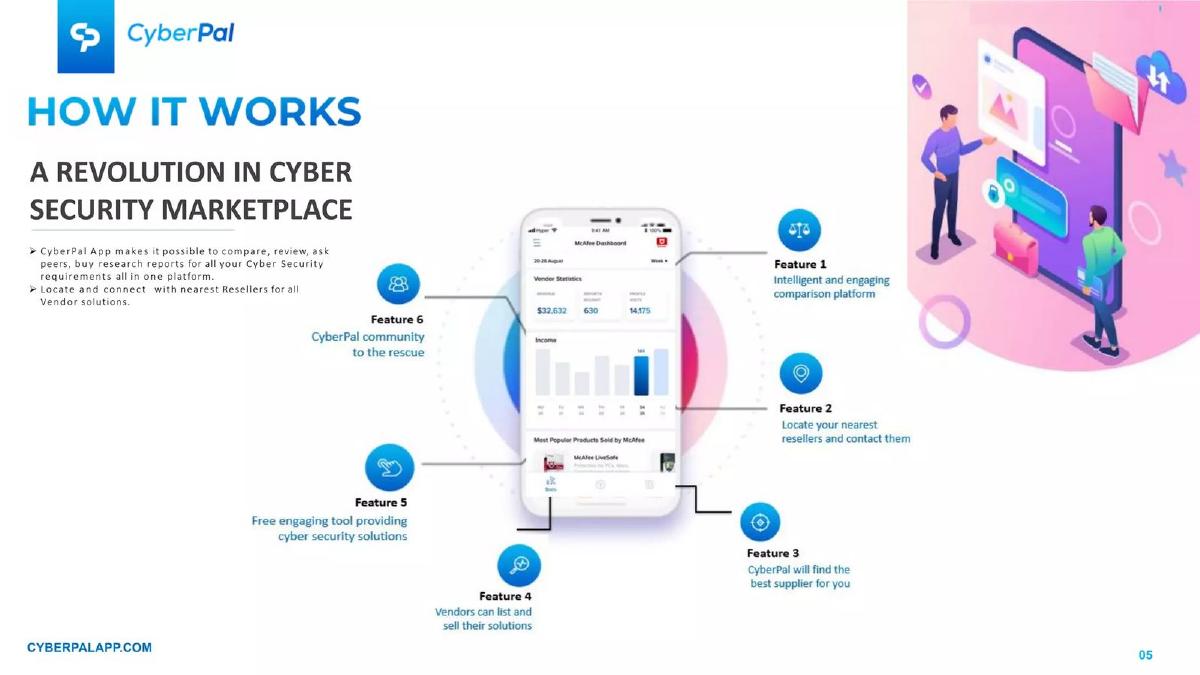
Seed stage (recorded). A marketplace app for buying security products. One app screen with labelled features.
CyberPal deck, slide 5. Exact stored slide matched to this analysis.
Our analysis: Shows that an app exists and what a buyer and a vendor can each do in it.
Evidence and limitation: One app screen and six features; no usage figures.
What a founder can adapt: Number your features around the screen where each happens.
Supporting analysis
What the deck claims: "How it works." "A revolution in cyber security marketplace." "CyberPal App makes it possible to compare, review, ask peers, buy research reports for all your Cyber Security requirements all in one platform." Around a phone screen: "Feature 1: Intelligent and engaging comparison platform." "Feature 2: Locate your nearest resellers and contact them." "Feature 3: CyberPal will find the best supplier for you." "Feature 4: Vendors can list and sell their solutions." "Feature 5: Free engaging tool providing cyber security solutions." "Feature 6: CyberPal community to the rescue."
Presentation choice: Labelling features around a real screen ties each claim to the product.
When it does not fit: "A revolution" adds nothing; the stock illustration on the right takes space the screen could use.
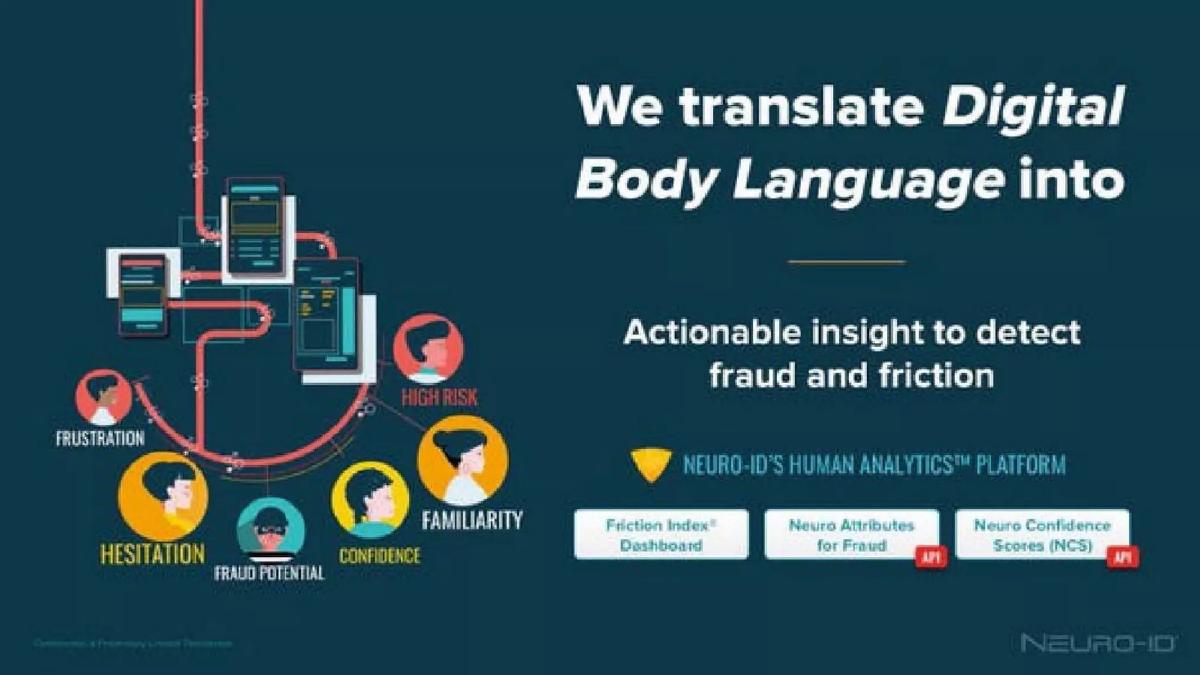
Series B (recorded). Fraud and friction detection from user behaviour. Named product modules.
Neuro-ID deck, slide 6. Exact stored slide matched to this analysis.
Our analysis: Turns an abstract idea ("digital body language") into three things a customer can buy: one dashboard and two APIs.
Evidence and limitation: Three named products and the signals they read; no screens or figures.
What a founder can adapt: Name each module and say what it outputs and how it is delivered (dashboard, API, agent).
Supporting analysis
What the deck claims: "We translate Digital Body Language into actionable insight to detect fraud and friction." "Neuro-ID's Human Analytics Platform." Three product boxes: "Friction Index Dashboard", "Neuro Attributes for Fraud" (API), "Neuro Confidence Scores (NCS)" (API). Illustration labels: "Frustration", "Hesitation", "Fraud potential", "Confidence", "Familiarity", "High risk".
Presentation choice: Naming modules and marking which are APIs tells the investor how the product is delivered.
When it does not fit: Add one example output, such as a sample score, so the modules are not just labels.
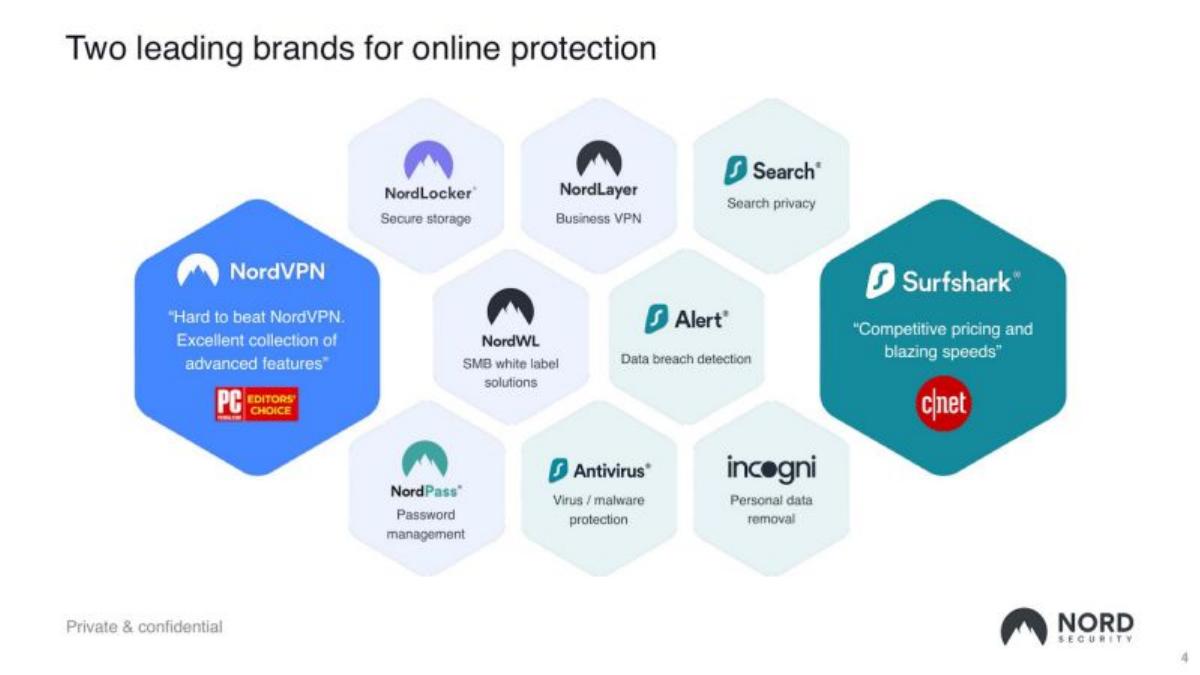
Series A (recorded). Consumer and business VPN and privacy tools. A portfolio of products.
Nord Security deck, slide 4. Exact stored slide matched to this analysis.
Our analysis: For a company with many products, a map shows the range in one view and which two brands lead.
Evidence and limitation: Ten named products with a one-line function each and two press quotes; no customer figures on this slide.
What a founder can adapt: If you sell several products, show them together, with the lead product largest and one proof point on it.
Supporting analysis
What the deck claims: "Two leading brands for online protection." Hexagons: "NordVPN" ("Hard to beat NordVPN. Excellent collection of advanced features", PC Editors' Choice), "Surfshark" ("Competitive pricing and blazing speeds", CNET), "NordLocker: Secure storage", "NordLayer: Business VPN", "Search: Search privacy", "NordWL: SMB white label solutions", "Alert: Data breach detection", "NordPass: Password management", "Antivirus: Virus / malware protection", "Incogni: Personal data removal".
Presentation choice: The two press quotes give outside proof for the lead products.
When it does not fit: A map of ten products suits a later-stage company; an early startup should show one product in depth.
Growth stage (recorded). Physical security: lock boxes and door locks. Product photos with captions.
Nu-Set deck, slide 4. Exact stored slide matched to this analysis.
Our analysis: For a physical product, a clear photo does the job a screenshot does for software.
Evidence and limitation: Real product photos with captions; no sales figures.
What a founder can adapt: Photograph the product on a plain background with a short caption under each.
Supporting analysis
What the deck claims: "Our Products." "We offer you a range of security products, especially when it comes to lock boxes, electronic door locks, and master keyed lock systems." Four photos: "Lock boxes: Including push button, electronic, wireless, key lock box, mechanical boxes." "Security: Door locks, door hardware, keypad door lock, patio door locks, padlocks, gym locks." "Design: Customized design capabilities married with simple and secure locking mechanism." "Smart Box: Mobile phone enabled, wireless communication, use and entry tracking."
Presentation choice: Each photo has a caption listing what it covers, so the range is clear in seconds.
When it does not fit: Say which product sells most or is newest; four equal tiles hide the priority.
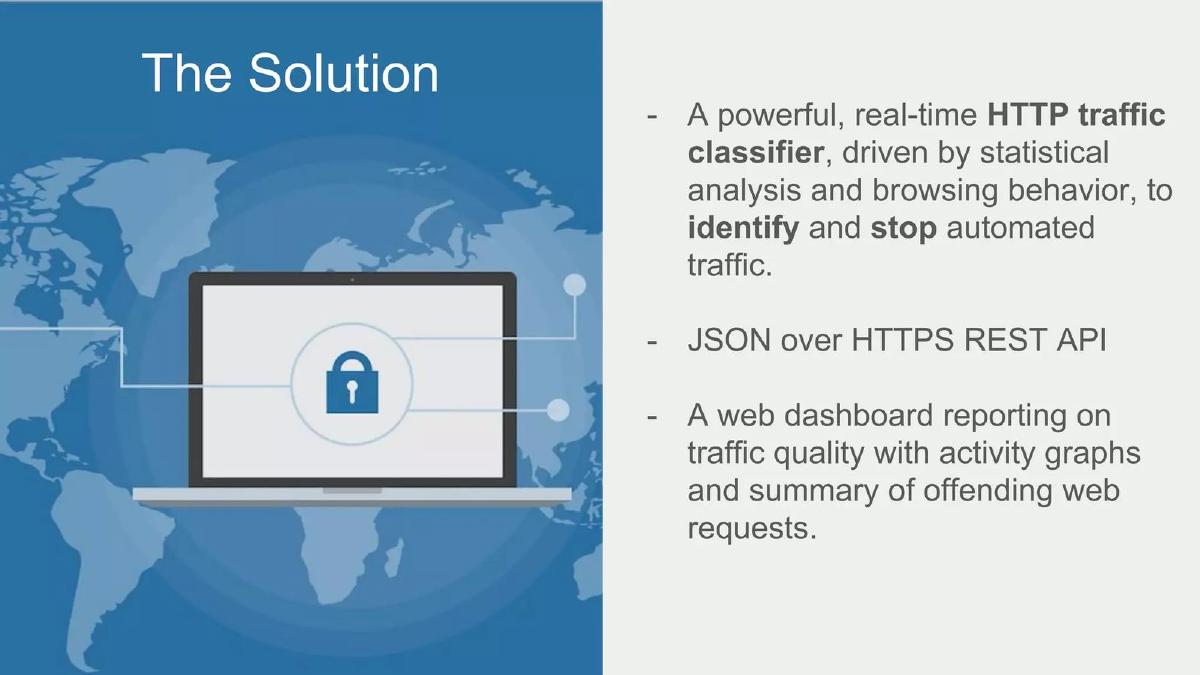
Pre-seed (recorded). Bot and fake-traffic filtering for websites. Three product parts in text.
Quarantyne deck, slide 4. Exact stored slide matched to this analysis.
Our analysis: Clear about what the product consists of, but the investor has to imagine the dashboard it describes.
Evidence and limitation: Three named parts (classifier, API, dashboard); no screen or figures.
What a founder can adapt: Keep the three-part breakdown and replace the stock image with a screenshot of the dashboard.
Supporting analysis
What the deck claims: "The Solution." "A powerful, real-time HTTP traffic classifier, driven by statistical analysis and browsing behavior, to identify and stop automated traffic." "JSON over HTTPS REST API." "A web dashboard reporting on traffic quality with activity graphs and summary of offending web requests." A stock image of a laptop with a padlock on a world map.
Presentation choice: Splitting the product into engine, API and dashboard shows how a customer would use it.
When it does not fit: Stock padlock images say "security" without showing anything about your product.
Seed stage (recorded). Developer security tools. Bullets and an analogy.
Snyk deck, slide 2. Exact stored slide matched to this analysis.
Our analysis: Tells the investor who the product is for (developers) and gives a one-line comparison to a known company.
Evidence and limitation: Five bullets; no screen, customers or figures.
What a founder can adapt: Lead with who uses it and one familiar comparison, then show what they see.
Supporting analysis
What the deck claims: "Snyk: So Now You Know." "Developer Oriented Web Security Tools." "Application Security Monitoring & Prevention." "Based on code instrumentation & machine learning." "Product per threat: 3rd party, AppSec, privacy..." "New Relic for Security."
Presentation choice: An analogy ("New Relic for Security") gives an investor a quick mental model, useful at a very early stage.
When it does not fit: Without a screen, the analogy carries the whole slide; add a mock-up of the first result a developer gets.
Series A (recorded). Supply-chain security for small businesses. Feature names in boxes (weaker example).
iSecureCyber deck, slide 6. Exact stored slide matched to this analysis.
Our analysis: The investor learns the product's claimed qualities but not what a supplier report looks like or who reads it.
Evidence and limitation: Five feature names; no screen, output or figures.
What a founder can adapt: Show the supplier risk report itself and caption the one decision it helps a buyer make.
Supporting analysis
What the deck claims: "Product Features." "Base - Supply Chain Security." Five boxes: "Seamless risk reporting", "End to end Automation", "Integrated with apps like DocuSign", "Continuous Supplier Monitoring", "Threat based supplier assessment".
Presentation choice: Included for contrast: boxes of feature names are common in security decks and show nothing concrete.
When it does not fit: Words like "seamless" and "end to end" describe any product; replace them with outputs.
How the product is presented, whether a real screen or photo is shown, and whether the slide says what the product outputs.
Example
Product
Presented as
Real screen or photo
Output shown
MedCrypt
Medical device security
Screenshot + functions
Yes (text small)
Yes (vulnerability list)
CyberPal
Security buying marketplace
App screen + features
Yes
Partly
Neuro-ID
Fraud detection
Three named modules
No
Named, not shown
Nord Security
VPN and privacy tools
Portfolio map
No (logos)
No
Nu-Set
Physical locks
Product photos
Yes (photos)
n/a (physical)
Quarantyne
Bot traffic filtering
Three parts in text
No (stock image)
Described
Snyk
Developer security
Bullets + analogy
No
No
iSecureCyber
Supply-chain risk
Feature boxes
No
No
Key Takeaways
Show a real screen: the alert, report or finding the buyer receives.
Name each part of the product and what it outputs.
Say who uses it (security team, developer, consumer).
Replace adjectives ("seamless", "end to end") with what the product does.
Build your cybersecurity product slide
Start with what the security team receives, then show where it appears.
User. Who uses it: security analyst, developer, IT admin, consumer.
Output. The alert, finding, score or report the product produces.
Where it lives. Dashboard, API, agent, browser extension, device.
Status. What is live today and what is planned.
Copyable framework: [Screenshot of main view] For [user]: [product] produces [output] via [dashboard/API]. It does: [3 functions]. Live: [features]. Planned: [features].
Illustrative example 1 — written by us
Before: Product Features: Seamless risk reporting. End to end Automation. Integrated with apps like DocuSign. Continuous Supplier Monitoring. Threat based supplier assessment.
After: [Screenshot: supplier risk report] For a small business owner: one report per supplier with a risk rating and the checks behind it. Updated [frequency]. Sends contracts via DocuSign. Live: [features]. Planned: [features].
What improved: Our illustrative rewrite; not iSecureCyber's wording. Bracketed parts are placeholders to fill with real facts. It replaces feature names with the report a buyer would receive.
What this guide adds
The library already has cybersecurity problem and solution guides, a general product slide guide, product slides by stage, and SaaS, developer tool, AI and other sector product guides. The cybersecurity solution guide covers how security decks describe the fix; this page looks at how the product itself is shown.
Sector labels come from the sector recorded for each published teardown (high confidence for MedCrypt, Neuro-ID, Quarantyne and iSecureCyber; medium for CyberPal, Nord, Nu-Set and Snyk). None of these eight slides appears in another guide. Other slides from the Quarantyne, Snyk and iSecureCyber decks are used elsewhere in the library for different lessons.
Four ways security decks show the product
Real screen (MedCrypt, CyberPal): a screenshot of the product with its functions listed beside it.
Named modules (Neuro-ID, Quarantyne): the product split into parts, each with a name and output.
Portfolio (Nord, Nu-Set): several products shown together, with a proof point or caption per product.
Bullets or boxes (Snyk, iSecureCyber): capabilities described in words. The investor sees no product.
Common mistakes
Stock padlocks. Generic security images show nothing about your product.
Adjectives as features. "Seamless" and "end to end" fit any product.
Unreadable screenshots. Zoom into the part that matters.
No user named. Say whether an analyst, developer or consumer uses it.
Diagnostic checklist
A real, readable screen or photo.
The output the buyer receives.
Each module named with how it is delivered.
Who uses it.
Live vs planned marked.
Frequently asked questions
How we chose these examples
Corpus: published pitch deck teardowns on StartupFundraising.com. Founder-uploaded private decks are excluded.
Selection (2026-09-27): we took teardowns whose recorded sector is cybersecurity with a stored slide image and readable text mentioning the product, platform, app, features or how it works. We viewed eighteen candidate slides, left out slides already used in other guides, slides that were not about the product (team, market size, why-now and metrics slides from the ngrok, NeuraLegion, MetaCert and KnowBe4 decks), cover-style slides with one sentence (Netmaker, Cobalt, FleetDM, iSecureCyber's solution slide) and a second product slide from the same deck (Nord's section title), and kept eight that show different ways of presenting a security product. iSecureCyber is included as a weaker example for contrast.
Sector is the category recorded for each teardown (high confidence for MedCrypt, Neuro-ID, Quarantyne and iSecureCyber; medium for CyberPal, Nord, Nu-Set and Snyk). Nu-Set sells physical security products; it is included because its recorded sector is security and it shows how to present a physical product. Stages as recorded: Quarantyne, pre-seed; CyberPal and Snyk, seed; MedCrypt, Nord and iSecureCyber, Series A; Neuro-ID, Series B; Nu-Set, growth.
Review: stored slide images were checked on 2026-09-27 and matched to company, deck and slide number, and quoted text was read from the images (editorial model review). No person has yet completed an editorial review of this page.
Claims and figures are as shown on the slides; we have not verified them. We make no claim that any slide caused a fundraising outcome.