Neuro-ID's 11-slide deck is a masterclass in translating complex, academic technology into a high-value enterprise SaaS proposition. By framing their behavioral tracking as 'Digital Body Language,' the founders moved beyond simple fraud detection into the broader category of customer experience (CX) optimization. The deck leans heavily on the pedigree of its co-founders—doctoral professors with over 30,000 academic citations—and the commercial track record of its CEO, who previously oversaw liquidity events exceeding $500 million. While the deck lacks a specific financial 'Ask' slide or detai…
Key takeaways
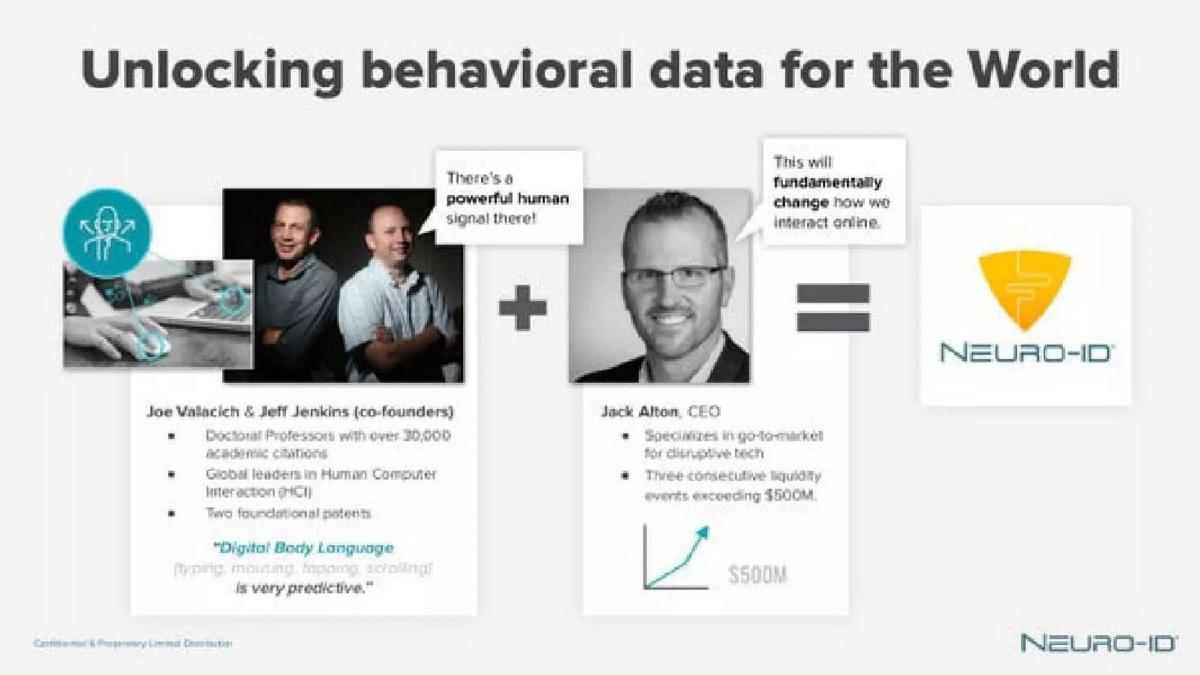
- The company defines its core technology as 'Digital Body Language,' encompassing typing, mousing, tapping, and scrolling (Slide 3).
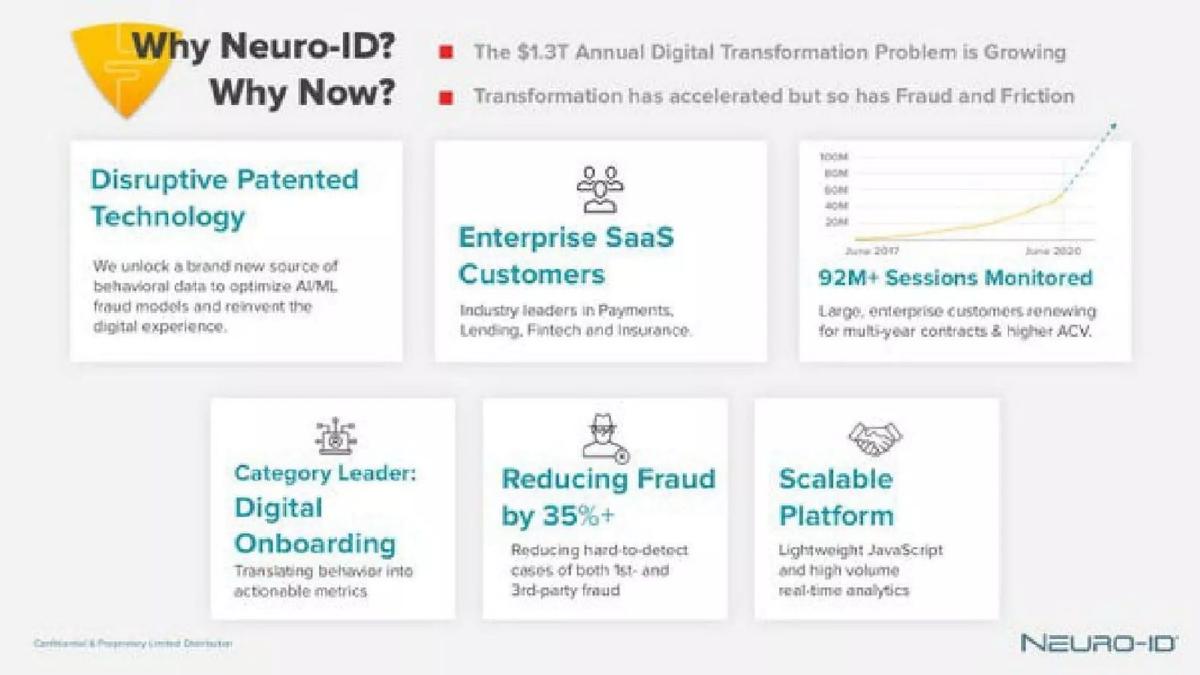
- Neuro-ID claims to reduce hard-to-detect fraud cases by 35% or more (Slide 4).
- The platform had monitored over 92 million sessions by June 2020, showing a significant growth curve from 2017 (Slide 4).
- The founding team combines deep academic research (30,000+ citations) with executive experience in $500M+ liquidity events (Slide 3).
- The product is delivered via a 'lightweight JavaScript' and high-volume real-time analytics platform (Slide 4).
- The deck identifies a $1.3 trillion annual digital transformation problem as the primary market driver (Slide 4).
- Neuro-ID segments users into 'Genuine Applicants' (low friction) and 'Fraudulent Applicants' (high friction) to balance CX and security (Slide 7).
- The advisory board includes former executives from Wells Fargo, Expedia, and SoFi, providing vertical-specific credibility (Slide 10).
The Narrative: From Academic Research to Enterprise Fraud Defense
Neuro-ID’s pitch deck is a concise 11-slide presentation that focuses on the transition from deep scientific research to a scalable enterprise SaaS product. The deck, used during their Series B phase where they eventually raised $42 million, centers on a proprietary concept they call "Digital Body Language." By framing behavioral data in a way that mimics human intuition in face-to-face interactions, the company positions itself as a bridge between security and user experience.
Slides 1-2: The Hook and the Human Element
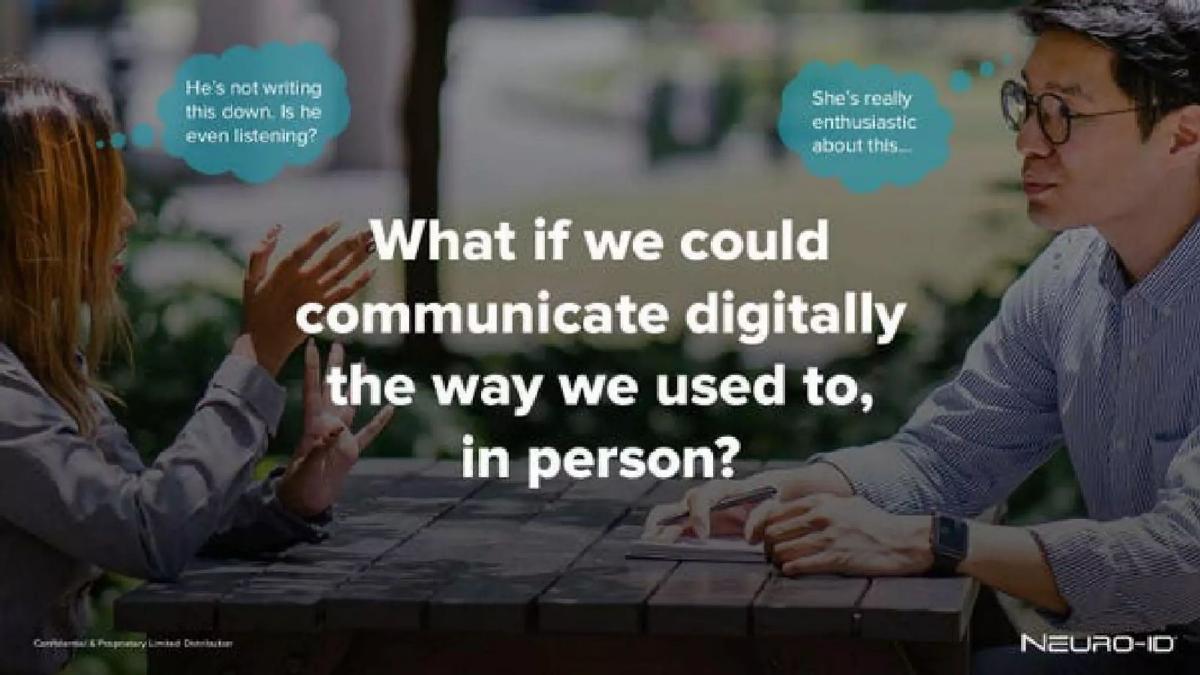
The deck opens with a minimalist title slide (Slide 1) featuring the logo and the tagline: "Human Analytics for the Digital World." This sets the stage for a high-level conceptual pitch rather than a purely technical one. Slide 2 uses a lifestyle image of two people talking in person, with thought bubbles representing the unspoken cues we pick up during conversation—such as whether someone is listening or enthusiastic. The central question, "What if we could communicate digitally the way we used to, in person?" serves as the emotional hook, suggesting that digital interactions currently lack the nuance of physical ones.
Slide 3: The Pedigree Slide
Slide 3 is arguably the most important slide in the deck for a Series B investor. It introduces the "Unlocking behavioral data for the World" concept by combining the academic power of the co-founders with the commercial success of the CEO. The slide highlights that Joe Valacich and Jeff Jenkins are doctoral professors with over 30,000 academic citations and two foundational patents. This is immediately balanced by CEO Jack Alton, who is credited with three consecutive liquidity events exceeding $500 million. This "Science + Sales" equation is designed to de-risk the investment by showing the tech is proven and the leadership knows how to exit.
Slide 4: The Value Proposition and Traction
Slide 4, titled "Why Neuro-ID? Why Now?", packs six key proof points into one view. It identifies a $1.3 trillion digital transformation problem and highlights a 35%+ reduction in fraud. Most importantly, it shows a traction graph that spikes in June 2020, reaching over 92 million monitored sessions. This slide establishes that the company is no longer in the "idea" phase; it is a scalable platform with enterprise SaaS customers in payments, lending, and insurance who are renewing multi-year contracts.
Slides 5-7: Product Mechanics and Segmentation
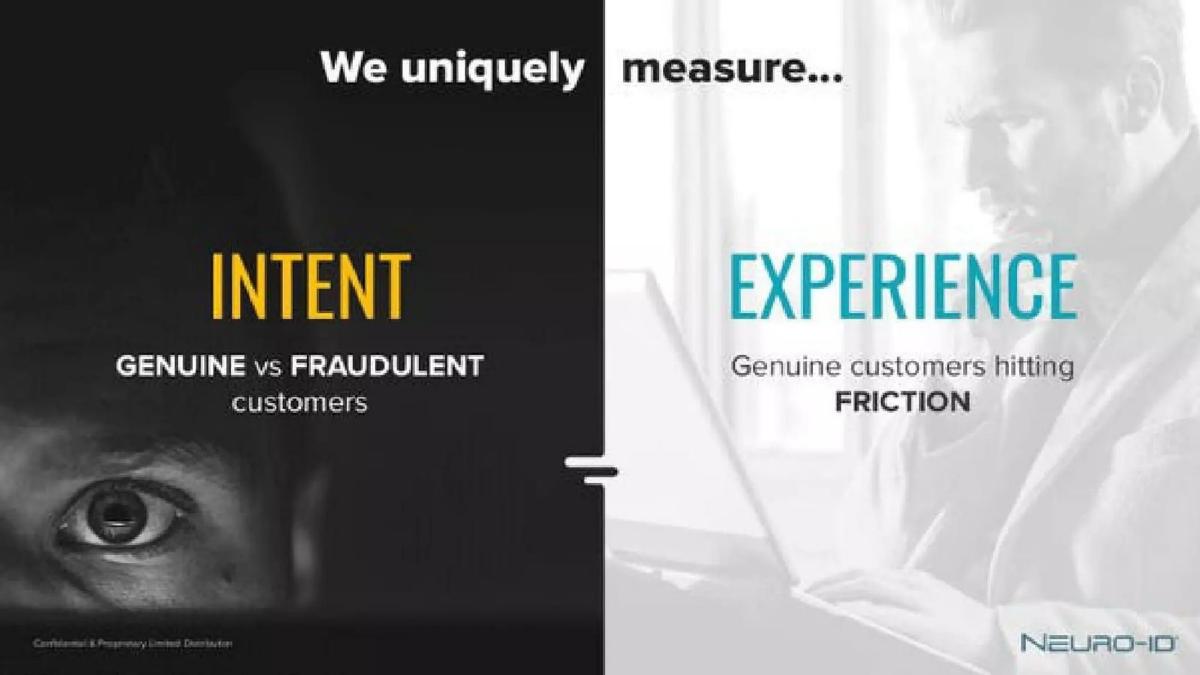
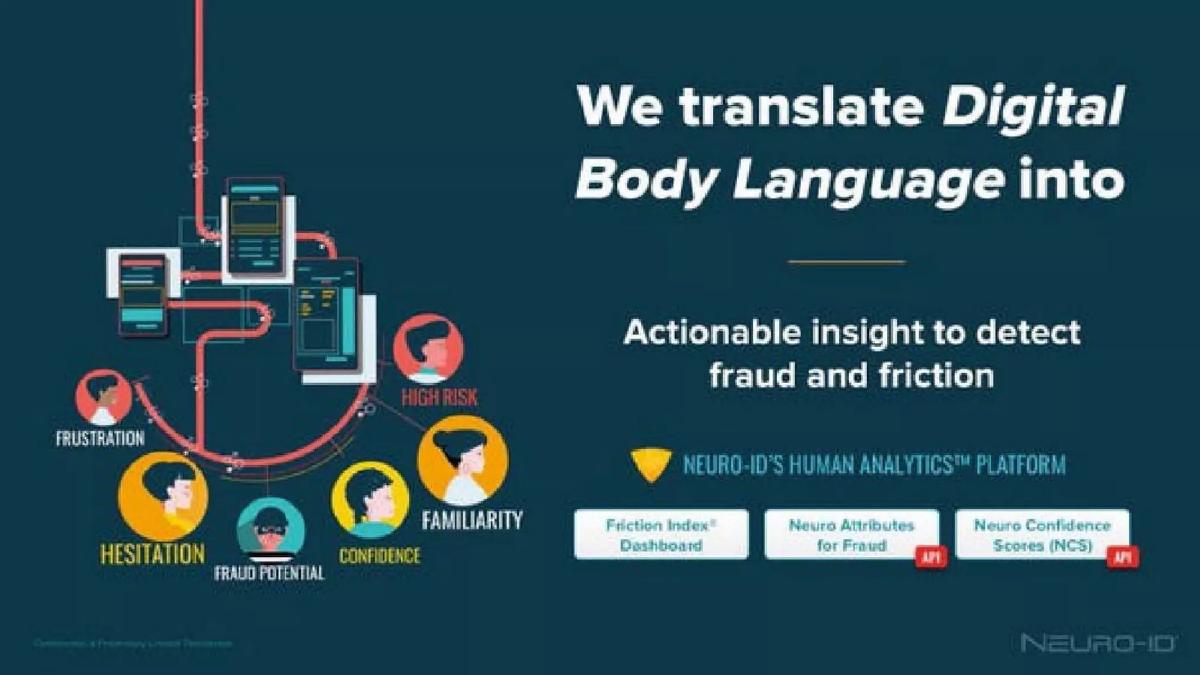
Slide 5 introduces the dual-value proposition: measuring "Intent" (Genuine vs. Fraudulent) and "Experience" (Friction). This is a clever positioning move because it appeals to both the Chief Security Officer and the Chief Product Officer. Slide 6 illustrates how "Digital Body Language" is translated into actionable insights through three specific outputs: a Friction Index Dashboard, Neuro Attributes for Fraud (API), and Neuro Confidence Scores (API). Slide 7 visualizes the business outcome: a balance scale where "Genuine Applicants" receive a "Frictionless CX" while "Fraudulent Applicants" are pushed through "Higher Friction verification." This slide clearly explains the ROI—saving money on fraud while making money by not annoying good customers.
Slide 8: Use Cases and Behavioral Markers
Slide 8 gets more granular about what the software actually monitors. For genuine applications, it looks for "Drop-off Prediction" and confusion. For fraudulent applicants, it monitors for "Low Familiarity" with personal info (indicating someone is reading off a script or database), "Session Fluency," and "Computer Savviness." This slide is critical for technical due diligence, as it explains the specific behaviors that trigger the fraud alerts mentioned earlier in the deck.
Slides 9-11: Team, Advisors, and Conclusion
Slide 9 presents "A Winning Team," adding the CFO and COO to the leadership group established on Slide 3. Slide 10, "Our Advisors," is particularly strong for a Series B deck. It lists six advisors across Fraud/Risk, Fintech, Technology, Strategy, Operational Excellence, and Lending. By including names from Wells Fargo, Expedia, and SoFi, Neuro-ID signals to investors that they have deep roots in their target verticals. The deck concludes on Slide 11 with a simple "Thank You" and the company logo.
What Works in the Neuro-ID Deck
The "Digital Body Language" Metaphor: By giving their technology a relatable name, they make complex behavioral analytics easy for a non-technical investor to understand and evangelize. · Academic Credibility: Citing 30,000+ academic citations (Slide 3) is a powerful way to establish a "moat." It suggests the technology isn't easily replicated by a competitor starting from scratch. · Dual-Sided ROI: Most fraud decks focus only on stopping bad actors. Neuro-ID focuses equally on the "Genuine" customer experience, which expands their market from just security to the much larger world of CX and conversion optimization. · Clear Traction: The jump to 92 million sessions (Slide 4) provides the necessary "hockey stick" visual that Series B investors look for to justify a larger valuation.
What is Missing from the Neuro-ID Deck
The Ask: There is no slide detailing how much capital is being raised or how it will be deployed (e.g., hiring, R&D, international expansion). · Competitive Landscape: The deck does not mention other behavioral biometrics companies or explain why Neuro-ID’s patented approach is superior to existing fraud detection tools. · Financials and Unit Economics: For a Series B, the lack of ARR (Annual Recurring Revenue), LTV (Lifetime Value), and CAC (Customer Acquisition Cost) is unusual. These were likely handled in a separate data room, but their absence in the main deck is notable. · Market Size (TAM/SAM): While they mention a $1.3T digital transformation problem, they don't define their specific addressable market size in dollars.
What a Founder Should Copy
The "Equation" Approach to Team: If you have a technical founder and a commercial lead, use the "Founder + CEO = Company" visual from Slide 3. It tells a complete story of innovation and execution in one glance. · Segmenting the Solution: Slide 7 is a perfect example of how to show a product's impact on two different user groups. Founders should copy this "Balance Scale" visualization to show how their product optimizes conflicting business goals. · Vertical-Specific Advisors: Don't just list advisors; categorize them by the value they bring (Slide 10). Showing you have a "Lending" advisor and a "Fraud" advisor tells the investor you have the right doors open in your target industries. · Outcome-Oriented Headlines: Instead of labeling a slide "Our Product," they use "Separate genuine customers from fraudulent ones" (Slide 7). Every headline in the deck is a statement of value.
Frequently asked questions
- What is the primary problem Neuro-ID solves?
- According to Slide 8, Neuro-ID addresses the conflict between creating a frictionless digital experience and preventing fraud. They solve this by determining user intent and experience in real-time. This allows 'genuine' users to be fast-tracked through onboarding while 'malicious' users are identified through anomalous behaviors like low familiarity with personal info or specific criminal behavior profiles.
- How does the technology actually work?
- The deck describes the technology as a 'Human Analytics Platform' that uses a lightweight JavaScript to monitor real-time behavioral data (Slide 4). It tracks 'Digital Body Language'—specifically how a user types, moves their mouse, taps, or scrolls—and translates those signals into a Friction Index, Neuro Attributes for Fraud, and Neuro Confidence Scores (Slide 6).
- What kind of traction did Neuro-ID show in this deck?
- On Slide 4, the company displays a growth chart showing they surpassed 92 million monitored sessions by June 2020. They also note that they serve 'Industry leaders in Payments, Lending, Fintech and Insurance' and are securing multi-year contracts with higher Annual Contract Value (ACV), though specific revenue figures are not disclosed.
- Who are the key people behind the company?
- The team is split between academic and commercial leadership (Slide 3 and 9). Co-founders Joe Valacich and Jeff Jenkins are doctoral professors and leaders in Human-Computer Interaction (HCI). CEO Jack Alton brings go-to-market expertise, citing three consecutive liquidity events exceeding $500 million. The team also includes a CFO/Head of Strategy and a COO/Head of Customer Success.
- What is missing from this Series B deck?
- This deck is notably brief for a Series B. It lacks a detailed competitive analysis, a breakdown of the total addressable market (TAM), specific financial projections, and a slide detailing the 'Ask' (how much they are raising and how they will spend it). It relies more on high-level value propositions and team pedigree than granular business operations data.