Netmaker's $2.3M seed deck is a masterclass in technical storytelling for a developer-centric product. The company identifies a specific shift in networking—moving away from hardware toward virtualized overlay networks—and positions itself as the infrastructure-first alternative to consumer-leaning VPNs. The deck's strength lies in its traction slide, which cites being the #3 fastest-growing startup on GitHub in Q1 2022 and having over 10,000 devices in active use. While the financial projections are redacted in this public version, the roadmap clearly outlines a transition from a free, sourc…
Key takeaways
- The deck identifies a $3.6B Secure Cloud Overlay market within a broader $1000B cloud computing sector (Slide 5).
- Traction is anchored by open-source metrics, including 5.5k GitHub stars and 1000 community members (Slide 8).
- The product is positioned as 'built for infra,' specifically differentiating itself from Tailscale by using Kernel WireGuard and configuring for infrastructure (Slide 12).
- Netmaker reports 50% month-over-month growth for six months leading up to the pitch (Slide 8).
- The business model follows an 'Open Core' strategy, moving from a self-hosted platform to a closed-source Pro version (Slide 9).
- The technical co-founders, Alex and Dillon, leverage their experience managing multi-cloud and Kubernetes teams at IBM (Slide 13).
- The roadmap targets a transition to a SaaS model by 2023, including backups and a network backbone (Slide 10).
- Product functionality is summarized in a four-step 'How it works' diagram involving a UI-managed server and machines synced 'by magic' (Slide 7).
Introduction and Vision
Slide 1: Title Slide
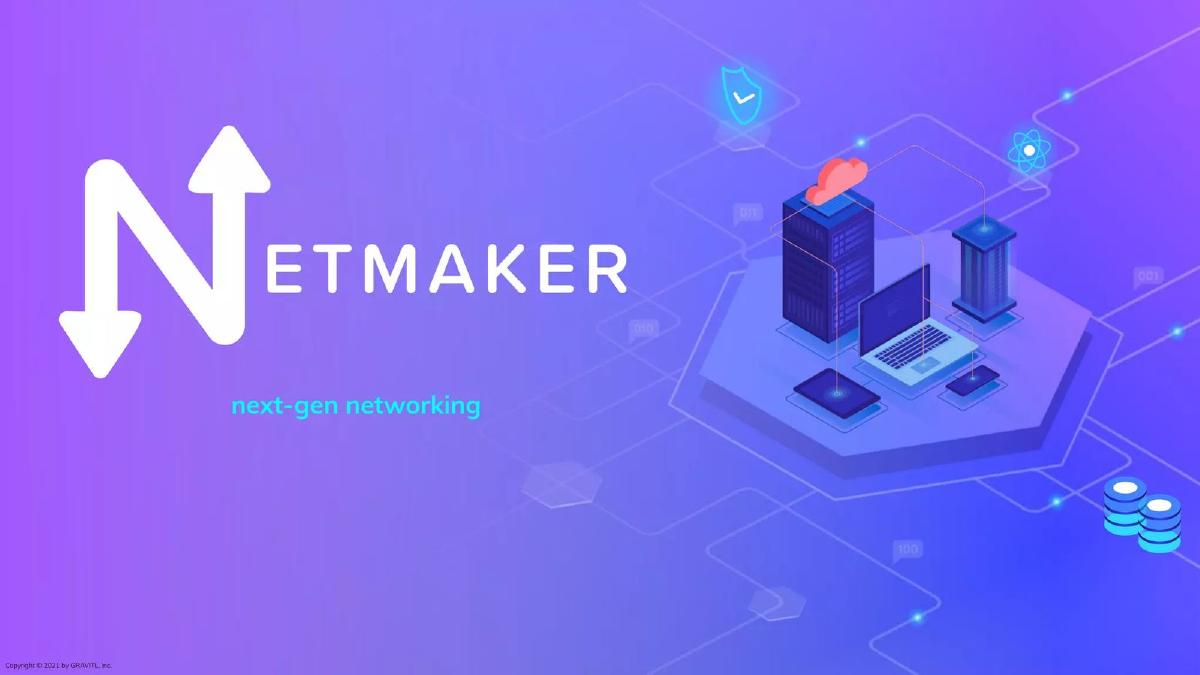
The deck opens with a clean, high-contrast title slide featuring the Netmaker logo—a stylized 'N' with up and down arrows—and the tagline 'next-gen networking.' The background uses a purple-to-blue gradient with isometric illustrations of servers, laptops, and cloud icons, immediately signaling a focus on cloud infrastructure. A small copyright notice for 2021 by GRAVITL, Inc. appears in the corner.
Slide 2: The Problem
Netmaker frames the problem broadly: 'Modern networking is fundamentally flawed.' They categorize the current state of the industry into three pain points: Static, Complex, and Insecure. The slide includes a complex AWS VPC diagram to visually represent the 'complex' nature of existing solutions, ending with the ominous note, 'Every year it's getting worse.'
Slide 3: The Vision
This is a 'future-state' slide. It predicts that in 10 years, network infrastructure will be entirely virtualized with simple overlay networks. The boldest claim is that 'No company will own networking hardware or configure complex networks.' This sets the stage for Netmaker to be the tool that facilitates this transition.
Product and Market
Slide 4: The Solution
Netmaker introduces its platform as a tool that 'simplifies networking by securely connecting devices everywhere.' The slide explicitly mentions the use of WireGuard , which it claims makes the platform 'extremely fast, secure, and dynamic.' The accompanying graphic shows nodes labeled Office, IoT, AWS, Data Center, and Edge all interconnected.
Slide 5: Market Size
The deck uses a nested circle diagram to define its Total Addressable Market (TAM). It starts with Cloud Computing at $1000B, narrows to Cloud Networking at $60B, and identifies the specific 'Secure Cloud Overlay' market as a $3.6B market . This is a realistic and focused approach to market sizing, rather than claiming the entire $1T cloud market.
Slide 6: Product Interface
This slide provides a screenshot of the Netmaker dashboard. It shows a 'devops Nodes' list with columns for Addresses, Version, Network, and Status (all marked 'HEALTHY'). The text emphasizes the ability to 'Easily create and manage virtual networks that span clouds, data centers, and edge environments.'
Slide 7: How it Works
A technical architecture diagram explains the four-step process: 1. Admin manages networks via UI, 2. Machines added with keys, 3. Machines kept in sync 'by magic,' and 4. Client devices hook in via gateway. The diagram shows the relationship between the Netmaker Server (using CoreDNS and SQL) and the Mesh Network of Netclient nodes.
Traction and Business Model
Slide 8: Traction
This is arguably the strongest slide in the deck. It lists impressive growth metrics: 10,000+ devices in active use, 1400+ production platforms, and 50% MoM growth for six months. It also highlights community engagement with 1000 members and 5.5k stars on GitHub, citing Runa Capital's index to prove they were the #3 fastest-growing startup on GitHub in Q1 2022.
Slide 9: Business Model
Netmaker details an 'Open Core Model.' The 'Current' phase focuses on adoption through a source-available, self-hosted platform. The 'Next' phase introduces a 'Closed Source Pro Version.' While the specific dollar amounts for SMB and Enterprise spend are redacted in this version, the slide sets a goal for 'Redacted MRR by end of 2023' supported by 150 SMBs and 5 Enterprises.
Slide 10: Go to Market
The GTM strategy is presented as a timeline from 2021 to 2023. Phase 1 (2021) was 'Start Free' to build community. Phase 2 (2022, where the arrow indicates they are currently) is 'Add Enterprise' features like redundancy and metrics. Phase 3 (2023) is 'Go SaaS,' adding backups and a network backbone.
Slide 11: Roadmap
This slide provides a granular quarterly breakdown for 2022 and 2023. Key milestones include IPv6 networks and a Client GUI in Q2 2022, a Beta Enterprise version in Q3 2022, and a 1.0 release in Q4 2022. For 2023, the focus shifts to SaaS Beta, Kubernetes integrations, and a 2.0 release, culminating in a 'Redacted MRR' target in Q4 2023.
Competition and Team
Slide 12: Competition
Netmaker uses a standard checkmark grid to compare itself against Tailscale, Defined Networking (Nebula), and Aviatrix. Netmaker claims to be the only one that checks all four boxes: Creates Mesh VPNs, Uses Kernel WireGuard, Configures for Infrastructure, and achieves >90% Speed of direct, unencrypted connections . Notably, it differentiates from Tailscale by claiming Tailscale does not use Kernel WireGuard or configure specifically for infrastructure.
Slide 13: Team
The team slide features the two technical co-founders, Alex and Dillon. Their credentials include working together at IBM , managing teams for multi-cloud and Kubernetes, and helping 'secure millions in deals.' This establishes them as founders who understand the enterprise environments they are trying to sell into.
Slide 14: Closing
The deck ends with a simple logo slide. There is no 'Ask' slide in this version, which is common in public-facing teardowns where specific funding terms are removed.
What Netmaker Does Well
The deck excels at technical validation . By citing their GitHub growth and specific performance metrics (like the >90% speed claim), they speak directly to the concerns of their primary user base: DevOps and Infrastructure engineers. The transition from 'Open Source' to 'Enterprise' is a well-trodden and successful path in software, and Netmaker maps this out clearly. The use of a specific, smaller TAM ($3.6B) makes the business case feel more grounded and achievable than generic 'trillion-dollar' cloud pitches.
What is Missing
The most notable omission is a detailed financial breakdown . While the public version has redacted these, a standard seed deck should ideally show unit economics or a clear plan for how the $2.3M will be deployed (the 'Use of Funds'). Additionally, while the 'How it Works' slide mentions machines are synced 'by magic,' a sophisticated investor might want more detail on the orchestration layer to ensure the 'magic' is scalable and proprietary. There is also no mention of a Board of Directors or existing advisors, which can add weight to a seed-stage team.
Founder Takeaways
Leverage Open Source: If you have a developer tool, GitHub stars and community growth are your most valuable currency. Netmaker uses these to prove market fit before they have massive revenue. · Differentiate by Use Case: Netmaker doesn't just say they are 'better' than Tailscale; they say they are 'built for infra.' This specific positioning helps them avoid a head-to-head battle for the general VPN market and focuses them on high-value data center use cases. · Show the Roadmap: For an Open Core company, the path to monetization can be confusing. The clear distinction between 'Source-available,' 'Pro,' and 'SaaS' in Slides 9 and 10 provides a logical narrative for how a free tool becomes a profitable business. · Use Credible Benchmarks: Citing Runa Capital's index (Slide 8) provides third-party validation that is much more convincing than a founder simply claiming their product is popular.
Frequently asked questions
- What is the core problem Netmaker aims to solve?
- According to Slide 2, Netmaker argues that modern networking is 'fundamentally flawed' because it is static, complex, and insecure. The deck suggests that existing solutions merely hide these issues rather than solving them, leading to increased difficulty in managing infrastructure as it scales.
- How does Netmaker differentiate itself from competitors like Tailscale?
- Slide 12 provides a direct comparison. Netmaker claims to be specifically 'built for infra.' Unlike Tailscale, Netmaker highlights its use of 'Kernel WireGuard' and its ability to achieve '>90% speed of direct, unencrypted connections,' positioning it as a higher-performance option for data centers and edge environments.
- What is the significance of their GitHub ranking?
- Slide 8 notes that Netmaker was the '#3 fastest growing startup on GitHub in Q1, 2022' according to Runa Capital. For a seed-stage technical startup, this serves as a powerful proxy for developer interest and market validation before significant revenue is established.
- What is the planned revenue model?
- Slide 9 outlines an 'Open Core Model.' The company started with a source-available, self-hosted platform to drive adoption. The next phase involves a 'Closed Source Pro Version' targeting SMBs and Enterprises, followed by a full SaaS offering mentioned in the roadmap on Slide 10.
- Who are the founders and what is their background?
- The company was founded by Alex and Dillon. Slide 13 states they worked together at IBM, where they managed teams focused on multi-cloud and Kubernetes (k8s) and helped secure 'millions in deals,' establishing their domain expertise in enterprise infrastructure.