New Era ADR’s 13-slide deck is a masterclass in establishing founder-market fit and identifying a clear, painful bottleneck in a massive industry. By positioning legal disputes as a 'massive cost of doing business' rather than just a legal hurdle, the team appeals to the economic interests of enterprise leaders. The deck highlights a highly experienced founding team with multiple exits and deep legal backgrounds, which is critical for a high-trust sector like ADR (Alternative Dispute Resolution). Their 'Stripe for Law' analogy—where companies simply copy-paste contract language to adopt the p…
Key takeaways
- The founding team features three members with previous exits and deep legal experience at AmLaw 20 firms (Slide 2).
- Traditional litigation is framed as a 2-3 year process costing $100K-$1M+ per case, which New Era claims to reduce by 90% (Slide 3, 5).
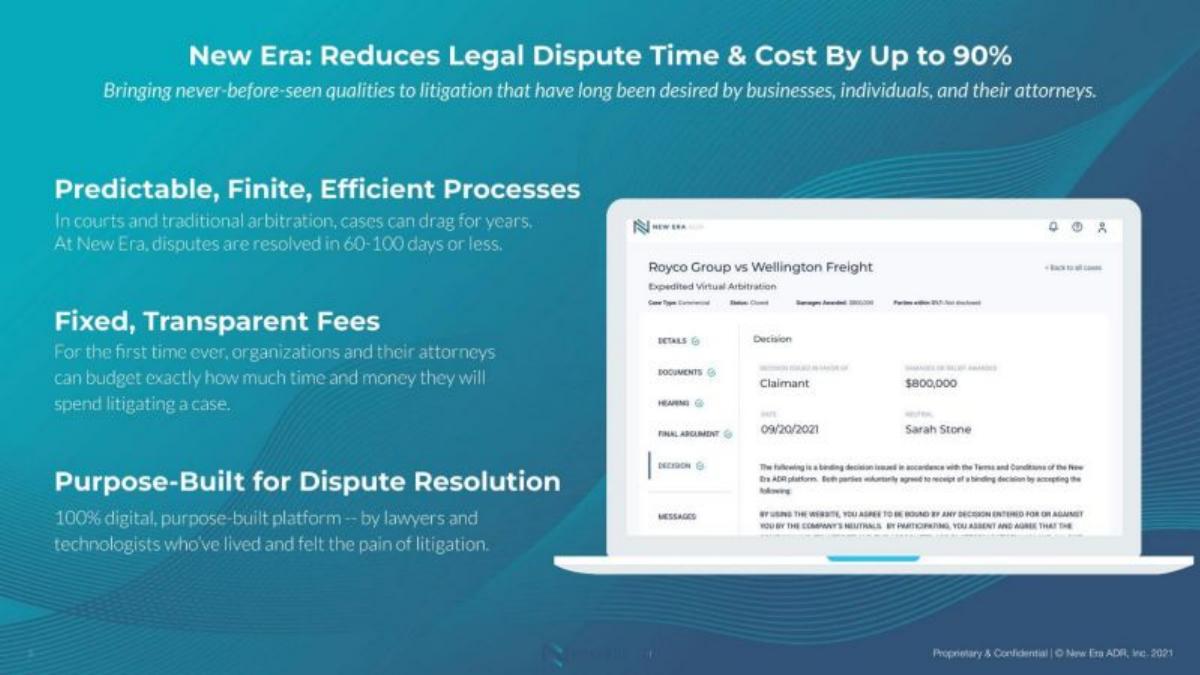
- The platform resolves disputes in 60-100 days or less using a 100% digital, purpose-built platform (Slide 5).
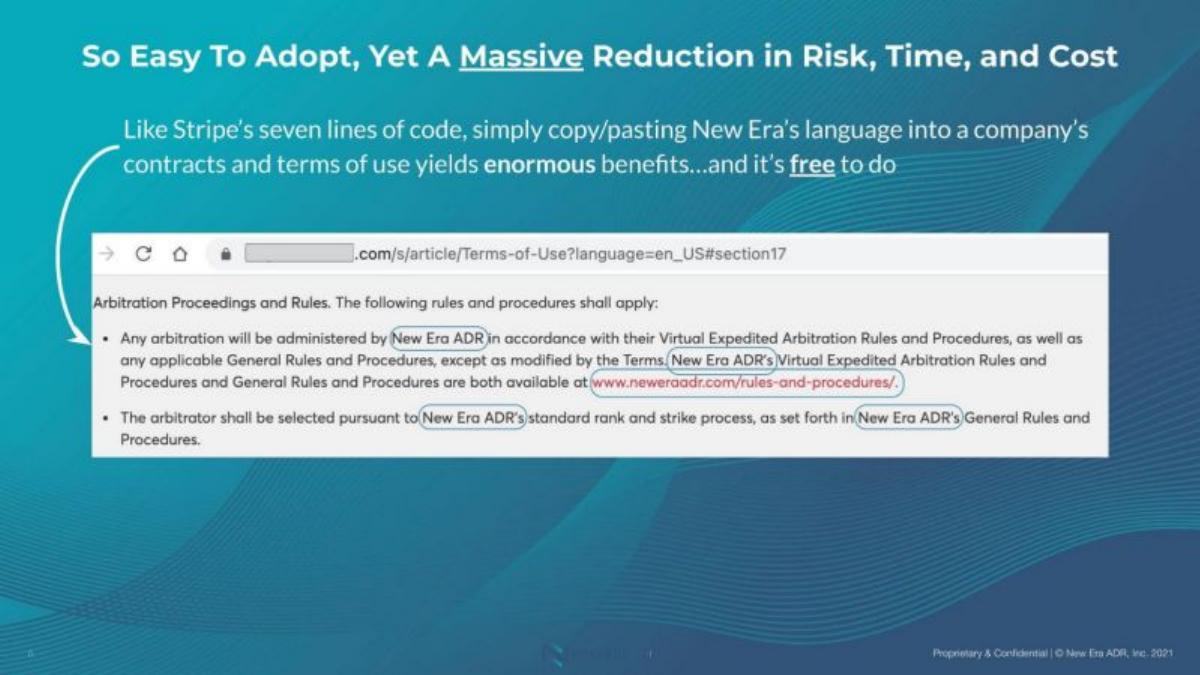
- Adoption is driven by a 'copy/paste' model of contract language, similar to Stripe's seven lines of code (Slide 6).
- The Total Addressable Market (TAM) is valued at $250 billion, with a Serviceable Obtainable Market (SOM) of $11 billion (Slide 9).
- Traction grew exponentially from 300 contracts in April 2021 to approximately 30,000,000 contracts by August 2021 (Slide 10).
- The company secured a multi-year contract with a Fortune 500 company within four months of launch (Slide 10).
- The deck utilizes a high-profile advisory board including founders of OptionsXpress and Reverb to bolster credibility (Slide 13).
Executive Summary: The Digital Transformation of Litigation
New Era ADR’s pitch deck is a focused, 13-slide narrative that targets one of the last remaining 'analog' bastions of the enterprise: the legal dispute. By framing litigation as a massive, unpredictable drain on corporate resources, the company positions its automated platform as an essential financial and operational tool rather than just a legal service. The deck successfully balances high-level market opportunity ($250B TAM) with granular proof of execution, specifically the rapid scaling of contract adoption.
Slide 1: Title and Value Proposition
The cover slide establishes a clean, professional brand identity. The subtitle, "Reinventing the massive litigation industry and saving companies and individuals up to 90% in cost and time," immediately quantifies the value proposition. This 90% figure is the 'north star' metric used throughout the deck to justify the shift from traditional courts to a digital platform.
Slide 2: The Team - Founder-Market Fit
New Era ADR places its team slide second, a strategic move for a Seed-stage company in a high-barrier-to-entry industry. The slide highlights four co-founders: Collin Williams, Rich Lee, Michelle Tyler, and Shane Mulrooney . Key credentials cited include "1 exit" for three of the four members and backgrounds as "Ex-AmLaw 20" litigators and "General Counsel." The bottom of the slide features a 'logo wall' of previous employers, including Oracle, Jones Day, Kirkland & Ellis, and Etsy , signaling that the team understands both the legal requirements and the tech-scaling requirements of the business.
Slide 3: The Problem - Inefficiency as a Cost
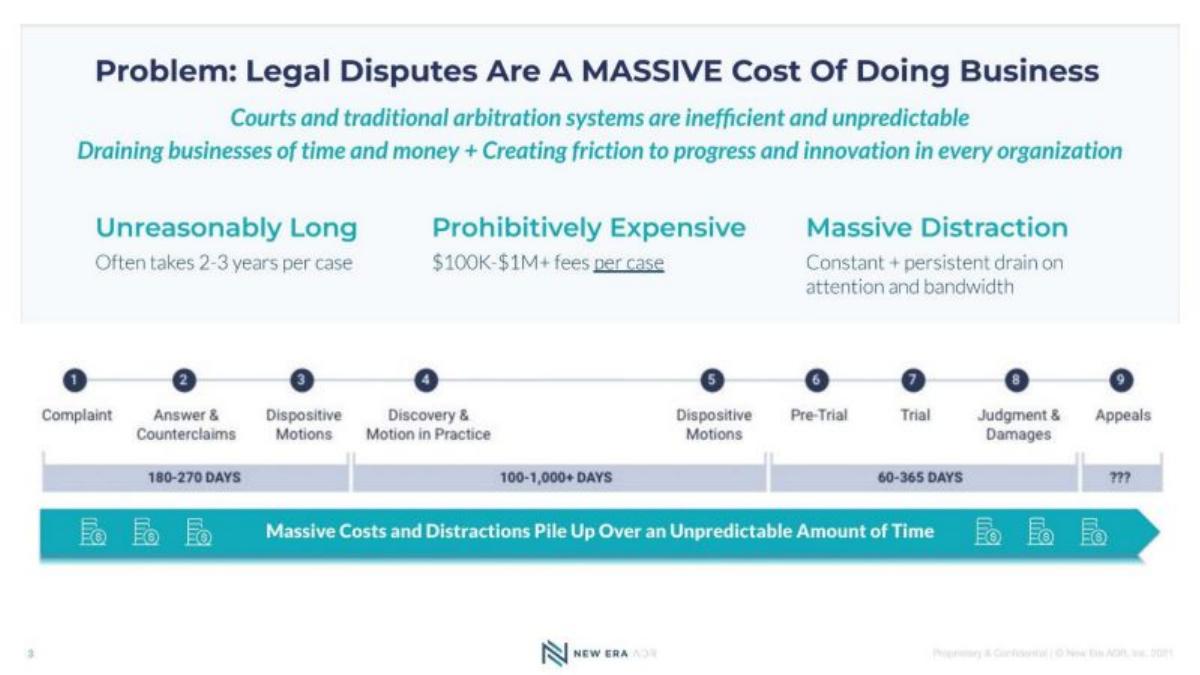
The problem is defined not just as a legal issue, but as a "MASSIVE Cost of Doing Business." The slide breaks down the pain points into three categories: Unreasonably Long (2-3 years per case), Prohibitively Expensive ($100K-$1M+ fees per case), and Massive Distraction. A timeline graphic at the bottom illustrates the 9-step traditional litigation process, noting that steps 1 through 8 can take over 1,000 days, with the appeals process (step 9) marked with a question mark, indicating total unpredictability.
Slide 4: The Human Element
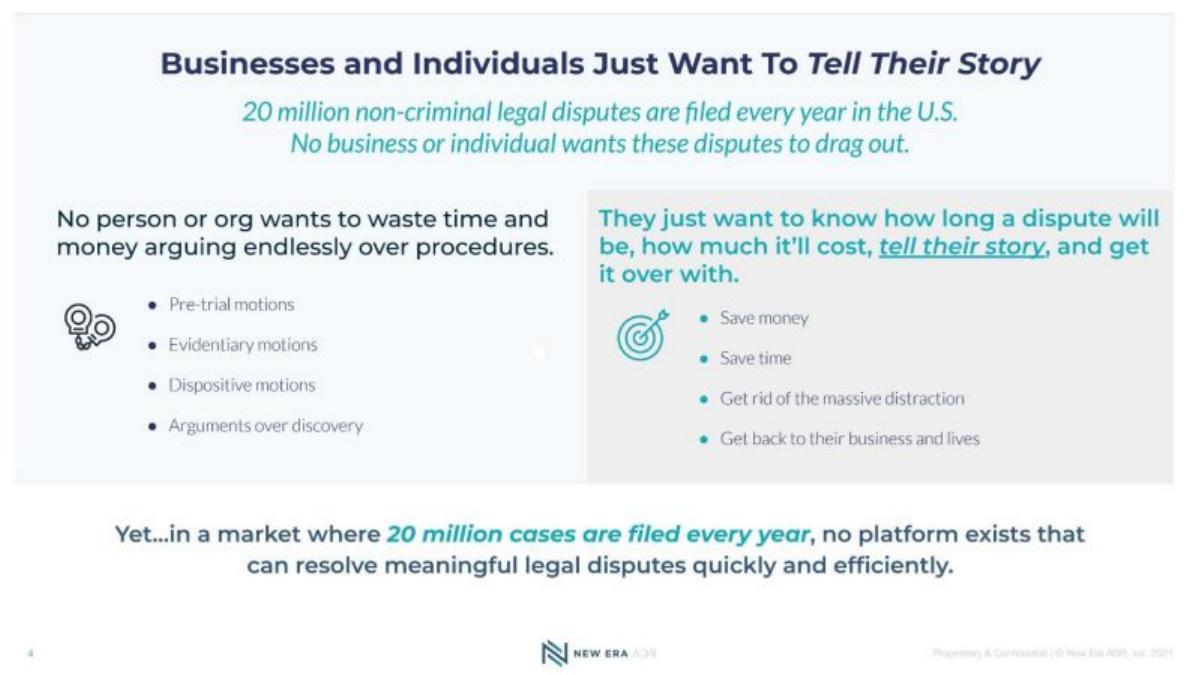
Slide 4 shifts the focus to the 20 million non-criminal legal disputes filed every year in the U.S. It argues that businesses and individuals don't want to argue over procedures (motions, discovery); they want to "tell their story" and get back to their lives. This slide serves to humanize the problem while reinforcing the massive volume of the market.
Slide 5: The Solution - The Digital ADR Platform
The solution slide introduces the product interface via a laptop mockup. It promises "Predictable, Finite, Efficient Processes" where disputes are resolved in 60-100 days or less . It also highlights "Fixed, Transparent Fees," which addresses the cost unpredictability mentioned in the problem slide. The platform is described as "100% digital" and "purpose-built" by the very people who have felt the pain of litigation.
Slide 6: The 'Stripe' Analogy for Adoption
This is arguably the most important slide for a venture investor. It addresses the 'go-to-market' challenge: how do you get people to use a new legal forum? New Era ADR compares itself to Stripe’s seven lines of code . By copy-pasting New Era’s language into a company’s contracts and terms of use, the company becomes the default resolution platform. A screenshot of a "Terms of Use" page shows the specific highlighted text that links to New Era's rules and procedures.
Slide 7: Business Model and Product Tiers
The company offers two primary ways to engage with the platform: Tailored Subscription Risk Solutions and On-Demand Arbitrations + Mediations . This suggests a hybrid SaaS and transactional model. The slide emphasizes that the platform is "fairer" and "more accessible," aiming to remove the "gamesmanship" typical of traditional litigation.
Slide 8: Market Size - The $250B Opportunity
The market slide uses a standard concentric circle diagram to define the opportunity:
TAM (Total Addressable Market): $250 Billion · SAM (Serviceable Addressable Market): $178 Billion · SOM (Serviceable Obtainable Market): $11 Billion
Crucially, the slide notes that New Era will "grow the size of this market" because millions of disputes currently go unfiled due to cost and time. This 'market expansion' narrative is a common trope in successful tech pitches (e.g., Uber expanding the black car market).
Slide 9: Traction and Momentum
Slide 10 provides a monthly timeline of growth from April 2021 to August 2021. The metrics are impressive for a five-month window:
April 2021: Launched with $1.7M pre-seed; adopted in 300+ contracts. · June 2021: Adopted in 1,000+ contracts. · July 2021: Signed multi-year contract with Fortune 500 ; adopted in ~16,000,000 contracts. · August 2021: Adopted in ~30,000,000 contracts .
The jump from 1,000 to 30 million contracts in two months is the 'hockey stick' moment of the deck, likely driven by the Fortune 500 deal mentioned in July.
Slide 10: Social and Professional Impact
The deck takes a moment to address the broader impact on Organizations, Law Firms, Individuals, and Society . It argues that law firms will actually see "increased profitability" by doing more sophisticated work and offering flat fees, rather than getting bogged down in procedural 'grunt work.' This is a clever way to neutralize potential opposition from the legal establishment.
Slide 11: Use of Proceeds
The 'Ask' slide is titled "Capital to Accelerate Market Penetration In A Greenfield Market." It lists four objectives: Increase First Mover Advantage, Expand Growth and Engineering Teams, Fuel Product Development, and Forward-Looking Revenue Goals. Note: The specific dollar amount of the raise and the specific revenue goals are redacted/greyed out in this version of the deck, which is common for public teardowns but leaves the reader wanting more specifics on the round's terms.
Slide 12: The Advisory Board
To further de-risk the investment, Slide 13 showcases ten "Active & Engaged Advisors." These include high-profile names like David Kalt (Founder of OptionsXpress and Reverb), Sean Chou (Founder of Catalytic), and Mark Partin (Chief Privacy Officer at Oracle). Having a mix of tech founders and legal experts (like the Deputy Dean of the University of Chicago School of Law) reinforces the company's dual identity as a legal-tech powerhouse.
Slide 13: Closing Statement
The final slide is a simple mission statement: "Legal disputes are friction to progress and innovation. We’re reshaping a massive industry to exponentially reduce costs and make the justice system more accessible for all." It invites the investor to "Join us on our journey."
What New Era ADR Does Well
1. The Stripe Analogy: Comparing a legal platform to a developer tool like Stripe is brilliant. It reframes a complex, slow-moving legal sale into a simple, high-velocity technical implementation. It tells the investor that this isn't just a law firm with a website; it's a scalable infrastructure play.
2. Credibility Building: In the legal space, trust is everything. By leading with a team of AmLaw 20 veterans and closing with an advisory board of billion-dollar-exit founders, New Era ADR effectively silences the 'can they actually do this?' question before it's even asked.
3. Quantified Pain: The deck doesn't just say litigation is bad; it says it takes 1,000+ days and costs $1M. These specific numbers make the 90% savings claim feel grounded in reality rather than marketing fluff.
What Is Missing From the Deck
1. Unit Economics: While the deck mentions subscriptions and on-demand fees, it provides no data on the average contract value (ACV), the cost to resolve a case, or the margins on the platform. Investors would want to know if the 90% savings for the customer still leaves enough room for a high-margin SaaS business.
2. Competitive Landscape: The deck claims to be a "First Mover" in a "Greenfield Market." However, traditional ADR giants like AAA (American Arbitration Association) and JAMS exist, as do other legal-tech startups. A slide addressing why these incumbents can't simply digitize their own processes would have been valuable.
3. The 'Neutral' Supply Side: Arbitrations require arbitrators (neutrals). The deck focuses heavily on the technology and the parties in the dispute, but says little about how they recruit, vet, and pay the legal professionals who actually decide the cases on the platform.
Founder Takeaways: What to Copy
Focus on Frictionless Adoption: If your product requires a change in behavior or a long sales cycle, find your version of the "copy/paste" slide. Show the investor exactly how easy it is for a customer to say 'yes.'
Leverage Your Pedigree: If you are building in a regulated or traditional industry (Law, Healthcare, Finance), your team slide is your most important asset. Don't hide it at the end. Use it to build an immediate foundation of trust.
The 'Market Expansion' Argument: Don't just fight for a piece of the existing pie. Explain how your lower price point or increased efficiency will bring new customers into the market who were previously priced out. This turns a large market into a massive one.
Frequently asked questions
- How much did New Era ADR raise with this deck?
- According to the catalogue facts, New Era ADR raised $4.6M in a Seed round in 2022. The deck itself (Slide 10) mentions a previous $1.7M pre-seed funding round in April 2021, but does not explicitly state the target amount for the round associated with this specific presentation.
- What is the core value proposition for businesses?
- The core value proposition is the reduction of time and cost by up to 90%. As stated on Slide 5, New Era ADR moves cases from a traditional 2-3 year timeline to a 60-100 day resolution window with fixed, transparent fees, allowing companies to budget accurately for litigation.
- How does the platform acquire users?
- New Era ADR uses a 'low-friction' adoption strategy. Slide 6 explains that companies can simply copy and paste specific arbitration language into their terms of use or contracts. This 'Stripe-like' approach makes the platform the default venue for any future disputes arising from those contracts.
- What is the business model?
- The deck outlines a dual-revenue approach on Slide 7: Tailored Subscription Risk Solutions for organizations looking to reduce litigation exposure, and On-Demand Arbitrations + Mediations for entities that wish to use the platform on a per-case basis without a subscription.
- Who are the founders and why are they qualified?
- The team (Slide 2) consists of legal and tech veterans. Collin Williams (Chairman) and Shane Mulrooney (Growth) are both former AmLaw 20 litigators and General Counsels with exits. Rich Lee (CEO) is a 2x General Counsel with an exit. This deep domain expertise is vital for navigating the regulatory and professional complexities of the legal industry.