Contractbook’s 13-slide deck is a highly efficient example of a Series A presentation that prioritizes traction and market vision over feature lists. The deck highlights a nearly 4x year-over-year ARR growth and a 110% Net Dollar Retention, signaling strong product-market fit. Its core thesis—that contracts should be stored as metadata rather than static PDFs—provides a clear technological moat. By targeting the underserved SME market in both the US and EU, Contractbook identifies a $124B TAM. The presentation concludes with a transparent funding history, showing a jump from a $4M Seed to a $…
Key takeaways
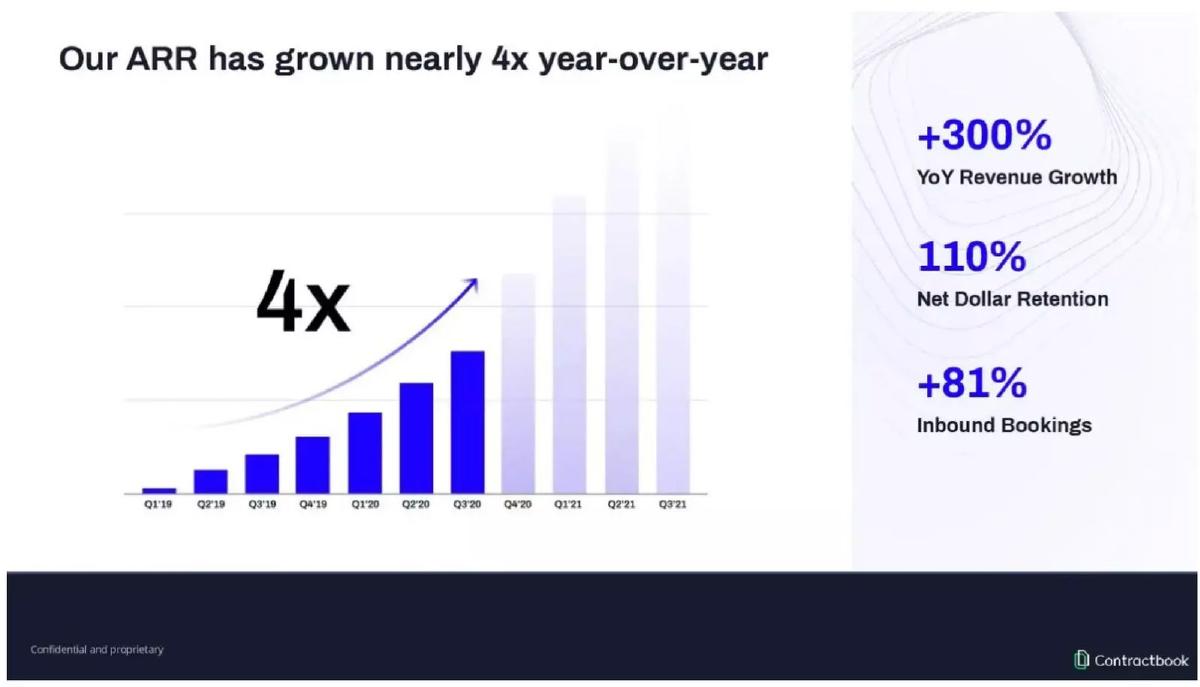
- The company reports nearly 4x year-over-year ARR growth as of Q3 2020 (Slide 6).
- Contractbook achieves a 110% Net Dollar Retention, indicating strong expansion within existing accounts (Slide 6).
- The deck identifies a $124B Total Addressable Market based on 53.9M SMEs in the US and EU (Slide 9).
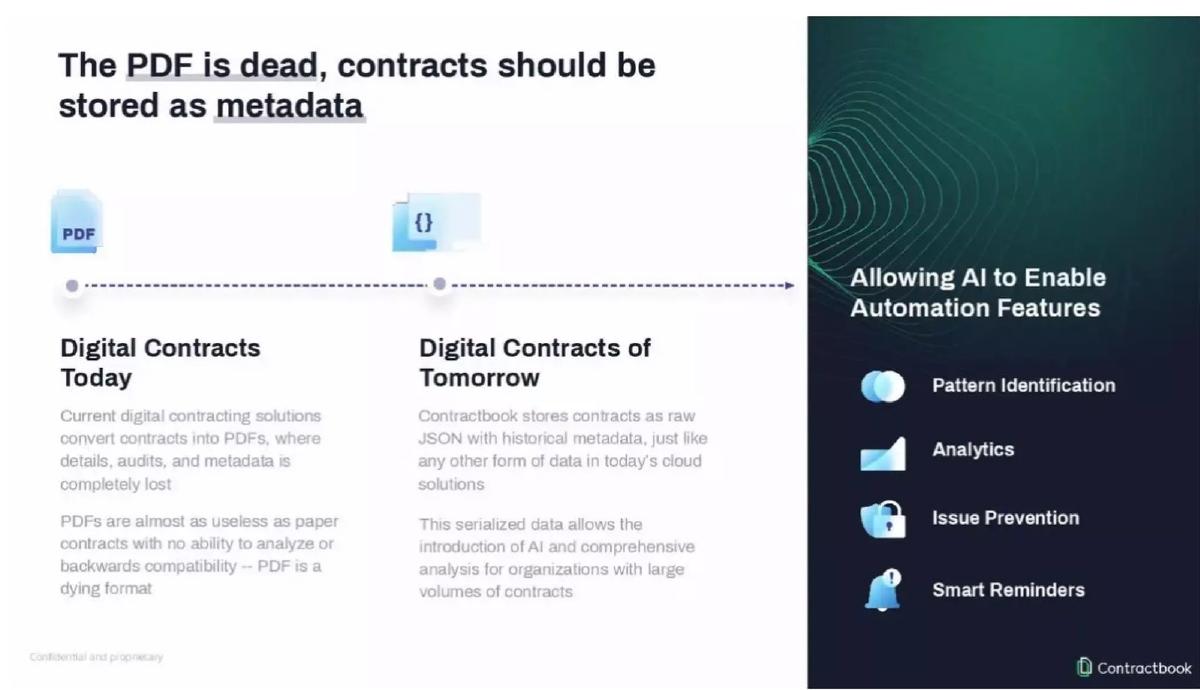
- A core technical differentiator is the shift from PDF storage to raw JSON with historical metadata (Slide 5).
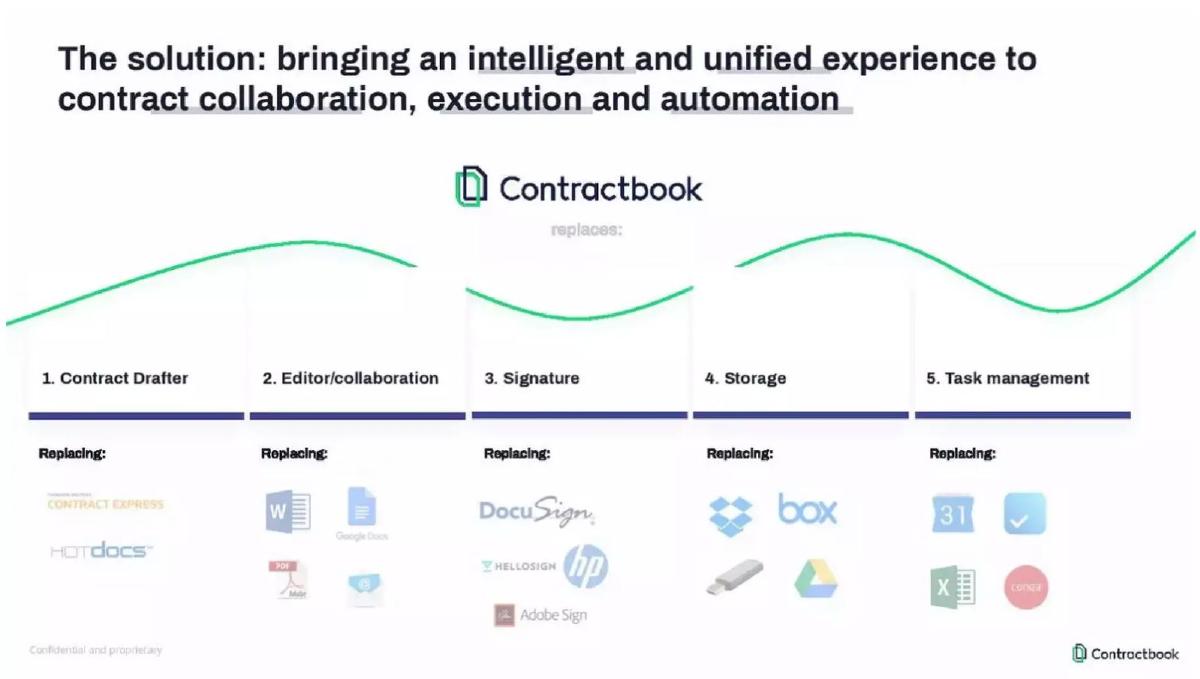
- The platform aims to replace five distinct tool categories: drafters, editors, signature tools, storage, and task management (Slide 3).
- Organic usage is growing at a rate of 22% quarter-over-quarter (Slide 7).
- The team is 60+ strong and distributed throughout Europe, with founders based in Copenhagen (Slide 11).
- The deck explicitly states a $9.4M Series A round led by Bessemer Venture Partners and Gradient Ventures (Slide 12).
Introduction: The Data-First Approach to Legal Tech
Contractbook’s December 2020 pitch deck is a masterclass in Series A storytelling. At this stage, investors are looking for proof of a repeatable sales motion and a massive market opportunity. Contractbook delivers both by framing the legal industry’s reliance on PDFs as a fundamental technical debt that their platform resolves. By treating contracts as raw data (JSON) rather than images or static text, they unlock automation capabilities that traditional e-signature or storage players cannot match.
Slide 1-2: The Hook and the Pain Point
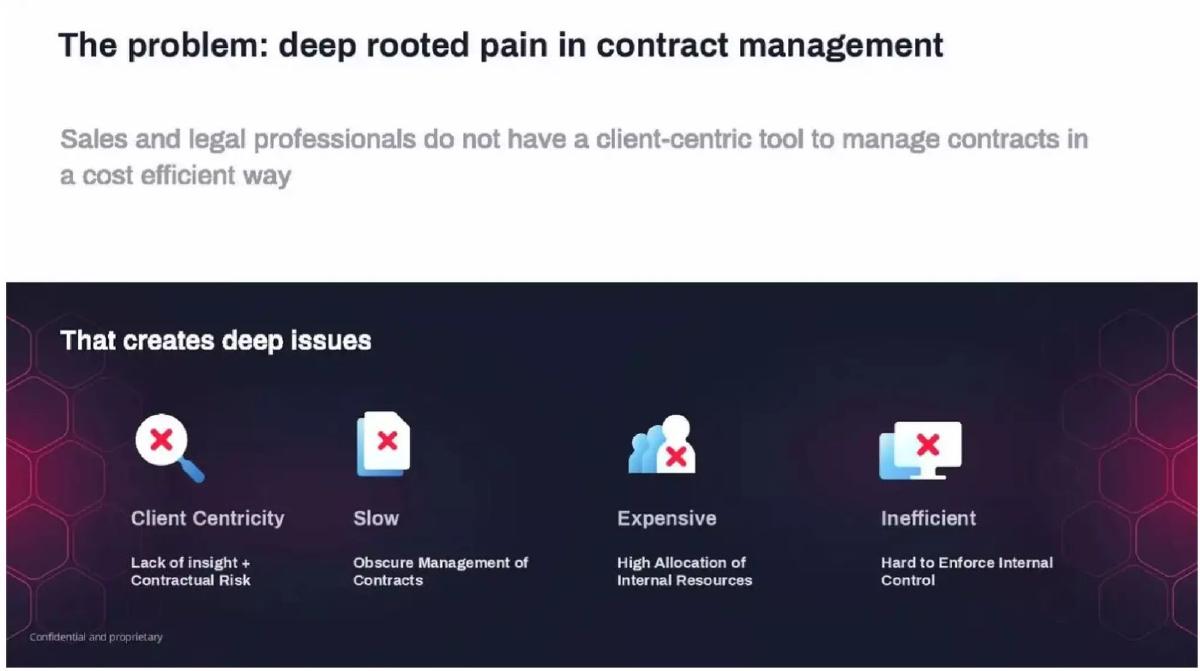
The deck opens with a clean title slide, Slide 1 , establishing the brand as "A smarter way to work with contracts." It quickly moves to Slide 2 , which defines the problem: "deep rooted pain in contract management." The slide identifies that sales and legal professionals lack a "client-centric tool" that is cost-efficient. It breaks the pain down into four pillars: Lack of insight (Client Centricity), Obscure management (Slow), High allocation of resources (Expensive), and Hard to enforce control (Inefficient). This sets a broad stage for a solution that touches multiple departments, not just legal.
Slide 3-5: The Solution and Technical Moat
Slide 3 is a critical "replacement" slide. It visualizes the Contractbook ecosystem as a unified wave that replaces five distinct categories: Contract Drafters (HotDocs), Editors (Word/Google Docs), Signatures (DocuSign/HelloSign), Storage (Box/Dropbox), and Task Management (Excel/Trello). This positions the company as a platform, not a point solution.
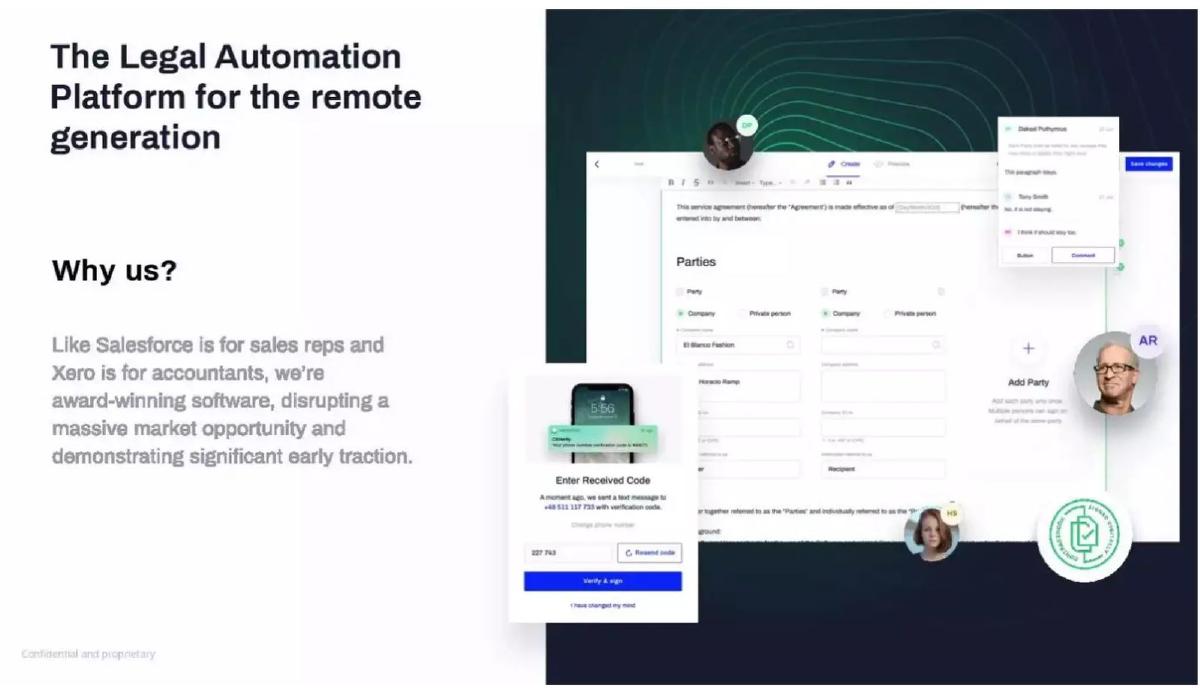
Slide 4 introduces the product interface, describing it as "The Legal Automation Platform for the remote generation." It uses a Salesforce/Xero analogy to establish its category-defining ambitions. Slide 5 presents the deck's most compelling technical argument: "The PDF is dead." By contrasting "Digital Contracts Today" (static PDFs) with "Digital Contracts of Tomorrow" (raw JSON with metadata), Contractbook explains how it enables AI features like pattern identification and issue prevention. This slide justifies why they are different from every other e-signature tool on the market.
Slide 6-8: Traction and Social Proof
The deck shifts into high gear with Slide 6 , showcasing that ARR has grown nearly 4x year-over-year. The metrics are top-tier: +300% YoY Revenue Growth , 110% Net Dollar Retention , and +81% Inbound Bookings . The 110% NDR is particularly important for SaaS investors, as it proves the product is sticky enough that customers spend more over time.
Slide 7 reinforces this with usage data. It shows two charts: "Contracts created" and "Contracts stored." A notable spike in Q2 2018 is attributed to "GDPR Enforced," showing the company's ability to capitalize on regulatory tailwinds. The slide claims a 5x increase in stored contracts in the last year and 22% organic QoQ growth . Slide 8 provides social proof through customer quotes from Hi Fitness, Webbler, Mutebox, and Frankly Juice, emphasizing speed ("2-3 minutes to create a contract") and future-proofing.
Slide 9-10: Market Opportunity and Positioning
Slide 9 tackles the TAM (Total Addressable Market). It uses a simple but effective calculation: 53.9M US & EU SMEs multiplied by a $2.3K Annual ASP equals a $124B TAM . The slide notes that their realized ASP has grown by 104% YTD in 2020, suggesting they are successfully moving up-market or increasing their value per seat.
Slide 10 summarizes their competitive edge into four quadrants: Ease of Implementation (under an hour), Immediate Value (simplification and storage), Self-Service for SMBs (business-critical for the long-tail), and Geographic Edge (limited competition in Europe). This slide addresses the "Why Now" and "Why You" questions simultaneously.
Slide 11-13: The Team and The Ask
Slide 11 introduces the founders: Niels Martin Brochner (CEO), Jarek Owczarek (CPO), and Viktor Heide (COO). It also highlights a "Distributed team" of 60+ people. The right side of the slide is a "who's who" of venture capital, listing advisors and investors from Gradient Ventures and Bessemer Venture Partners , including Mary D’Onofrio and David Cowan. This level of institutional backing is a massive signal of quality.
Slide 12 is the "Ask" slide, though it functions more as a history of success. It shows a $4M Series Seed in October 2019 led by Gradient and byFounders, followed by the "Now"—a $9.4M Series A led by Bessemer and Gradient. The stated goal for the funds is to "expand sales internationally." The deck concludes with a simple "Thank you!" on Slide 13 .
What Works in This Deck
The "PDF is Dead" Narrative: By attacking the industry standard (PDFs) as a "dying format," Contractbook creates a sense of urgency and technical superiority. · Exceptional Retention Metrics: Stating a 110% Net Dollar Retention is a powerful way to prove product-market fit without needing a long list of features. · Clear Replacement Logic: Slide 3 clearly shows which budgets Contractbook is competing for, making it easier for an investor to understand the sales process. · Bottom-Up TAM: Instead of using a vague Gartner number, they calculated their market based on their own realized ASP and actual SME counts.
What Is Missing
Unit Economics: While they mention ASP growth, there is no mention of CAC (Customer Acquisition Cost) or LTV (Lifetime Value), which are standard for a Series A teardown. · Competitive Matrix: The deck lists tools it replaces, but it doesn't explain how it wins against direct competitors in the CLM space like Ironclad or Juro. · Financial Projections: There are no forward-looking revenue targets or a breakdown of how the $9.4M will be spent across specific departments (e.g., % to R&D vs. % to Sales).
What a Founder Should Copy
The Salesforce Analogy: If you are building a platform, compare yourself to a known category leader (Slide 4) to anchor the investor's expectations. · Visualizing the Stack: Use logos of well-known companies (Slide 3) to show exactly what your software replaces. It’s the fastest way to communicate utility. · Traction over Features: Notice that this deck has very few screenshots of the actual software. It focuses almost entirely on growth rates and data structures, which is what moves the needle at Series A.
Frequently asked questions
- What is Contractbook's primary value proposition?
- Contractbook positions itself as a 'Legal Automation Platform' that creates an intelligent, unified experience for contract collaboration, execution, and automation. Unlike traditional systems that treat contracts as static documents, Contractbook treats them as data. By storing contracts as raw JSON rather than PDFs, the platform enables AI-driven features like pattern identification, issue prevention, and automated reminders, effectively replacing a fragmented stack of tools like DocuSign, Box, and Google Docs.
- How does the company justify its $124B TAM?
- The market size is calculated using a bottom-up approach focused on Small and Medium Enterprises (SMEs). The deck cites 25.1M SMEs in Europe and 28.8M in the U.S., totaling 53.9M potential customers. By applying a realized Annual Average Selling Price (ASP) of $2.3K—which the company notes has grown by 104% year-to-date in 2020—they arrive at the $124B figure. This indicates they are targeting the 'long-tail' of the market rather than just enterprise legal departments.
- What are the key growth metrics shared in the deck?
- The deck is heavy on traction. It shows a nearly 4x increase in ARR from Q1 2019 to Q3 2020. Supporting this is a 300% year-over-year revenue growth rate, 110% Net Dollar Retention, and an 81% increase in inbound bookings. Usage metrics are equally strong, with a 5x increase in contracts stored on the platform over the last year and a 22% organic quarter-over-quarter growth rate in platform usage.
- Who are the key investors and team members?
- The company was founded by Niels Martin Brochner (CEO), Jarek Owczarek (CPO), and Viktor Heide (COO). The team is supported by high-profile investors and advisors, including Darian Shirazi (Gradient Ventures), Mary D’Onofrio and David Cowan (Bessemer Venture Partners), and Lars Floe Nielsen (founder of SiteCore). The Series A round featured in the deck was led by Bessemer and Gradient, totaling $9.4M.
- What is missing from this pitch deck?
- The deck lacks a detailed slide on unit economics (LTV/CAC ratios), a specific roadmap of upcoming features, and a direct competitive landscape matrix. While it lists logos of tools it replaces, it doesn't provide a feature-by-feature comparison against direct competitors in the CLM (Contract Lifecycle Management) space. Additionally, there is no detailed breakdown of how the $9.4M Series A capital will be allocated beyond a general mention of expanding sales internationally.