Convelio’s Series B deck is a masterclass in niche dominance and operational scaling. By targeting the $1.6 trillion market for non-palletized, high-value goods—starting specifically with art—the company demonstrated a clear path from a fragmented, 'low-tech' status quo to a tech-enabled ecosystem. The deck highlights a staggering 98% CAGR and a competitive pricing advantage of 46% over traditional incumbents. With a strong focus on product-market fit evidenced by a 53 NPS and a high-caliber team with backgrounds from Rocket Internet and Uber, Convelio successfully argued that their 'land & e…
Key takeaways
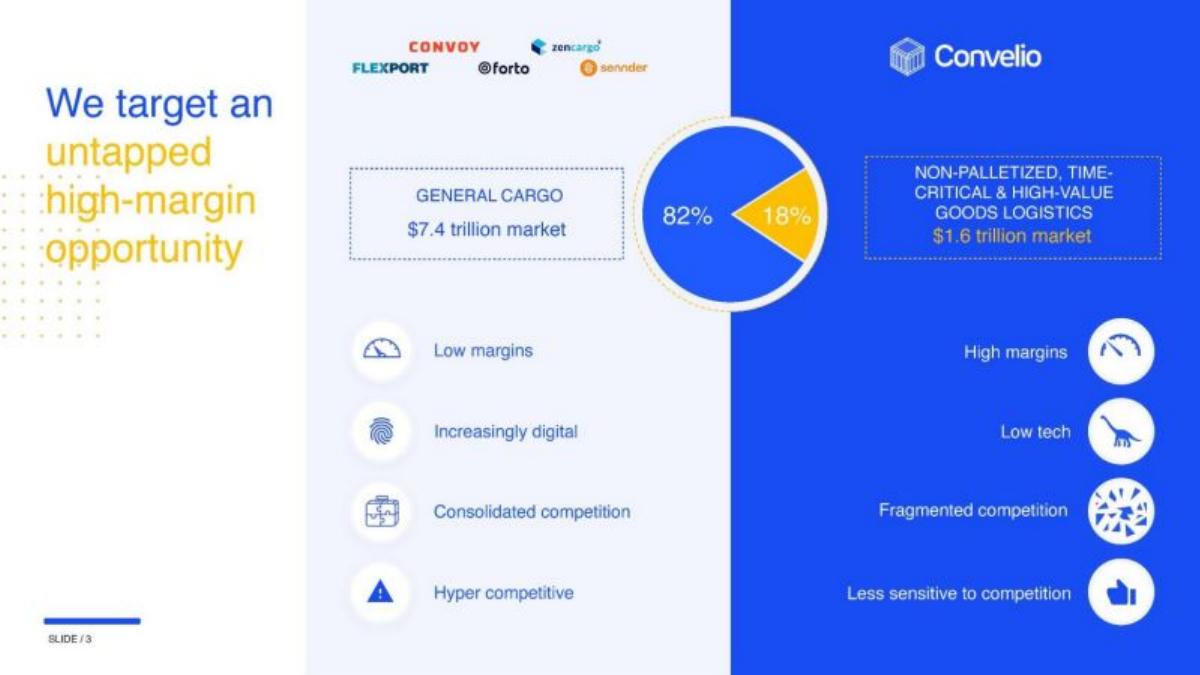
- Convelio identifies a $1.6 trillion market for non-palletized, high-value goods logistics, contrasting it with the $7.4 trillion general cargo market on slide 3.
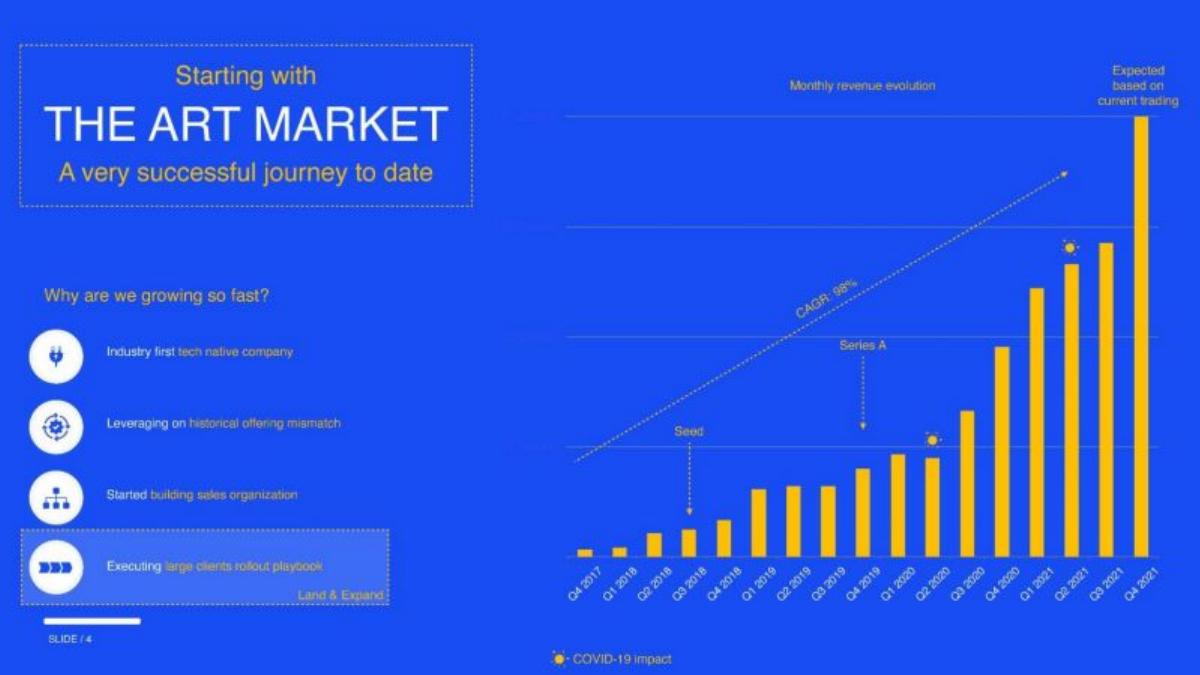
- The company reported a 98% CAGR in monthly revenue from Q4 2017 through Q3 2021, as shown on slide 4.
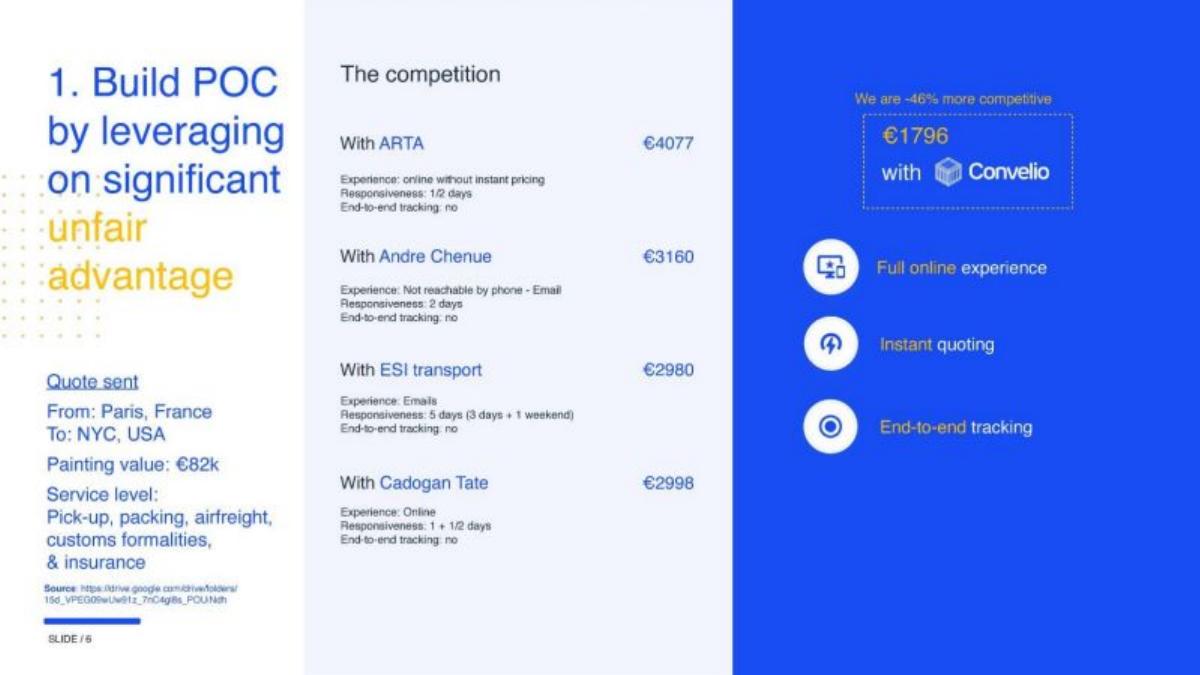
- A direct price comparison on slide 6 claims Convelio is 46% more competitive than traditional players like ARTA and Cadogan Tate.
- The platform achieves a Net Promoter Score (NPS) of 53, supported by qualitative customer testimonials on slide 7.
- Technical efficiency is a core value prop, with the ability to move from quoting to tracking in under 2 minutes via mobile, per slide 10.
- The 'land & expand' strategy is explicitly detailed across slides 5 through 7 as a three-step process: build POC, convert on quality, and expand.
- The $35M+ raise is earmarked for US acceleration, European consolidation, and technology automation, according to slide 14.
- The team slide (15) showcases deep operational expertise, featuring former leaders from Rocket Internet, Uber, and DB Schenker.
Executive Summary: The Art of Logistics Scaling
Convelio’s Series B pitch deck is a clinical demonstration of how to pitch a verticalized logistics play. By the time they reached this $35M round in 2022, the company had already established itself as the dominant digital force in fine art transportation. The deck focuses heavily on the transition from a 'low-tech' fragmented market to a 'tech-native' ecosystem. With a 98% CAGR and a clear competitive moat based on pricing and speed, the narrative is less about 'if' the model works and more about 'how fast' it can be exported to the US and broader high-value categories.
Slide 1-2: Vision and Identity
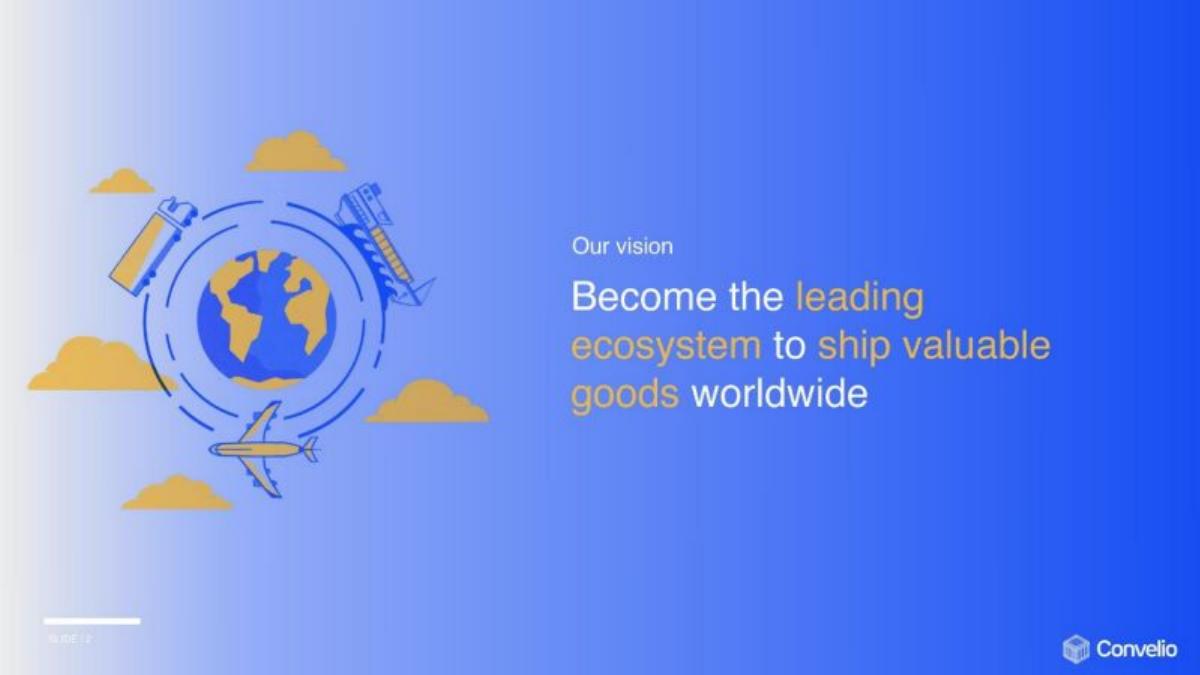
The deck opens with a clean, illustrative cover slide that immediately signals the intersection of fine art and digital work. Slide 2 defines the vision: 'Become the leading ecosystem to ship valuable goods worldwide.' Note the use of the word 'ecosystem' rather than 'company' or 'service,' suggesting a platform play that extends beyond simple freight forwarding.
Slide 3: The $1.6 Trillion Opportunity
This is a critical positioning slide. Convelio separates the logistics world into two halves. On the left, the $7.4 trillion 'General Cargo' market occupied by giants like Flexport and Convoy. They characterize this as a 'hyper-competitive,' 'low margin' space. On the right, they highlight their target: 'Non-palletized, time-critical & high-value goods logistics,' a $1.6 trillion market. They claim this niche offers high margins, fragmented competition, and is 'low tech,' creating a perfect entry point for a digital disruptor.
Slide 4: Traction and Revenue Evolution
Slide 4 provides the 'meat' for Series B investors. It shows a bar chart of monthly revenue evolution from Q4 2017 to Q4 2021. The headline figure is a 98% CAGR . The chart also marks the timing of their Seed and Series A rounds, showing a consistent upward trajectory even through the 'COVID-19 impact' periods. They attribute this growth to being an 'industry first tech native company' and executing a 'large clients rollout playbook.'
Slide 5-7: The Land & Expand Playbook
Slide 5 acts as a transition to their strategy. Slide 6 breaks down their 'significant unfair advantage.' They provide a direct quote comparison for a painting shipped from Paris to NYC. Convelio’s price of €1796 is 46% more competitive than the nearest rival, ARTA (€4077). They also highlight features their competitors lack: full online experience, instant quoting, and end-to-end tracking. Slide 7 reinforces this with a Net Promoter Score of 53 and several customer testimonials from galleries and operations heads, proving that their low price doesn't come at the cost of service quality.
Slide 8-9: Market Inefficiencies
Slide 9 contrasts 'Unaddressed market problems' with 'How Convelio tackles them.' The 'deal-breakers' in the old world include quotes taking 48 hours and opaque pricing. Convelio counters with a 'first-of-its-kind instant quoting solution' and an e-commerce API for platform integrations. This slide effectively argues that Convelio isn't just a better service; it's a 'deal-enabler' for the art market.
Slide 10-12: The Technology Platform
Slide 10 shows the mobile interface, claiming users can go 'from quoting to tracking in Slide 11 notes that the platform serves 1000+ clients each week . Slide 12 provides a horizontal view of the shipping value chain (Quoting, Booking, Tracking) and maps their various software layers—pricing algorithms, freight management software, and public APIs—across that chain. This illustrates that they have built a full-stack solution rather than just a front-end wrapper.
Slide 13: Social Proof
A full-page testimonial from Cécile Bernard, Global Head of Operations at Sotheby’s , provides massive institutional credibility. She describes Convelio’s solutions as 'pivotal' to their digital strategy, validating that the world’s largest art institutions are reliant on Convelio’s tech.
Slide 14: The $35M+ Ask
The 'Ask' slide is direct. They are raising €35M+ to execute on four pillars: 1) Accelerate in the US (noting the US is 44% of the fine-art market), 2) Consolidate European offering, 3) Technology (large scale integrations), and 4) Enhancing the offering to capture additional high-revenue opportunities.
Slide 15-18: Team and Culture
The team slide (15) is impressive, featuring 12 key leaders with backgrounds from Rocket Internet, Accenture, DB Schenker, Uber, and Mirakl . Slide 16 provides a headcount breakdown: 120 in France, 24 in the UK, and 16 in the US. It also includes cultural metrics like an average age of 29 and 56% women in management. Slide 17 shares an Employee Satisfaction Survey where 70% are 'Very Satisfied,' and slide 18 is a group photo to humanize the scale of the operation.
What Works in This Deck
The Margin Argument: By explicitly distancing themselves from 'General Cargo' and the low-margin battles of Flexport, Convelio makes a compelling case for why their unit economics are superior. · The Price Comparison: Slide 6 is devastatingly effective. Showing a 46% price difference for the exact same route and service level makes the 'unfair advantage' claim feel earned. · Institutional Validation: The Sotheby’s quote on slide 13 is a 'closer.' In the insular world of fine art, having the Global Head of Operations at Sotheby's call your tech 'pivotal' is the strongest possible signal. · Clarity of Strategy: The 'Land & Expand' section (Slides 5-7) provides a clear roadmap of how they acquire and retain customers, removing the mystery from their 98% CAGR.
What Is Missing
Unit Economics: While they mention 'high margins' generally, the deck lacks a slide dedicated to Contribution Margin, LTV (Lifetime Value), or CAC (Customer Acquisition Cost). For a Series B, investors usually want to see the specific profitability of a single shipment. · Churn and Retention Data: They mention 'Land & Expand,' but they don't provide a cohort analysis or net dollar retention (NDR) figures to prove that clients actually grow their spend over time. · Competitive Landscape: Aside from the price comparison on slide 6, there is no traditional 'competitor matrix.' They ignore other tech-enabled logistics startups that might be eyeing the high-value space.
Founder Lessons: What to Copy
Vertical Focus: If you are entering a crowded market (logistics), don't pitch against the giants. Pitch the 'untapped high-margin opportunity' that the giants are too big to service properly. · The 'Deal-Enabler' Narrative: Don't just say your software is faster; say it enables deals that couldn't happen before. By providing instant quotes, Convelio allows galleries to close sales on the spot. · Quantify the 'Unfair Advantage': Use a real-world case study (like the Paris to NYC shipment) to show exactly how much better/cheaper you are than the status quo. · Human Capital as a Moat: At Series B, your team should look like an 'all-star' cast. Convelio’s team slide doesn't just list names; it lists the specific high-growth companies those people helped build.
Frequently asked questions
- What is Convelio's core business model?
- Convelio operates as a tech-enabled logistics provider specializing in high-value, non-palletized goods, specifically fine art. They provide an end-to-end platform that handles instant quoting, booking, and tracking. Unlike traditional freight forwarders, they use proprietary algorithms to offer instant pricing and a digital-first experience for galleries, auction houses, and collectors.
- How does Convelio differentiate itself from general logistics companies like Flexport?
- As shown on slide 3, Convelio distinguishes between 'General Cargo' (low margin, consolidated) and 'High-Value Goods Logistics' (high margin, fragmented). While companies like Flexport focus on the $7.4T general market, Convelio targets the $1.6T high-value niche which is less sensitive to competition and requires specialized handling that generalists are not equipped to provide.
- What are the key metrics used to prove growth in the deck?
- The primary growth metric is a 98% CAGR in monthly revenue evolution from 2017 to 2021 (Slide 4). They also highlight a 53 NPS score to prove customer satisfaction and a 46% price advantage over incumbents to demonstrate their 'unfair advantage' in the market.
- What is the 'Land & Expand' strategy mentioned in the deck?
- The strategy involves three phases: 1) Building a Proof of Concept (POC) by offering significantly lower prices and better tech (instant quoting), 2) Converting customers based on superior service quality and high NPS, and 3) Executing a large client rollout playbook to capture more volume from existing accounts.
- How does Convelio plan to use the $35M Series B funding?
- According to slide 14, the funds are allocated to four areas: accelerating growth in the US (which represents 44% of the fine-art market), consolidating their European presence by opening local offices, investing in large-scale integrations and operational automation, and capturing additional high-revenue opportunities.