Logistics Competition Slides: 5 Real Pitch Deck Examples
How logistics and delivery startups show competition in a pitch deck: quote a real shipment against named rivals, name the brokers and middlemen you replace.
Logistics Competition Slide: Compare on Price, Speed and Reliability for a Real Shipment
Logistics buyers compare on a few hard things: price, speed, reliability and tracking. That makes the competition slide easy to test, because a reader can ask "for which shipment?" This guide compares five real logistics competition slides on whether they name who the customer uses today, and whether they compare on a job the customer actually needs done.
TL;DR
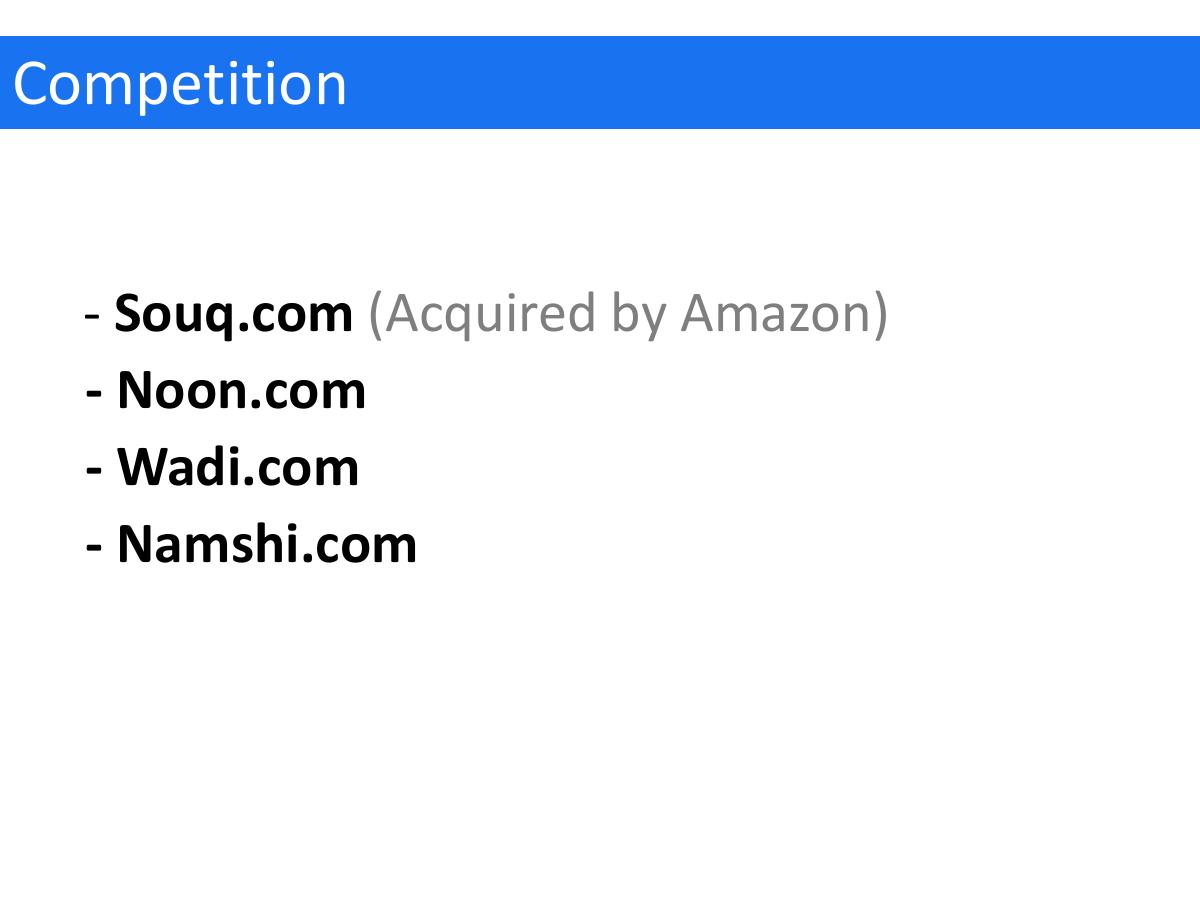
Quote one real job against named rivals. Convelio priced the same Paris-to-New York painting shipment with four art shippers (EUR 2,980 to 4,077) against its own EUR 1,796, and noted each rival's response time and tracking. OtterLogic names the alternative its buyers use, freight brokers and agents on the phone, and sizes it. Dimension's table puts franchises, brokers, a national hauler and "guy with a truck" side by side. Fastbox shows courier market shares without saying how it competes, and Jebelz lists four rival names and nothing else.
Logistics competition slides from real pitch decks
Each example shows the exact stored slide above its analysis and links to the full teardown. The most checkable comparisons come first; weaker ones follow for contrast. Claims are as shown on the slides; comments are ours.
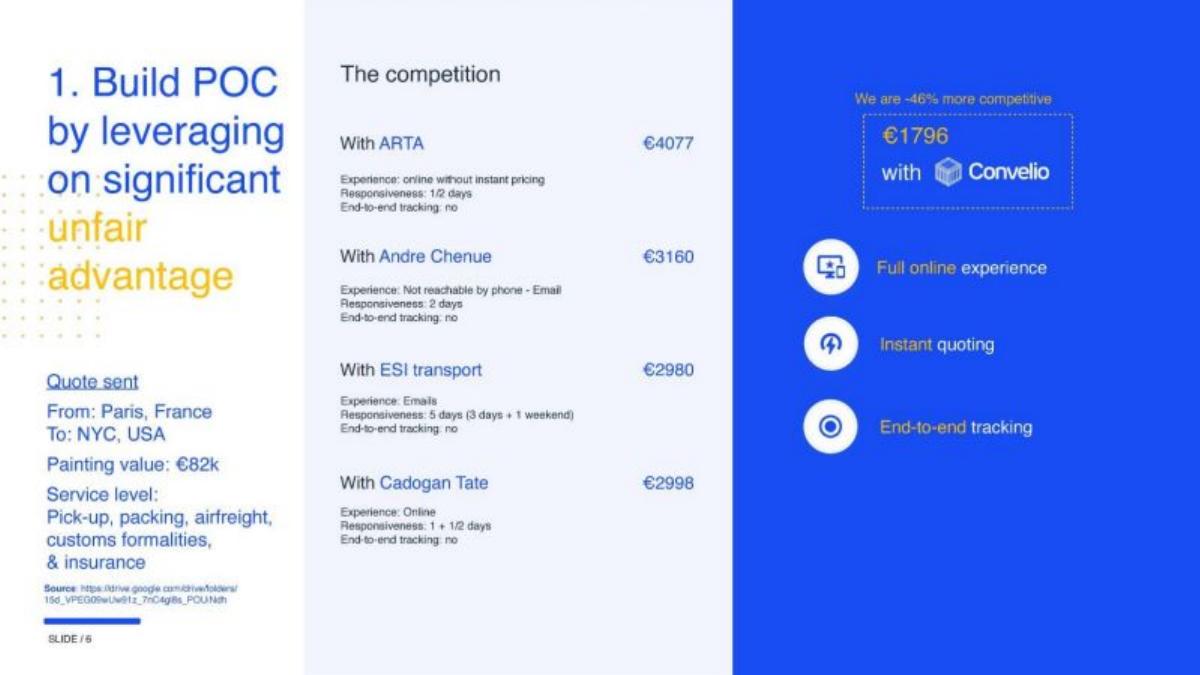
Convelio competition slide — slide 6
Online shipping for art and high-value goods. The slide is headed "1. Build POC by leveraging on significant unfair advantage".
Convelio deck, slide 6. Exact stored slide matched to this analysis.
Our analysis: A real like-for-like test: one shipment, one service level, four named rivals, price plus response time and tracking.
Evidence and limitation: The four rival quotes average about EUR 3,304, and EUR 1,796 is about 46% below that average, which matches the slide's "-46%"; it is about 40% below the cheapest rival (ESI, EUR 2,980). The slide does not say the figure is against the average. We have not seen the quotes in the linked folder.
What a founder can adapt: Request quotes for one typical job from your three or four real rivals, keep the route and service level identical, and show price, turnaround and tracking.
Supporting analysis
What the deck claims: "Quote sent. From: Paris, France. To: NYC, USA. Painting value: EUR 82k. Service level: Pick-up, packing, airfreight, customs formalities, & insurance." Rivals: ARTA EUR 4,077 ("online without instant pricing", responsiveness 1/2 days, no end-to-end tracking); Andre Chenue EUR 3,160 ("Not reachable by phone - Email", 2 days, no tracking); ESI transport EUR 2,980 (emails, 5 days, no tracking); Cadogan Tate EUR 2,998 (online, 1 + 1/2 days, no tracking). "We are -46% more competitive. EUR 1,796 with Convelio." Plus: full online experience, instant quoting, end-to-end tracking. A source link to a shared folder.
Presentation choice: It is the most checkable slide here. An investor can see exactly what was quoted and could repeat the test.
When it does not fit: Say the percentage is against the rivals' average (against the cheapest it is about 40%), and note that one quote is one data point; say how typical the job is.
Software for shippers to manage trucking directly, 2017 deck. The slide combines market size with the competitive picture.
OtterLogic deck, slide 4. Exact stored slide matched to this analysis.
Our analysis: It names the real alternative, the broker and the phone-based freight agent, and sizes how much money flows through it.
Evidence and limitation: A footnote marker on "3PL" points to a source not visible on the slide. The figures are not dated.
What a founder can adapt: If you replace a middleman, name it, give its count or spend, and say what your customer saves by going direct.
Supporting analysis
What the deck claims: "Imagine what happened to travel agents; OtterLogic transforms the $57B managed transport market." US 3PL spend: $57B domestic transportation management (brokers), $13B dedicated contract carriage, $47B international, $117B total. "3PL Trucking: Highly fragmented and undifferentiated. 130+ medium or larger 3PL companies in US; thousands of independent brokers. Highly manual brokerage processes. Thousands of dedicated freight agents making phone calls." OtterLogic: "Cutting out the broker - make going direct easy."
Presentation choice: For many logistics startups the competitor is a middleman or a manual process. Naming it and its scale answers "who loses if you win?"
When it does not fit: Show at least one number for the saving (fee, hours, time to book). "Minimize labor" alone is a claim.
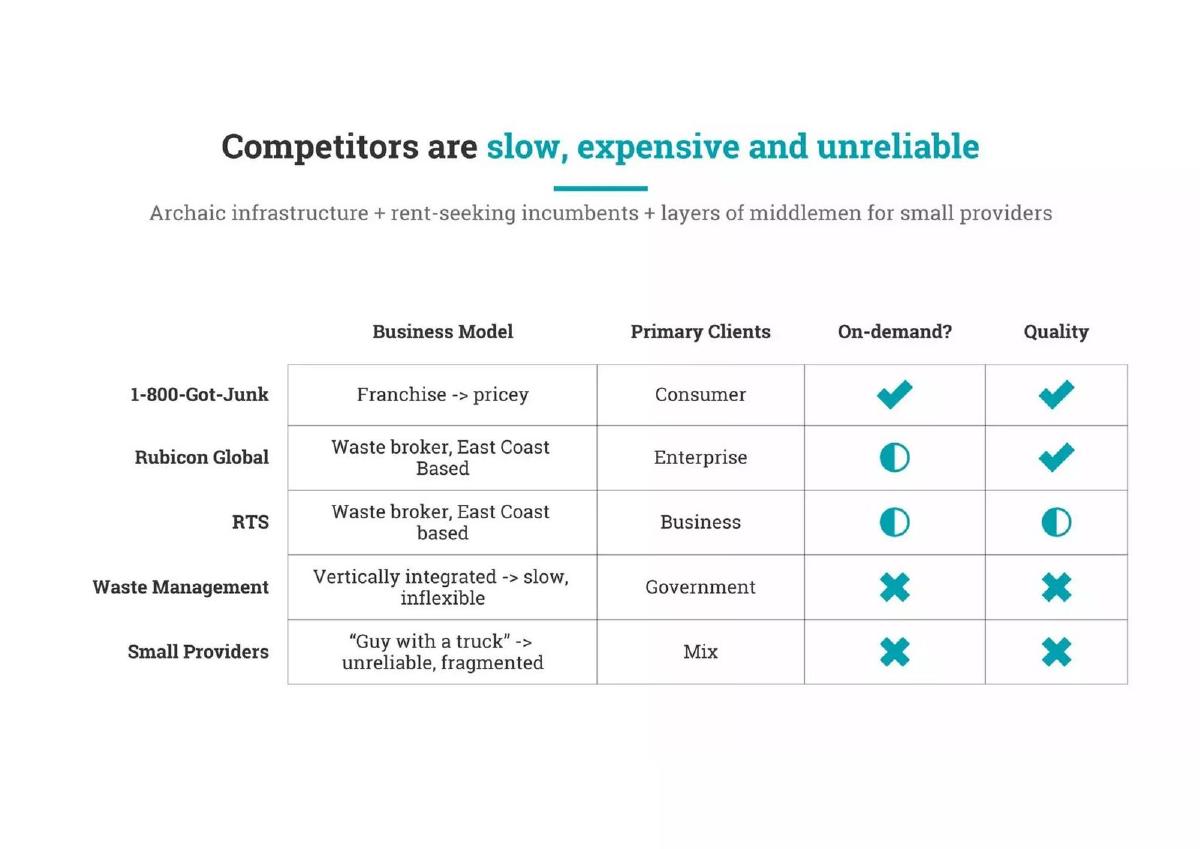
On-demand marketplace for waste and junk removal. Five-row comparison table.
Dimension deck, slide 5. Exact stored slide matched to this analysis.
Our analysis: It covers the full range a customer might call, from a national franchise to a local independent, and gives one rival full marks.
Evidence and limitation: Ratings are the company's own; no price, response time or source is given.
What a founder can adapt: List rivals by type (franchise, broker, incumbent, independent) and add a row for your own company.
Supporting analysis
What the deck claims: "Competitors are slow, expensive and unreliable. Archaic infrastructure + rent-seeking incumbents + layers of middlemen for small providers." Rows: 1-800-Got-Junk (franchise, pricey; consumer; on-demand yes; quality yes), Rubicon Global (waste broker, East Coast; enterprise; partial; yes), RTS (waste broker, East Coast; business; partial; partial), Waste Management (vertically integrated, slow, inflexible; government; no; no), Small providers ("guy with a truck", unreliable, fragmented; mix; no; no).
Presentation choice: Including the small local option and admitting 1-800-Got-Junk scores on both measures makes the table more credible than a clean sweep.
When it does not fit: The table has no row for Dimension, and "quality" is undefined. Add your row and one measurable column such as price or pickup time.
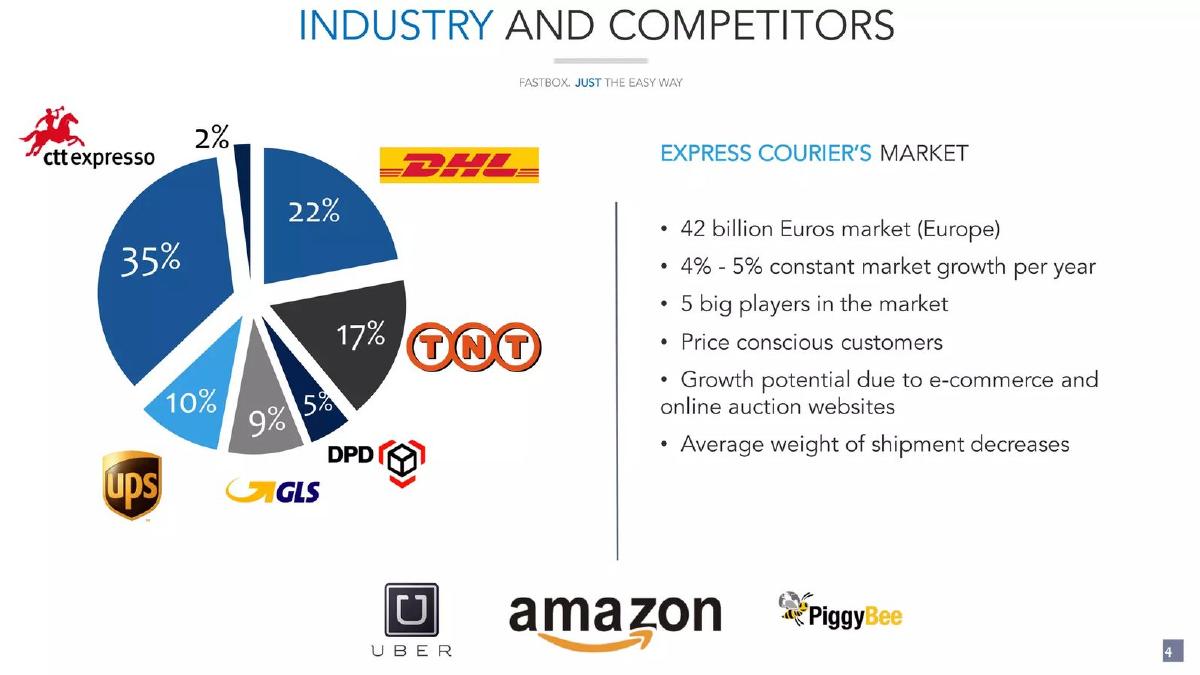
Courier startup, European express market. Slide titled "Industry and Competitors".
Fastbox deck, slide 4. Exact stored slide matched to this analysis.
Our analysis: It shows who holds the market, but not how Fastbox would take share from them.
Evidence and limitation: No source, date or geography for the shares; the large ctt expresso share suggests Portugal rather than Europe, which the slide does not say. "5 big players" does not match the six named.
What a founder can adapt: Keep one line on the incumbents' share, then compare on the job: price and delivery time for a typical parcel.
Supporting analysis
What the deck claims: Pie chart with logos: ctt expresso 35%, DHL 22%, TNT 17%, UPS 10%, GLS 9%, DPD 5%, 2% unlabelled. "Express courier's market: 42 billion Euros market (Europe); 4% - 5% constant market growth per year; 5 big players in the market; Price conscious customers; Growth potential due to e-commerce and online auction websites; Average weight of shipment decreases." Logos below: Uber, Amazon, PiggyBee.
Presentation choice: Shown for contrast: a market-share chart is useful context, but it is not a comparison.
When it does not fit: Unsourced shares, and logos (Uber, Amazon) with no explanation of why they are on the slide.
Whether each slide names the alternative customers use, compares on a concrete job, and gives a basis.
Example
Real alternative named
Concrete comparison
Evidence or source
Convelio
Yes (four art shippers)
Yes (one quoted shipment)
Partly (link to quotes)
OtterLogic
Yes (brokers, freight agents)
Partly (market spend)
Partly (footnote)
Dimension
Yes (five rival types)
Partly (own ratings)
No
Fastbox
Yes (couriers)
No (market shares)
No
Jebelz
Yes (names only)
No
No
Key Takeaways
Use one real shipment or job, with the same route and service level for every rival.
Compare on price, speed, reliability and tracking: what logistics buyers are judged on.
Name the middleman or manual process you replace, not only other startups.
Include the small local option ("guy with a truck") if customers use it.
Market-share charts describe the market; they do not show how you win.
Build your logistics competition slide
Start from one job your customer needs done.
The job. What typical shipment or task will you compare on (route, size, service level)?
Alternatives. Who would the customer call today: an incumbent carrier, a broker, a local independent, their own team?
Measures. Which two or three matter most: price, time to quote, delivery time, tracking, damage rate?
Proof. Can you get real quotes or times from each alternative for that job? When and how were they collected?
Where you lose. Where does a rival beat you (coverage, brand, capacity), and why will customers still choose you?
Copyable framework: For [job], [rival A] quoted [price/time], [rival B] [price/time]; we quoted [price/time] with [tracking/other]. Quotes collected [date].
Illustrative example 1 — written by us
Before: Competitors are slow, expensive and unreliable.
After: For a same-day 20 km pallet delivery in Leeds, two national carriers quoted GBP 95 and GBP 110 with next-day pickup; a local van quoted GBP 60 with no tracking. We quoted GBP 70, pickup within 2 hours, live tracking. Quotes collected March 2026.
What improved: Our illustrative rewrite; figures are invented for the example. It fixes one job, names the rival types, compares on price, speed and tracking, and dates the test.
What this guide adds
The general competition slide guide covers any business. Logistics is unusually easy to compare: the same shipment can be quoted by several providers, and speed and tracking are yes-or-no facts. A founder can often run the test themselves before the pitch, as Convelio did.
The logistics problem, solution, product and traction guides cover other slides from similar decks. Here we look only at how each deck handles rivals and alternatives.
How we read each slide
We quote the text on the stored slide images. We have not re-run any quote or checked the market-share figures. Only Convelio gives a source link for its comparison.
Common mistakes
Adjectives instead of a test. "Slow and expensive" is easy to replace with one real quote.
Different jobs for different rivals. Keep route, size and service level identical.
Market share as comparison. Shares describe the market; add how you win share.
Leaving yourself off the table. Every comparison needs a row for your company.
Unexplained percentages. Say which rival or average a saving is measured against; Convelio's -46% matches the rivals' average, not the cheapest quote.
Diagnostic checklist
Compares on one real, described job.
Names the rivals and middlemen customers use today.
Shows price, speed or tracking, not only adjectives.
Includes your own row and any row where a rival wins.
Says when and how quotes or figures were collected.
Frequently asked questions
How should a logistics startup compare itself with competitors?
Pick one typical shipment, get quotes or times from the rivals customers really use, and compare on price, speed and tracking. Convelio did this for a Paris-to-New York painting shipment against four named art shippers.
Who are the competitors for a freight or delivery startup?
Often not other startups: incumbent carriers, brokers and freight agents, the customer's own team, or a local independent. OtterLogic names brokers and phone-based freight agents; Dimension includes "guy with a truck".
Is a market-share pie chart enough for the competition slide?
No. It shows who holds the market but not why a customer would switch. Fastbox's chart would be stronger with a price and delivery-time comparison beside it.
How we chose these examples
Corpus: published pitch deck teardowns on StartupFundraising.com. Founder-uploaded private decks are excluded.
Selection (2026-09-27): we searched extracted slide text in decks tagged logistics for competition, competitors, competitive landscape, alternatives, incumbents, "vs" and advantage. About 30 slides matched; most were agendas, market or company-overview slides.
Kept five with stored slide images. Excluded: Smatbeba p5 (already used in another guide), Moobitaxi p7 and Mose Delivery p9 (no stored image; no new uploads requested), Market Convoy p6 (e-commerce, not logistics), and listed-company decks.
Jebelz is an online retailer with its own delivery, tagged as logistics in our library; we kept it as a contrast example.
Review: stored slide text and images were checked on 2026-09-27 and matched to company, deck and slide number (editorial model review). No person has yet completed an editorial review of this page. We make no claim that any slide caused a fundraising outcome.