Logistics Product Slides: 7 Real Pitch Deck Examples
How logistics and delivery startups show their product: a shipment screen with driver and price, the driver's app, three platform layers.
Logistics Product Slides: Real Pitch Deck Examples
Seven product slides from logistics decks (on-demand courier apps, a driver app for e-commerce shippers, a logistics software platform, peer-to-peer deliveries, product verification codes, office catering delivery and a Kenyan delivery service), shown in full. In logistics the product is a shipment moving from A to B, so investors want to see who books it, who moves it, how it is tracked and what it costs. The stronger slides show a real screen with a price or fee; the weaker ones list steps in text.
TL;DR
A logistics product slide should show the shipment as the customer or driver sees it, with the price. Dailivery shows a completed delivery with pick-up time, assigned driver and a CHF 68 cost beside five steps. MoveCrop shows the app its couriers use, with a live order and map. 7bridges explains its software in three layers. DonkiDrive explains its service in three steps and states its 10% fee. Chekkit shows how a code moves from factory to consumer. CaterSquad numbers a delivery flow in pictures with no words. Smatbeba lists four steps in plain text, the weaker example here.
Logistics product slides
Each example shows the exact stored slide above its analysis and links to the full teardown. Stronger examples first. Claims and figures are as shown on the slides; we have not verified them.
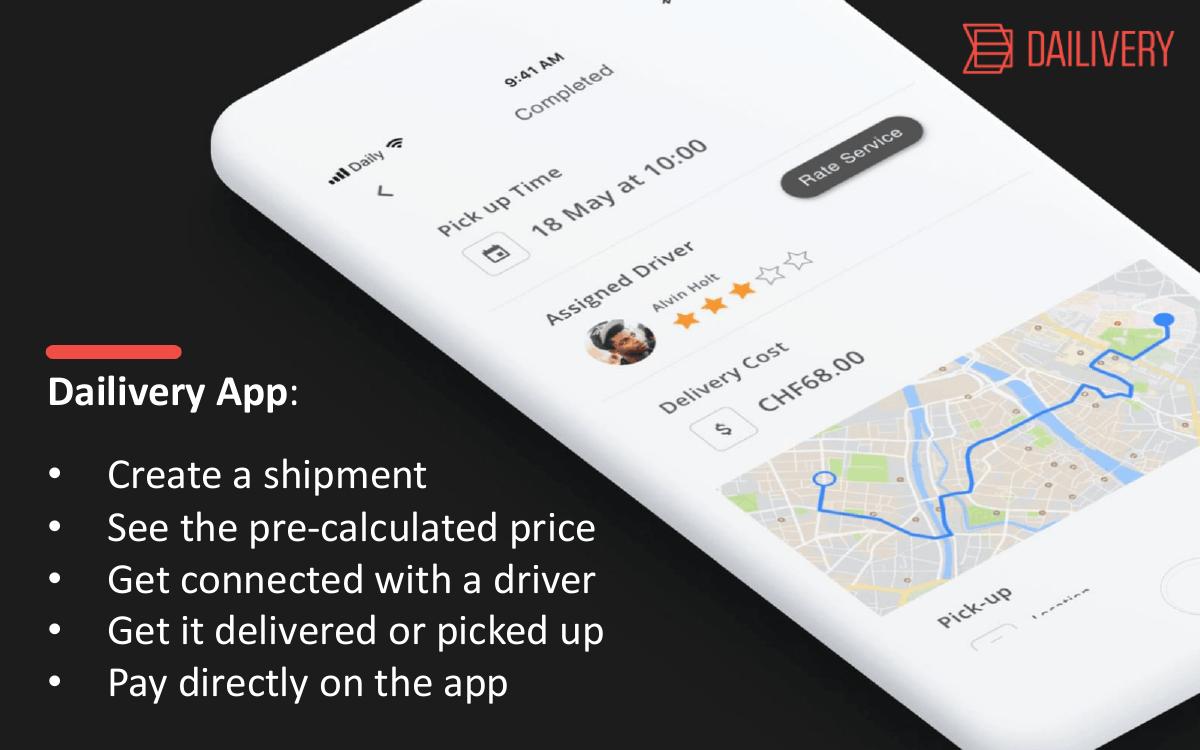
Dailivery product slide — slide 4
Pre-seed (recorded; MVP launched, first paying customer in beta). On-demand courier app. A real screen beside five steps.
Dailivery deck, slide 4. Exact stored slide matched to this analysis.
Our analysis: The clearest example here: the steps say what the customer does, and the screen shows the result, including the price.
Evidence and limitation: A screenshot with a real-looking price, driver and route; no volume figures on this slide.
What a founder can adapt: Put your booking or tracking screen beside a five-step list of what the customer does.
Supporting analysis
What the deck claims: "Dailivery App: Create a shipment. See the pre-calculated price. Get connected with a driver. Get it delivered or picked up. Pay directly on the app." The phone shows a "Completed" delivery: "Pick up Time 18 May at 10:00", "Assigned Driver" with a star rating, "Delivery Cost CHF68.00", "Rate Service" and a route map.
Presentation choice: A price on the screen answers "what does this cost?" before the investor asks.
When it does not fit: Keep the screen straight and large enough to read; tilted phones lose detail.
Stage not recorded. Delivery software for e-commerce. The courier's app.
MoveCrop deck, slide 6. Exact stored slide matched to this analysis.
Our analysis: It shows the product from the courier's side, which is where delivery software is won or lost.
Evidence and limitation: A real app screen with an order; three feature bullets; no usage figures.
What a founder can adapt: Show the screen of whoever does the work (driver, picker, dispatcher) and enlarge the key part.
Supporting analysis
What the deck claims: "Mobile Application." "Synchronize Oder/ Shipment status." "Update shipper location, activities.." "Communication features, support make call via IP/PBX." A phone showing a map and an order list, an enlarged order card (address, order number, "COD: 0 VND", a delivered button, camera and call icons) and a "Scan to download" QR code.
Presentation choice: Zooming into one order card makes a small phone screen readable.
When it does not fit: Explain terms like "COD" and keep the typo-free labels; small errors undercut a product slide.
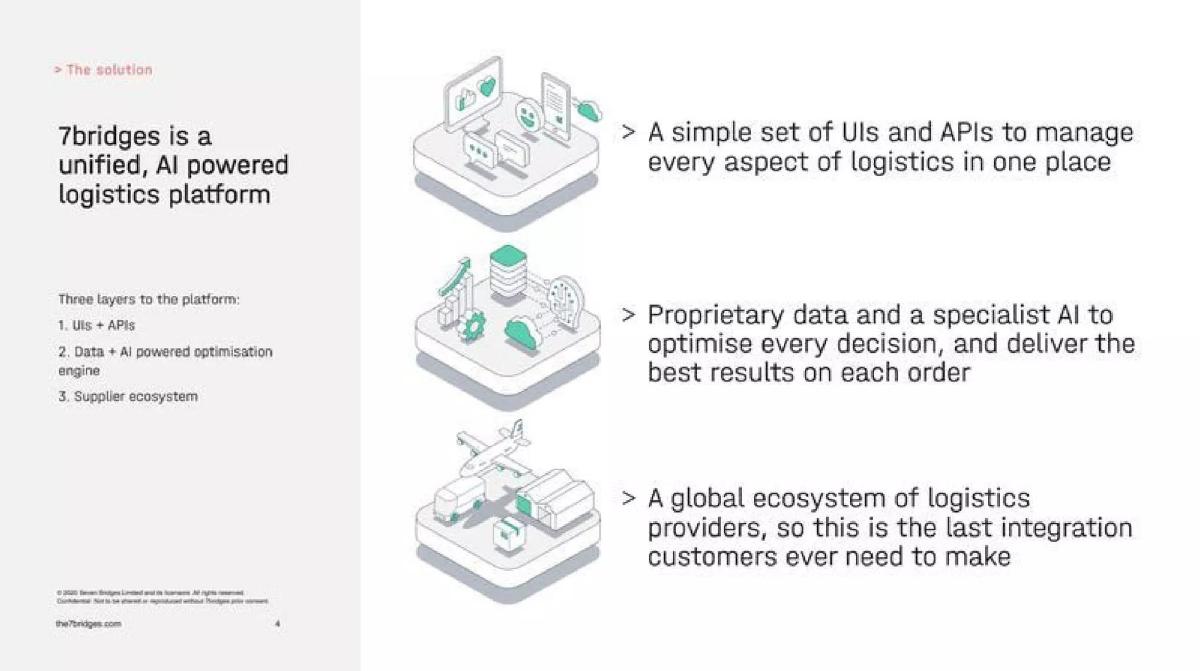
Seed or Series A (recorded). Logistics software platform. Three layers.
7bridges deck, slide 4. Exact stored slide matched to this analysis.
Our analysis: The layers explain how the platform is built and why a customer would only integrate once.
Evidence and limitation: Three layers with a sentence each and drawings; no screen or figures.
What a founder can adapt: Show your platform as two or three layers and name the one that is proprietary.
Supporting analysis
What the deck claims: "7bridges is a unified, AI powered logistics platform." "Three layers to the platform: 1. UIs + APIs 2. Data + AI powered optimisation engine 3. Supplier ecosystem." "A simple set of UIs and APIs to manage every aspect of logistics in one place." "Proprietary data and a specialist AI to optimise every decision, and deliver the best results on each order." "A global ecosystem of logistics providers, so this is the last integration customers ever need to make."
Presentation choice: For software that sits between shippers and carriers, a layer diagram shows where the value lives.
When it does not fit: Add one screen or result; drawings alone don't show the software exists.
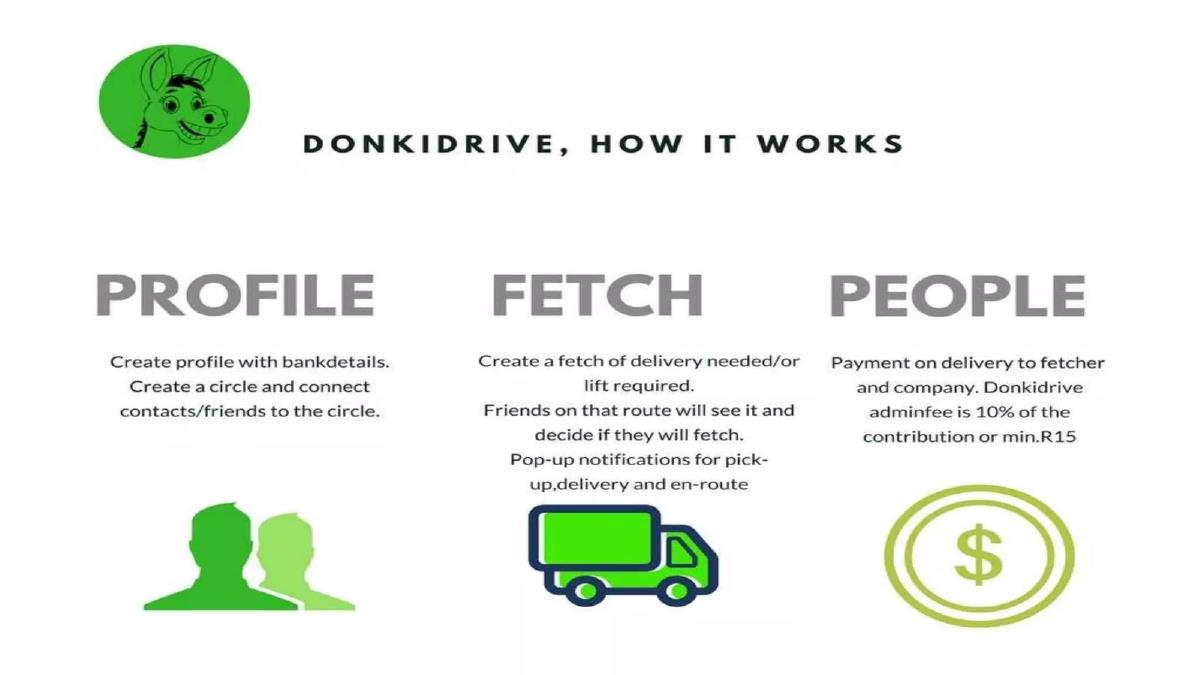
Stage not recorded. Peer-to-peer deliveries between friends. Three steps with the fee.
DonkiDrive deck, slide 5. Exact stored slide matched to this analysis.
Our analysis: It explains an unusual model (friends deliver for each other) and how the company earns in one slide.
Evidence and limitation: Three steps and a stated fee (10% or R15 minimum); no screen.
What a founder can adapt: End your how-it-works steps with who pays whom and your cut.
Supporting analysis
What the deck claims: "Donkidrive, how it works." "Profile: Create profile with bankdetails. Create a circle and connect contacts/friends to the circle." "Fetch: Create a fetch of delivery needed/or lift required. Friends on that route will see it and decide if they will fetch. Pop-up notifications for pick-up, delivery and en-route." "People: Payment on delivery to fetcher and company. Donkidrive adminfee is 10% of the contribution or min.R15."
Presentation choice: Naming the fee on the product slide ties the product to revenue.
When it does not fit: Show the app; a novel model needs more proof it exists than icons.
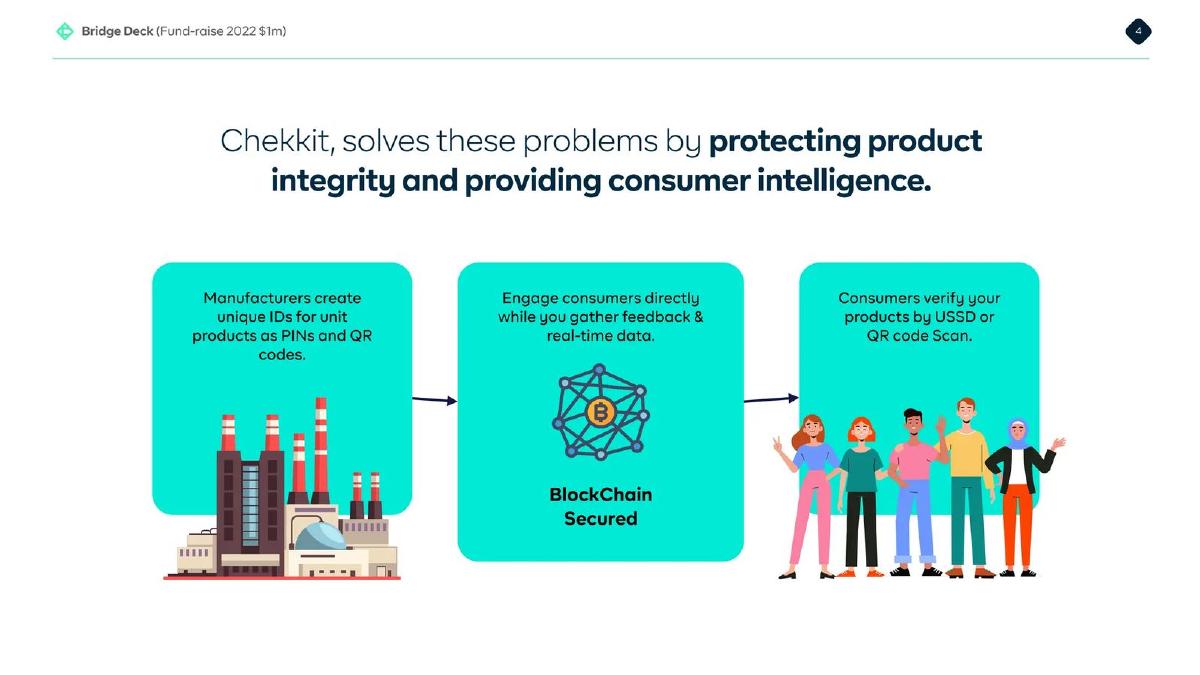
Seed (recorded; bridge round). Product verification codes. A three-box flow.
Chekkit deck, slide 4. Exact stored slide matched to this analysis.
Our analysis: The flow makes clear who does what: the manufacturer issues codes, the consumer checks them, the data comes back.
Evidence and limitation: A three-step flow with illustrations; no screen, pricing or volume.
What a founder can adapt: Draw the flow from your buyer to their customer and label the data that comes back.
Supporting analysis
What the deck claims: "Chekkit, solves these problems by protecting product integrity and providing consumer intelligence." "Manufacturers create unique IDs for unit products as PINs and QR codes." "Engage consumers directly while you gather feedback & real-time data." "BlockChain Secured." "Consumers verify your products by USSD or QR code Scan."
Presentation choice: Naming USSD as well as QR shows the product works on basic phones, which matters in its market.
When it does not fit: "BlockChain Secured" needs a reason; say what it prevents.
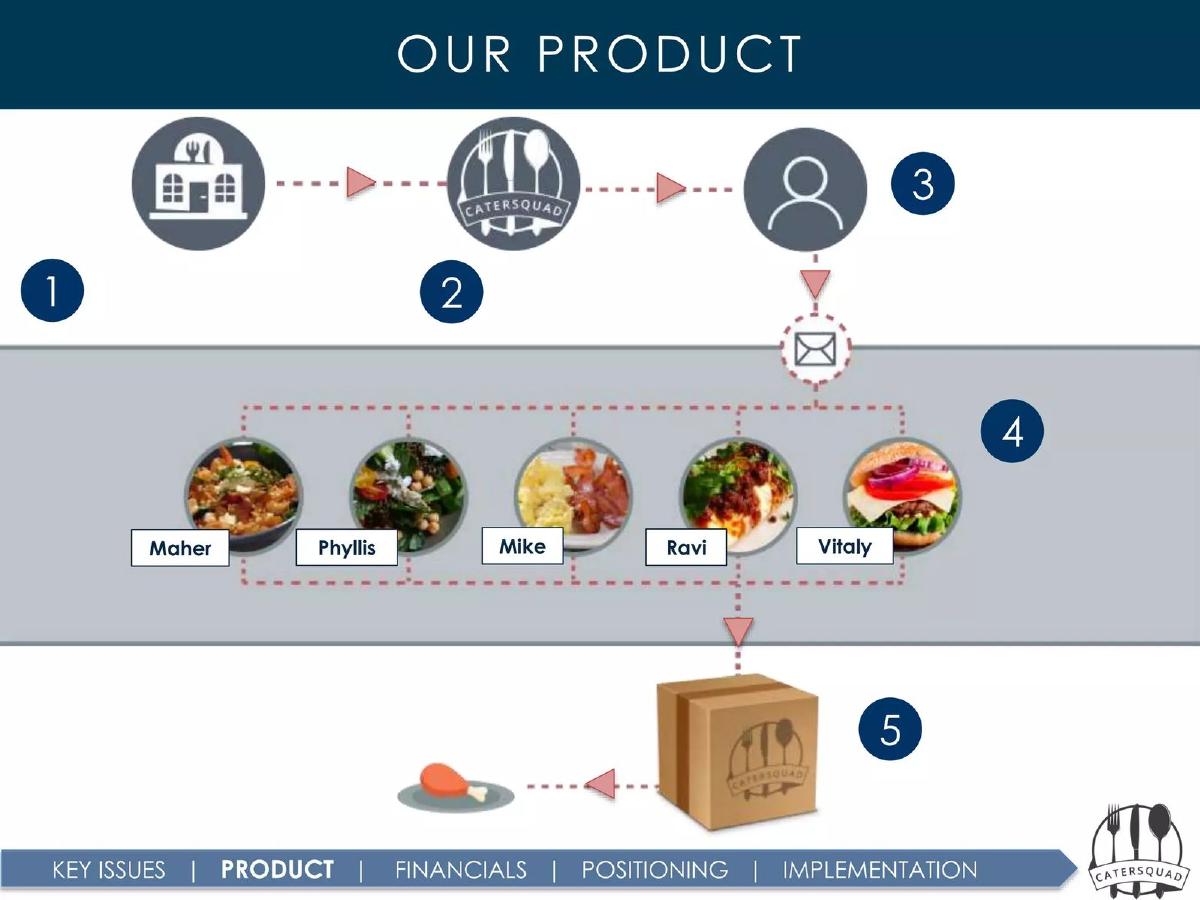
Early stage (recorded; EIA program). Office catering delivery. A numbered picture flow.
CaterSquad deck, slide 3. Exact stored slide matched to this analysis.
Our analysis: It suggests individual meal choices bundled into one delivery, but the investor has to guess.
Evidence and limitation: Pictures and numbers only; no words explain the steps.
What a founder can adapt: Keep the numbered flow and add three or four words under each number.
Supporting analysis
What the deck claims: "Our Product." Five numbered steps in pictures: an office (1), the CaterSquad logo (2), a person (3), an email icon leading to five named dishes ("Maher", "Phyllis", "Mike", "Ravi", "Vitaly") (4), and a CaterSquad box delivered as a meal (5).
Presentation choice: Pictures help if each step also has a short label; here none do.
When it does not fit: Don't rely on the presenter to explain every step; decks get read without them.
Seed (recorded). On-demand deliveries in Kenya. Four steps in text (weaker example).
Smatbeba deck, slide 3. Exact stored slide matched to this analysis.
Our analysis: The steps are clear but generic; the investor can't tell how this differs from any courier app.
Evidence and limitation: Four text steps; no screen, price or picture.
What a founder can adapt: Add a screenshot of the quotation and one line on what is different.
Supporting analysis
What the deck claims: "How it works." "1. Book a delivery through app or website and get quotation." "2. Nearest drivers are notified, and they confirm pickup." "3. Contact driver and track delivery." "4. Pay at the end of delivery."
Presentation choice: Included for contrast: the same four steps as Dailivery without the screen or price.
When it does not fit: Steps every competitor shares don't show an advantage.
How the product is presented, whether a real screen appears, and whether a price or fee is stated.
Example
Product
Presented as
Real screen
Price or fee
Dailivery
Courier app
Screen + steps
Yes
CHF 68 delivery
MoveCrop
Courier app for shippers
Screen + bullets
Yes
No
7bridges
Logistics software
Three layers
No
No
DonkiDrive
Peer-to-peer delivery
Three steps
No
10% fee
Chekkit
Verification codes
Three-box flow
No
No
CaterSquad
Catering delivery
Numbered pictures
No
No
Smatbeba
On-demand delivery
Text steps
No
No
Key Takeaways
Show the booking or tracking screen, with a real price on it.
Say who moves the goods: your drivers, partners or the crowd.
State the fee or take rate if it is simple.
Number the steps, and label each one in words.
Build your logistics product slide
Start with the screen where a shipment is booked or tracked, then add the money.
Screen. Booking, tracking or driver screen with a real order on it.
Who moves it. Your fleet, partner carriers, or the crowd.
Price. What a typical shipment costs the customer, and your fee.
Difference. The one step you do better than other couriers.
Copyable framework: [Screen with order and price] [Customer] books in [n] steps; [who] picks up within [time]. Typical price: [price]; our fee: [fee]. Unlike [alternative], we [difference].
Illustrative example 1 — written by us
Before: 1. Book a delivery through app or website and get quotation. 2. Nearest drivers are notified, and they confirm pickup. 3. Contact driver and track delivery. 4. Pay at the end of delivery.
After: [Screenshot: quotation screen] Book a delivery in [n] taps and see the price up front ([typical price]). The nearest driver confirms within [time]; track and pay on delivery. Unlike [alternative], [difference].
What improved: Our illustrative rewrite; not Smatbeba's wording. Bracketed parts are placeholders to fill with real facts. It adds the screen, the price and one difference.
What this guide adds
The library already has logistics problem and solution guides, a general product slide guide, product slides by stage, and sector product guides for marketplaces, mobility, hardware and others. This page looks at how a delivery or supply-chain product is shown to an investor.
Sector labels come from the sector recorded for each published teardown (high confidence for Chekkit and DonkiDrive; medium for the other five). None of these seven slides appears in another guide. Other slides from the Dailivery, CaterSquad and Smatbeba decks are used elsewhere in the library for different lessons.
Four ways logistics decks show the product
Real screen (Dailivery, MoveCrop): the customer's or driver's app with an order, a map and, for Dailivery, a price.
Layers or flow (7bridges, Chekkit): the parts of the system and how goods or data pass through them.
Steps with money (DonkiDrive): three steps from sign-up to payment, with the company's fee.
Steps without detail (CaterSquad, Smatbeba): a numbered picture flow or a text list, leaving the investor to fill the gaps.
Common mistakes
No screen. A text list doesn't show the app exists.
No price. Investors want to know what a delivery costs and what you keep.
Unlabelled pictures. Numbered icons need words to be read without a presenter.
Generic steps. Book, track, pay is what every courier offers; show your difference.
Diagnostic checklist
A real booking, tracking or driver screen.
Who moves the goods.
Price and fee.
One clear difference.
Frequently asked questions
How we chose these examples
Corpus: published pitch deck teardowns on StartupFundraising.com. Founder-uploaded private decks are excluded.
Selection (2026-09-27): we took teardowns whose recorded sector is logistics, slides 2 to 7, with a stored slide image and readable text mentioning the product, app, features or how it works. We viewed ten candidate slides, left out slides already used in other guides, slides without a stored image (Eziban's how it works), a second slide from the same deck (MoveCrop's back-end features), a slide mainly about food rather than delivery (HomeCooks), and a slide built around a stock photo (Mose Delivery's service slide), and kept seven that show different ways of presenting a logistics product. Smatbeba is included as a weaker example for contrast.
Sector is the category recorded for each teardown (high confidence for Chekkit and DonkiDrive; medium for the other five). Stages as recorded: Dailivery, pre-seed; Chekkit and Smatbeba, seed; 7bridges, seed or Series A; CaterSquad, early stage; MoveCrop and DonkiDrive, not recorded.
Review: stored slide images were checked on 2026-09-27 and matched to company, deck and slide number, and quoted text was read from the images (editorial model review). No person has yet completed an editorial review of this page.
Claims and figures are as shown on the slides; we have not verified them. We make no claim that any slide caused a fundraising outcome.