Smatbeba’s pitch deck is a brief, 7-slide overview of an on-demand logistics marketplace operating in Kenya. The company identifies a significant pain point: logistics costs contribute 60-70% to the final cost of goods in Africa (Slide 1). By 2019, the startup achieved 1,000+ completed trips and registered over 200 vehicles (Slide 6). The narrative centers on affordability and accessibility for the 'mass market,' contrasting itself against competitors who focus on high-end B2B and urban clients (Slide 5). While the deck provides clear market validation and early traction figures, it completel…
Key takeaways
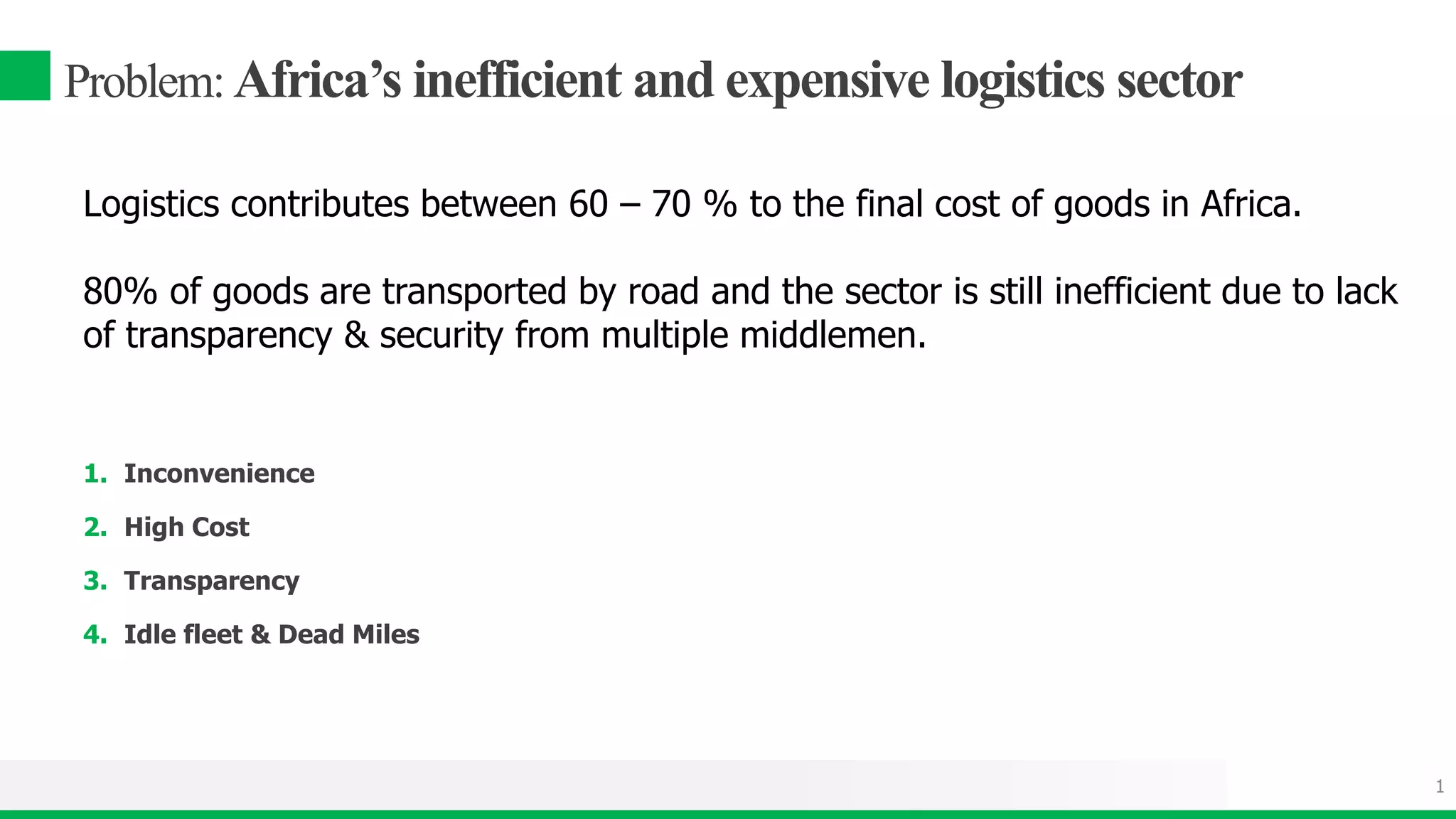
- Logistics costs account for 60-70% of the final cost of goods in Africa, creating a massive efficiency gap (Slide 1).
- The Kenyan land transport sector is valued at $2 billion with an 8% annual growth rate (Slide 4).
- Smatbeba differentiates itself by targeting the 'mass market' (urban and rural) whereas competitors like Sendy focus on expensive B2B/urban clients (Slide 5).
- The startup completed over 1,000 trips in 2019 and paid out over $40,000 to drivers (Slide 6).
- The platform has secured partnerships with industry leaders including Mzuri Sweets, Sunveat, and Victory Farms (Slide 6).
- The founding team combines logistics industry experience, computer science expertise, and financial accounting (Slide 7).
- The deck lacks a business model slide, failing to explain how the company generates revenue from its marketplace transactions.
- There is no 'Ask' slide, leaving investors unaware of the capital requirements or the intended use of funds.
Executive Summary: The Mass-Market Logistics Play
Smatbeba’s pitch deck is a lean, 7-slide presentation that focuses on the logistical bottlenecks within the Kenyan market. The core thesis is that by digitizing the marketplace and removing middlemen, the company can significantly lower the cost of goods for the average consumer. The deck relies heavily on 2019 data to demonstrate early product-market fit and operational capability. While the narrative is clear, the document is structurally incomplete for a formal Series A or even a late Seed round, as it ignores the mechanics of the business model and the specifics of the investment opportunity.
Slide 1: Problem
The deck opens with a macro-economic problem statement. It claims that logistics contributes between 60 – 70% to the final cost of goods in Africa. This is a staggering figure intended to grab investor attention by highlighting the sheer scale of inefficiency. The slide identifies four specific pain points: Inconvenience, High Cost, lack of Transparency, and 'Idle fleet & Dead Miles.' By noting that 80% of goods move by road, the founders establish that their focus on land transport addresses the most critical segment of the supply chain.
Slide 2: Solution
The solution is described as a 'digital delivery marketplace.' The slide lists four value propositions: reducing cost by eliminating middlemen, increasing transparency through insured cargo, providing vetted and trained transporters, and increasing fleet engagement. This slide is purely text-based and lacks a visual representation or a 'unique selling point' that explains how their digital marketplace differs from a standard load board or a basic app.
Slide 3: How it works
This slide outlines a simple four-step user journey: 1. Book via app/website and get a quotation; 2. Nearest drivers are notified and confirm; 3. Contact driver and track delivery; 4. Pay at the end of delivery. While clear, this process is now industry-standard for on-demand logistics. The slide fails to mention if the 'quotation' is algorithmic or manual, and it does not specify the payment methods (e.g., mobile money, cash, or credit), which is a vital detail for the African market.
Slide 4: Market Validation
Smatbeba provides two key figures here: a $200 billion African Logistics Market and a $2 Billion Kenyan Land Transport Sector. They cite the Kenya National Bureau of Statistics for an 8% growth rate in the sector. By narrowing the focus from the continent to Kenya, the deck shows a realistic initial target market. However, it does not break these numbers down into TAM (Total Addressable Market), SAM (Serviceable Addressable Market), and SOM (Serviceable Obtainable Market), which would help investors understand the actual revenue potential for a marketplace player.
Slide 5: Competition
The competitive matrix is one of the more informative slides in the deck. It plots players on an axis of Convenience vs. Affordability. Smatbeba positions itself in the 'Convenient and Affordable' quadrant. It characterizes Sendy as 'Expensive' and focused on 'B2B and urban clients,' and Kobo360 as focused on 'B2B and the retail sector.' Interestingly, it includes the 'Informal Sector' as a competitor, noting its lack of safety and unpredictable pricing. This positioning suggests Smatbeba is trying to capture the volume of the informal market by providing formal-sector reliability at informal-sector prices.
Slide 6: Traction
This slide provides concrete proof of activity. The company reports over 200 vehicles registered and 1,000+ completed trips in 2019. The mention of 'Over $40,000 Paid out to drivers' is a useful metric, as it demonstrates the platform's ability to generate economic value for its supply side. The list of partners—Mzuri Sweets, Sunveat, and Victory Farms—adds significant credibility, showing that established businesses are willing to trust the platform with their cargo.
Slide 7: Team
The final slide introduces the three co-founders. Anthony Ndolo (CEO) brings the necessary industry domain expertise with 5+ years in logistics. Emily Mogeni (CTO) provides the technical backbone with a Master’s in Information System Management. Timon Ouma (CFO) rounds out the trio with financial qualifications (CPA). The team appears balanced on paper, covering operations, technology, and finance, which are the three pillars of a logistics marketplace.
What Smatbeba Does Well
The deck is highly focused. It does not get bogged down in technical jargon or unnecessary features. By highlighting the 60-70% cost contribution of logistics (Slide 1), the founders immediately establish the 'why' behind their business. The competitive analysis (Slide 5) is also a highlight; rather than just listing names, it explains the strategic gap Smatbeba intends to fill—specifically the 'low-end' and rural markets that larger B2B players might overlook. The inclusion of specific partner names (Slide 6) provides the social proof necessary to validate a two-sided marketplace.
Critical Omissions
The most glaring omission is the Business Model . The deck explains how the service works for the user, but never mentions how Smatbeba makes money. Is it a commission on every trip? A subscription for fleet owners? Lead generation fees? Without this, an investor cannot evaluate the scalability or profitability of the venture. Furthermore, there is no Financial Projection or Unit Economics . In logistics, margins are notoriously thin, and understanding the cost per acquisition (CAC) versus the lifetime value (LTV) of a customer is essential. Finally, the lack of an Ask Slide is a major tactical error. A pitch deck is a tool to get a meeting for an investment; if you don't state how much you are raising and what you will do with the money, the deck loses its primary purpose.
Founder Takeaways: What to Copy and What to Avoid
Copy the Market Positioning: Smatbeba’s use of a competitive matrix to identify a specific niche (the mass market/rural sector) is an excellent way to show how a small player can coexist with well-funded giants like Kobo360. Founders should always look for the 'underserved' segment of a crowded market.
Avoid the 'Teaser' Trap: While brevity is good, 7 slides is likely too few for a serious pitch. A founder should never leave out the 'Ask' or the 'Revenue Model.' Even if the revenue model is simple, documenting it shows that you are thinking like a business owner, not just a product manager. Additionally, ensure your data is current; using 2019 data in a later year suggests a lack of recent momentum or a stale deck.
Strengthen the 'How it Works' Slide: Instead of just listing steps (Slide 3), founders should use screenshots of the actual app or a flow diagram. This proves the product actually exists and gives investors a sense of the user experience. Smatbeba’s slide is a bit too abstract for a 'digital' solution.
Frequently asked questions
- What is the primary problem Smatbeba is solving?
- According to Slide 1, the company is addressing Africa's inefficient and expensive logistics sector. Specifically, it highlights that 80% of goods are transported by road, but the sector suffers from a lack of transparency, security issues caused by multiple middlemen, high costs, and the prevalence of 'dead miles' where trucks travel empty.
- How does Smatbeba compare to other logistics startups in the region?
- Slide 5 uses a competitive matrix to position Smatbeba as both 'Affordable' and 'Convenient.' It explicitly names Sendy and Kobo360 as competitors that focus on high-end B2B and urban clients. Smatbeba claims to serve both B2B and the 'low-end market' through a wide variety of transport options, including rural markets.
- What traction did the company show in its early stages?
- Slide 6 reports that in 2019, Smatbeba registered over 200 vehicles and completed more than 1,000 trips. The company also disclosed that it had paid out over $40,000 to drivers and established partnerships with local companies such as Mzuri Sweets, Sunveat, and Victory Farms.
- Who are the founders of Smatbeba?
- Slide 7 introduces three co-founders: Anthony Ndolo (CEO), who has over 5 years of logistics experience; Emily Mogeni (CTO), who holds a Master’s in information system management; and Timon Ouma (CFO), a CPA with over 5 years of experience in finance and accounting.
- What critical information is missing from this pitch deck?
- The deck is missing several standard components required for a full investment review. Most notably, it lacks a Business Model slide (revenue streams), a Financials slide (burn rate, margins), a Marketing/Growth strategy, and a Funding Ask slide. It functions more as a 'teaser' than a complete fundraising document.