The July 2016 Goldmoney Inc. investor presentation outlines the company's evolution from a traditional precious metal custodian into a comprehensive fintech platform. By integrating the legacy Goldmoney business with the BitGold technology stack, the company aims to solve inefficiencies in national currencies and regional settlement systems. The deck emphasizes gold's historical stability compared to the US Dollar, citing specific cost-of-life metrics from 1985 to 2015. With $1.85 billion in client assets and 1.10 million sign-ups as of June 2016, the company demonstrates significant scale. T…
Key takeaways
- Goldmoney reports $1.8 billion in client assets and 41,000 customers for its legacy business on slide 5.
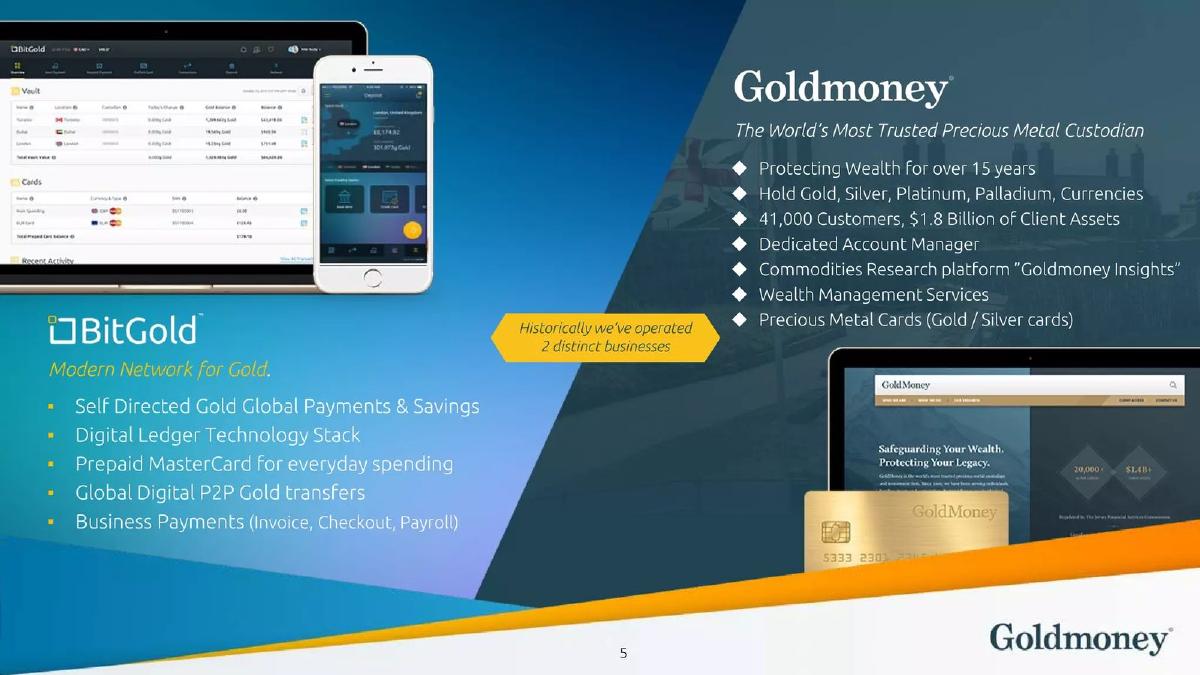
- The BitGold side of the business offers a digital ledger technology stack for P2P gold transfers and business payments as shown on slide 5.
- The company argues that national currencies are inefficient for global trade due to long settlement times and high exchange rate costs on slide 9.
- Slide 13 provides a mathematical argument for gold, showing that the cost of a truck in gold dropped from 857 grams in 1985 to 739 grams in 2015, while the USD price rose from $9,000 to $27,825.
- Goldmoney positions its digital offering as superior to ETFs by providing ownership of underlying metal and 1% pricing over spot on slide 17.
- The business platform allows merchants to process global payments from any currency for a 1% fee as stated on slide 21.
- The leadership team includes Darrell MacMullin, former Head of PayPal Canada, and Josh Crumb, former Sr. Metals Strategist at Goldman Sachs on slide 25.
- Monthly global transaction volume grew from $53.2 million in May 2016 to $77.4 million in June 2016 according to slide 29.
Executive Summary: The Institutionalization of Digital Gold
The July 2016 Goldmoney Inc. Investor Relations presentation is a comprehensive look at a company attempting to bridge the gap between ancient stores of value and modern fintech infrastructure. At this point in its history, Goldmoney had recently merged its legacy bullion business with BitGold, a technology-first platform. The deck serves to explain how these two entities work together to create a "Global Operating System for Gold." It moves from a philosophical and mathematical defense of gold as money into a detailed breakdown of a multi-product ecosystem serving individuals, businesses, and high-net-worth investors.
Slide 1: Title and Branding
The cover slide establishes the company's core identity: "The Global Network for Gold." It features the Goldmoney logo and the TSX:XAU ticker, indicating that the company is publicly traded on the Toronto Stock Exchange. The imagery—a woman using a laptop and a credit card alongside small gold cubes—immediately signals the intersection of physical precious metals and digital commerce. This sets the stage for a presentation that is less about mining and more about financial technology.
Slide 5: The Dual Business Model
Slide 5 is a pivotal slide that explains the company's structure following the integration of BitGold and Goldmoney. It notes that "Historically we've operated 2 distinct businesses." On the left, the BitGold side is described as a "Modern Network for Gold," focusing on self-directed savings, a digital ledger technology stack, prepaid MasterCards, and P2P transfers. On the right, the legacy Goldmoney brand is positioned as "The World's Most Trusted Precious Metal Custodian," boasting 15 years of history, 41,000 customers, and $1.8 billion in client assets. This slide effectively communicates that the company has both the "new school" tech growth potential and the "old school" stability and asset base.
Slide 9: The Problem with Modern Money
The presentation shifts to the macro problem on slide 9. Under the headline "Money has become a Technology," the company argues that while innovation has optimized money movement via new "communication protocols," these systems are insufficient for global trade. The slide explicitly lists the pain points of current national currencies and regional settlement systems: inefficiency, long settlement times, high costs for exchange rates, and price volatility. This establishes the "Why Now" and the market gap that Goldmoney intends to fill by using gold as a universal settlement layer.
Slide 13: The Mathematical Case for Gold
Slide 13 provides the "Proof in the Math" for gold as a store of value. It compares the cost of life in US Dollars versus Gold (in grams) from 1985 to 2015. The data is striking: while a burger went from $1.60 to $4.79 in USD, it went from 0.15 grams to 0.13 grams in gold. Similar trends are shown for transportation, fuel, and entertainment. This slide is designed to appeal to the rational investor by demonstrating that gold savings protect purchasing power over long horizons, unlike fiat currency which is subject to inflation.
Slide 17: Technological Evolution and Competitive Advantage
Slide 17 is a competitive analysis disguised as an evolution chart. it compares "Traditional Physical Gold Purchase," "Gold ETF Investment," and the "Goldmoney Personal + Business" offering. The traditional route is criticized for high premiums (3-5%) and long settlement times. ETFs are noted for having no ownership of the underlying metal and being "not easily transferable." Goldmoney positions itself as the superior alternative, offering fully allocated .9995 bullion, real-time settlement for as little as .01 grams, free storage with Brinks, and a low 1% fee over spot price. Crucially, it adds "Full payment capabilities," which neither physical gold nor ETFs provide.
Slide 21: The Merchant Ecosystem
The deck expands into B2B services on slide 21. It asks "Why Merchants Love Goldmoney" and lists features such as ecommerce payment acceptance, invoicing, and global payroll. The business model for this segment is clear: a 1% fee to process global payments from any currency and a 1% fee to store or redeem gold. The slide emphasizes "Global Reach" and "Cost-Effective" as the primary drivers for merchant adoption, suggesting that Goldmoney is positioning itself as a competitor to traditional payment processors like PayPal, but with a gold-backed ledger.
Slide 25: Leadership and Expertise
The "Multi-Disciplinary Team" on slide 25 is a significant strength of the deck. It features Darrell MacMullin (CEO of Goldmoney Network), whose background as the former Head of PayPal Canada adds immense credibility to the company's payment ambitions. Josh Crumb (Founder & CSO) brings institutional metal expertise from Goldman Sachs, while Roy Sebag (Founder & CEO) provides the investment management perspective. The inclusion of a CFO from PwC and a CTO with deep encryption experience rounds out a team that appears capable of handling both the regulatory and technical challenges of a global financial network.
Slide 29: Traction and Network Effects
Slide 29 focuses on the "Virality of a Healthy Network Effect." It presents two bar charts showing growth from May 2016 to June 2016. Global Client Assets grew from $1,668.3 million to $1,853.5 million, while Monthly Global Transaction Volume jumped from $53.2 million to $77.4 million. While the timeframe is short (only one month of growth is shown), the absolute numbers are large enough to demonstrate significant market presence and active usage of the platform's payment features.
Slide 33: The Future Roadmap and KPIs
The final slide in this selection, slide 33, summarizes the company's status as it enters "Year 2." It reiterates the June 2016 KPIs: 1.10 million sign-ups, $1.85 billion in client assets, and $77.4 million in transaction volume. It then outlines the four pillars of the "Global Operating System for Gold": Personal Savings, Wealth & Lending, Business Services, and a Distributed Gold Network (debit cards and APIs). This slide serves as a summary of the entire pitch, showing where the company is and where it is going.
What Goldmoney Does Well
The deck is exceptionally strong at framing the problem . By using historical data to show the erosion of USD purchasing power compared to gold, they create a logical necessity for their product. They don't just say gold is good; they show the math. Furthermore, the clarity of the product tiers (Personal vs. Business) and the specific fee structures (1% over spot) make the business model transparent and easy to understand for investors.
The team slide is a masterclass in building credibility. For a company trying to disrupt both the gold market and the payments market, having former executives from Goldman Sachs and PayPal is a powerful signal that the company understands both worlds. The traction metrics are also presented in absolute terms that are difficult to ignore, showing a platform that is already operating at scale rather than just a theoretical startup.
What Is Missing from the Deck
Despite its strengths, there are notable omissions in these slides. There is no explicit mention of the regulatory landscape . Operating a global gold-backed payment network involves complex Anti-Money Laundering (AML) and Know Your Customer (KYC) requirements across multiple jurisdictions. While they mention "compliance" on the team slide, a dedicated slide on their regulatory status and licenses would be expected for a company of this nature.
Additionally, while the deck mentions a "1% fee," it does not provide unit economics or a path to profitability . We see transaction volumes and asset totals, but we don't see the company's burn rate or net revenue after operating costs. There is also a lack of a specific "Ask." As an investor relations presentation, it may be intended for general market updates rather than a specific funding round, but for a pitch deck, the absence of a clear funding goal and use of proceeds is a gap.
Founder's Guide: What to Copy
Founders should look to slide 13 for how to use data to tell a story . Instead of just saying "inflation is bad," they showed how many grams of gold a truck cost 30 years ago versus today. This kind of tangible comparison is much more memorable than abstract percentages. If your product solves a long-term problem, find a way to visualize that problem over a multi-decade horizon.
Another element to emulate is the evolutionary comparison on slide 17. By placing their product at the end of a natural progression (Physical -> ETF -> Goldmoney), they make their solution feel like an inevitable next step rather than a risky new invention. This "evolutionary" framing helps reduce investor perceived risk by anchoring the new technology in a well-understood historical context.
Final Thoughts
Goldmoney's 2016 deck is a sophisticated piece of financial storytelling. It successfully takes a "boring" asset class—physical gold—and wraps it in a high-growth fintech narrative. By focusing on utility (payments and business services) rather than just speculation, the company broadens its total addressable market significantly. While the deck could use more detail on the regulatory and financial specifics, the combination of a high-pedigree team and massive existing assets makes for a compelling case for gold as a digital technology.
Frequently asked questions
- What is the core value proposition of Goldmoney's technology?
- Goldmoney aims to remove the friction associated with traditional physical gold and the limitations of gold ETFs. According to slide 17, their technology allows for real-time purchase and settlement of gold as small as .01 grams, with 1% pricing over spot and full payment capabilities (sending and requesting gold). This transforms gold from a static investment into a liquid, spendable asset.
- How does Goldmoney compare the purchasing power of gold versus the US Dollar?
- Slide 13 uses a 'Cost of Life' comparison between 1985 and 2015. It shows that while the US Dollar price of food, transportation, and fuel increased significantly, the cost in grams of gold actually decreased or remained stable. For example, fuel cost 0.11 grams of gold in 1985 and fell to 0.07 grams in 2015, whereas the USD price rose from $1.16 to $2.51.
- What features does Goldmoney offer to business merchants?
- As detailed on slide 21, the business platform includes ecommerce, donation, and subscription payment acceptance, an invoicing platform, and a global payroll tool. Merchants can process global payments from any currency for a 1% fee and choose to either store the gold balance or redeem it to their local currency for an additional 1% fee.
- Who are the key members of the Goldmoney leadership team?
- The team, shown on slide 25, is led by CEO Roy Sebag (former Portfolio Manager) and Darrell MacMullin (CEO of Goldmoney Network and former Head of PayPal Canada). Other key members include Founder Josh Crumb (ex-Goldman Sachs), CFO Katie Sokalsky (ex-PwC), and CTO Alessandro Premoli, who has over a decade of experience in encryption and cryptography.
- What were the company's key performance indicators as of mid-2016?
- Slide 33 lists three primary KPIs as of June 2016: 1.10 million sign-ups, $1.85 billion CAD in client assets, and $77.4 million CAD in monthly transaction volume. The deck also highlights a growth trend on slide 29, showing transaction volume increasing by over $24 million between May and June of 2016.