Gogohire’s 13-slide seed deck from 2014 is characterized by extreme brevity and high-impact visuals. It identifies a clear friction point in the recruitment market—the inefficiency of job boards and recruiters—and proposes a curated marketplace for tech sales talent. The deck relies heavily on social proof, featuring logos from over 100 customers including Dropbox and Okta, and emphasizes a 'high bar' with only a 15% admission rate for talent. While it lacks traditional financial projections or a detailed 'ask' slide, it compensates with strong founder-market fit, highlighting a CEO who was a…
Key takeaways
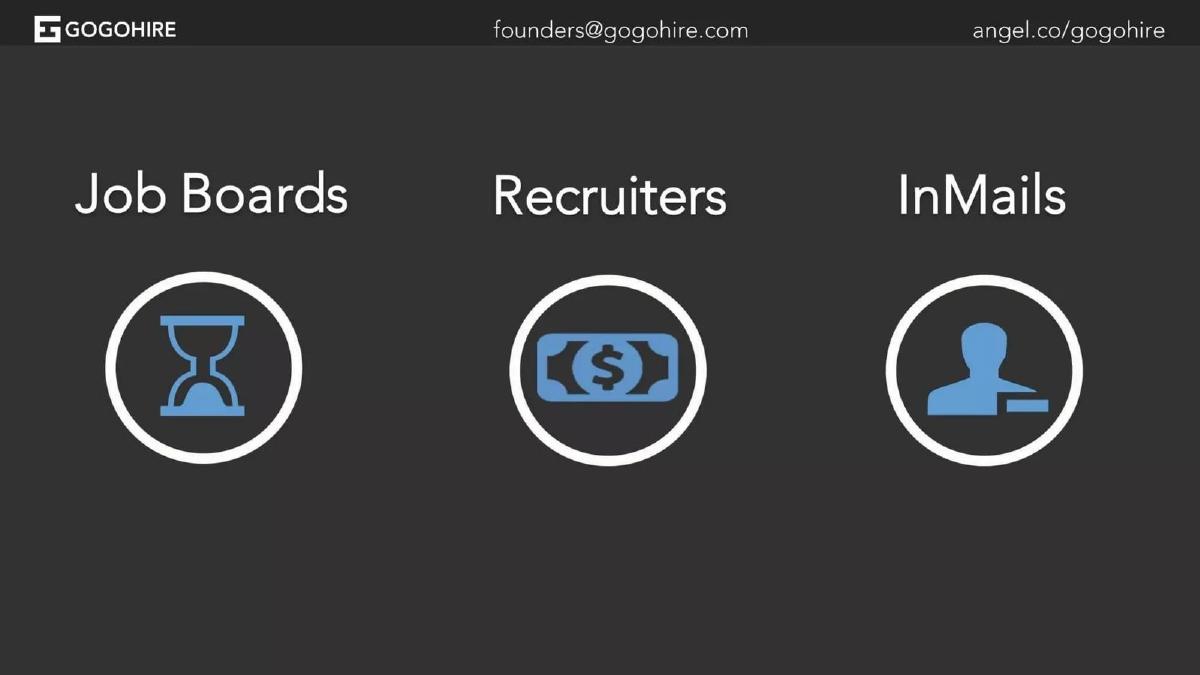
- The deck identifies three core pain points in hiring: slow job boards, expensive recruiters, and inefficient InMails (Slide 3).
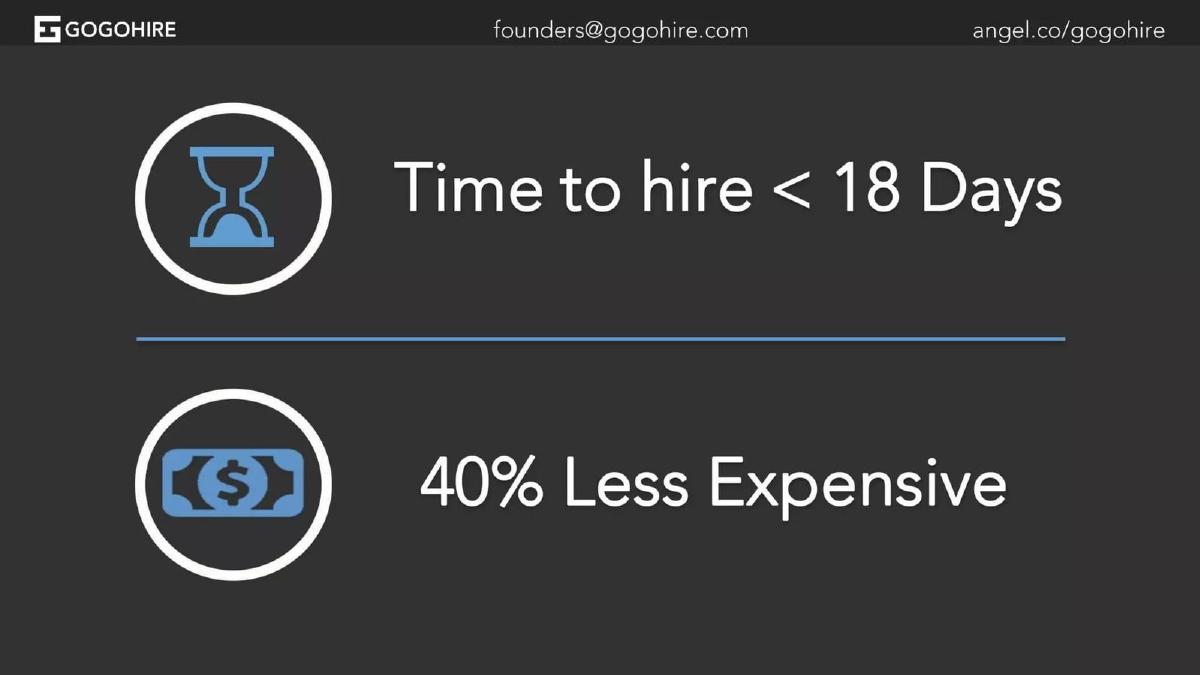
- Gogohire claims a 'Time to hire < 18 Days' and a cost structure that is '40% Less Expensive' than traditional methods (Slide 6).
- The platform utilizes a 'High Bar for Talent,' admitting only 15% of applicants to ensure quality (Slide 8).
- A 'Matching Algorithm' is touted as the core technology, resulting in a 55% interview acceptance rate (Slides 9 and 10).
- The company demonstrates significant early traction with a list of '100+ Customers' including major tech names like Dropbox and Okta (Slide 7).
- Founder-market fit is a central theme, with CEO Pete Ryan cited as a 'Sales MVP' at LinkedIn for FY11 and FY13 (Slide 12).
- The deck targets a specific $6B US market for Tech Sales within a broader $30B All Sales market (Slide 11).
- The presentation is notably missing a financial ask, a use-of-funds breakdown, and detailed revenue projections.
The Minimalist Manifesto: Analyzing Gogohire’s Seed Deck
Gogohire’s 2014 seed deck is a fascinating example of the 'less is more' philosophy in startup fundraising. In an era where decks often balloon to 20 or 30 slides filled with dense charts, Gogohire opted for a 13-slide presentation that relies on high-impact statements and clean design. The company, which focuses on a curated marketplace for tech sales talent, uses this deck to signal that they understand the value of a salesperson's time—and by extension, an investor's time.
The Hook and the Problem
Slide 1: Title Slide The deck opens with a high-resolution image of a clean workspace, featuring the Gogohire logo and the tagline: 'Sales Talent. Delivered.' It is professional and immediately establishes the brand's focus on efficiency and results.
Slide 2: The Face of the Problem Interestingly, Slide 2 is simply a large portrait of a man with the 'talkdesk' logo in the corner. While it lacks text, it likely served as a visual aid for a live pitch, representing a specific customer persona or a success story. It humanizes the hiring process right at the start.
Slide 3: The Friction Points This slide identifies the three 'villains' of the recruiting story: Job Boards (represented by an hourglass, implying they are slow), Recruiters (represented by a dollar sign, implying they are expensive), and InMails (represented by a silhouette, implying they are impersonal or ignored). By grouping these together, Gogohire sets the stage for a solution that is fast, affordable, and high-signal.
The Solution and Value Proposition
Slide 4: The Mission Statement Gogohire defines itself as 'The Fast and Scalable Way to Hire Elite Sales Talent.' This is a direct response to the problems identified on the previous slide. It promises speed and quality, which are the two most critical metrics for any hiring manager.
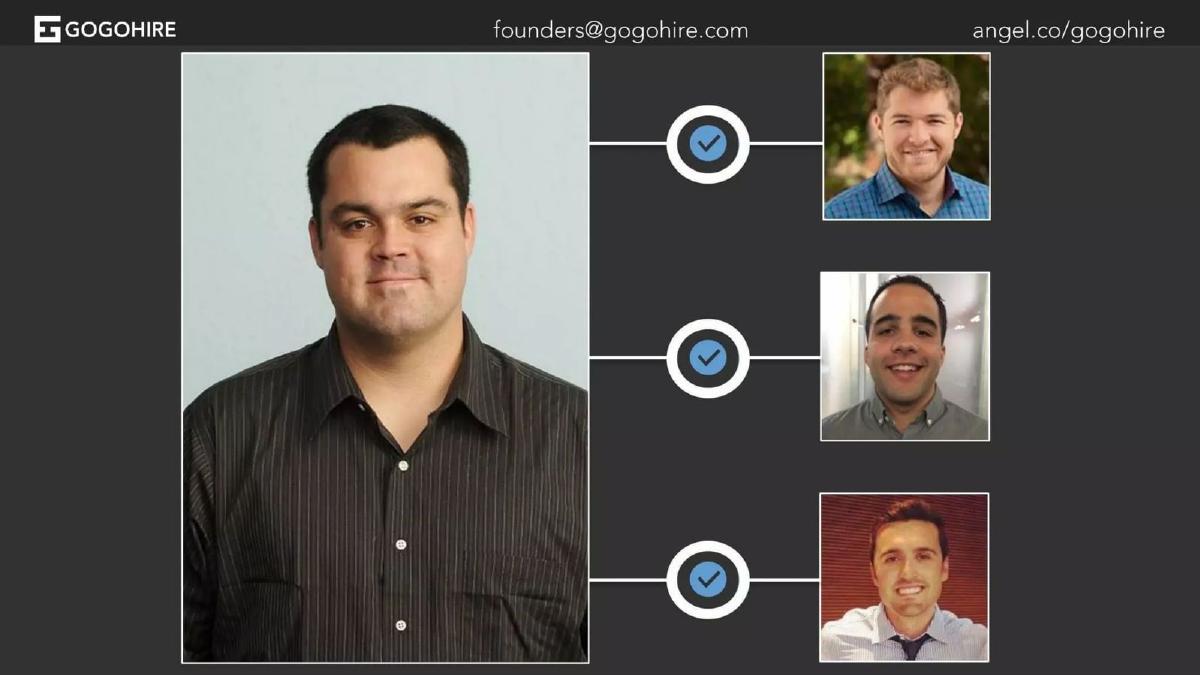
Slide 5: The Curation Process This slide uses a visual flow showing a single candidate being matched with three different hiring managers, each marked with a blue checkmark. This illustrates the marketplace dynamic: a single high-quality candidate can generate multiple high-intent opportunities, creating a more efficient ecosystem for both sides.
Slide 6: Quantifiable Benefits Gogohire puts hard numbers on its value proposition: 'Time to hire Slide 7: Social Proof The '100+ Customers' slide is the heavy hitter of the deck. By displaying logos for Dropbox, Okta, Sunrun, and HackerRank, Gogohire proves that it has already penetrated the elite tier of Silicon Valley tech companies. This level of traction for a 2014 seed-stage company is highly impressive and likely did much of the heavy lifting in the fundraise.
Slide 8: The Quality Filter To maintain the 'Elite' promise, Gogohire highlights its 'High Bar for Talent,' stating that 'Only 15% Applicants [are] Admitted.' This scarcity model is essential for a curated marketplace; it tells employers that the platform has already done the first three rounds of interviewing for them.
Slide 9: The Product in Action The 'Matching Algorithm' slide shows a clean UI of the platform. It features a countdown timer ('Until Current Match Ends'), which introduces a sense of urgency and 'drop' culture to the hiring process. This gamification of recruitment is a distinct product choice that separates it from static job boards.
Slide 10: The Result The '55% Interview Acceptance' rate is a key efficiency metric. In traditional recruiting, the ratio of 'requests sent' to 'interviews booked' is often much lower. This figure validates the effectiveness of the matching algorithm and the quality of the 15% admitted talent pool.
Market and Team
Slide 11: Market Size Gogohire defines its US Market in two boxes: 'Tech Sales' at $6B and 'All Sales' at $30B. This is a classic TAM/SAM (Total Addressable Market / Serviceable Addressable Market) slide, showing a large immediate opportunity with a clear path to a much larger adjacent market.
Slide 12: The Team The team slide is exceptionally strong for a seed stage. Pete Ryan (CEO) is highlighted as a 'Sales MVP' at LinkedIn for two separate years, giving him ultimate credibility in the sales space. Adarsh Uppula (CTO) is credited with winning 32 hackathons and having a Cisco background, signaling a high-velocity engineering culture. This is a classic 'hustler and hacker' duo with deep domain expertise.
Slide 13: Closing The final slide provides contact information and an AngelList link, maintaining the minimalist aesthetic of the rest of the deck.
What Works
Extreme Focus: By narrowing the scope to 'Tech Sales,' Gogohire avoids the trap of trying to be a generalist HR platform. This focus makes their '15% admission' and 'matching algorithm' claims much more believable. · Founder-Market Fit: The CEO’s background at LinkedIn is the perfect pedigree for this specific business. It suggests he understands the limitations of LinkedIn’s own products (like InMail) and knows how to build something better for sales professionals. · Metric-Driven: The deck doesn't just use adjectives; it uses numbers. 18 days, 40% cheaper, 15% admission, 55% acceptance. These are the metrics that matter to VCs.
What is Missing
The Ask: There is no slide indicating how much money the company is raising or what they intend to do with it. While this might have been handled in a separate document or a verbal conversation, its absence in the deck is notable. · Revenue and Business Model: While they mention being '40% Less Expensive,' they don't explicitly state their pricing model (e.g., contingency fee, subscription, or per-hire). · Competition: The deck ignores direct competitors in the 'curated marketplace' space (like Hired.com, which was active at the time). A competitive matrix would have helped define their unique moat. · Roadmap: There is no vision for what the product becomes in 2-3 years. The deck focuses entirely on the 'now.'
What a Founder Should Copy
The 'Villain' Slide: Slide 3 is a perfect example of how to quickly communicate market pain points using simple icons and text. It’s much more effective than a wall of bullet points. · Logo Density: If you have traction, show it. Slide 7 doesn't just list names; it uses recognizable logos to build instant trust. · The Scarcity Angle: If your product relies on quality, don't be afraid to boast about who you don't let in. The '15% admission' stat is a powerful marketing tool for both investors and customers.
Frequently asked questions
- What is Gogohire's primary value proposition?
- Gogohire positions itself as the 'Fast and Scalable Way to Hire Elite Sales Talent.' It specifically targets the inefficiencies of traditional recruiting by offering a curated marketplace where only the top 15% of sales applicants are admitted. This curation leads to a reported 55% interview acceptance rate and a time-to-hire of under 18 days, which is significantly faster than industry averages.
- How does Gogohire justify its market size?
- The deck segments the US market into two categories: 'Tech Sales' and 'All Sales.' It values the immediate opportunity in Tech Sales at $6B and the broader potential market for all sales hiring at $30B. This suggests a 'land and expand' strategy, starting with a high-density niche before moving into the general sales recruitment market.
- What evidence of traction does the deck provide?
- Traction is primarily shown through customer volume and brand names. Slide 7 explicitly states the company has '100+ Customers' and displays logos for high-growth tech companies such as Dropbox, Okta, HackerRank, and Sunrun. This serves as a powerful signal that the product has already been validated by sophisticated hiring teams in the target market.
- Who are the founders and why are they qualified?
- The team consists of Pete Ryan (CEO) and Adarsh Uppula (CTO). Ryan brings deep domain expertise as a former LinkedIn sales leader and two-time 'Sales MVP.' Uppula provides the technical backbone, noted for winning 32 hackathons and having experience at Cisco. This combination of sales excellence and technical speed is presented as the ideal mix for building a sales-focused recruitment platform.
- What is missing from the Gogohire pitch deck?
- The deck is missing several standard fundraising components. There is no 'Ask' slide detailing how much capital is being raised or at what valuation. It also lacks a roadmap, financial projections, and a detailed breakdown of unit economics or revenue models. Furthermore, there is no explicit slide addressing the competitive landscape beyond the general categories of 'Job Boards' and 'Recruiters.'