The GOED investor deck from August 2020 outlines the company's position as a leading online marketer of brand-name appliances, transitioning a 70-year legacy into a modern e-commerce platform. With $47.6 million in 2019 sales and a catalog of over 22,000 appliances, GOED highlights its unique status as the only publicly traded entity among the three nationally established online appliance retailers. The deck emphasizes a scalable business model where advertising spend directly correlates with revenue performance, evidenced by a 105.2% year-over-year increase in site sessions for Q2 2020. By f…
Key takeaways
- GOED achieved $47.6 million in sales in 2019, positioning itself as a major player in the online appliance space (Slide 4).
- The company offers a massive digital inventory with over 22,000 appliances available online (Slide 4).
- The US household appliance market is projected to grow from $21 billion in 2020 to $40 billion by 2025 at a 13.7% CAGR (Slide 7).
- GOED identifies as one of only three nationally established online appliance retailers and the only one that is publicly traded (Slide 10).
- The business model relies on five growth drivers: Advertising, Customers, Selection, Platform, and Service (Slide 13).
- The company maintains partnerships with premium brands including KitchenAid, Whirlpool, LG, Samsung, and Bosch (Slide 16).
- Q2 2020 performance showed significant growth, with site sessions up 105.2% and orders up 92.9% year-over-year (Slide 22).
- Management includes veterans with experience at major retailers like hhgregg and Lumber Liquidators (Slide 19).
GOED Investor Deck Teardown: The Digital Shift of Big-Ticket Retail
The GOED (Goedeker’s) investor presentation from August 2020 serves as a blueprint for how a legacy brick-and-mortar retailer can pivot to a high-growth e-commerce model. With a 70-year history, the company uses this deck to convince investors that it has successfully 'applied' its decades of experience to the online world. The deck focuses heavily on market tailwinds, a scalable customer acquisition model, and the unique competitive advantage of being a specialist in a world of generalists.
Slide 1: Title and Branding
The cover slide establishes the brand identity immediately, using a collage of high-end kitchen and home environments. The central text, "70+ Years of Appliance Experience Applied Online," bridges the gap between traditional reliability and modern technology. Notably, the slide features the NYSE American: GOED ticker, signaling to investors that this is a public company presentation rather than a private venture round.
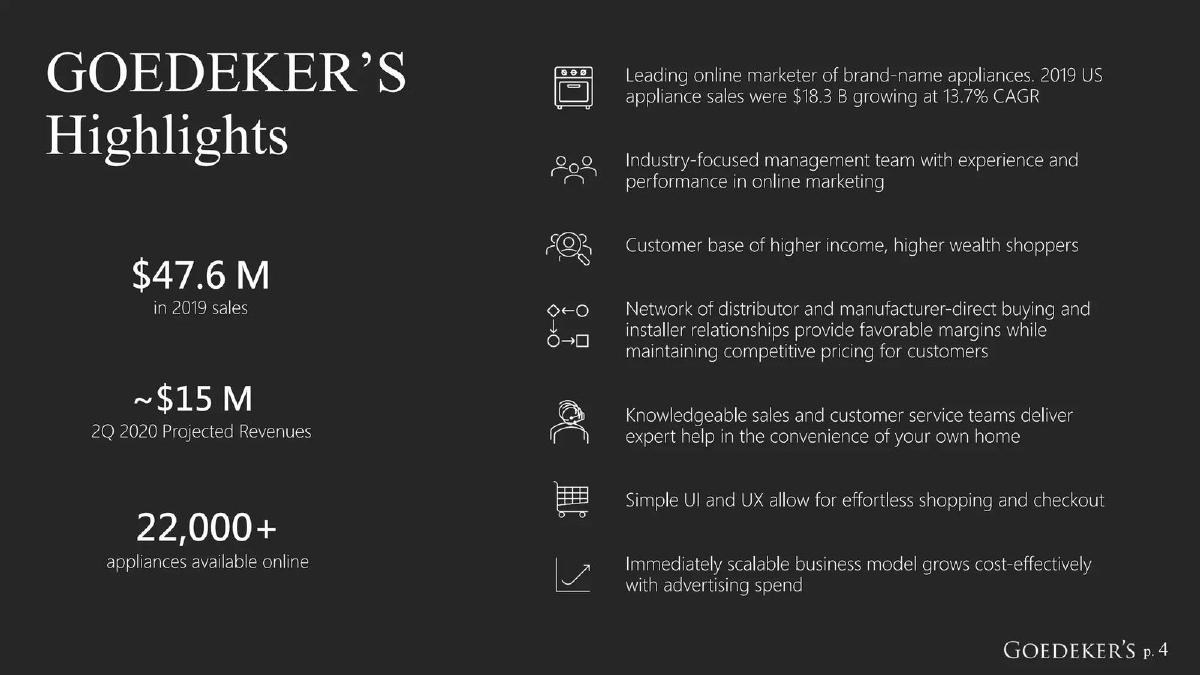
Slide 4: GOEDEKER’S Highlights
This slide acts as the executive summary. It lists three key metrics: $47.6 M in 2019 sales , ~$15 M in 2Q 2020 Projected Revenues , and a catalog of 22,000+ appliances available online . The right side of the slide lists qualitative strengths, including a 'higher income, higher wealth' customer base and a 'network of distributor and manufacturer-direct buying' that supports favorable margins. The mention of an 'immediately scalable business model' that grows with advertising spend is a crucial hook for growth-oriented investors.
Slide 7: Market Opportunity
GOED frames the appliance market as a 'core consumer product' sector. Citing Statista and Consumer Reports, the slide notes a $21 B 2020 US Market Size growing at a 13.7% CAGR , expected to reach $40 B by 2025 . The most critical data point here is that 80% + of consumers research and compare appliances online, justifying GOED's digital-first strategy. The slide also lists the top five most purchased appliances, led by Cooktops/Ranges and Refrigerators, grounding the market size in specific product categories.
Slide 10: Competitive Positioning
In a very sparse and direct slide, GOED claims its territory: "We are one of three nationally-established online appliance retailers. We are the only one publicly traded." This creates a sense of scarcity and exclusivity. By positioning itself against only two other unnamed national competitors, GOED simplifies the competitive landscape for the investor, suggesting a dominant market position with a unique public-market liquidity advantage.
Slide 13: The Five Areas That Drive Growth
This slide outlines the operational pillars of the company: Advertising, Customers, Selection, Platform, and Service. Each is represented by a circular graphic. While visually simple, it communicates that growth isn't just about one factor, but a combination of targeted marketing (Google), a premium customer profile, a wide product range, a robust digital platform, and high-touch customer service.
Slide 16: Brand Partnerships
To prove its 'Selection' pillar, Slide 16 displays a wall of logos from major appliance manufacturers. Featured brands include KitchenAid, Whirlpool, Maytag, LG, Samsung, Frigidaire, GE, and Bosch. This serves as social proof, demonstrating that the world’s largest appliance makers trust GOED to represent their products online. For a retailer, these relationships are the lifeblood of the business and represent a significant barrier to entry for new competitors.
Slide 19: Management Team
The deck provides detailed biographies for two key executives. CEO Douglas T. Moore is highlighted for his 25 years of retail experience, including a stint as Chief Merchandising and Marketing Officer at hhgregg and a board seat at Lumber Liquidators . CFO Robert D. Barry is noted for his experience with 1847 Holdings and his background as a CPA. The bios emphasize experience in store operations, supply chain, and public company management, aiming to reassure investors that the company is in professional hands.
Slide 22: Ad Spend and Revenue Performance
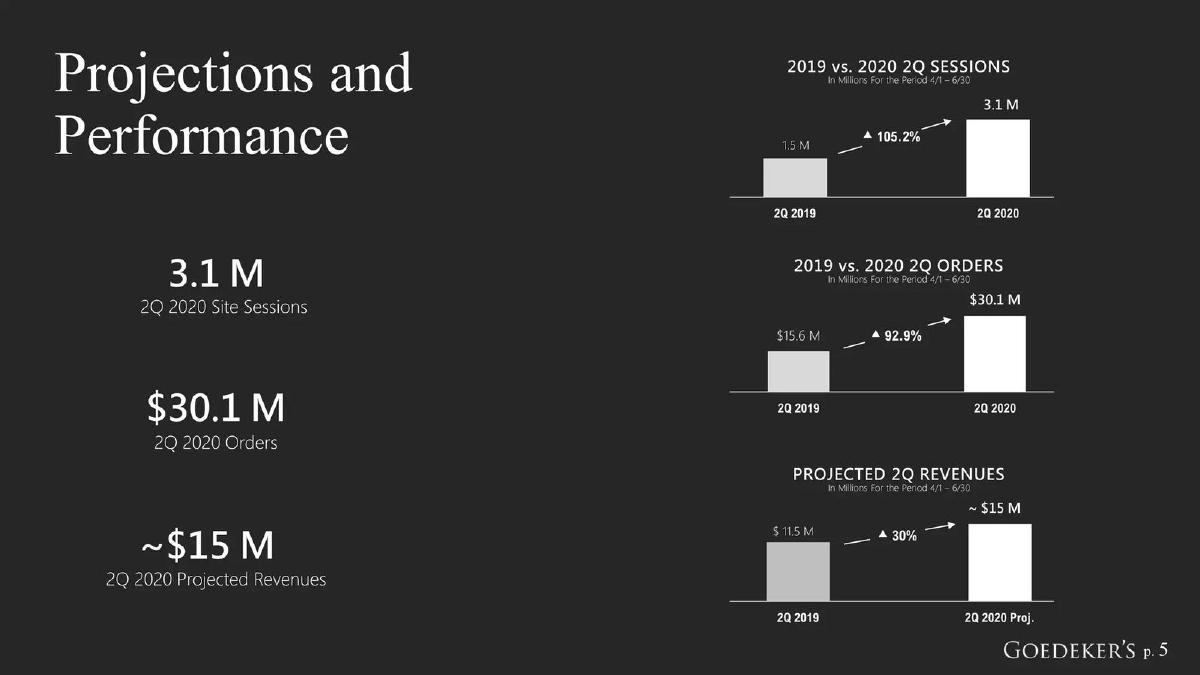
This is arguably the most important slide for a growth investor. It provides a direct correlation between marketing activity and financial results. It shows 2Q 2020 Site Sessions at 3.1 M (up 105.2% YoY) and 2Q 2020 Orders at $30.1 M (up 92.9% YoY) . Interestingly, while orders were $30.1 M, projected revenues were listed at ~$15 M , suggesting a lag between order placement and revenue recognition or a specific accounting treatment for their sales. The clear upward trend lines across all three charts (Sessions, Orders, and Revenues) visualize the 'immediately scalable' claim made earlier in the deck.
Slide 25: Investment Summary
The final slide summarizes the thesis. It reiterates the 70+ years of experience, the industry-focused management, and the multi-billion dollar market transition to online sales. It emphasizes the "high-touch and informative sales engagement" required for big-ticket items and concludes with the projection of continued growth based on YTD performance. The slide repeats the Q2 2020 growth percentages (105.2% session growth, 92.9% order growth) to leave the investor with the most impressive numbers.
What Works in This Deck
The GOED deck succeeds by focusing on a clear, repeatable growth lever: advertising spend. By showing that increased site sessions lead directly to increased orders, the company makes a compelling case that more capital will lead to more revenue. The use of industry-specific data (like the 80% online research stat) validates their business model without requiring the investor to take a leap of faith. Furthermore, the management bios are strong, linking the leadership team to well-known national retail brands, which builds immediate credibility.
What Is Missing
The most glaring omission in this teardown of the 9 provided slides is unit economics. While we see top-line growth and order volume, there is no mention of Customer Acquisition Cost (CAC), Lifetime Value (LTV), or gross margins. For an e-commerce business, especially one selling heavy, low-margin items like appliances, shipping costs and return rates are critical factors that are not addressed here. Additionally, there is no specific 'Ask' slide in this selection, nor is there a detailed breakdown of how the 'Platform' or 'Service' pillars actually function technically or operationally. The deck also lacks a competitor comparison table , choosing instead to simply state that there are only two other national competitors without naming them or explaining how GOED wins against them.
Founder Takeaways
Quantify the Correlation: If your business model relies on a specific lever (like ad spend), show the direct historical correlation between that lever and your key performance indicators (KPIs). GOED’s Slide 22 is a perfect example of this. · Leverage Legacy: If you are pivoting an old business, don't hide the age. Use it as a badge of 'experience' and 'reliability' that new startups lack. GOED’s '70+ years' branding is a powerful trust signal. · Simplify the Competitive Landscape: You don't always need a complex matrix. Sometimes, a bold statement about your unique position (e.g., "the only publicly traded player") is more memorable. · Focus on Big-Ticket Nuance: If you sell expensive items, emphasize the human element. GOED correctly identifies that 'big-ticket' purchases require 'high-touch' service, which differentiates them from automated giants.
Frequently asked questions
- What is GOED's primary value proposition to investors?
- GOED positions itself as a high-growth e-commerce platform built on a 70-year foundation of appliance expertise. Its primary value proposition is its ability to scale revenue cost-effectively through advertising spend within a massive, fragmented market. As the only publicly traded dedicated online appliance retailer at the time of the deck, it offered investors a unique entry point into the digital shift of big-ticket home goods.
- How does GOED differentiate itself from larger general retailers like Amazon or Home Depot?
- While the deck doesn't name these competitors directly, it emphasizes a 'high-touch and informative sales engagement' and 1-on-1 communication for big-ticket purchases. By focusing exclusively on appliances and maintaining a knowledgeable sales team, GOED aims to provide a level of expertise and customer service that generalist e-commerce giants often struggle to replicate for complex home installations.
- What role does advertising play in GOED's business model?
- Advertising is central to GOED's growth strategy. Slide 22 explicitly links ad spend to revenue performance, showing that a surge in site sessions (up 105.2%) led to a near-doubling of orders (up 92.9%). The deck describes the model as 'immediately scalable,' suggesting that the company can predictably drive top-line growth by increasing its marketing budget.
- Who are the key members of the management team?
- The team is led by CEO Douglas T. Moore, who brings over 25 years of retail experience, including roles at hhgregg and Lumber Liquidators. CFO Robert D. Barry provides financial leadership with a background in public companies and retail consulting. Their combined experience is presented as a pillar of the company's ability to execute its online transition (Slide 19).
- What are the projected market opportunities mentioned in the deck?
- GOED targets the US household appliance market, which it valued at $21 billion in 2020. The deck highlights a significant shift in consumer behavior, noting that over 80% of consumers research appliances online. With the market expected to reach $40 billion by 2025, GOED sees a massive runway for growth as more of these transactions move from physical stores to digital platforms (Slide 7).