Claira’s 15-slide deck, used for a 2024 strategic round, positions the company as a specialized alternative to general-purpose AI in the fintech and legal tech sectors. The narrative centers on the failure of traditional Natural Language Processing (NLP) to handle the complex, conditional logic inherent in financial agreements. Claira introduces a proprietary 'logic map' technology that converts sentences into actionable data without the need for massive, client-provided training sets. While the deck is technically robust and clearly defines its market position against standard Contract Lifec…
Key takeaways
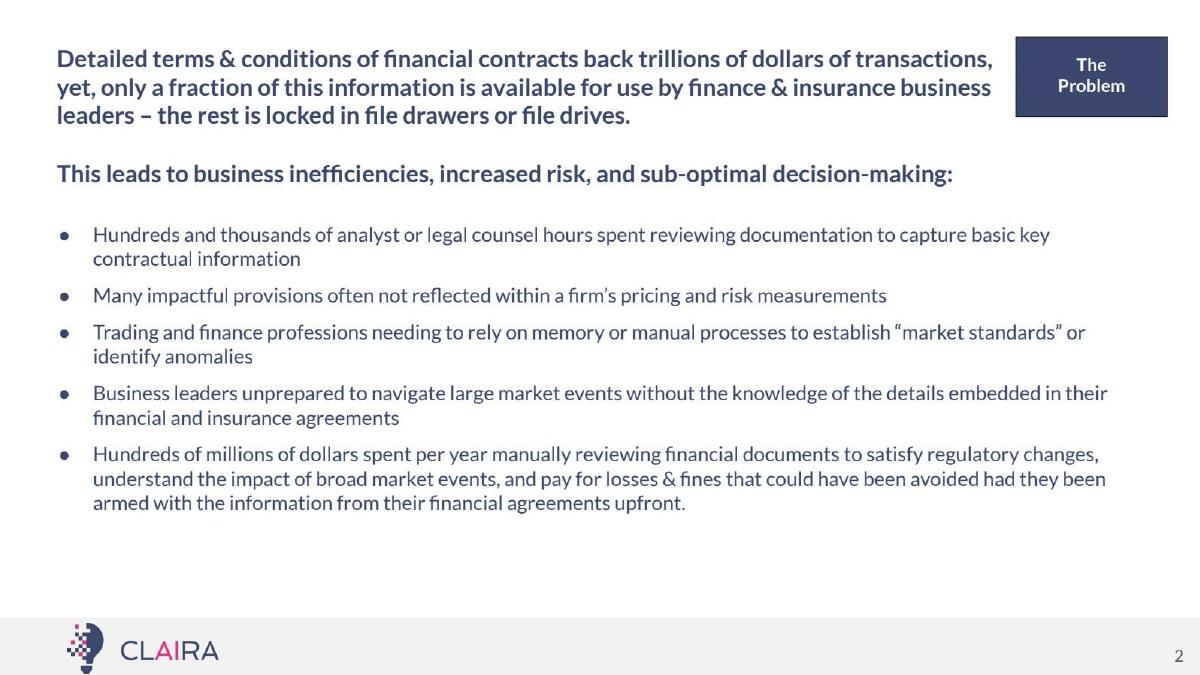
- Claira identifies a massive data gap where trillions of dollars in transactions are backed by contracts with information 'locked in file drawers' (Slide 2).
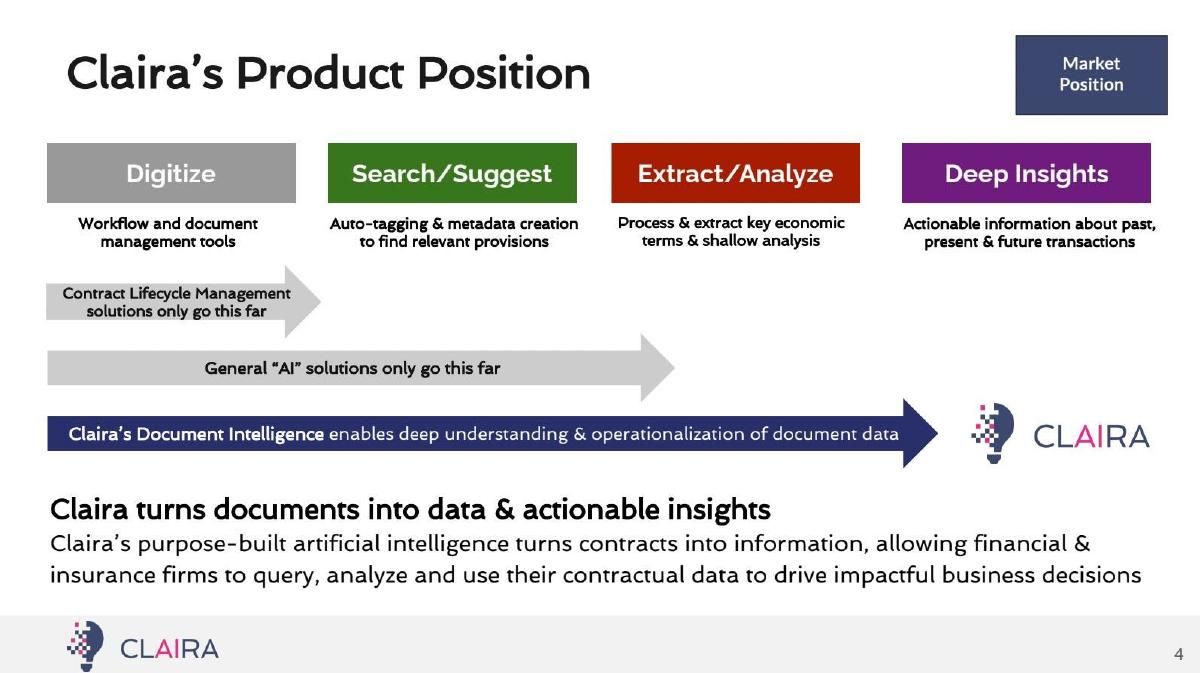
- The company positions itself beyond 'General AI' and 'CLM' by offering 'Deep Insights' and operationalization of document data (Slide 4).
- A core thesis of the deck is that general NLP fails in legal contexts because it relies on pattern matching rather than understanding unique legal language (Slide 6).
- The deck provides a concrete example of how 'Maturity Dates' can be obscured by conditional logic, which traditional AI struggles to calculate (Slide 6).
- Claira’s proprietary technology is visualized as a logic map that converts raw sentences into 'If/Then' decision trees (Slide 8).
- The platform claims to extend to various financial documents without additional training, illustrated by a complex network diagram of LIBOR and credit protection nodes (Slide 10).
- The 'Client Engagement' model replaces traditional data labeling with a collaborative definition and configuration process (Slide 12).
- The deck omits a team slide, financial projections, and a specific funding ask, suggesting a highly targeted strategic use case.
Executive Summary: The Technical Strategic Pitch
Claira’s pitch deck is a focused, technical document designed to explain a complex solution to a sophisticated audience. Operating at the intersection of AI, Fintech, and Legal Tech, the company avoids the common pitfalls of 'AI hype' by leaning into the specific limitations of current Large Language Models (LLMs) and Natural Language Processing (NLP) in the financial sector. The deck, reported by Business Insider as part of a 2024 strategic round, serves more as a product deep-dive than a traditional seed or Series A deck. It lacks the standard 'Why Now' and 'Team' slides, focusing instead on the 'How it Works'—a critical factor for strategic investors in the highly regulated world of finance.
Slide 1: Introduction
The deck opens with a headshot of Joseph Squeri, identified as the CTO and COO of Exos. While not a traditional title slide for Claira itself, this suggests a strong tie to Exos or a presentation context where leadership credibility is established upfront. The presence of a high-level executive from a digital finance firm immediately signals the deck's target audience: institutional finance and enterprise technology leaders.
Slide 2: The Problem - The Trillion Dollar Information Gap
Slide 2 establishes the stakes. It notes that financial contracts back 'trillions of dollars of transactions,' yet the data is 'locked in file drawers or file drives.' The slide lists five specific pain points, including the 'hundreds of thousands of analyst or legal counsel hours' spent on manual review and the 'hundreds of millions of dollars' spent annually to satisfy regulatory changes. By quantifying the problem in terms of hours and regulatory fines, Claira moves the conversation from a 'nice-to-have' tool to a risk-mitigation necessity.
Slide 4: Market Positioning
This slide is a classic 'step-up' diagram. It categorizes the market into four stages: Digitize, Search/Suggest, Extract/Analyze, and Deep Insights. Claira positions itself at the far right of this spectrum. Crucially, it labels 'Contract Lifecycle Management' (CLM) solutions as only capable of digitization, and 'General AI' as only capable of shallow extraction. Claira’s 'Document Intelligence' is presented as the only solution that enables the 'operationalization of document data,' which is a key phrase for firms looking to integrate contract data into live trading or risk systems.
Slide 6: The Failure of General AI
Slide 6 is perhaps the most important slide for a technical investor. It outlines the 'Struggles of broad-based NLP & ML approaches.' The company argues that general AI relies on pattern matching, which fails in legal language because legal terms are unique and highly conditional. The slide uses the 'Maturity Date' as a case study, showing how a date might be 'Directly Stated,' 'Calculated' (e.g., 7th anniversary from the agreement date), or 'Conditional' (e.g., shall be X if Y does not apply). This level of specificity demonstrates that the founders understand the edge cases that cause standard AI tools to fail in production.
Slide 8: The Proprietary Solution - Logic Maps
To solve the pattern-matching problem, Claira introduces its 'Logic Map' technology. Slide 8 shows a raw legal sentence regarding a 'Calculation Agent' and demonstrates how Claira converts it into a Boolean logic flow (If/Then/True/False). By turning prose into a decision tree, Claira makes the contract 'machine-readable' in a way that traditional text extraction does not. This is the 'moat' of the company: the ability to translate legal ambiguity into computational logic.
Slide 10: Scalability Without Retraining
Slide 10 features a dense, complex network diagram. The text claims that Claira 'extends to various financial documents & use cases without additional training.' It highlights specific nodes like 'LIBOR,' 'Collateral Requirement,' and 'Credit Protection.' This addresses a major concern for enterprise buyers: the 'cold start' problem. If the tool can handle new document types without months of manual labeling, the time-to-value is significantly reduced.
Slide 12: A New Engagement Model
This slide compares 'Traditional AI Engagement' with 'Claira Engagement.' The traditional model is depicted as a repetitive cycle of labeling, training, and re-labeling. Claira’s model is presented as a four-step consultative process: Define, Discuss, Configure, and Deliver. This slide is clearly aimed at the operations or legal departments of large banks, promising a 'white-glove' configuration that doesn't require the client to provide thousands of training examples—a common hurdle in secure financial environments.
Slide 15: The Vision
The deck concludes with a summary statement: 'Claira’s proprietary document intelligence technology enables trade, finance, and insurance professionals to make better decisions faster.' It includes the company website but, notably, no 'Ask' slide. There is no mention of the round size, valuation, or use of proceeds.
What Claira's Deck Does Well
Technical Differentiation: In a market saturated with 'AI for legal' startups, Claira does an excellent job of explaining why general models fail. The 'Maturity Date' example on Slide 6 is a masterclass in using a specific, relatable pain point to prove technical superiority.
Visualizing the Invisible: The Logic Map on Slide 8 is a powerful visual aid. It takes an abstract concept (computational linguistics) and makes it tangible. Investors can see exactly how the software 'thinks,' which builds trust in the product's accuracy.
Focus on Operationalization: The deck repeatedly uses the word 'actionable.' It isn't just about reading contracts; it's about turning them into data that can drive 'impactful business decisions.' This aligns the product with the revenue-generating parts of a bank, not just the cost-center legal department.
What is Missing from the Claira Deck
The Team Slide: There is no slide detailing the founders' backgrounds, their expertise in linguistics, or their history in finance. In a strategic round, the 'who' is often as important as the 'what,' and its absence here is striking.
Traction and Social Proof: While the deck mentions the types of firms that could benefit, it does not list any current pilots, customers, or partners. There are no quotes from users or metrics showing how much time or money has been saved in real-world applications.
Business Model and Financials: There is no information on how Claira makes money. Is it a SaaS seat-based model? A per-document fee? A professional services hybrid? Similarly, there are no financial projections or historical growth data.
The Competitive Landscape: While Slide 4 mentions 'General AI' and 'CLM,' it doesn't name specific competitors. A strategic investor would want to know how Claira stacks up against incumbents like Kira Systems, Eigen Technologies, or Seal Software.
Founder Takeaways: Copy the Logic, Add the Context
Founders building in complex, regulated industries should study Claira's approach to problem definition . By breaking down a single field (Maturity Date) into its various legal permutations, they prove they are experts in the domain. This 'expert-to-expert' communication style is highly effective for strategic rounds.
However, most founders should not omit the Team and Traction slides. Unless you are in a very specific strategic negotiation where those details are already known, you must prove that you are the right team to build this and that the market is already responding to your solution. Claira’s deck is a 'Product and Tech' deck; a successful 'Fundraising' deck usually needs to be a 'Business and Market' deck as well.
Finally, the Engagement Model slide (Slide 12) is a great addition for B2B enterprise decks. It preemptively answers the question, 'How much work is this going to be for my team?' By showing a streamlined onboarding process, you lower the perceived barrier to entry for a potential customer or partner.
Frequently asked questions
- What is the primary problem Claira is solving?
- Claira addresses the 'locked' data within complex financial and insurance contracts. Slide 2 notes that while trillions of dollars are at stake, business leaders lack access to the specific terms and conditions governing these transactions, leading to hundreds of millions of dollars spent on manual reviews and regulatory fines.
- How does Claira differentiate itself from other AI legal tools?
- According to Slide 4, most Contract Lifecycle Management (CLM) tools only handle digitization, and general AI only reaches basic extraction. Claira claims to provide 'Deep Insights' by using a logic-based approach rather than simple pattern matching, allowing for the operationalization of complex contractual data.
- What is a 'Logic Map' in the context of this deck?
- As shown on Slide 8, a logic map is Claira's proprietary way of breaking down a raw sentence into a flow chart. It identifies variables (like a 'Calculation Agent') and applies conditional logic (If/Then) to determine the legal outcome based on specific events, such as a 'Potential Event of Default'.
- Does the deck show any financial traction or customer logos?
- No. The 15-slide deck is focused entirely on the problem, the technical solution, and the engagement model. It does not list current revenue, growth metrics, or specific client names, although it mentions the types of professionals (trade, finance, insurance) who use the tool.
- What is the 'Difference in client engagement' mentioned on Slide 12?
- Claira argues that traditional AI requires clients to provide thousands of labeled examples and undergo constant retraining. In contrast, Claira’s model involves a four-step process: Define, Discuss, Configure, and Deliver, where the Claira team establishes queries based on client definitions rather than massive data labeling.