Civicrowd is a civic crowdfunding platform aiming to solve the disconnect between local governments and their citizens. By positioning itself as the 'Kickstarter of Government,' the company proposes a model where citizens can prioritize and fund public projects while cities gain a new financing source and increased transparency. The deck outlines a clear revenue model based on an 8% project commission and whitelabeling services. While the market data highlights significant growth in German crowdfunding—rising 175% to €5.36m in 2013—the venture relies heavily on a solo founder, Andreas Weigand…
Key takeaways
- The company positions itself as the 'Kickstarter of Government' to provide cities with additional financing sources (Slide 3).
- Civicrowd plans to charge an 8% commission per project, with 3% allocated to payment systems and 5% for the platform (Slide 6).
- The vision includes scaling from Berlin to Madrid, Paris, and Lisbon within three years (Slide 5).
- Market data shows German crowdfunding grew 175% in 2013, reaching a total of €5.36 million in capital (Slide 8).
- The founder identifies Citizinvestor, ioby, and Neighbor.ly as international competitors but claims no active civic crowdfunding platform exists in Germany (Slide 8).
- The funding request is for €150,000 in seed financing, with €30,000 already confirmed at the time of the deck (Slide 9).
- The team slide features a single founder, Andreas Weigand, highlighting his Master in Finance and experience at FactSet (Slide 10).
- The deck mentions the existence of a 30-page business plan based on 'Business Model Generation' available upon request (Slide 10).
Civicrowd Pitch Deck Analysis
Civicrowd enters the market with a proposition that sits at the intersection of FinTech and GovTech. The deck focuses on the inefficiency of local government funding and the lack of direct citizen participation in urban development. By leveraging the mechanics of crowdfunding, the company seeks to create a transparent loop between city hall and the street level.
Slide 1: Title Slide
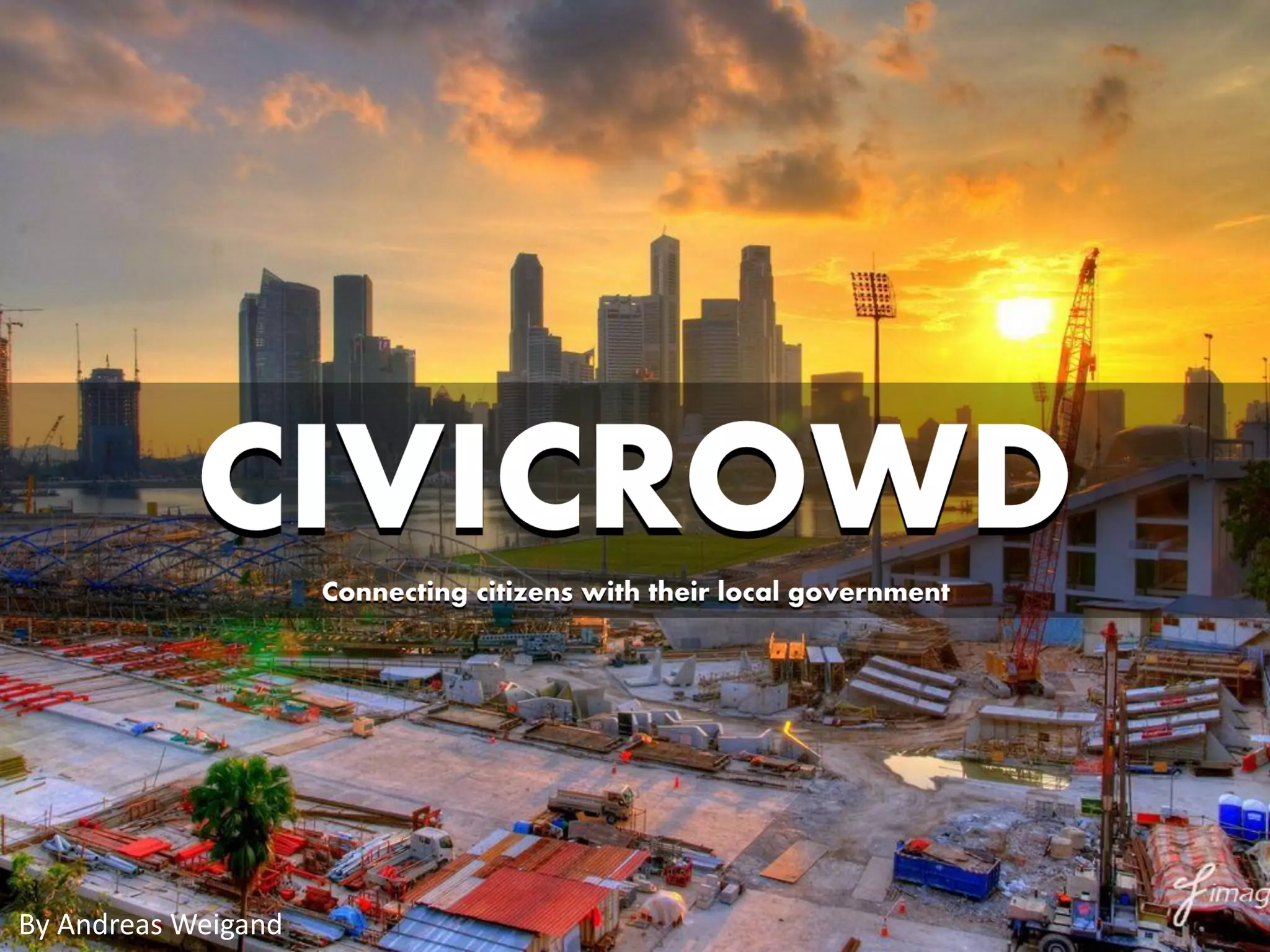
The cover slide features a high-contrast city skyline at sunset, emphasizing the urban focus of the venture. The tagline, "Connecting citizens with their local government," clearly defines the company's mission. The slide attributes the deck to Andreas Weigand, establishing the solo-founder nature of the presentation from the outset.
Slide 2: The Problem
Slide 2 uses a split-screen approach to define the problem for two distinct stakeholders. For citizens, the barriers are a difficulty in investing in communities, an inability to fund public projects directly, and no way to communicate project priorities. For cities, the deck cites high debt, lack of real-time interaction with residents, and low transparency. The use of a "not equal" sign between the two groups visually represents a breakdown in the social contract regarding public spending.
Slide 3: The Solution - The Kickstarter of Government
The solution is introduced using a high-level analogy: "The Kickstarter of Government." This is a standard pitch deck technique to provide immediate context. The slide defines Civicrowd as a crowdfunding platform that connects citizens with local government, aiming to bridge the gap identified in the previous slide.
Slide 4: Solution Mechanics
This slide provides a functional overview of how the platform works. It illustrates a circular flow of value. Cities post projects with funding needs, approve citizen-led projects, and provide feedback. Citizens, in turn, can crowdfund projects, post their own ideas, and "like" projects to help the government prioritize. The central themes are listed as "Transparency, Interaction, Results."
Slide 5: Vision and Scalability
The vision slide sets a three-year roadmap. The primary goal is to become the largest civic crowdfunding platform in Europe. The tactical plan involves a launch in Berlin, followed by scaling to three additional European hubs: Madrid, Paris, and Lisbon. This indicates an ambition to capture major metropolitan markets rather than focusing on smaller municipalities first.
Slide 6: Building Blocks (Business Model Canvas)
Slide 6 is a condensed version of a Business Model Canvas. It details nine key areas:
Key Partners: Municipalities, local governments, NGOs, and charities. · Key Activities: Marketing, R&D, and partnership development. · Value Proposition: Empowering citizens and providing additional financing for cities. · Customer Segments: Governments, citizens, and corporations. · Revenue Streams: An 8% project commission (3% for payments, 5% for the platform) and whitelabeling. · Cost Structure: Platform development, marketing, and staff salaries.
Slide 7: Global Market Context
This slide attempts to quantify the opportunity. It notes that civic crowdfunding is in an "infant stage." It cites a $3 billion yearly global crowdfunding market, with $1 billion being donation-based. Within that, it identifies a $10 million niche for civic crowdfunding growing at a 58% annual rate. The slide argues that early penetration is vital for long-term dominance.
Slide 8: The German Market and Competition
Slide 8 focuses on the domestic German market. It includes three bar charts showing growth from 2011 to 2013 in total projects (1,611), successful projects (922), and mediated capital (€5.36 million). The text highlights a 175% growth rate in 2013. In terms of competition, it lists US and UK players but claims a first-mover advantage in Germany, noting that the only potential local competitor, "Place2help," had not yet launched.
Slide 9: Funding Requirements
The "Ask" slide is straightforward. Civicrowd is seeking €150,000 in seed financing. Crucially, it notes that €30,000 is already confirmed. The funds are earmarked for platform building and the whitelabeling service, with the goal of providing one year of runway to achieve traction.
Slide 10: Team and Contact
The final slide introduces Andreas Weigand. His credentials include a Master in Finance from IE Business School and experience as a Senior Consultant at FactSet. It also mentions his academic work on crowdfunding research with the University of Brasilia. The slide concludes by mentioning a 30-page business plan is available, suggesting the founder has done extensive background work beyond these ten slides.
What Civicrowd Does Well
The deck is highly efficient. In just ten slides, it covers the problem, solution, business model, market size, and the specific funding ask. The use of the "Kickstarter for X" analogy is effective for a seed-stage pitch because it immediately communicates the user experience and the revenue model without requiring deep technical explanation.
The revenue model on Slide 6 is particularly clear. By breaking down the 8% commission into payment costs versus platform revenue, the founder demonstrates an understanding of gross margins and the underlying costs of financial transactions. Providing specific market growth figures for the German market (175% growth) adds a layer of urgency to the investment opportunity.
What is Missing from the Civicrowd Deck
The most glaring omission is a technical co-founder or a broader team. Slide 10 presents a solo founder with a finance and consulting background. For a platform-based business, investors typically look for a technical lead to mitigate the risks of outsourced development, especially since "Platform development" is the primary use of funds on Slide 9.
Furthermore, there is no mention of the regulatory or legal hurdles associated with government partnerships. Working with municipalities often involves complex procurement processes and legal restrictions on how public funds can be co-mingled with private donations. The deck treats "Cities" as a standard customer segment without acknowledging the long sales cycles typical of GovTech.
Finally, the deck lacks a demonstration of the product. There are no wireframes, screenshots, or mockups of the platform. While the circular flow on Slide 4 explains the logic, seeing the actual interface would help validate the "Interaction" and "Transparency" claims.
Founder Lessons: What to Copy
Founders should emulate the clarity of the "Building Blocks" slide. Many decks hide their business model in long paragraphs; Civicrowd uses a structured grid that allows an investor to see the entire operational logic of the company at a glance. It shows that the founder has thought through not just the product, but the entire ecosystem required to sustain it.
Another strong point is the specific geographic roadmap on Slide 5. Instead of saying "we will scale globally," the founder identifies specific cities (Berlin, Madrid, Paris, Lisbon). This makes the vision feel tangible and allows investors to evaluate the founder's understanding of those specific markets. If you are pitching a localized service, naming your next three targets is always better than vague generalities.
Lastly, the inclusion of "Already confirmed" funds on the funding slide is a powerful psychological trigger. It shows momentum and social proof, even if the amount (€30,000) is a small fraction of the total ask. It signals to new investors that they are not the first ones to take the risk.
Frequently asked questions
- What is Civicrowd's primary business model?
- Civicrowd operates on a commission-based model. According to slide 6, they charge an 8% fee on successfully funded projects. Of this, 3% covers payment system costs, leaving 5% as revenue for the platform. Additionally, the company plans to generate revenue through whitelabeling their software for other organizations or municipalities.
- Who are the target customers for this platform?
- The platform serves a two-sided market. On the supply side, the customers are municipalities and local governments looking for project funding and citizen engagement. On the demand side, the segments include individual citizens, corporations, and philanthropic organizations interested in investing in local community improvements (Slide 6).
- How does the company plan to use the requested €150,000?
- As stated on slide 9, the seed financing is intended to build the core platform and develop the whitelabeling service. The founders estimate this amount will cover the first year of business operations, providing enough runway to reach a point where the platform gains significant traction.
- What is the competitive landscape for civic crowdfunding in Germany?
- Slide 8 notes that while there are established players in the US (like Citizinvestor and ioby) and the UK (Spacehive), there was no active civic crowdfunding platform in Germany at the time of the deck. It mentions a potential competitor, 'Place2help,' which had not yet launched a product.
- What are the main risks identified in the deck's structure?
- The most prominent risk is the solo-founder structure; slide 10 only lists Andreas Weigand, which suggests a lack of technical or operational co-founders. Additionally, the reliance on government partnerships (Slide 6) introduces long sales cycles and bureaucratic hurdles that are not explicitly addressed in the risk or strategy sections.