Clair Health's 13-slide deck is a masterclass in using early momentum to de-risk a complex hardware and healthcare play. By reporting 5,600+ pre-orders and a 23,000+ person waitlist just nine weeks after emerging from stealth, the company shifts the investor conversation from 'will people want this?' to 'how fast can we scale?' The deck balances consumer-facing hype with institutional credibility, citing a network of clinical partners and a team with backgrounds at the FDA, Apple, and Stanford Medicine. While the deck is light on specific unit economics and long-term competitive moats, the sh…
Key takeaways
- The company claims the title of 'World's first wearable hormone monitor' on Slide 1, establishing a clear category-leading position.
- Clair identifies a $100B market opportunity linked to four specific hormones that are currently untracked, according to Slide 2.
- Traction is the primary focus, with Slide 3 highlighting 5,600+ pre-orders and a 23,000+ waitlist within nine weeks of launch.
- The deck leans heavily on B2B credibility, citing 'B2B device purchase MOUs' on Slide 4 and a network of clinical partners on Slide 5.
- A November launch date is explicitly stated on Slide 5, providing a clear timeline for near-term milestones.
- The team slide (Slide 7) emphasizes regulatory and technical expertise with logos from the FDA, Meta, Apple, and Stanford Medicine.
- Slide 13 claims the technology is 'validated against gold-standard hormone assays in a real-world clinical trial,' addressing technical risk.
- The deck omits specific financial projections, unit economics, and a detailed breakdown of the $11.6M use of funds, as seen on Slide 9.
The Pitch Deck Analysis
Slide 1: Title and Vision
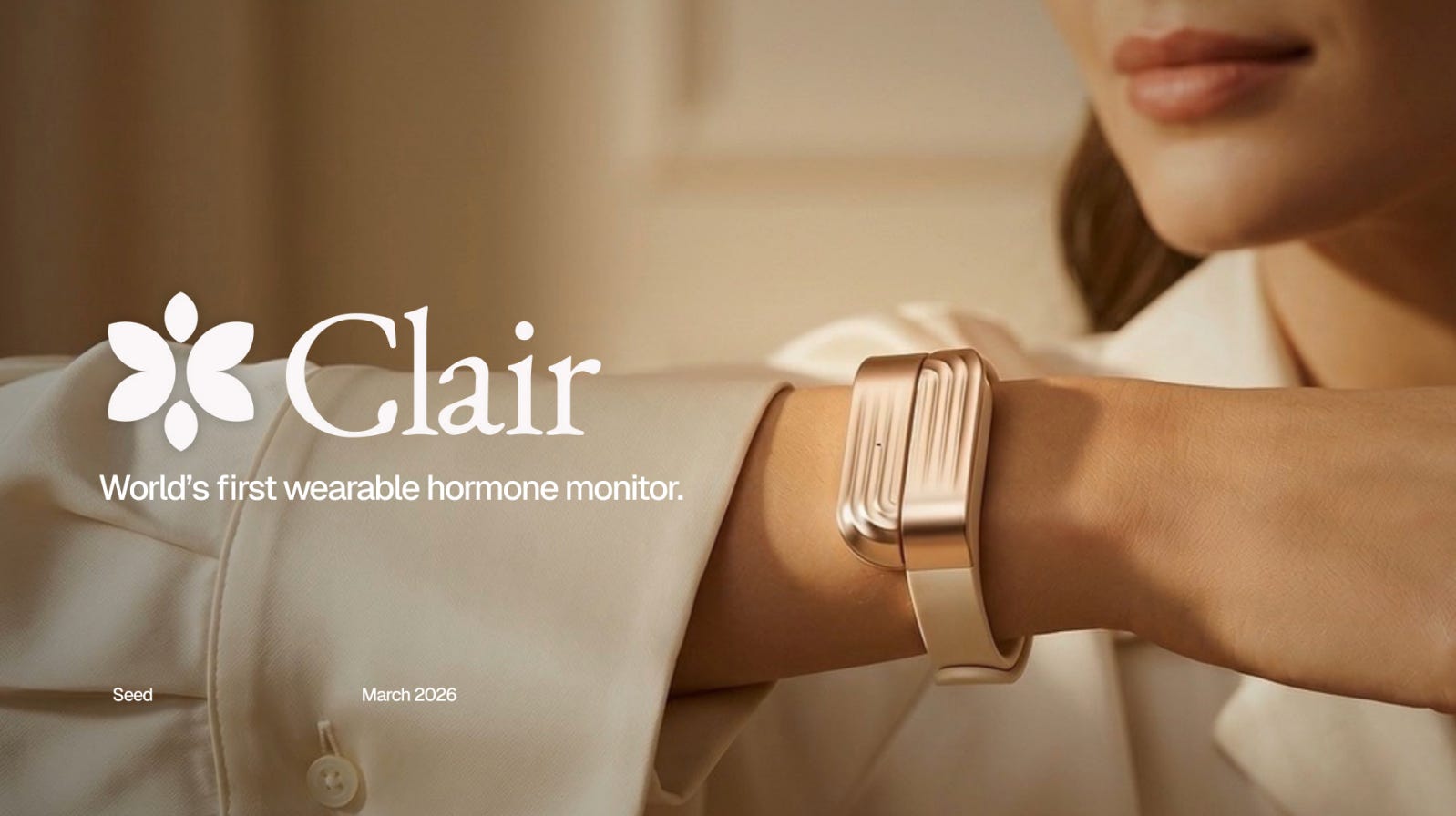
The opening slide establishes Clair as the "World's first wearable hormone monitor." The imagery features a high-fidelity shot of a wrist-worn device that looks more like jewelry or a high-end consumer electronic than a medical peripheral. The branding is clean, using a serif font that suggests a premium, consumer-focused health brand. The date is listed as March 2026, which likely refers to a projected milestone or a future-dated version of the deck used for specific investor updates, though the round was reported as 2024.
Slide 2: The Problem and Market Opportunity
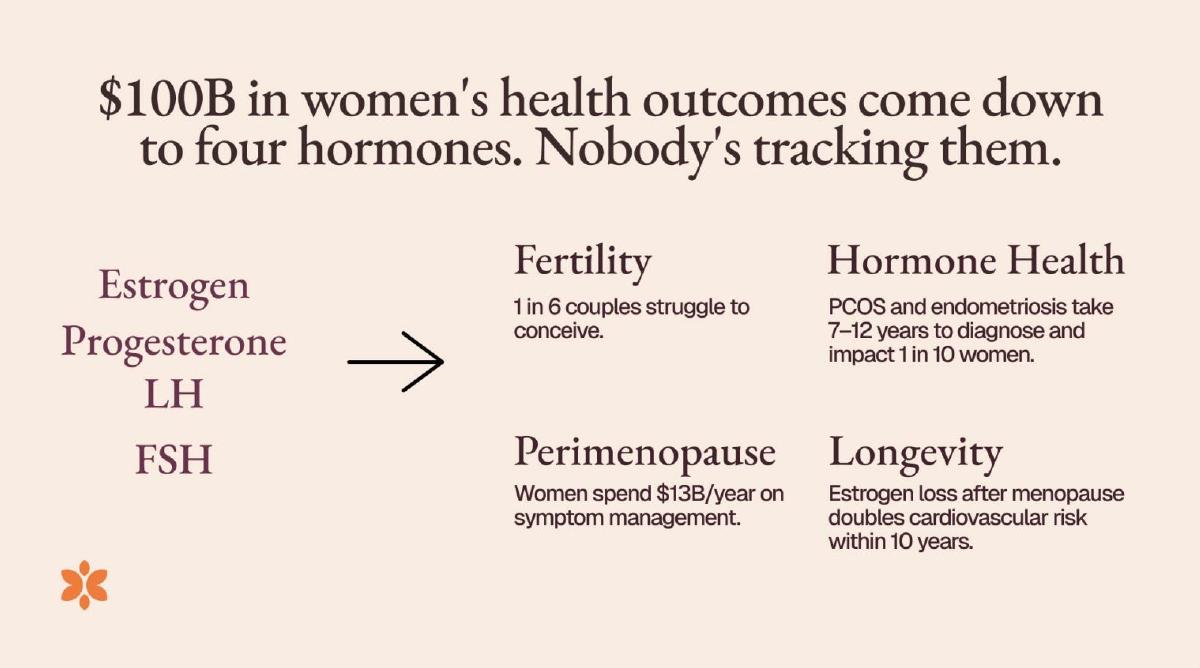
Clair frames the problem through a massive financial lens: "$100B in women's health outcomes come down to four hormones." The slide asserts that "Nobody's tracking them," highlighting a significant gap in the current wearable market (dominated by heart rate and sleep tracking). By quantifying the impact of these hormones on health outcomes, Clair elevates the product from a "nice-to-have" wellness gadget to a critical healthcare tool.
Slide 3: Traction and Pre-orders
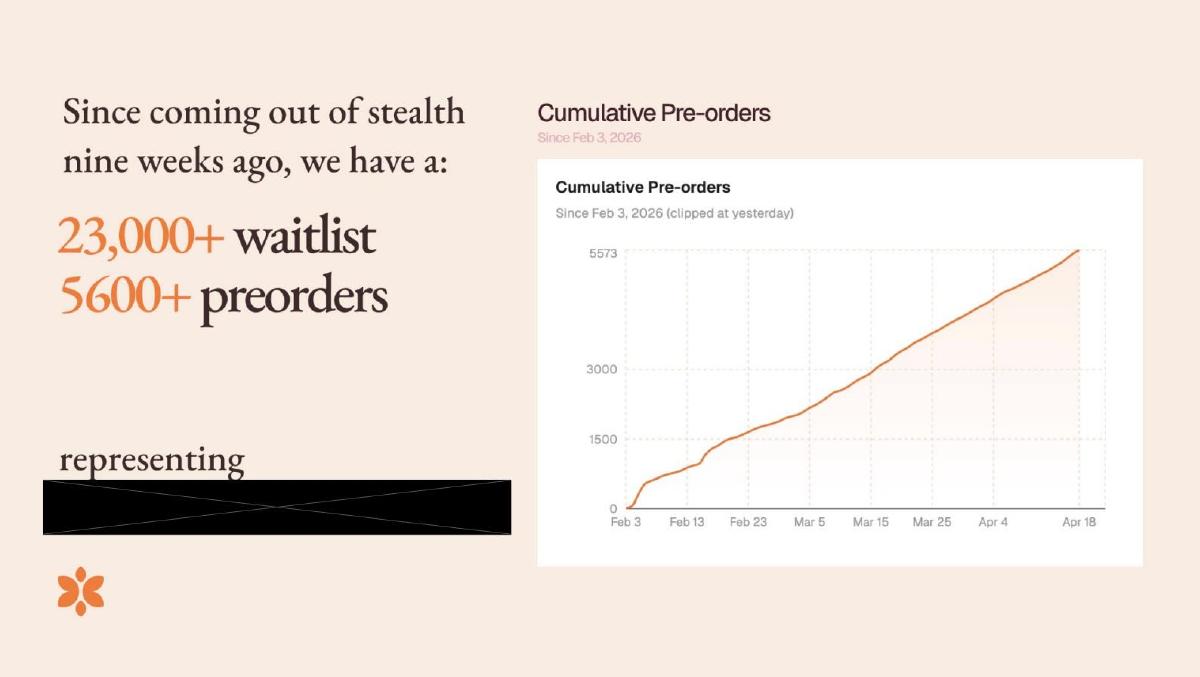
This is the most impactful slide in the deck. It states that since coming out of stealth nine weeks ago, the company has secured a "23,000+ waitlist" and "5,600+ preorders." A cumulative pre-order graph shows a steady, near-linear climb from February 3 to April 18. This slide effectively de-risks the investment by proving that the product-market fit is already being validated by consumer dollars before the product has even launched.
Slide 4: B2B Strategy
Slide 4 focuses on institutional validation. It mentions "B2B device purchase MOUs" (Memorandums of Understanding). While the specific names of these partners are redacted in the provided images, the presence of this slide tells investors that Clair isn't just a DTC play; they are building the infrastructure for enterprise sales and clinical integration.
Slide 5: Clinical Partnerships
The company claims to have built a "network of clinical partners ahead of our November launch." The slide explains that these partners drive user adoption and that Clair’s APIs integrate with existing software. This is a crucial point for scalability, as it suggests the device can become a part of a patient's formal medical record or treatment plan, rather than just a siloed consumer app.
Slide 6: Press and Traction
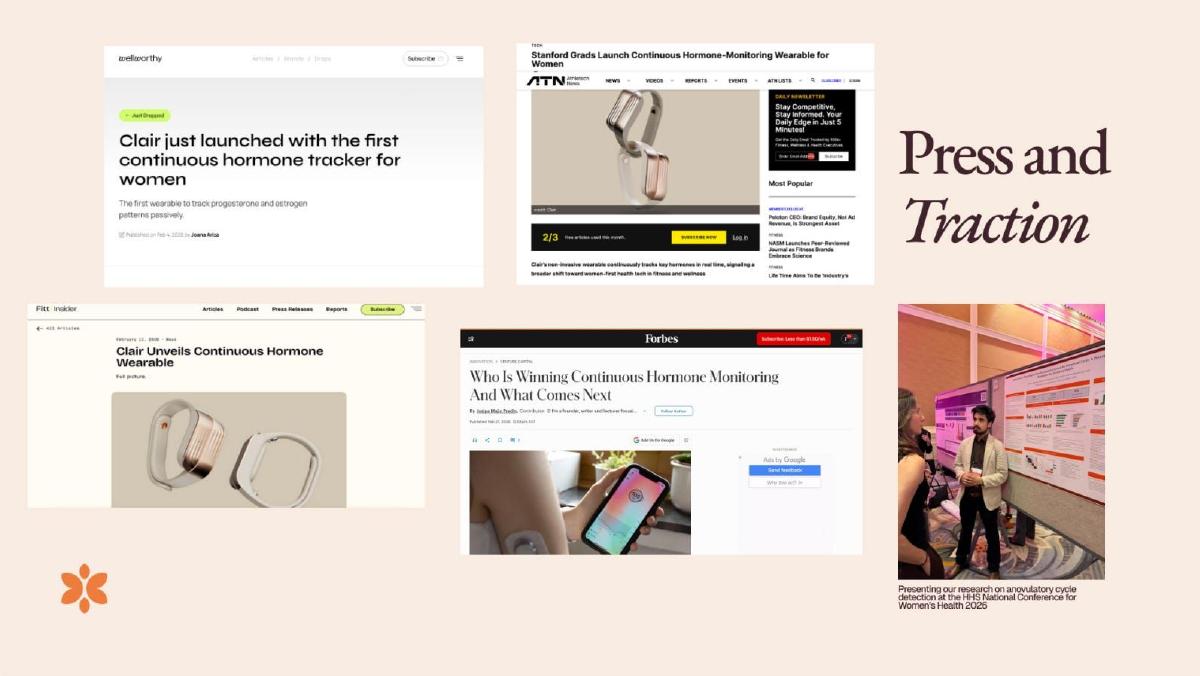
This slide serves as social proof. While the specific logos are not detailed in the text, the header "Press and Traction" indicates that the company has already begun generating media buzz, which is vital for maintaining the momentum shown on the pre-order slide.
Slide 7: The Team
The team slide is heavy on pedigree. Co-Founder and CEO Jenny Duan is credited with growth and marketing at early-stage startups and founding the NEXT Creator Collective. Co-Founder and CTO Abhinav Agarwal brings technical weight with a Stanford BS and MS in CS AI, and experience as a CTO at KOS and a visiting scientist at Stanford AIMI. The slide also features a "logo wall" of former employers and institutions, including Meta, FDA, Apple, Stanford Medicine, Yale School of Medicine, Johnson & Johnson, and Eight Sleep. This mix of consumer tech, hardware, and regulatory experience is designed to build confidence in their ability to execute a complex health-tech product.
Slide 8: Market Timing
The slide titled "The window for hormone monitoring is now" likely addresses why this hasn't been done before and why current technological or cultural shifts make this the right moment for Clair. It positions the company at the intersection of the "quantified self" movement and the rising focus on specialized women's health (FemTech).
Slide 9: The Ask
Clair states they are "raising seed to accelerate growth and to capitalize on our momentum." The specific amount is redacted in the slide, but publisher reports confirm this was an $11.6M round. The use of funds is broken down into four bullet points: funding ongoing research, scaling GTM (Go-To-Market), integrating data, and one redacted item. This is a standard Seed-stage ask, focused on moving from a validated prototype/pre-order phase to a full-scale commercial launch.
Slide 10 & 11: Appendix and References
Slide 11 provides a list of references, including the WHO, NCBI, and the FDA. Citing the FDA's "general wellness policy-low-risk devices" is a strategic move to signal to investors that they have a clear understanding of the regulatory landscape and a potential path to market that avoids the most grueling clinical trial requirements if they stay within the wellness category.
Slide 12 & 13: Product and Technology
The final slides dive into the product's functionality. Slide 12 describes the device as the "first continuous window into female hormones." Slide 13, "Turning signals into Hormone Insight," shows the app interface. It highlights "Real-time interpretation," a "Female biology model" that learns from the user, and "Actionable insights." Crucially, it claims the technology is "Validated against gold-standard hormone assays in a real-world clinical trial," which is the ultimate technical defense for a health wearable.
What Clair Health Does Well
1. Traction as a Shield: Hardware is notoriously difficult to fund at the Seed stage. Clair bypasses the "hardware is hard" skepticism by showing a massive, growing waitlist and thousands of paid pre-orders. This proves that even if the hardware is difficult, the market demand is undeniable.
2. Credibility by Association: The team slide is exceptionally strong. By including logos like the FDA and Apple, they signal that they aren't just enthusiasts; they have people who have navigated the specific regulatory and manufacturing hurdles that kill most health-tech startups.
3. Clear Category Definition: They don't call themselves a "health tracker." They are the "World's first wearable hormone monitor." This clear, bold claim makes them the default leader in a newly defined category.
What is Missing from the Deck
1. Unit Economics: There is no mention of the Bill of Materials (BOM), the retail price, or the expected margins. For a hardware company, understanding the cost to produce versus the price to sell is critical for long-term viability.
2. Competitive Landscape: The deck claims "nobody's tracking them," but there are several companies in the at-home hormone testing space (e.g., Mira, Proov) that use urine strips. A slide explaining why a wearable is superior to these existing methods would have strengthened the "why now" argument.
3. Long-term Data Strategy: While they mention "integrating data," there is little detail on how they plan to use the massive dataset they will collect. In health-tech, the data is often more valuable than the hardware; a slide on their data moat or AI capabilities would have been beneficial.
Founder Takeaways
Lead with the 'Wow' Metric: If you have 5,000+ pre-orders in nine weeks, that should be the center of your deck. Clair didn't bury their traction; they made it the core of their narrative. · Pedigree Matters in Regulated Industries: If you are building in healthcare, your team slide needs to scream "compliance" and "expertise." Clair's use of institutional logos is a highly effective way to communicate this without writing paragraphs of text. · Visual Consistency: The deck looks like the product. The warm tones, elegant fonts, and high-quality renders create a cohesive brand identity that makes the company feel more mature than a typical Seed-stage startup. · Address Regulatory Early: By referencing specific FDA guidance in their bibliography, Clair shows they aren't ignoring the regulatory elephant in the room. Founders should always show they have a map for the legal landscape they are entering.
Frequently asked questions
- How does Clair Health prove there is demand for a hormone wearable?
- Clair Health uses Slide 3 to showcase immediate market validation. They report over 5,600 pre-orders and a waitlist exceeding 23,000 people, all achieved within nine weeks of exiting stealth mode. A cumulative growth chart visually reinforces this rapid adoption, suggesting that the consumer appetite for hormone tracking is significant and underserved by existing wearables.
- What specific hormones does the Clair device track?
- While Slide 2 mentions that $100B in health outcomes are tied to four hormones, the specific names are not listed on that slide. However, Slide 13 shows app mockups tracking Estrogen, Progesterone, LH (Luteinizing Hormone), and FSH (Follicle-Stimulating Hormone). The device aims to provide a 'continuous window' into these levels rather than the point-in-time data offered by traditional blood tests.
- Is the Clair Health device FDA cleared?
- The deck does not explicitly state that the device has received FDA clearance. However, Slide 7 highlights 'regulatory experts' on the team and includes the FDA logo among their background credentials. Slide 11 also references FDA guidance for 'general wellness policy-low-risk devices,' suggesting the company may be pursuing a wellness classification or is currently navigating the regulatory pathway.
- What is the company's go-to-market strategy?
- Clair Health employs a dual-track strategy. Slide 3 demonstrates a strong Direct-to-Consumer (DTC) pull through pre-orders. Simultaneously, Slides 4 and 5 highlight a B2B approach, mentioning 'B2B device purchase MOUs' and a 'network of clinical partners' intended to drive user adoption and integrate with existing healthcare software via APIs.
- What are the primary risks addressed in the deck?
- The deck addresses two main risks: market risk and technical risk. Market risk is countered by the high volume of pre-orders (Slide 3). Technical and clinical risk is addressed on Slide 13, where the company claims its 'female biology model' has been validated against 'gold-standard hormone assays' in clinical trials, though specific trial data is not provided in the main slides.