The Whiplash pitch deck is a rare example of extreme minimalism in the Series A stage. Spanning only 9 slides, the presentation eschews traditional sections like 'Market Size,' 'Problem,' and 'Business Model' in favor of raw, undeniable traction. By the time the reader reaches the final slide, they have seen a $20M sales pipeline, $3.8M in existing revenue, and a growth chart that suggests significant momentum. The deck relies on the 'show, don't tell' principle, using customer testimonials to imply the product's superiority over competitors like Shipwire. While it lacks a formal 'Ask' or det…
Key takeaways
- The deck leads with a clear, one-sentence value proposition: 'The Shipping Department for eCommerce' (Slide 1).
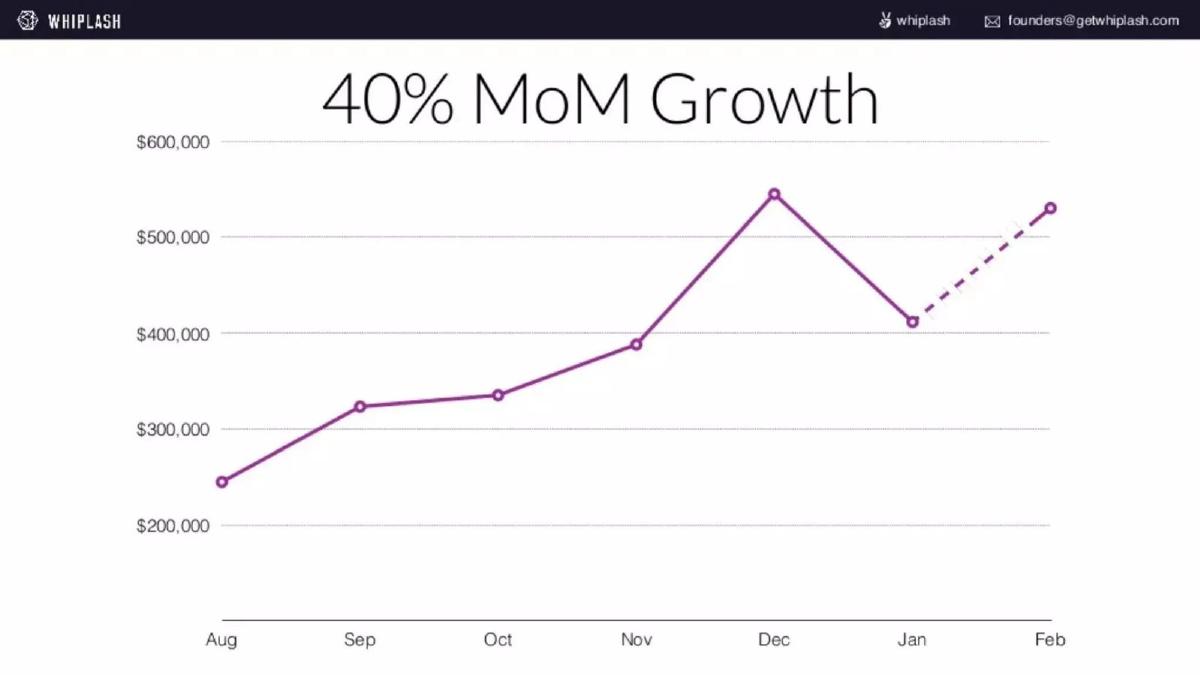
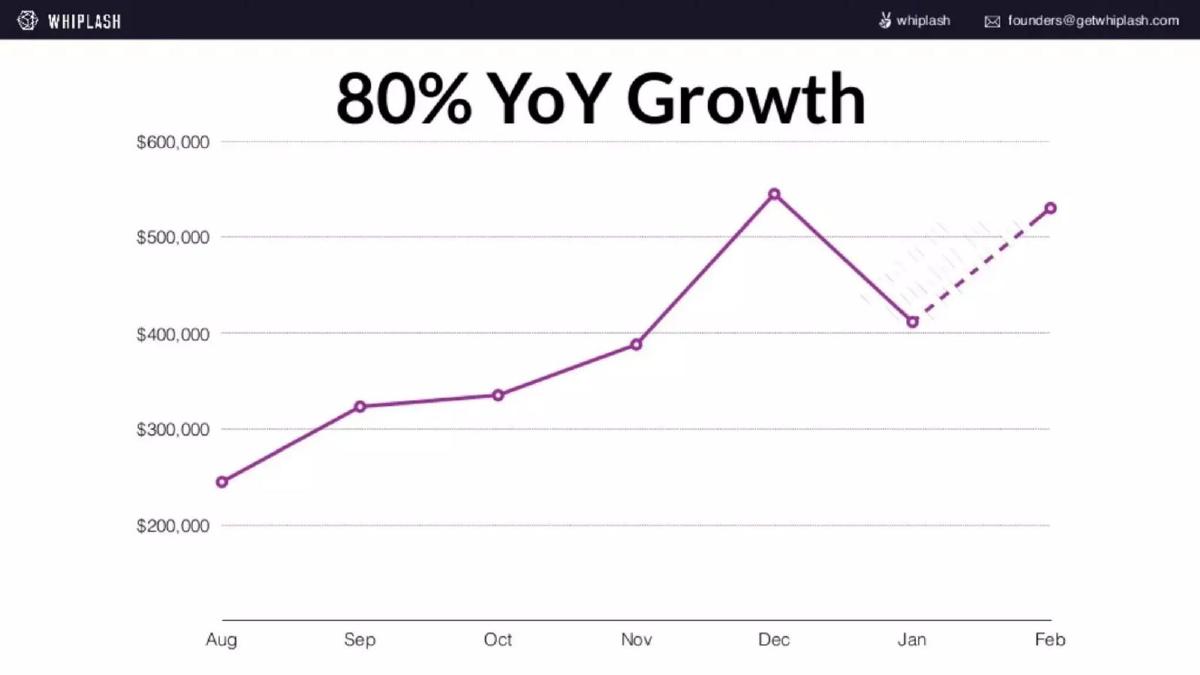
- Traction is the centerpiece, highlighting 40% Month-over-Month growth (Slide 3) and 80% Year-over-Year growth (Slide 4).
- The company demonstrates significant scale for a Series A, reporting $3.8M in bootstrapped revenue for 2015 (Slide 7).
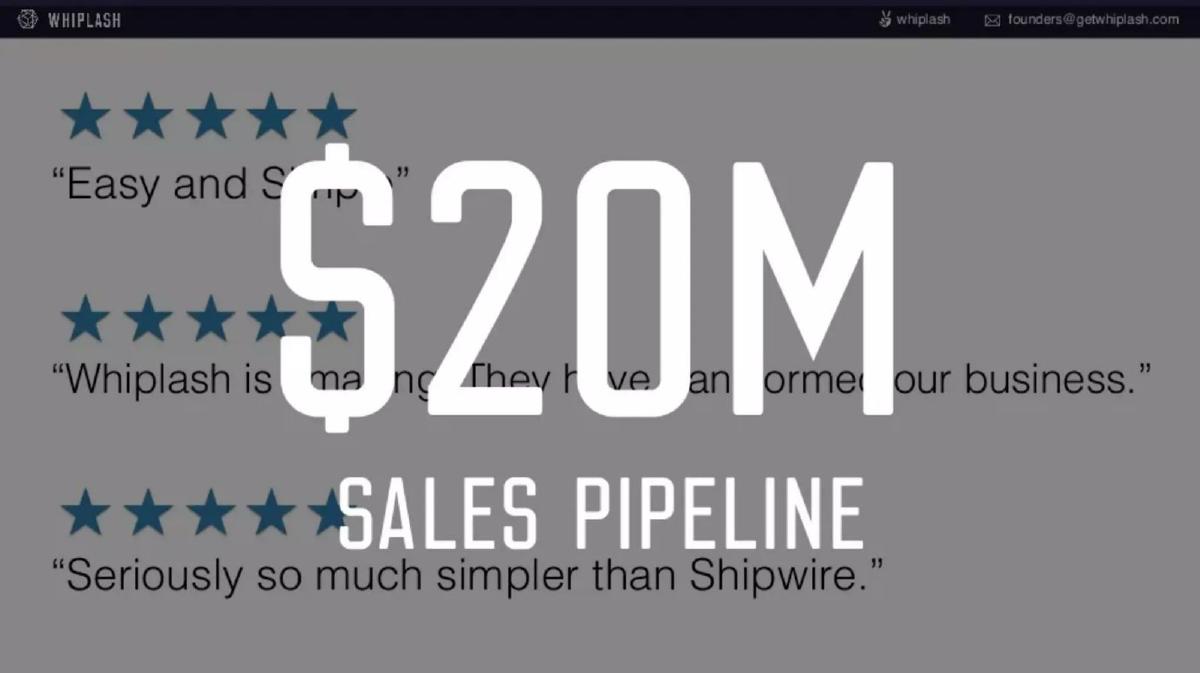
- Future potential is quantified via a $20M sales pipeline, providing a forward-looking metric to balance historical data (Slide 6).
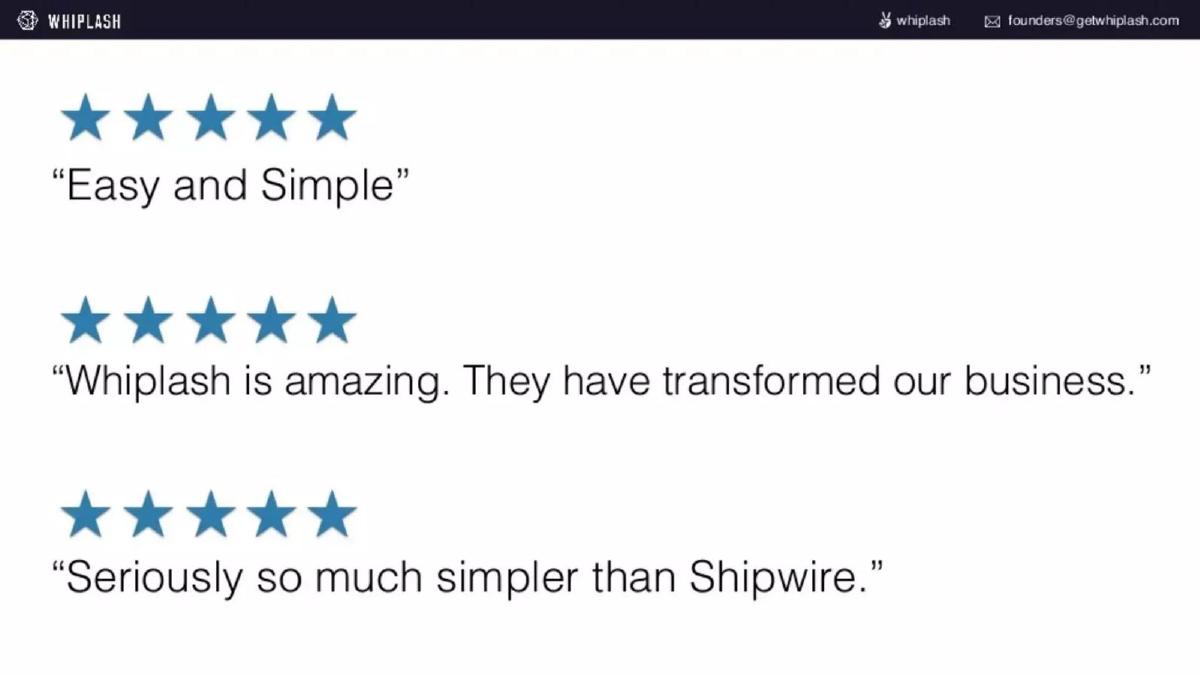
- Competitive positioning is handled through a customer quote stating the service is 'so much simpler than Shipwire' (Slide 5).
- The team slide emphasizes practical experience, including a Technical Lead from U of M and a CEO from VGKids.com (Slide 8).
- Unit economics are briefly addressed on the final slide, revealing a 17% Gross Margin (Slide 9).
- The deck completely omits a formal 'Problem' slide, assuming the investor understands the pain points of e-commerce fulfillment.
The Power of Brevity in Series A Fundraising
The Whiplash pitch deck is a masterclass in minimalist persuasion. In an era where decks often stretch to 20 or 30 slides filled with complex diagrams and market research, Whiplash managed to communicate their value proposition and massive traction in just nine slides. This deck was used for their Series A, a stage where investors typically demand deep due diligence. However, Whiplash makes the argument that when your numbers are this good, you don't need to talk as much.
Founded in 2009, Whiplash positioned itself as the 'Shipping Department for eCommerce.' By the time this deck was circulated in 2015, they had already achieved what most startups struggle to do with millions in venture capital: they bootstrapped to nearly $4 million in annual revenue. This teardown explores how they used that leverage to build a compelling, albeit brief, narrative.
Slides 1-2: The Identity and The Role
Slide 1: Title Slide The deck opens with a high-contrast image of a workshop, overlaid with a purple tint. The logo is prominent, but the most important element is the sub-headline: "The Shipping Department for eCommerce." This is a perfect one-sentence pitch. It tells the investor exactly what the company does and who it serves without using buzzwords like 'synergy' or 'disruption.'
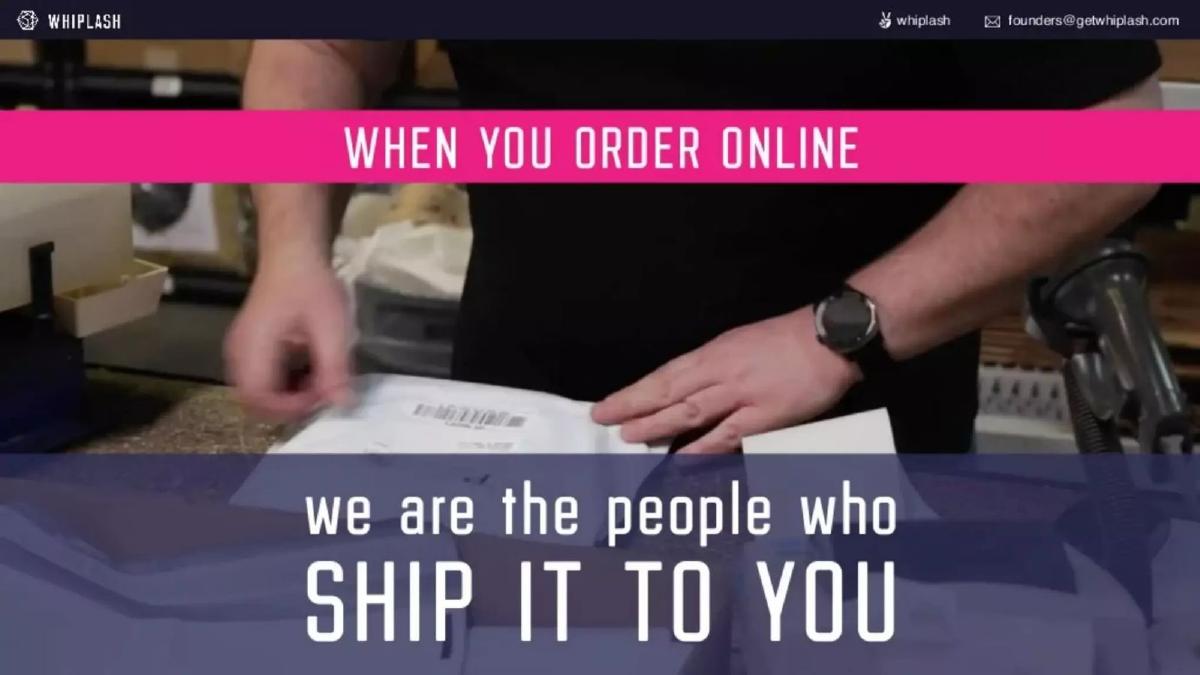
Slide 2: The Human Element Slide 2 uses a full-bleed image of a worker packing a parcel. The text reads: "WHEN YOU ORDER ONLINE we are the people who SHIP IT TO YOU." This slide serves to ground the high-tech world of e-commerce in physical reality. It defines the company's place in the value chain. It’s not a software-only play; it’s a service that handles the physical 'last mile' of the transaction.
Slides 3-4: The Growth Narrative
Slide 3: 40% MoM Growth This is where the deck begins to do the heavy lifting. The slide shows a line graph tracking revenue from August to February. The headline is "40% MoM Growth." The Y-axis shows revenue climbing from approximately $250,000 in August to over $500,000 by December. There is a slight dip in January—common in retail and e-commerce post-holidays—but the dotted line projection for February shows an immediate recovery. By leading with growth, Whiplash answers the investor's most important question: 'Is this a rocket ship?'
Slide 4: 80% YoY Growth To prove that the monthly growth isn't just a fluke or a seasonal spike, Slide 4 presents the same graph but with a "80% YoY Growth" headline. This provides the necessary context for the MoM figures. It suggests a sustained, long-term upward trajectory. The consistency between Slide 3 and Slide 4 reinforces the reliability of their data.
Slides 5-6: Social Proof and The Future
Slide 5: Customer Testimonials Instead of a feature list, Whiplash uses three five-star reviews. The quotes are: "Easy and Simple," "Whiplash is amazing. They have transformed our business," and "Seriously so much simpler than Shipwire." The third quote is the most strategic, as it directly attacks a major competitor (Shipwire) through the mouth of a customer. This is far more effective than a founder-created 'Checkmark Comparison' slide.
Slide 6: The Pipeline Slide 6 overlays a massive "$20M SALES PIPELINE" over the previous testimonials. This is a crucial transition. Slides 3 and 4 showed what they have done; Slide 6 shows what they will do. For a Series A investor, the pipeline is the collateral for the investment. It suggests that the growth shown in the previous slides is not just going to continue, but likely accelerate.
Slides 7-8: The Foundation and The Team
Slide 7: The Bootstrapped Milestone This slide is a bold statement: "BOOTSTRAPPED $3.8M 2015 REVENUE." The use of the word 'bootstrapped' is a massive signal to investors. It tells them that the founders are capital-efficient, know how to build a real business without outside help, and that every dollar of venture capital injected now will be used to scale an already-profitable or near-profitable engine.
Slide 8: The Team The team slide features the three principals standing in a warehouse aisle, surrounded by USPS bins. This visual choice is intentional—it shows they are 'in the trenches.' Mark Dickson is listed as the Technical Lead from U of M. James Marks is the CEO, formerly of VGKids.com. Sean Hurley is listed as an Advisor for Modest Mouse. While the team slide is light on traditional 'Big Tech' logos (Google, Facebook, etc.), it emphasizes domain expertise in e-commerce and logistics.
Slide 9: The Summary and The Unit Economics
Slide 9: Closing Slide The final slide returns to the imagery of the first slide but adds three key metrics: "$3.8M 2015 Revenue," "40% MoM Growth," and "17% Gross Margin." This is the first time gross margin is mentioned. In a logistics business, 17% is a respectable figure that proves the business model is sustainable. The slide also includes an AngelList link and a contact email, but notably lacks a specific 'Ask' for a dollar amount.
What Works in the Whiplash Deck
The most successful aspect of this deck is its unwavering focus on traction . By the time an investor finishes these nine slides, they have seen revenue, growth rates, pipeline value, and gross margins. There is no fluff. The deck assumes the investor is smart enough to understand the market and instead focuses on proving that Whiplash is winning that market.
The visual consistency is also a strength. The use of purple overlays and a specific font style gives the deck a professional, branded feel despite its simplicity. Finally, the competitive positioning on Slide 5 is a brilliant way to handle rivals without being defensive or overly aggressive.
What is Missing from the Whiplash Deck
While the minimalism is a strength, it also leaves several questions unanswered. First, there is no 'Ask' slide . A pitch deck is a tool to raise money; not stating how much you want or what you will do with it is a missed opportunity to set the terms of the conversation. Second, there is no mention of the technology . Whiplash describes itself as a shipping partner, but in 2015, the 'secret sauce' for these companies was usually their proprietary warehouse management software (WMS). The deck doesn't explain why their tech is better than the competition's.
Additionally, the lack of a 'Problem' slide is risky. While e-commerce fulfillment is a known pain point, articulating the specific way Whiplash solves it (e.g., faster integration, better accuracy, lower rates) would have added more depth to the 'Simpler than Shipwire' claim.
What a Founder Should Copy
Lead with your strongest foot: If you have millions in revenue and high growth, make that the first thing the investor sees. Don't bury your traction on Slide 12. · Use social proof for competition: Instead of saying you are better than Competitor X, find a customer quote that says it for you. It carries significantly more weight. · Keep the value prop simple: "The Shipping Department for eCommerce" is a perfect example of a 'High Concept Pitch.' It requires zero explanation. · Show the 'Work': The team slide in the warehouse is much more effective for a logistics company than three headshots in front of a white wall. It proves you understand the physical reality of your business. · Be transparent with margins: Even if your margins aren't 'software margins,' showing them (as Whiplash did with their 17% figure) builds trust and shows you have a handle on your unit economics.
Frequently asked questions
- What is the primary focus of the Whiplash pitch deck?
- The primary focus is traction and revenue. Unlike many early-stage decks that spend time explaining the 'why' or the market opportunity, Whiplash focuses almost entirely on the 'what'—specifically their $3.8M in revenue and rapid growth rates. It is a performance-based deck designed to show that the business is already working at scale.
- How does Whiplash handle competition in this deck?
- Whiplash handles competition indirectly through social proof. On slide 5, they include a five-star testimonial that explicitly mentions a competitor: 'Seriously so much simpler than Shipwire.' This allows the founders to claim product superiority through the voice of a customer rather than making potentially biased claims themselves.
- Is the 17% gross margin shown on slide 9 good for this industry?
- In the world of physical logistics and third-party fulfillment (3PL), a 17% gross margin is standard to healthy. Unlike software-as-a-service (SaaS) which often sees 80%+ margins, logistics involves heavy variable costs like labor, warehouse space, and shipping. Showing this figure demonstrates transparency about the business's operational realities.
- Why are there no slides about the market size or the problem?
- Whiplash likely assumed that Series A investors in the e-commerce space were already well-aware of the massive market size and the inherent difficulties of shipping. By omitting these standard slides, they kept the deck tight and focused entirely on their specific execution and momentum, which is often more persuasive at later stages.
- What is missing from the Whiplash pitch deck?
- The deck is missing several 'standard' elements: a slide detailing the specific 'Ask' (how much money they want), a 'Use of Funds' breakdown, a detailed 'Problem' slide, and any long-term financial projections beyond the current pipeline. It also lacks a deep dive into the technology stack powering the fulfillment service.