Whyse is a French peer-introduction network that raised on a 38-slide seed deck in November 2021 asking for EUR 1.2 million. The deck contains real operating data - roughly 300 introductions since January, 67% completed, and an honestly reported Sean Ellis score of 12% very disappointed - but its use-of-funds table totals EUR 1.7 million against a EUR 1.2 million ask, and its market size is sourced to another startup's pitch deck. The product does not appear until slide 16.
Key takeaways
- Whyse's 2021 seed deck asked for EUR 1.2 million while its use-of-funds slide budgeted 773 KEUR, 767 KEUR and 160 KEUR across three teams - a total of 1,700 KEUR, or 42% more than the raise, with no reconciling line.
- The deck reports a Sean Ellis product-market-fit score of 12% very disappointed from a June 2021 survey of 165 users, under a headline reading 'We approach our PMF' - while slide 35 sets 40% very disappointed as the benchmark.
- Slide 28 sources its market size of 91 million US and 70 million European tech professionals to a link on a pitch-deck-sharing site, meaning the TAM is cited to a different startup's fundraising material.
- The strongest slide is a worked example: searching LinkedIn for someone who set up Salesforce at a sub-60-person B2B company returns Salesforce employees and heads of sales at non-SaaS companies.
- The deck spends fifteen slides on problem framing before explaining what Whyse actually does, and puts its two-person founding team on slide 38 of 38.
- No revenue figure appears anywhere in 38 slides despite a logo wall of paying startups and a stated price of EUR 100 per month for 10 employees.
- Whyse's most checkable evidence is a competitor's failure: France's largest product community Slack, with 1,500+ members, had two posts in its main channel in two weeks.
- The deck's north-star milestones of 400 customers and 6,000 employees imply roughly EUR 480k ARR at the stated price, but the deck never does that multiplication for the reader.
What this deck actually is
This is a 38-slide seed fundraising deck for Whyse , a French startup building what it calls a "decentralized skills network" — a service that introduces employees at different companies to each other so they can talk through real work problems with a peer who has actually solved them. The PDF was produced on 9 November 2021 in Keynote on macOS, and it is asking for EUR 1.2 million .
It is a genuine investor deck, not a sales deck and not a recreation. It has a problem section, a market section, traction, a business model, a use of funds, and a team slide. It also has real operating data from a proof of concept that ran through 2021: introduction volume by month, a Sean Ellis product-market-fit survey run on 165 users in June, a two-month growth experiment, and a named price.
What makes this deck worth reading slide by slide is not that it is bad. It isn't. The founders clearly did the work, ran the survey honestly, and put the unflattering number on the slide instead of hiding it. What makes it worth reading is that the deck contains two arithmetic problems that an investor will find within four minutes: the product-market-fit slide reports a number that is 28 points below the benchmark the deck itself sets later, and the use-of-funds slide spends EUR 1.7 million of a EUR 1.2 million raise.
Ten slides of problem statement precede the first mention of what Whyse is. That structural choice costs more than either arithmetic error.
Slide-by-slide walkthrough
Slide 1 — Cover
The cover carries one word: whyse . No tagline, no date, no round name, no "seed deck," no contact line. In a deck that gets forwarded between partners at a fund — which is the entire point of sending a PDF — the cover is the only slide guaranteed to be seen out of context. Here it communicates nothing except the spelling of the company name. One line under the logo ("Peer introductions between employees at different companies — EUR 1.2M seed, November 2021") would carry the whole deck through a forward.
Slide 2 — The two existing paths
The framing: employees in tech have two ways to progress — peer learning through their social network, and online communities. Fine as a setup. The English is broken ("there is two solution to progress"), and it stays broken throughout the deck. For a French team raising from French and European funds this is survivable; it is not survivable if this deck goes to a US fund, because a reader who has to re-parse three sentences per slide stops reading at slide six.
Slide 3 — Why LinkedIn does not work
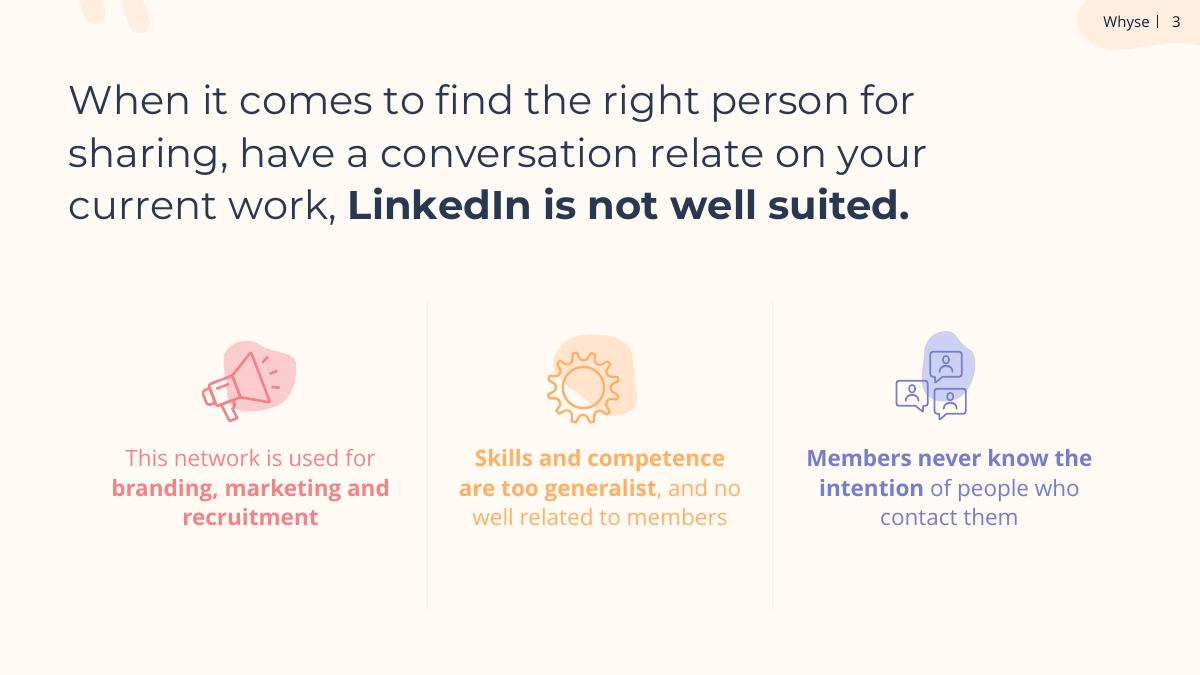
Three columns: LinkedIn is used for branding, marketing and recruitment; skills data is too generalist; members never know why someone is contacting them. This is the strongest structural slide in the problem section because each of the three claims gets its own dedicated slide immediately afterwards. That is good deck architecture — assert, then prove, in that order.
Slide 4 — Proof point one: LinkedIn is a marketing channel
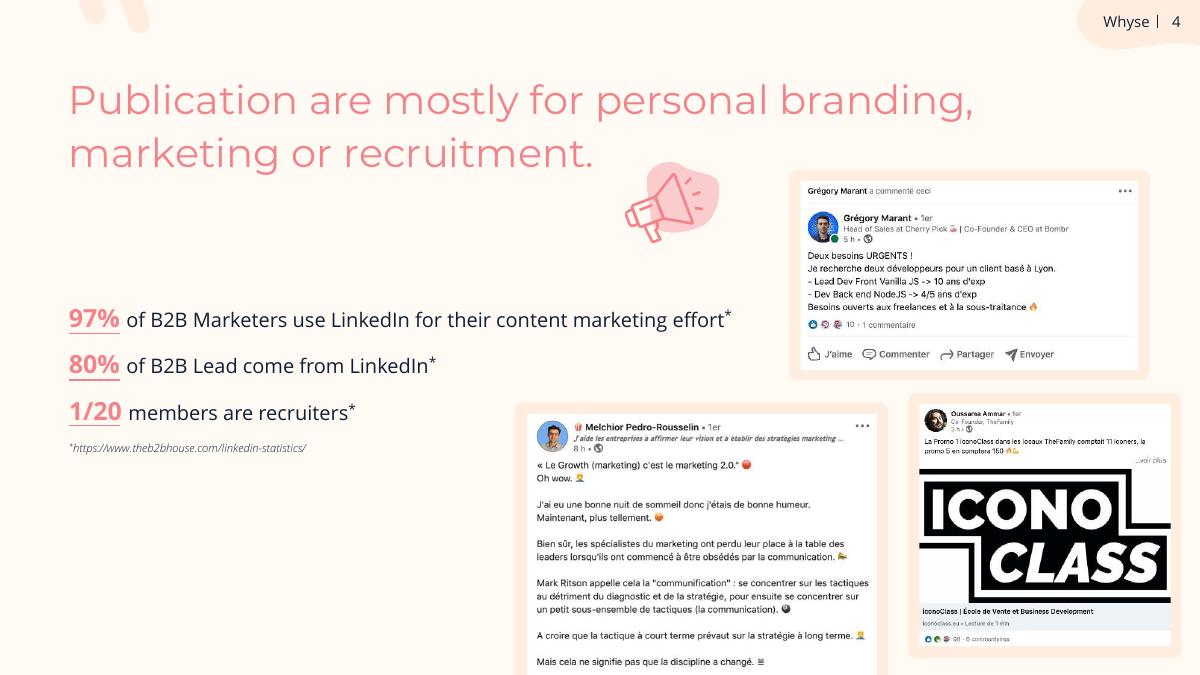
Three statistics: 97% of B2B marketers use LinkedIn for content marketing, 80% of B2B leads come from LinkedIn, 1 in 20 members is a recruiter. All three are footnoted to a single source: theb2bhouse.com, a marketing blog's statistics roundup.
The problem is not that the numbers are wrong. It is that all three come from one aggregator page with no date, and an aggregator page is a citation of a citation. An investor who Googles the source lands on a content-marketing article and quietly discounts every other number in the deck. Cite the primary source, or cite LinkedIn's own reporting, or drop the stat.
Slide 5 — Proof point two: the data is too generalist
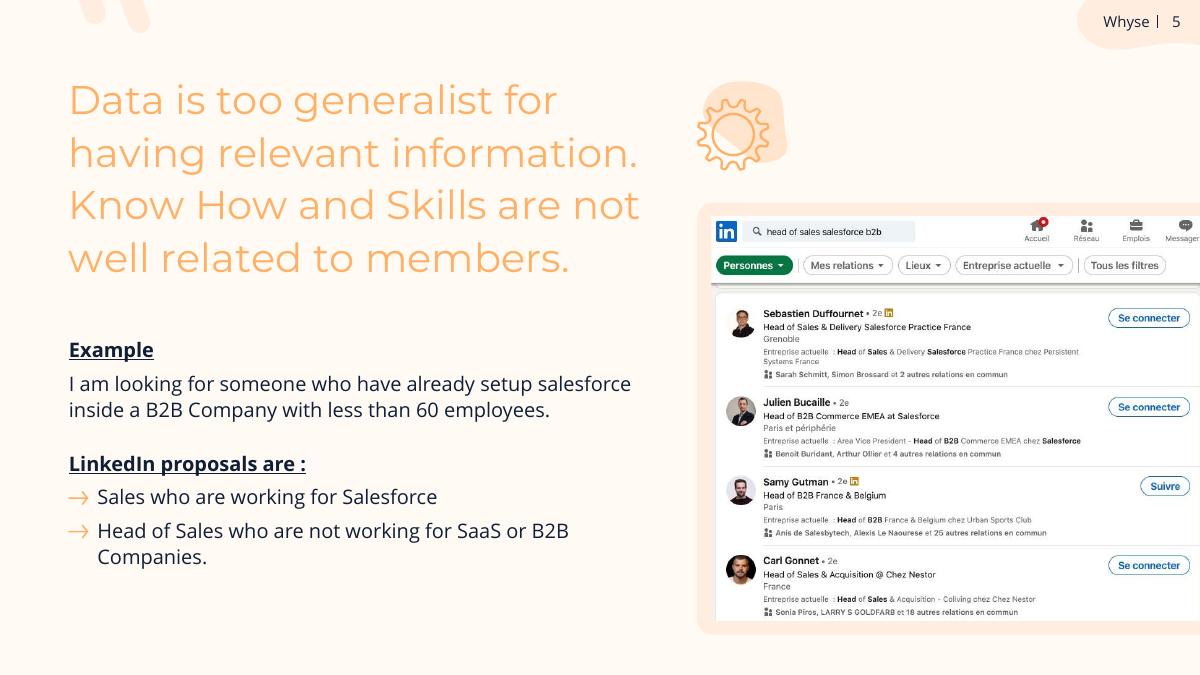
This is the best slide in the deck and it should be slide 2. It gives a concrete query — "I am looking for someone who has already set up Salesforce inside a B2B company with fewer than 60 employees" — and then lists what LinkedIn actually returns: salespeople who work at Salesforce, and heads of sales at companies that are neither SaaS nor B2B.
That is the entire company thesis in one worked example. It is specific, it is falsifiable, it is instantly recognisable to anyone who has run that search. Everything in slides 2 through 11 is trying to say what this slide says on its own.
Slide 6 — Proof point three: intent is unreadable
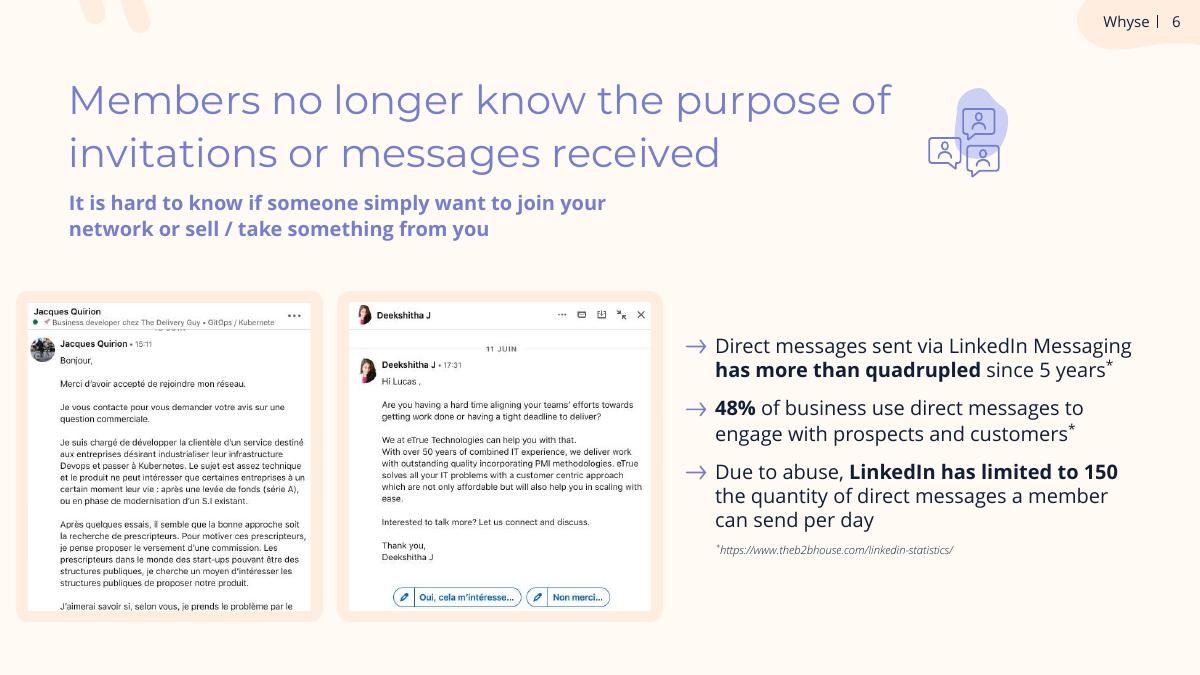
Members cannot tell whether an invitation is networking or a sales pitch. Supporting data: LinkedIn DM volume has more than quadrupled in five years, 48% of businesses use DMs to engage prospects, and LinkedIn caps members at 150 DMs per day because of abuse. The 150-per-day cap is the most persuasive fact in the whole problem section — it is a platform admitting the problem in its own product constraints — and it is set in the smallest type on the slide.
Slide 7 — The shift
A single-sentence slide: digital workers move to specialized professional communities when they want to share with peers. Good pacing. Single-assertion slides are underused and this one earns its place.
Slide 8 — Communities fail too
Three numbered failures: lack of engagement and spam; know-how, tools and content not related to members; lack of privacy and intimacy. Again asserted then proven over the next three slides. The structure is disciplined.
Slide 9 — Proof: the dead Slack
The largest product community in France, a Slack with 1,500+ members, had two posts in the main channel in two weeks . That is a devastating, checkable, specific fact. It is the second-best slide in the deck. It is unnamed, which is polite and probably wise, but the absence of a name makes it slightly less verifiable — a screenshot with the workspace name blurred but the channel visible would land harder.
Slide 10 — Proof: finding expertise is a mess
The Salesforce query returns for a second time, now applied to communities: your options are to ask a question at random and hope, or scroll until something relevant appears. Repeating the same worked example across two different failure modes is a good technique — it holds the reader's model of the problem constant while the villain changes.
Slide 11 — Proof: no privacy
You cannot challenge a business problem in a public channel; you either ask publicly for a private conversation or cold-DM a stranger. Correct, and it is the failure mode Whyse's product actually addresses. It arrives on slide 11.
Slide 12 — The opportunity
"Cracking the introduction market" — LinkedIn is too generalist, vertical communities are growing but do not deliver, migration from LinkedIn to communities proves the pain. The third claim is asserted without a number. If migration is the wedge, it needs a measurement.
Slides 13–15 — Back Market and Etsy
Three slides on the unbundling argument: Back Market took share from Amazon on refurbished goods, Etsy took share from eBay on handmade goods, Whyse will take share from LinkedIn on professional introductions.
The analogy is sound and Back Market is a smart local reference for a French deck. But three slides is two too many — the pattern is legible after the first example, and by slide 15 the reader has spent 40% of a 38-slide deck without learning what the product does. Compress to one slide with both logos side by side.
Slide 16 — Finally, the product
Whyse is described as a decentralized skills network enabling knowledge sharing between employees at different organizations, with four attributes: facilitator, safe space, promote networking, focus on real situations. The closing line — "a caring and secured network which brings closer employees who need to share on business challenges with peers" — is the clearest sentence in the deck.
This slide is the answer to slide 5's question and it is fifteen slides late. Move it to slide 3.
Slide 17 — Three rules
Decentralized expertise and know-how; be a trusted third party; have a B2B model and growth strategy. Third one is not a rule, it is a business model. Two conceptual pillars plus one commercial pillar in the same numbered list makes the framework feel assembled rather than derived.
Slide 18 — Rule one: the data model
Whyse captures four things about each member: skills and main issue, stack and tools, employee type, company profile. This is the actual moat argument — the structured intent data LinkedIn does not have — and it gets four bullet points on a mostly empty slide. What is missing: how the data is collected, how it is kept fresh, and how many members currently have complete profiles.
Slide 19 — Rule two: trust
89% of users find their introduction relevant. One number, no denominator, no date, no definition of "relevant." The June survey later in the deck has 165 respondents; if this number comes from the same study, say so on the slide. A naked percentage with no base is the single most common credibility leak in seed decks.
Slide 20 — Rule three: engagement data
Two charts — growth of introductions (rising to roughly 300, February through November) and percentage of meetings realized (rising toward 80%) — plus two headline figures: 72% of users want to continue and 67% of introductions are realized .
This is real operating data and the trend is genuinely good: introductions climbing month over month while the completion rate climbs alongside them is the hard version of the graph, because volume usually degrades quality. But the y-axis on the introductions chart tops out around 300, and 300 introductions over eleven months is a small business. The deck never states the cumulative total, which forces the investor to read it off the axis — and an investor who has to read a number off a chart axis assumes you hid it deliberately.
Slide 21 — Where we stand
A three-step ladder: first users and customers (achieved), PMF ("we are close"), playbook (we know how to scale). Since January 2021, the proof of concept succeeded. Honest self-placement on a maturity ladder is rare and it works in the founders' favour here.
Slide 22 — The Sean Ellis test, reported honestly and framed badly
This is the most important slide in the deck. It reports a June study of 165 users:
82% would be disappointed if they could no longer use the product ("HAPPY") · 12% would be very disappointed ("TOO MUCH LOVE") · 2 introductions is the magic number for crossing 80% disappointed
The Sean Ellis product-market-fit benchmark is 40% "very disappointed." Whyse reports 12%. The deck then puts "+40% very disappointed" on slide 35 as a north-star milestone for the Series A — which means the deck itself names the benchmark, and by that benchmark slide 22 says the company is at less than a third of it.
The headline on slide 22 is "We approach our PMF." The number underneath it says the opposite. The founders deserve real credit for publishing the 12% instead of quietly leading with the 82% and hoping — most decks would have shown only the 82%. But leading with the softer metric in large type and labelling the hard one "TOO MUCH LOVE" reads as spin to any investor who knows the test, and every seed investor knows the test. The stronger play is to lead with "12% very disappointed today, 40% is the bar, here is the mechanism that closes the gap" — and the mechanism is already on the slide, because two introductions is the threshold.
Slide 23 — Employees from 250+ companies
A logo wall. Breadth of company coverage is the right metric for a network product, but 250 companies with roughly 300 total introductions means most of those companies contributed one person and one conversation. State the number of active users, not just the number of logos touched.
Slide 24 — "Amazing startups are starting to pay"
A second logo wall. No customer count, no MRR, no ARR, no average contract value, no logo-to-revenue mapping — anywhere in 38 slides. With a stated price of EUR 100 per month for 10 employees, an investor can compute that even ten paying customers is EUR 1,000 MRR, so the omission is not hiding a large number. But omitting revenue entirely from a deck asking for EUR 1.2 million forces the investor to assume the worst case, which is always lower than the truth.
Slides 25–26 — The onboarding funnel
Two full slides of flowchart: call with the manager, employee listing, free trial, reminder emails, yes/no branches, onboarding mail, first introduction, managed feedback, paid solution, new customer. This is internal operations documentation. It belongs in the data room, not in a 38-slide fundraising deck — an investor at slide 25 wants to know how big this gets, not which email fires when a manager does not reply. Two slides recovered here would have paid for a competition slide and a revenue slide.
Slide 27 — Target roles
C-level and heads, middle management and employees, across ops, product, sales, customer success, marketing and tech. Clear ICP definition by function, which is more useful than the usual company-size segmentation. Good slide.
Slide 28 — Market size, sourced from another startup's pitch deck
US: 91 million professionals in tech-heavy roles. Europe: 70 million. Over 100 million combined. The footnote is a link to pitchdeckhunt.com/pitch-decks/almanac — that is, the market-size number is cited to a copy of a different company's pitch deck posted on a deck-sharing site.
This is a genuine unforced error. Sourcing your TAM to another startup's fundraising material means the number has passed through at least two rounds of founder-favourable rounding before it reaches your slide, and any investor who clicks the link will see exactly that. There is also no bottom-up conversion: 161 million people is not addressable market, it is population. At EUR 10 per employee per month, the deck's own price, the bottom-up figure would be enormous and self-derived — which is strictly better than a borrowed top-down number.
Slide 29 — The ask
EUR 1.2 million to crack the professional introduction model, with three named milestones for Series A: build the largest collaborative network for companies, create value for employees and monetize, reach the north-star metrics. The ask is clear, it is on its own slide, and it is tied to a next round. That is exactly right. It arrives on slide 29 of 38, which is late but not fatal.
Slide 30 — "Network is the key"
Logos of famous network businesses with the observation that they all have network effects. This is a filler slide. It asserts a category truth that every investor already holds and adds nothing specific to Whyse.
Slide 31 — Growth on three pillars
Outbound (multi-channel account opening), inbound (brand and content), referral and internal growth (viral loops inside companies). The third is the only one with structural advantage for this product — a Whyse user inside a company naturally recruits colleagues — and it is listed last with the least detail.
Slide 32 — Growth is working
Launched in September on two pillars, doubled the user base in two months, projecting 1,000+ users by year end. Charts show active users climbing to roughly 250 and an acquisition-allocation breakdown across acquisition, internal growth and inbound.
Doubling in two months is real, and splitting acquisition by source is the sort of operational detail that builds confidence. But going from ~250 users in October to 1,000+ by December requires a 4x in two months immediately after a 2x in two months, and the deck does not explain what changes to make the rate accelerate. Projections that bend upward without a stated cause are the fastest way to spend the credibility the previous chart just earned.
Slide 33 — Bottom-up monetization
One employee: free, cold lead. Two or three: free, warm lead. Ten or more: paid customer at EUR 100 per month for 10 employees . Clean, legible, land-and-expand, and it names an actual price — which most seed decks refuse to do.
What is missing is the conversion rate between the tiers. The whole model rests on how often a single user becomes ten, and the company has been running since January, so that number exists. It is the single most valuable data point Whyse could have put in this deck and it is not here.
Slide 34 — Product roadmap
Three pillars: introduction (automatic ad-hoc intros, double opt-in), CRM (skills and tools base per company and employee), knowledge base (Q&A, sharing spaces). Sensible expansion from a point solution to a system of record. Double opt-in is the correct trust mechanic and deserves more than a bullet.
Slide 35 — North-star metrics
400+ customers (confirm the business model), 6,000+ employees (start to internationalize), 40%+ very disappointed (reach PMF). Three metrics, each tied to a purpose. At EUR 100 per month per 10 employees, 400 customers implies roughly EUR 40,000 MRR — around EUR 480k ARR — which is a coherent Series A entry point. The deck never does that multiplication for the reader. Do it for them; it is the strongest number the company can currently produce.
Slide 36 — Hiring plan
An org chart for the post-raise team: CEO, head of sales/growth with one sales and two growth/marketing hires, head of network, CTPO with three developers. That is nine roles on top of a two-person founding team, funded by EUR 1.2 million.
Slide 37 — Use of funds, which does not add up
Sales & Growth: 773 KEUR (salary 423, other 350) · Tech & Product: 767 KEUR (salary 617, other 150) · Support: 160 KEUR (salary 130, other 30)
That totals 1,700 KEUR against a 1,200 KEUR raise. The deck is spending EUR 500,000 it has not asked for — a 42% overrun — on the slide immediately before the team slide, which is where a partner's attention is highest because they are checking whether the plan is fundable.
There are innocent explanations: existing runway, a grant, French research tax credits, or an 18-month plan funded partly by revenue. Every one of those explanations belongs on the slide in a single line. Without it, the last quantitative thing an investor sees in this deck is a use-of-funds table that overspends the ask, and that is what they will remember when they open the follow-up email.
The internal split is also worth noting: 350 KEUR of non-salary spend in sales and growth is 45% of that team's budget, unexplained. For a company whose most defensible growth channel is internal referral — which is close to free — that is a large paid-acquisition bet with no line item.
Slide 38 — The team
Two people. Lucas (CEO), who started his first community in high school and has since built five local communities before founding Whyse at 28. Yann (CTO), an engineer who has spent two years building peer-to-peer learning technology. The closing line: "a passionate team which has worked for two years on this subject."
Two years of focused work on one problem by a community builder and an engineer is a legitimate founder-market-fit story, and it is told in about sixty words on the final slide of a 38-slide deck. It should be on slide 4. There are no advisors, no prior exits, and no answer to the obvious question of who runs sales — which matters, because slide 36 makes sales the largest hire.
What this deck does better than most startup pitch decks
It publishes the number that hurts. Reporting 12% "very disappointed" against a 40% benchmark, when the 82% figure was available to lead with, is real intellectual honesty. Most decks would have shown only the 82%. · Slide 5 is a worked example, not a claim. The Salesforce search and the useless results it returns proves the thesis in a way no market statistic could. · The dead Slack is checkable. 1,500 members, two posts in two weeks. Specific, falsifiable evidence beats an adjective every time. · Assert-then-prove architecture. Both problem sections state three claims and then dedicate one proof slide to each. That discipline is rare. · It names a price. EUR 100 per month for 10 employees, with a legible free-to-paid ladder. Most seed decks hide behind "monetization to be determined." · It places itself honestly on a maturity ladder. Slide 21 says "close to PMF," not "we have PMF." · Growth data is split by source. Showing acquisition, internal growth and inbound separately is an operator's chart, not a fundraiser's chart. · The ask is tied to Series A milestones. Slide 29 connects EUR 1.2M to three specific things that must be true before the next round.
Where this deck would fail in an investor meeting
The budget overruns the ask by 42%. 773 + 767 + 160 = 1,700 KEUR against a 1,200 KEUR raise, with no reconciling line. · The PMF headline contradicts the PMF number. "We approach our PMF" sits above 12% very disappointed, while slide 35 sets the bar at 40%. · There is no revenue figure anywhere. Logos of paying startups, a price, and no MRR, ARR, or customer count in 38 slides. · TAM is sourced from another company's pitch deck. A link to a deck-hunting site is the weakest possible provenance for a market number. · All LinkedIn statistics come from one undated marketing blog. One weak source supporting three slides of problem framing. · Fifteen slides before the product appears. Slide 16 answers the question slide 5 asks. · No competition slide. In 2021, Lunchclub, Shapr, Braintrust-style peer networks and vertical Slack communities all existed. Omitting them reads as unawareness, not as absence of competitors. · Two full slides of internal onboarding flowchart. Data-room material occupying prime deck real estate. · The 1,000-user projection accelerates without explanation. A 2x in two months does not justify a 4x in the next two. · The free-to-paid conversion rate is never stated, even though the entire model depends on it and the data exists. · Team on slide 38. Two years of founder-market fit, revealed last. · Persistent English errors across a deck aimed at an international market described on slide 28.
What the deck claims versus what the deck proves
"We approach our PMF" (slide 22) 12% very disappointed, n=165 Deck's own benchmark is 40% "Amazing startups are starting to pay" (slide 24) A logo wall No customer count, no MRR
EUR 1.2M raise (slide 29) 1,700 KEUR of budget (slide 37) 500 KEUR unexplained 100M+ addressable professionals (slide 28) A link to another startup's deck No primary source, no bottom-up 89% find introductions relevant (slide 19) Percentage only No denominator, no date, no definition 1,000+ users by year end (slide 32) ~250 actives, 2x in two months Requires an unexplained 4x
Bottom-up monetization works (slide 33) Tier structure and price Conversion rate between tiers absent
How you would rebuild this deck in 16 slides
Cover with a one-line description, the ask and the date. "Whyse — peer introductions between employees at different companies. EUR 1.2M seed, November 2021." · Open on slide 5. The Salesforce query and the useless results. One slide, no preamble. · Product on slide 3. What Whyse does, in the sentence already written at the bottom of slide 16. · Compress the problem to two slides. Keep the dead Slack (1,500 members, two posts) and the 150-DM cap. Cut the rest and replace the aggregator citations with primary sources. · Team on slide 4. Five local communities, two years on one problem, engineer plus community builder. State who owns sales. · One unbundling slide, not three. Back Market and Etsy side by side, two lines each. · Lead traction with the cumulative number. "N introductions since January across 250+ companies, 67% completed, 72% want to continue" — write the totals in text, put the trend in the chart. · Reframe the PMF slide around the gap. "12% very disappointed today. The bar is 40%. Users who complete two introductions cross 80% disappointed. Our whole roadmap is about getting more users to introduction two." · Add a revenue slide. Paying customers, MRR, average contract value, and the free-to-paid conversion rate. Small honest numbers beat absent numbers. · Rebuild the market bottom-up. Reachable companies × employees per company × EUR 10 per employee per month. Derive it, do not borrow it. · Add a competition slide. Lunchclub, Shapr, vertical Slack communities, LinkedIn itself — and the axis on which Whyse wins, which is structured intent data plus double opt-in. · Cut both onboarding flowcharts. Move them to the data room and reference them in one line. · Keep the pricing ladder exactly as it is and add the observed conversion rate between tiers. · Explain the growth projection. What changes between 250 and 1,000, and what it costs. · Fix the use of funds. Make the columns total EUR 1.2M, or add the line explaining the other EUR 500k — existing cash, grant, tax credit, revenue. · Close on the Series A milestones with the arithmetic done: 400 customers at EUR 100/month is roughly EUR 480k ARR.
The transferable lesson
Whyse's deck fails in the two places where founders assume nobody is checking: the source under a market number, and the sum of a budget table. Both are twenty-second fixes. Both are the first things a partner verifies, because verifying them is cheap and it tells you how the founders treat numbers when they think nobody is looking.
The deeper lesson is about slide 22. The founders had a hard number — 12% against a 40% bar — and they had two choices: bury it, or build the narrative around closing the gap. They did something in between, publishing the number honestly while writing a headline that argued against it. That middle path is the worst of the three, because it costs the credibility of hiding without earning the credibility of confronting. If your metric is below benchmark, the strongest possible slide says so in the headline and then spends the rest of the slide on the mechanism that fixes it. Whyse already had that mechanism on the same slide: two introductions.
Before you send your deck, do the two checks nobody does. Add every number in your use-of-funds table and confirm it equals the ask. Then open the source behind your largest market number and ask whether you would accept that provenance from someone pitching you.
Frequently asked questions
- What is Whyse?
- Whyse is a French startup founded around 2019-2021 that describes itself as a decentralized skills network. It introduces employees at different companies to each other so they can discuss real work problems with a peer who has solved the same problem, using structured data on each member's skills, tools, employee type and company profile, with double opt-in introductions.
- Is the Whyse deck a real investor pitch deck?
- Yes. It is a 38-slide seed fundraising deck created in Keynote on 9 November 2021, asking for EUR 1.2 million. It includes a problem section, market sizing, traction data from a 2021 proof of concept, a pricing model, a hiring plan, a use-of-funds budget and a team slide - the standard structure of a European seed deck.
- How much did Whyse raise and what for?
- The deck asks for EUR 1.2 million to reach three Series A milestones: build the largest collaborative network for companies, monetize employee value, and hit north-star metrics of 400+ customers, 6,000+ employees and 40%+ very disappointed on the Sean Ellis test. The round outcome is not disclosed in the deck.
- What is the biggest problem with the Whyse pitch deck?
- The use-of-funds slide does not match the ask. The three team budgets total 1,700 KEUR - 773 for sales and growth, 767 for tech and product, 160 for support - against a stated EUR 1.2 million raise. That EUR 500,000 gap appears one slide before the team, with no explanation of existing runway, grants or revenue.
- What does the Whyse deck's 12% product-market-fit number mean?
- It is the Sean Ellis test: the share of surveyed users who would be very disappointed if they could no longer use the product. The standard benchmark for product-market fit is 40%. Whyse reported 12% from 165 users in June 2021, publishing the unflattering number honestly but under a headline claiming the company was approaching product-market fit.
- Which slides from the Whyse deck should founders copy?
- Slide 5, which proves the thesis with a real LinkedIn search and the useless results it returns; slide 9, which cites a competitor community with 1,500 members and two posts in two weeks; and slide 33, which names an actual price of EUR 100 per month for 10 employees inside a clear free-to-paid ladder. All three trade adjectives for checkable specifics.