The Windward Ferries deck is a highly specialized document focused on the operational feasibility of a Southern Caribbean cruise-ferry service. Presented by Captain Tore Torsteinson, the deck foregoes traditional startup metrics in favor of granular vessel details, including engine specifications (Slide 6) and interior amenities like a 140-seat buffet (Slide 2). The core value proposition is a weekly circuit connecting Trinidad, Venezuela, St. Vincent, Barbados, St. Lucia, and Dominica (Slide 7). While it lacks a formal 'ask,' financial model, or competitive landscape, it provides a comprehen…
Key takeaways
- The project is led by Captain Tore Torsteinson and headquartered in Trinidad & Tobago (Slide 1).
- The vessel features a buffet restaurant with a capacity of 140 seats (Slide 2).
- Onboard amenities include a disco dance floor and a dedicated arcade area with slot machines (Slides 3, 4).
- Accommodation options include a '3 Berths Lux Cabin' featuring bunk beds and a desk (Slide 5).
- Technical specifications highlight two Caterpillar 3508 B generators (800 Kw each) and one Iveco Aifo 600 Kw generator (Slide 6).
- The proposed route is a weekly schedule starting and ending in Trinidad, with stops in Puerto la Cruz, St. Vincent, Barbados, St. Lucia, and Dominica (Slide 7).
- The deck includes detailed architectural blueprints for the Boat Deck, Promenade Deck, and Deck 5 (Slide 8).
- There is no mention of a funding goal, valuation, or revenue projections in the provided slides.
The Technical Prospectus: Windward Ferries Slide-by-Slide Analysis
The Windward Ferries deck is a departure from the typical Silicon Valley software pitch. It is a hardware-heavy, operationally focused document that treats the vessel itself as the primary character. For an analyst, this deck provides a wealth of information regarding the 'how' of the business, while leaving the 'how much' almost entirely to the imagination.
Slide 1: Title and Leadership
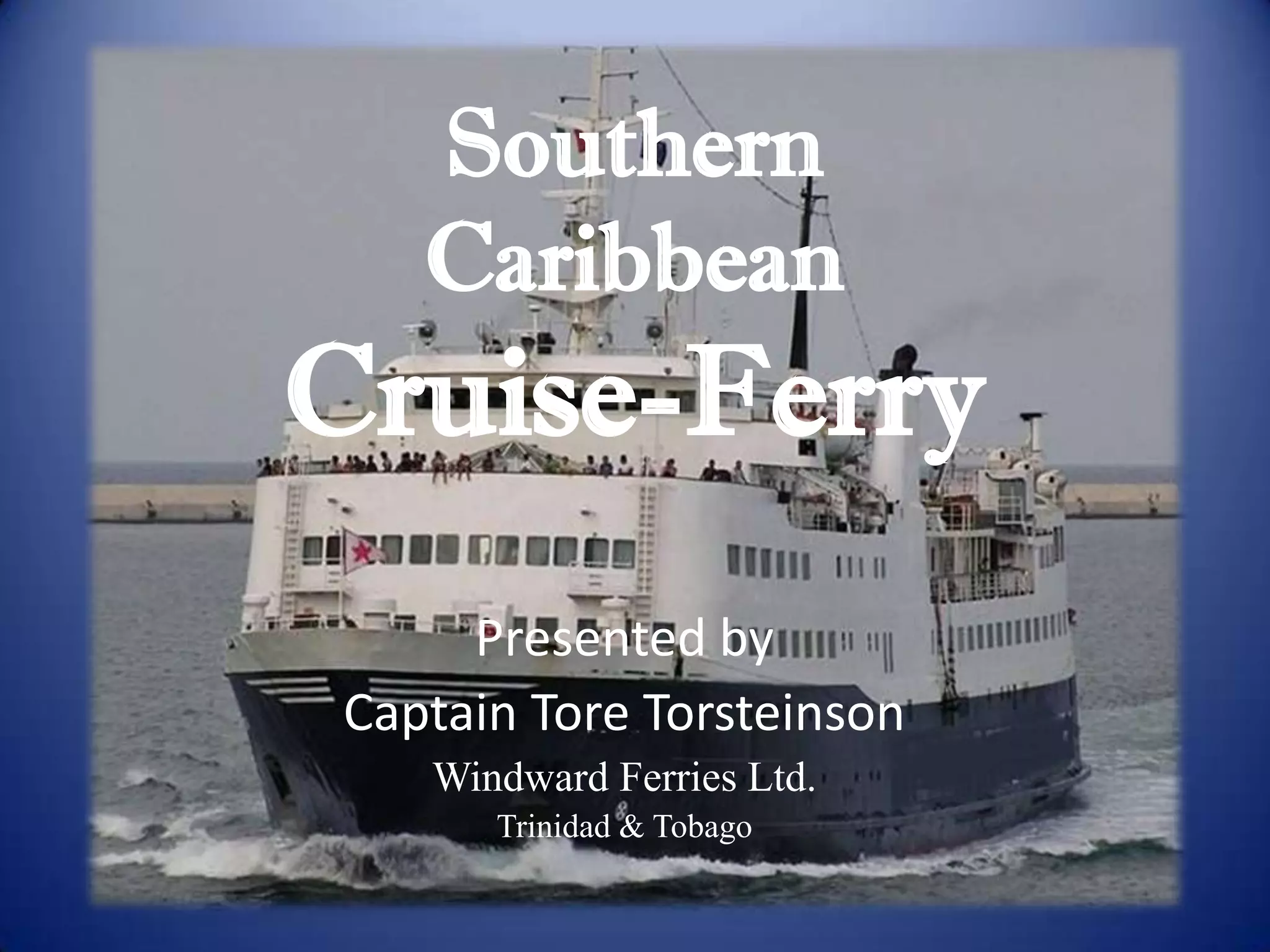
The cover slide establishes the geographic focus: the Southern Caribbean. It identifies the company as Windward Ferries Ltd. , based in Trinidad & Tobago . The presenter is Captain Tore Torsteinson , which immediately lends a level of maritime authority to the project. The background image shows a large, multi-deck ferry in open water, setting the scale for the venture.
Slide 2: Dining Capacity
Slide 2 focuses on the Buffet Restaurant . The key metric provided here is 140 seats . The photography shows a functional, cafeteria-style layout with yellow checkered tablecloths. This slide is intended to prove that the vessel can handle large passenger volumes for meal services, a critical component for overnight regional travel.
Slide 3: Entertainment Infrastructure
The Disco Dance Floor is shown from the perspective of the cafe on the deck above. This architectural choice—a multi-story atrium or viewing gallery—suggests a vessel designed for leisure, not just utilitarian transport. The slide emphasizes the 'Cruise' aspect of the 'Cruise-Ferry' label.
Slide 4: Ancillary Revenue Streams
Slide 4 displays the Arcade , which features a row of at least six slot machines and gaming terminals. In the maritime industry, onboard gaming and entertainment are vital high-margin revenue streams that offset the high fuel and maintenance costs of the vessel. The presence of these machines indicates a plan for onboard monetization beyond ticket sales.
Slide 5: Passenger Accommodations
The deck showcases a 3 Berths Lux Cabin . The image reveals a compact room with a bunk bed configuration (a single lower and single upper visible) and a small desk area. While labeled 'Lux,' the aesthetic is functional. This slide confirms the ship's capability for overnight voyages, which is necessary for the multi-day itinerary proposed later in the deck.
Slide 6: Engine Room Specifications
This is perhaps the most technical slide in the deck. It lists the Generators : 2 x Caterpillar 3508 B (800 Kw each) installed in 1997 and 1 x Iveco Aifo 600 Kw installed in 2010. For a maritime investor, the age and power output of the generators are critical for assessing maintenance risks and operational reliability. The photo shows a well-maintained, albeit older, engine room environment.
Slide 7: The Weekly Schedule
Slide 7 is the most important slide for understanding the business's reach. It outlines a weekly arrival and departure schedule . The route is ambitious: Trinidad serves as the hub, with a mid-week trip to Puerto la Cruz, Venezuela . The weekend is dedicated to the island chain: St. Vincent, Barbados, St. Lucia , and an optional Sunday stop in Dominica . This schedule suggests a high-utilization model where the ship is constantly in motion, maximizing potential ticket revenue across different jurisdictions.
Slide 8: Deck Plans
The final slide in this set provides Passenger Decks blueprints. It includes the Boat Deck (Deck No 7) , the Promenade Deck (Deck No 6) , and Deck 5 . These drawings show the distribution of cabins, lifeboats, public spaces, and the bridge. This level of detail is usually reserved for due diligence phases, proving that the vessel is a real, tangible asset with a defined configuration.
What Windward Ferries Does Well
The deck excels at operational transparency . By including engine specs, seating counts, and exact arrival/departure times, the founders eliminate any ambiguity about what the service actually is. They aren't pitching a 'platform'; they are pitching a ship and a route. The inclusion of the Captain's name on the front slide is a strong move in an industry where experience and licensure are the primary barriers to entry.
The visual evidence of the ship's interior—while dated—proves that the asset exists and is configured for the intended purpose. Many maritime startups fail because they pitch a concept without a vessel; Windward Ferries shows the kitchen, the beds, and the engines.
What is Missing from the Deck
The most glaring omission is the Financial Ask . There is no slide indicating how much money is needed, what it will be used for (e.g., fuel, port fees, vessel acquisition, or refurbishment), or what the equity/debt structure looks like. Furthermore, there are no Market Metrics . We don't see the estimated number of passengers traveling between Trinidad and St. Lucia annually, nor do we see the projected ticket prices or break-even load factors.
There is also a lack of Competitive Analysis . The Caribbean ferry market is notoriously difficult, with high fuel costs and competition from regional airlines like LIAT or Caribbean Airlines. The deck does not explain why a ferry is a superior or more profitable choice than existing air travel or cargo shipping options.
Lessons for Founders
Founders in capital-intensive industries (shipping, aviation, manufacturing) can learn from Windward's asset-first approach . If your business relies on a physical machine, show the machine. Show the specs. Show the layout. It builds immediate credibility that you have moved past the 'idea' phase.
However, founders must remember that logistics are not a business model . A schedule (Slide 7) tells an investor where the ship will be, but it doesn't tell them if the ship will make money. Every technical slide should ideally be paired with a commercial slide. For example, the '140-seat buffet' slide should be followed by a slide estimating the average revenue per passenger (ARPP) for food and beverage services.
Final Verdict: This is an excellent operational manual but an incomplete fundraising deck . It proves the 'how' but ignores the 'why' and the 'how much.'
Frequently asked questions
- What is the primary business model of Windward Ferries?
- Based on the slides, the company operates a 'Cruise-Ferry' model in the Southern Caribbean. This combines passenger transport between islands (Trinidad, St. Lucia, Barbados, etc.) with cruise-style amenities such as a buffet restaurant, disco, and arcade. It targets both regional travelers needing transport and tourists seeking a multi-destination experience.
- What are the technical capabilities of the vessel?
- The deck emphasizes the ship's power systems, specifically listing two Caterpillar 3508 B generators installed in 1997 and an Iveco Aifo generator installed in 2010. The inclusion of detailed deck plans for three levels suggests a vessel capable of carrying hundreds of passengers across multiple cabin classes and public spaces.
- Which islands are included in the ferry route?
- The weekly schedule covers a comprehensive loop: Trinidad (Tuesday/Thursday), Puerto la Cruz in Venezuela (Wednesday), St. Vincent (Friday/Monday), Barbados (Friday/Monday), St. Lucia (Saturday/Sunday), and an optional stop in Dominica on Sundays. This indicates a focus on the Windward Islands and the northern coast of South America.
- Is there a clear investment opportunity presented?
- No. The provided slides lack a formal 'Ask' or financial summary. There are no details on the cost of the vessel, ticket pricing, projected load factors, or how much capital is being sought. It functions as a technical and operational overview rather than a financial investment deck.
- Who is the key person behind this project?
- The deck is presented by Captain Tore Torsteinson of Windward Ferries Ltd. The branding on the ship in the photos also shows 'Red Star Ferries,' suggesting a potential partnership or a rebranding of an existing vessel for this specific Caribbean route.