WineSimple is an e-commerce platform that matches consumers with brand-name wines based on a 7-question taste quiz. The deck outlines a business model centered on 'owning the consumer, not the wine,' effectively acting as a personalized recommendation layer that fulfills orders without holding inventory. With a target margin of $16.00 on an $89.99 six-bottle box, the company projects growing wine revenue from $860K to $50M over four years. The pitch seeks $800K in secured convertible debt with a $3M cap to validate customer acquisition costs and improve long-term value. While the deck provide…
Key takeaways
- The company utilizes a 7-question quiz to generate a visual 'Taste Profile' covering weight, oak, tannin, intensity, acidity, and fruitiness (Slide 5).
- WineSimple operates on an inventory-light model, stated as 'Own the Consumer, Not the Wine' (Slide 6).
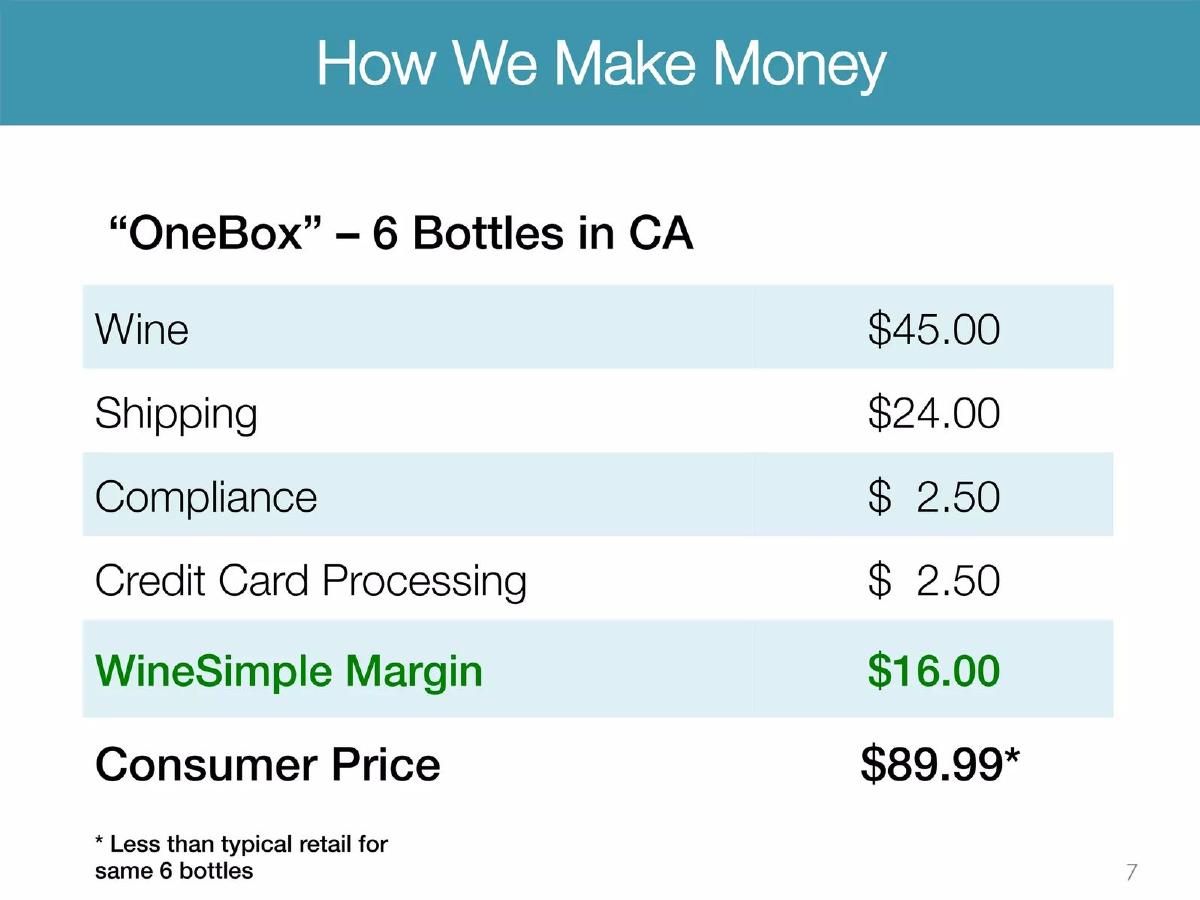
- Unit economics for a 6-bottle box in California show a $16.00 margin on an $89.99 consumer price (Slide 7).
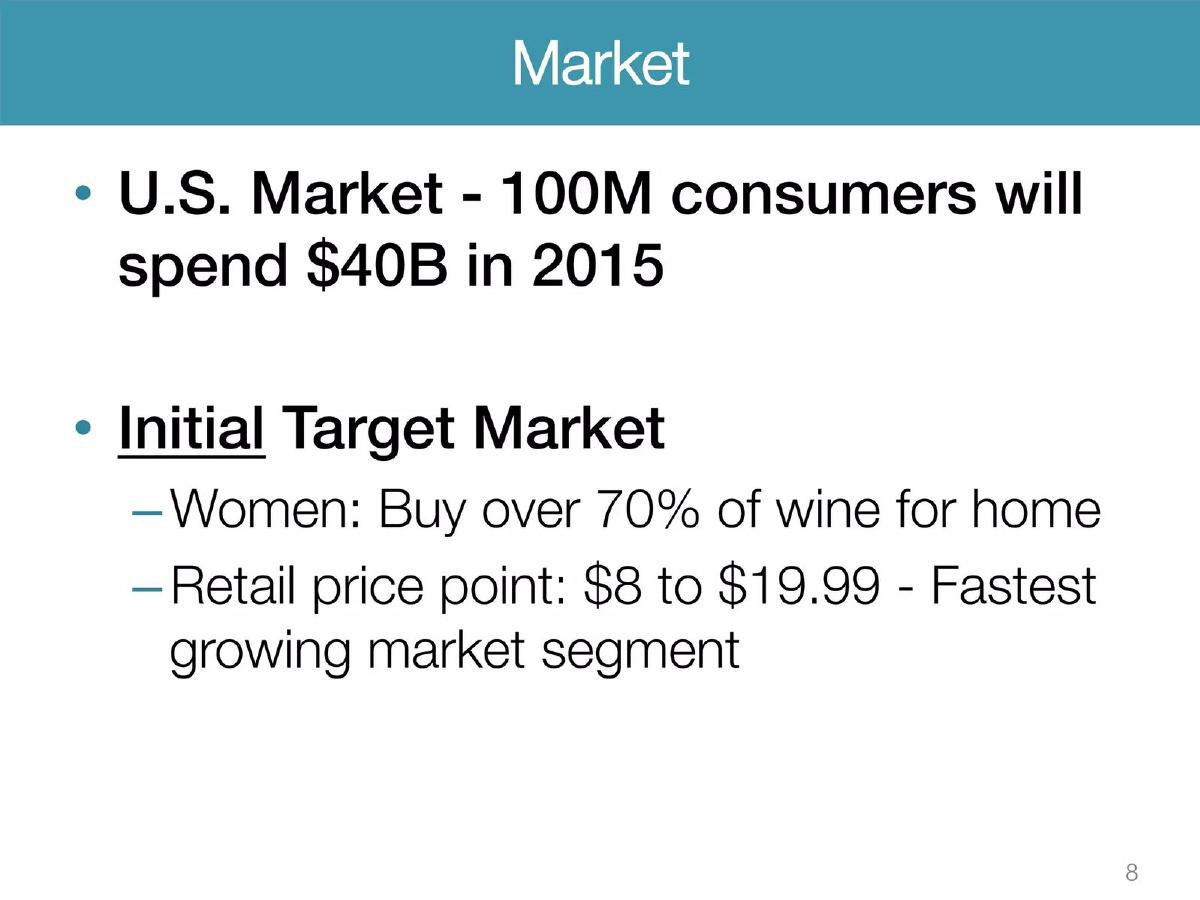
- The initial target market focuses on women, who buy over 70% of wine for home consumption, and the $8 to $19.99 retail price point (Slide 8).
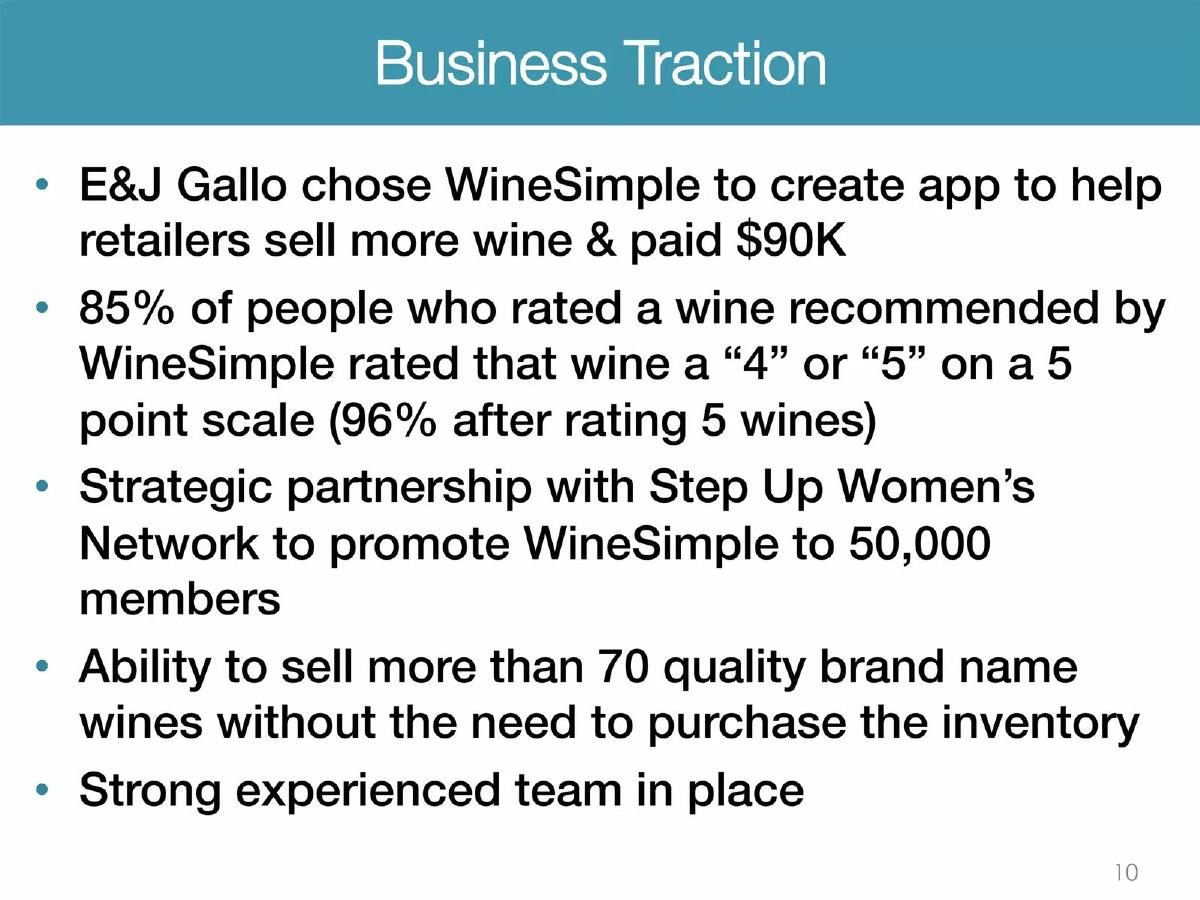
- Traction includes a $90K payment from E&J Gallo to create a retail sales app and a partnership with Step Up Women’s Network (Slide 10).
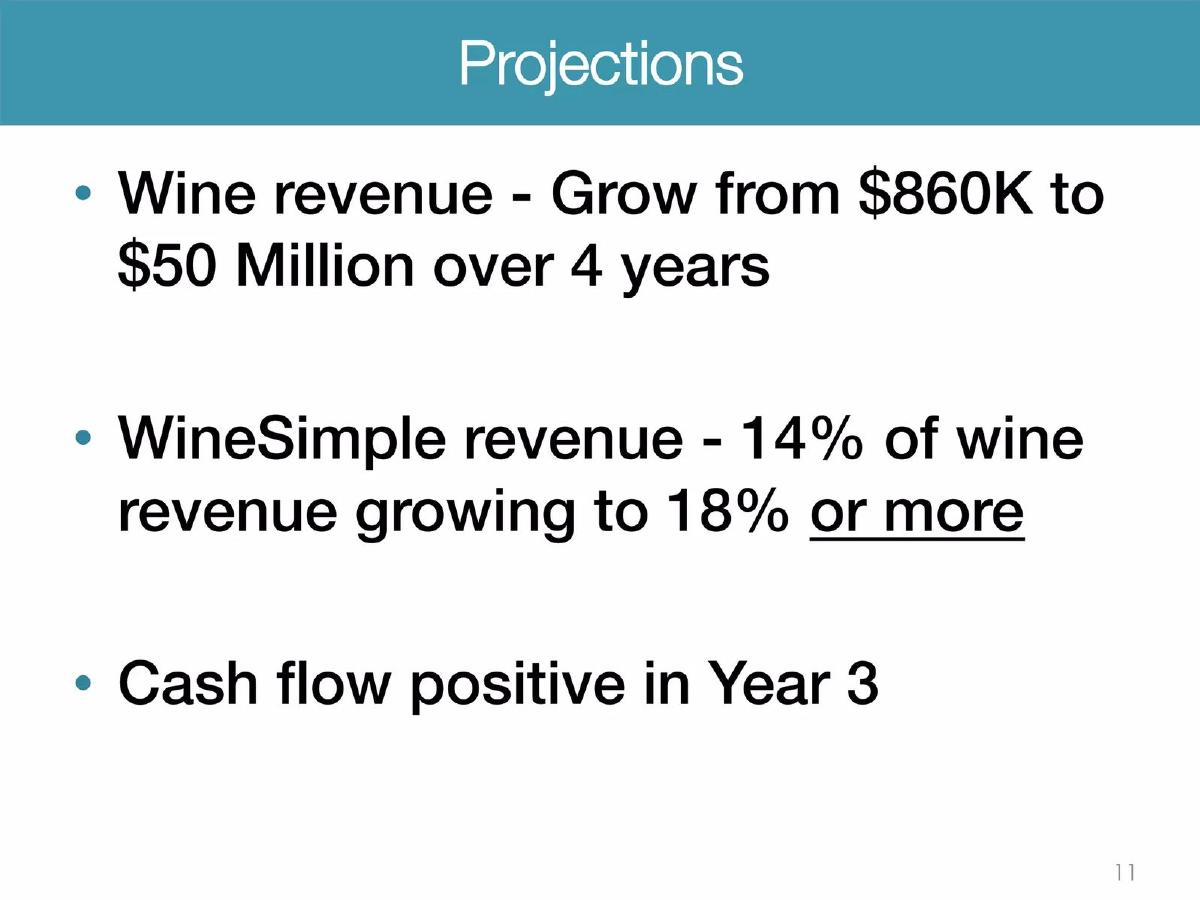
- Revenue projections aim for $50 million in wine revenue within four years, reaching cash flow positivity in Year 3 (Slide 11).
- The funding ask is $800K in secured convertible debt with a 20% discount and a $3M valuation cap (Slide 15).
- The exit strategy explicitly targets a sale at $80 million, calculated at a 20X EBITA multiple (Slide 16).
WineSimple Pitch Deck Analysis
WineSimple presents a 16-slide deck focused on solving the 'choice paralysis' inherent in the wine industry. The deck is structured logically, moving from the consumer problem to a data-driven solution, supported by specific unit economics and a clear funding ask. It positions the company not as a traditional retailer, but as a technology-enabled recommendation engine that facilitates e-commerce without the burden of inventory.
Slide 1: Title Slide
The cover slide introduces the WineSimple logo, which incorporates a wine bottle silhouette into the letter 'n'. The tagline 'FIND THE RIGHT WINE FOR YOU' immediately establishes the value proposition. A footer note indicates the deck 'Contains proprietary and confidential information,' and the background features a stylized row of wine bottles in muted tones.
Slides 2-3: The Problem and The Result
Slide 2 uses a full-bleed image of a consumer looking overwhelmed in a grocery store wine aisle. Slide 3 summarizes the consumer behavior resulting from this overwhelm: 'Most people buy the same wine every time, what’s on sale, or nothing at all.' This establishes a clear pain point: the difficulty of discovery in a crowded market leads to stagnation or lost sales.
Slides 4-5: The Solution and Taste Profile
Slide 4 defines the solution as an e-commerce business delivering 'quality brand name wine' matched to a 'Taste Profile' on a recurring basis. Slide 5 details the mechanism: a 7-question quiz that generates a visual profile. The graphic shows six metrics: Weight, Oak, Tannin, Intensity, Acidity, and Fruitiness. This suggests a data-driven approach to personalization that goes beyond simple red vs. white preferences.
Slide 6: Business Model
This slide contains a single, bold statement: 'Own the Consumer, Not the Wine.' This is a critical strategic distinction. It signals to investors that WineSimple is a capital-light business. By focusing on the customer relationship and the recommendation data rather than warehousing and logistics, the company aims for higher scalability and lower overhead than traditional wine clubs.
Slide 7: How We Make Money
Slide 7 provides a transparent breakdown of unit economics for a 6-bottle box sold in California. The consumer price is $89.99. The costs are listed as: Wine ($45.00), Shipping ($24.00), Compliance ($2.50), and Credit Card Processing ($2.50). This results in a $16.00 margin for WineSimple. A footnote claims this price is 'Less than typical retail for same 6 bottles,' suggesting a competitive pricing strategy despite the added value of personalization.
Slide 8: Market Opportunity
The deck cites a total U.S. market of 100 million consumers spending $40 billion in 2015. The initial target market is specifically defined: women, who buy over 70% of wine for home consumption, and the $8 to $19.99 retail price point, which is identified as the fastest-growing segment. This specificity shows the founders have a clear go-to-market strategy rather than just chasing a large, vague number.
Slide 9: Ecommerce Metrics
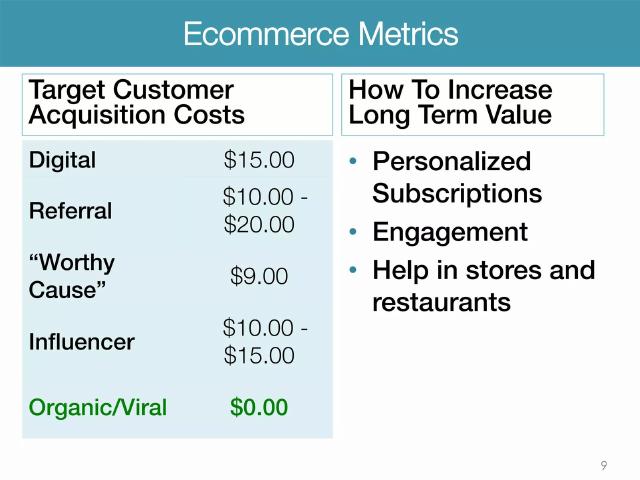
Slide 9 outlines target Customer Acquisition Costs (CAC) across various channels. Digital is pegged at $15.00, while 'Worthy Cause' marketing is lower at $9.00. The slide also mentions strategies to increase Long Term Value (LTV), including personalized subscriptions, engagement, and helping consumers in physical stores and restaurants. However, the deck does not provide current LTV or churn data, only 'How To Increase' it.
Slide 10: Business Traction
Traction is demonstrated through three main points: a $90K payment from industry giant E&J Gallo for a retail app, high user satisfaction ratings (85% to 96% rating wines 4 or 5 stars), and a partnership with Step Up Women’s Network reaching 50,000 members. The slide also reiterates the ability to sell 70+ brand-name wines without purchasing inventory, reinforcing the lean model.
Slide 11: Projections
The company projects growing wine revenue from $860K to $50 million over four years. It expects WineSimple’s take-rate (revenue as a percentage of wine revenue) to grow from 14% to 18% or more. The slide concludes with a goal of becoming cash flow positive in Year 3. These are ambitious targets, though the deck does not provide the underlying assumptions (e.g., number of subscribers required) to reach $50M.
Slide 12: Future Revenue Opportunities
Beyond the core subscription model, Slide 12 lists four expansion paths: increased profitability from lower wine costs (economies of scale), licensing the technology, advertising, and data sales. This suggests the founders view the 'Taste Profile' data as a secondary asset that could be monetized independently of wine sales.
Slide 13: Competition
The competitive matrix compares WineSimple against Naked Wines, Club W, Tasting Room, Drync/Delectable, and Hello Vino. WineSimple claims to be the only player offering 'True Personalized Selections' combined with 'Brand Name Wine,' 'No Inventory Cost,' and a 'Target Mass Market.' Most competitors are marked as lacking personalization or using private labels rather than brand names.
Slide 14: Team
The team slide lists five founders/management members (Robert Miller, Dick Wollack, Richard Marcus, Amanda Richardson, Nick Halsey) and three advisors. Rather than biographies, the slide uses a cluster of logos to represent their backgrounds, including Neiman Marcus, Snagajob, Prezi, Hotel Tonight, Pandora, Netflix, and StubHub. While the logos are impressive, the lack of specific roles or tenures for the individuals makes it difficult to assess the actual depth of the team.
Slides 15-16: Funding and Exit
Slide 15 states the ask: $800K in secured convertible debt with a 20% discount and a $3M cap. The use of funds is focused on 12+ months of operations and validating CAC/LTV metrics. Slide 16 explicitly targets an exit sale at $80 million, based on a 20X EBITA multiple, identifying e-commerce companies, retailers, and wine companies as potential buyers.
What WineSimple Does Well
Clear Unit Economics: Slide 7 provides a rare level of transparency regarding the costs and margins of a single transaction. This allows investors to quickly model the business's potential profitability. · Strategic Positioning: The 'Own the Consumer, Not the Wine' mantra is a powerful way to communicate a low-CAPEX business model in a traditionally inventory-heavy industry. · Defined Target Audience: By identifying women as the primary purchasers and focusing on a specific price bracket ($8-$19.99), the company demonstrates a sophisticated understanding of retail dynamics. · Traction with Industry Leaders: The $90K deal with E&J Gallo serves as significant third-party validation of their recommendation technology.
What is Missing from the Deck
Detailed Team Bios: Slide 14 relies entirely on logos. It is unclear which founder has wine industry expertise versus tech expertise, or who is working full-time on the venture. · Churn and Retention Data: For a subscription business, retention is the most critical metric. While Slide 10 mentions high ratings, it does not disclose how many users actually stay subscribed month-over-month. · Inventory Source Details: The deck claims 'No Inventory Cost,' but it does not explain the legal or logistical structure of how they fulfill brand-name wines without owning them (e.g., drop-shipping partnerships or specific retail tie-ins). · Assumption Details for Projections: Moving from $860K to $50M in four years is a steep curve. The deck lacks a 'bridge' showing the required subscriber growth or marketing spend to achieve those figures.
Founder Takeaways: What to Copy
The Visual Solution: Slide 5’s visualization of the 'Taste Profile' is excellent. It turns a complex, subjective experience (tasting wine) into a digestible, data-driven graphic that feels proprietary. · The Competitive Matrix: Slide 13 uses a simple checkmark system that highlights a 'white space' in the market. By choosing specific categories where they are the only 'all-of-the-above' winner, they create a compelling reason for their existence. · Specific Funding Terms: Slide 15 doesn't just ask for money; it provides the instrument (convertible debt), the discount, and the cap. This level of detail speeds up the due diligence process for interested investors. · Exit Realism: While many decks ignore the exit, Slide 16 names specific types of buyers and a target valuation multiple. This shows the founders are thinking about the investor's eventual liquidity event.
Frequently asked questions
- How does WineSimple differentiate itself from other wine clubs?
- According to Slide 13, WineSimple differentiates itself through 'True Personalized Selections' and a 'No Inventory Cost' model. While competitors like Tasting Room and Hello Vino offer brand-name wines, WineSimple claims to be the only one combining personalization with a mass-market target and zero inventory overhead, contrasting with Naked Wines which does not use brand-name labels.
- What are the specific unit economics for a WineSimple shipment?
- Slide 7 breaks down the 'OneBox' (6 bottles in CA). The consumer pays $89.99. Costs include $45.00 for wine, $24.00 for shipping, $2.50 for compliance, and $2.50 for credit card processing. This leaves WineSimple with a $16.00 margin per box, which the deck notes is less than typical retail for the same bottles.
- What is the company's customer acquisition strategy?
- Slide 9 lists target Customer Acquisition Costs (CAC) across five channels: Digital ($15.00), Referral ($10.00-$20.00), 'Worthy Cause' ($9.00), Influencer ($10.00-$15.00), and Organic/Viral ($0.00). The $800K funding round is specifically intended to validate these CAC figures and improve long-term value (LTV).
- What evidence of product-market fit is provided?
- Slide 10 cites that 85% of users who rated a recommended wine gave it a 4 or 5 out of 5. This satisfaction rate reportedly climbs to 96% after a user has rated five wines. Additionally, the company secured a $90K contract from E&J Gallo to build a retail-facing version of their recommendation technology.
- What are the terms of the investment being sought?
- As shown on Slide 15, WineSimple is raising $800,000. The instrument is secured convertible debt. The terms include a 20% discount to the next equity round and a $3 million valuation cap. The funds are earmarked for 12+ months of operations, CAC validation, and LTV improvement.