The Wiac pitch deck, surfaced in 2018, represents a project at the intersection of social activism, psychological research, and high-end virtual reality production. Rather than a traditional SaaS or consumer tech startup, Wiac positions itself as a 'trans-media, Afro-futurist narrative' designed to change perspectives for 'The Other.' The deck highlights significant early-stage validation through grants and prestigious lab acceptances, such as the Sundance Institute VR Lab and Oculus Launch Pad. However, the available slides focus heavily on thematic inspiration and philosophical underpinning…
Key takeaways
- The project is defined as a 'trans-media, Afro-futurist narrative' aimed at changing how marginalized groups perceive the world (Slide 1).
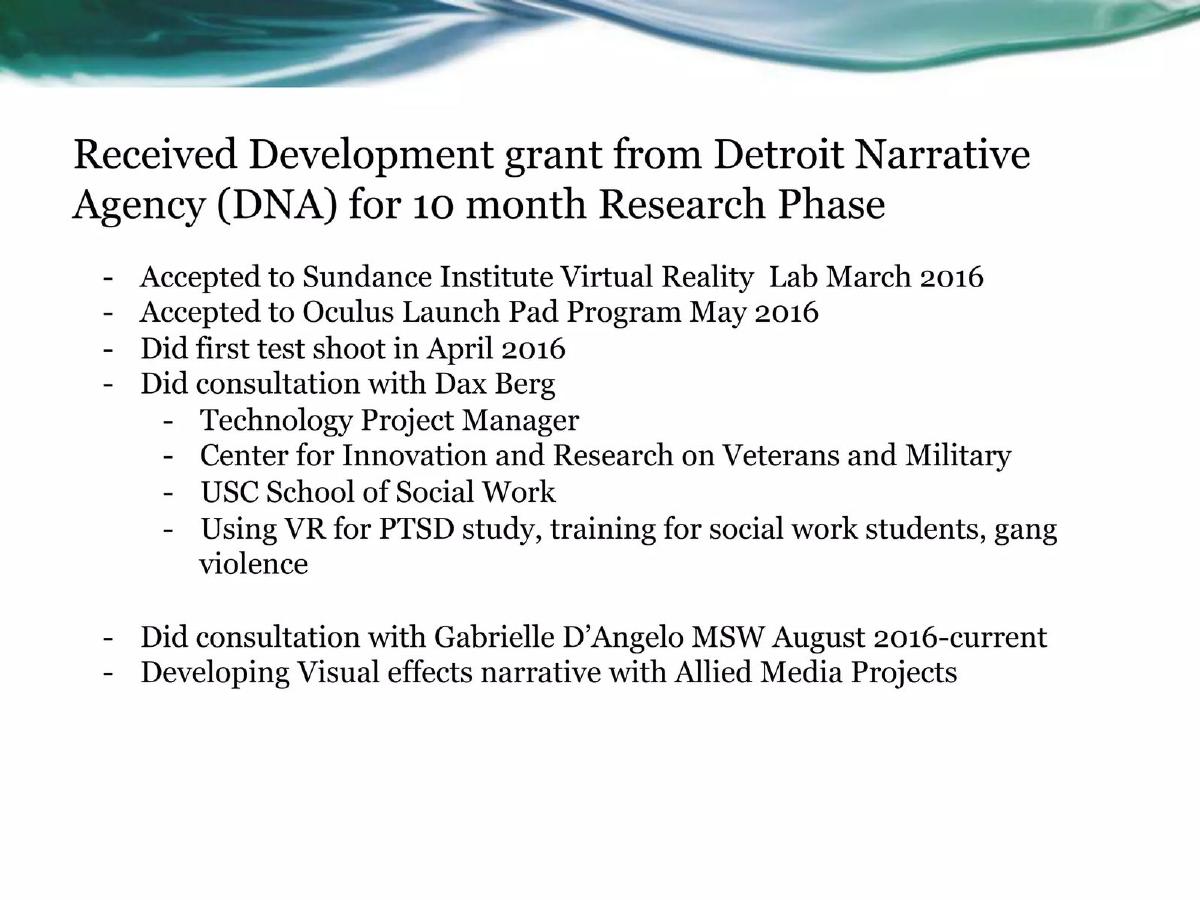
- Wiac secured a development grant from the Detroit Narrative Agency (DNA) for a 10-month research phase (Slide 2).
- The team achieved significant industry recognition by being accepted into the Sundance Institute VR Lab and the Oculus Launch Pad Program in 2016 (Slide 2).
- Research efforts included consultations with technology project managers at the USC School of Social Work regarding VR use for PTSD and gang violence training (Slide 2).
- The project identifies a problem in 'current media empires' that reward the sharing of negativity, citing a video with 313,000 views as an example (Slide 7).
- Production quality is emphasized through the use of the Nokia Ozo, described as a '$45,000.00 top VR camera' (Slide 8).
- The deck relies heavily on external cultural references, such as the Netflix series 'The OA' and quotes from Thich Nhat Hanh, to establish its tone (Slides 3 and 4).
- There is a complete absence of financial projections, revenue models, or a specific funding request in the provided slides.
Slide-by-Slide Teardown
Slide 1: Title and Vision
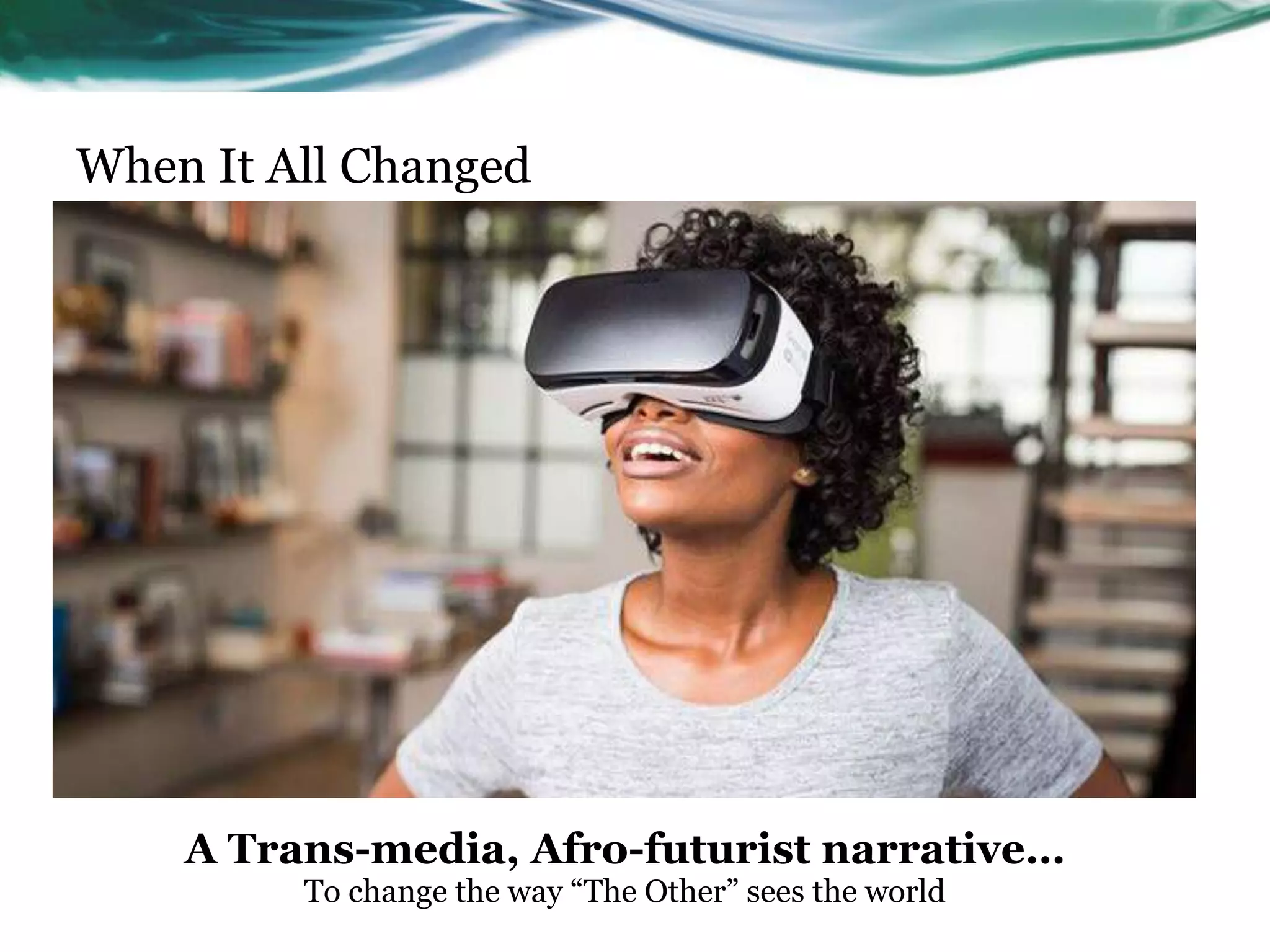
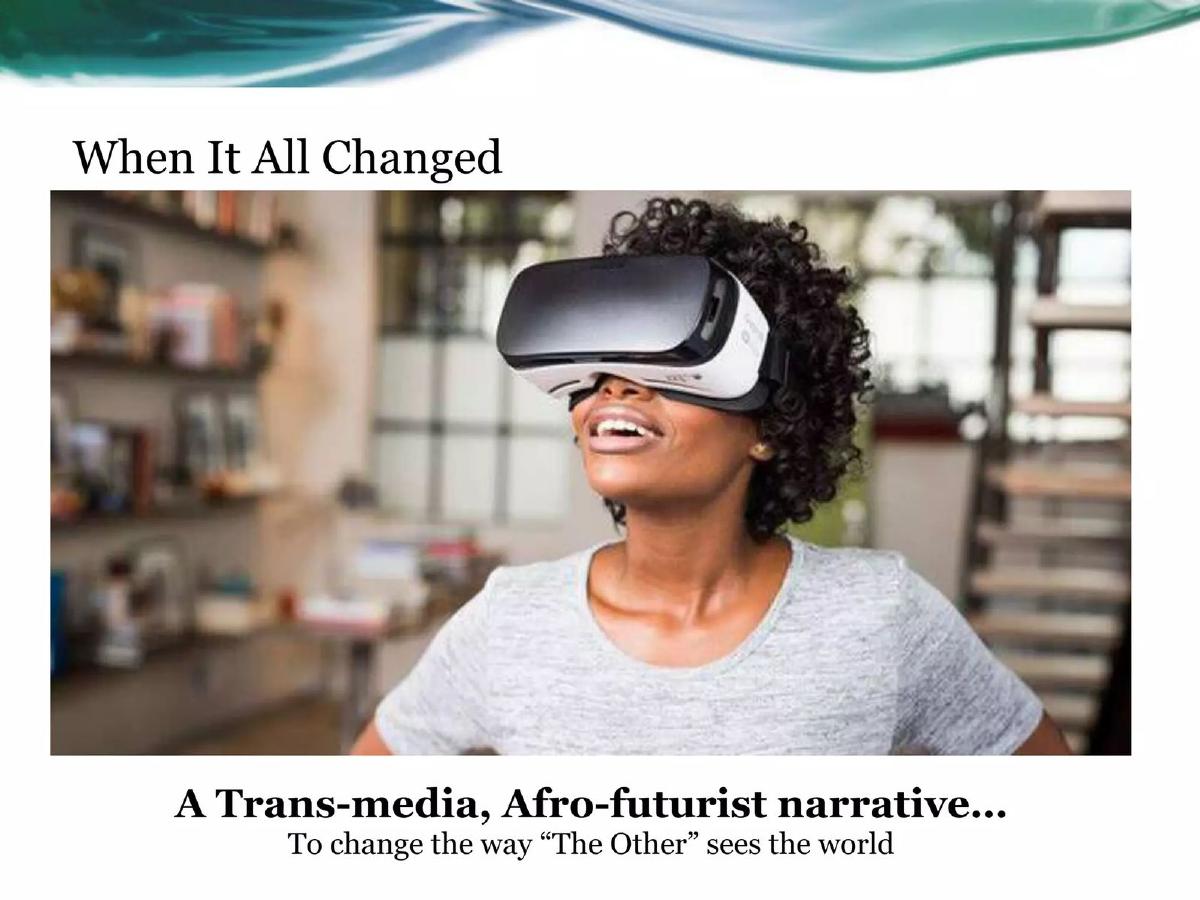
The opening slide introduces the project as 'When It All Changed.' It features a woman using a Samsung Gear VR headset. The subtitle defines the project as 'A Trans-media, Afro-futurist narrative... To change the way "The Other" sees the world.' This sets a high-level, conceptual tone, focusing on identity and perspective-shifting rather than a specific technical utility.
Slide 2: Traction and Validation
This is the most data-dense slide in the set. It lists several key milestones: a development grant from the Detroit Narrative Agency (DNA) for a 10-month research phase, and acceptances into the Sundance Institute Virtual Reality Lab (March 2016) and the Oculus Launch Pad Program (May 2016). It also notes a first test shoot in April 2016 and consultations with Dax Berg (USC School of Social Work) regarding VR applications for PTSD and gang violence. This slide successfully establishes the project's credibility within the niche of 'VR for Good.'
Slide 3: Philosophical Foundation
Slide 3 features a quote from Thich Nhat Hanh regarding fear and mindfulness. While it establishes the emotional and psychological intent of the project, it does not provide business information. It serves to reinforce the 'healing' aspect of the narrative mentioned in the previous slide's research notes.
Slide 4: Inspiration and Comps
Titled 'Current themes/Inspiration,' this slide displays promotional art for the Netflix series 'The OA.' In a creative pitch, this is used to signal the intended 'vibe' or narrative complexity. However, it lacks an explanation of why this specific show is a competitor or a thematic match, leaving the interpretation to the viewer.
Slide 5: Visual Metaphor
This slide contains an illustration of six human silhouettes in rainbow colors, connected by glowing energy. There is no text on this slide. It appears to be a visual representation of the 'trans-media' or 'Afro-futurist' themes, likely used as a backdrop for a verbal explanation of human connectivity or the 'aura' of the narrative.
Slide 6: Social Mission
The headline reads 'To inform resistance to the Mainstream/System.' The image shows three women with red 'X' tape over their mouths holding signs that say 'UPHOLD DEMOCRATIC THAILAND!' This slide pivots the deck toward political activism. It frames the VR project as a tool for political awareness or a medium for silenced voices, though it doesn't explain the specific link between the Thai protest imagery and the Afro-futurist narrative.
Slide 7: The Problem Statement
Wiac identifies a problem with modern media: 'The current media empires benefit from and rewards people for sharing negativity.' It shows a low-quality screenshot of a chaotic scene in a restaurant with a caption of 313,000 VIEWS . This is a classic 'villain' slide, positioning the project as the positive alternative to viral, negative content.
Slide 8: Technical Capability
The final slide in this set showcases the Nokia Ozo , labeled as a '$45,000.00 top VR camera.' By highlighting the cost and the 'SlashGear' watermark, the founders are attempting to demonstrate that they have access to, or are utilizing, professional-grade equipment to ensure the final product meets industry standards for immersive media.
What Works
Strong Institutional Validation: The inclusion of the Sundance Institute and Oculus Launch Pad (Slide 2) is a significant achievement. For a creative or social impact project, these names act as a proxy for quality and potential, suggesting that the project has already been vetted by experts in the VR field.
Interdisciplinary Approach: By citing consultations with the USC School of Social Work (Slide 2), the founders show they aren't just making a movie; they are investigating the psychological impact of their medium. This adds a layer of 'defensibility' to the project that a standard indie film pitch would lack.
Clear Thematic Identity: The deck is unapologetic about its focus on Afro-futurism and social resistance. This clarity helps it stand out to specific impact investors or grant-making organizations that prioritize marginalized voices and innovative storytelling.
What is Missing
Business Model: There is no mention of how this project sustains itself. Is it a one-off film? A series? A subscription platform for therapeutic VR? Without a revenue model, it is difficult to evaluate this as a startup investment.
The Team: While consultations are mentioned, the core creative and technical team is not introduced in these slides. Investors need to know who is actually building the narrative and managing the $45,000 hardware.
The 'Ask': The deck identifies the cost of the camera but never specifies how much capital is being raised or what that capital will be used for (e.g., production, distribution, or further research).
Market Size: There is no analysis of the VR market, the audience for Afro-futurist content, or the potential reach of 'trans-media' narratives. The deck relies entirely on the 'social good' angle without addressing the 'market opportunity.'
Founder Takeaways
Use 'Badges' for Credibility: If you have been accepted into a prestigious accelerator, lab, or received a notable grant, put it front and center as Wiac did on Slide 2. It immediately elevates the perceived value of the project.
Define the 'Villain' Clearly: Slide 7 effectively identifies a cultural problem (the reward for negativity). Founders should always try to personify the problem their company is solving, even if it is a broad cultural trend rather than a specific competitor.
Balance Art with Commerce: While the thematic slides (3, 5, and 6) are visually striking, a pitch deck needs to transition from 'why this matters' to 'how this works as a business.' Founders should ensure that for every 'inspiration' slide, there is a corresponding 'execution' or 'monetization' slide to keep investors grounded in the reality of the venture.
Frequently asked questions
- What is the core product Wiac is building?
- Based on the slides, Wiac is developing a VR-based 'trans-media, Afro-futurist narrative.' It appears to be a content-driven project rather than a software platform. The project combines cinematic storytelling with psychological research, specifically looking at how immersive technology can be used for social resistance and healing from trauma like PTSD.
- What stage of development was Wiac in during this pitch?
- The project was in a research and development phase. Slide 2 mentions a 10-month research phase funded by the Detroit Narrative Agency and a first test shoot conducted in April 2016. While the deck surfaced in 2018, the milestones listed suggest it was transitioning from conceptual research to early production.
- Who are the key partners or advisors mentioned?
- The deck lists consultations with Dax Berg, a Technology Project Manager at the Center for Innovation and Research on Veterans and Military Families (USC), and Gabrielle D’Angelo, an MSW. These partnerships suggest a heavy focus on the clinical and social work applications of their VR content.
- How does Wiac plan to make money?
- The provided slides do not contain a business model, pricing strategy, or monetization plan. The project is framed through the lens of social impact and 'informing resistance to the mainstream system,' which may suggest a non-profit or grant-funded trajectory rather than a traditional commercial exit.
- What technology is being used for production?
- Wiac emphasizes high production values by highlighting the use of the Nokia Ozo. Slide 8 explicitly notes the camera's $45,000 price tag, signaling to investors or grant bodies that the project is utilizing professional-grade hardware for its 360-degree immersive content.