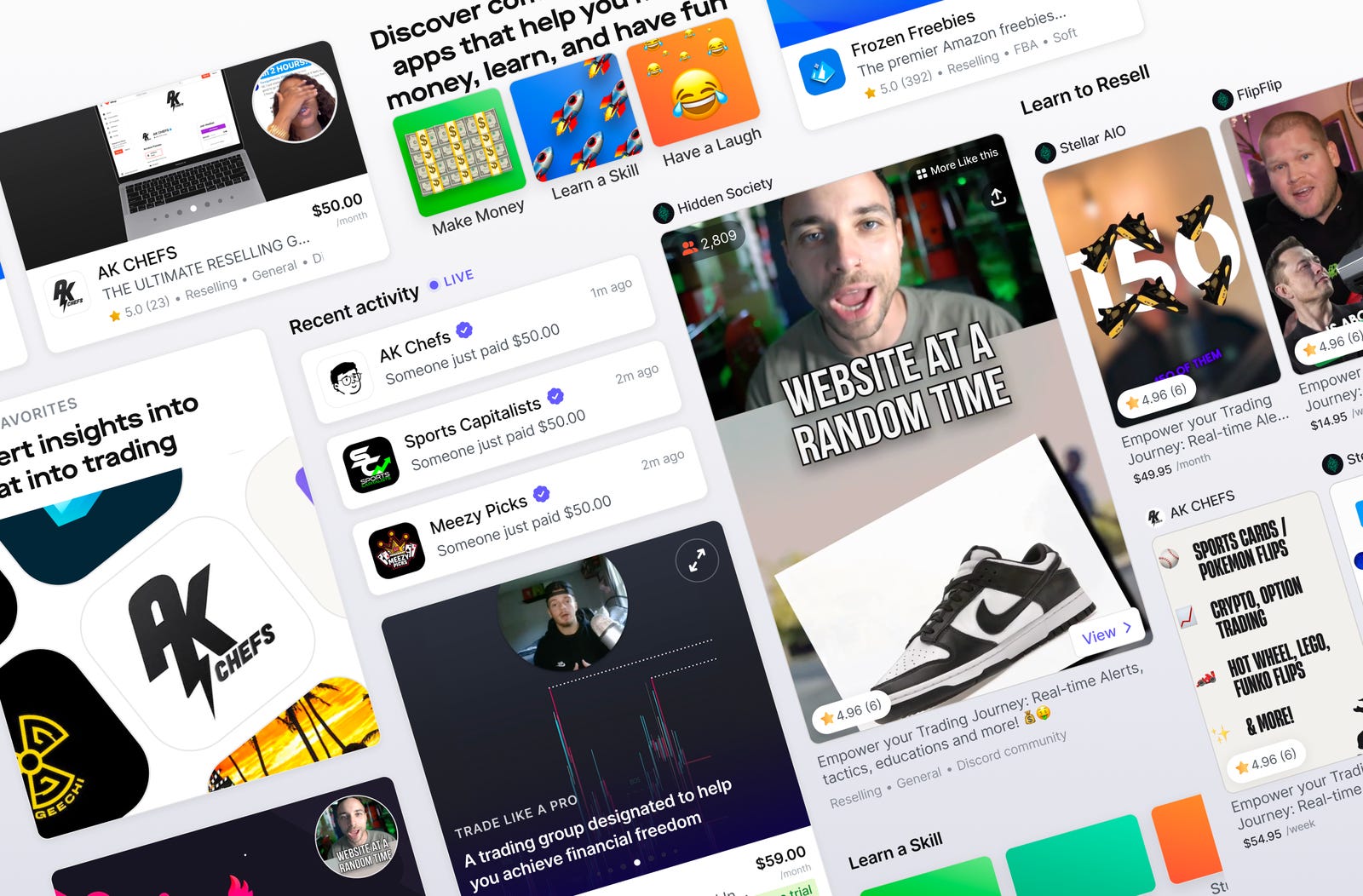
Whop's pitch deck is a departure from standard venture aesthetics, opting for a text-heavy Notion document format that emphasizes raw data and product functionality over polished graphic design. The deck successfully raised a $17M Series A in 2024 by showcasing a marketplace that bridges the gap between creator-led digital products and consumer discoverability. By positioning themselves as the 'Amazon for digital goods,' the founders highlighted a significant gap in the current e-commerce landscape where competitors like Shopify and Squarespace offer low discoverability. The deck leans into t…
Key takeaways
- The deck uses a Notion-based format rather than traditional slides, signaling a product-first, 'hacker' culture (Slide 2).
- Whop positions itself as a 'Shopify-like solution' for digital businesses but with 'Amazon-like' discoverability (Slide 4).
- The marketplace emphasizes recurring revenue, stating that a 'large proportion of our GMV is recurring' (Slide 2).
- Traction is demonstrated through a GMV bar chart showing significant growth from March to November (Slide 2).
- The team slide highlights extreme youth and technical experience, with the CPO and CTO both being high school or college dropouts (Slide 6).
- Whop identifies a competitive gap in 'discoverability,' noting that most creator gateways force sellers to drive their own traffic (Slide 5).
- The deck includes a specific case study of a creator who earned 'almost $48k' in less than three months on the platform (Slide 3).
- Operational efficiency is highlighted by a customer service team that has handled over 100,000 messages with a 3-minute median response time (Slide 6).
The Marketplace for the Digital Economy
Whop’s pitch deck is a fascinating example of the 'anti-deck' trend. Instead of high-fidelity graphics and minimalist bullet points, the company utilized a Notion-based document to raise its $17M Series A. This approach works because it mirrors the product itself: a platform for digital-native creators who value speed, utility, and transparency over corporate polish. The deck focuses on the mechanics of the marketplace, the velocity of the team, and a clear competitive gap in the e-commerce sector.
Slide 1: Visual Identity and Product Breadth
The opening slide is a dense collage of product screenshots. It immediately establishes the 'Amazon for digital goods' aesthetic. Visible categories include 'Make Money,' 'Learn a Skill,' and 'Have a Laugh.' Specific products like 'AK Chefs' (a reselling group) and 'Sports Capitalists' are shown with price points (e.g., $50.00/month) and star ratings. This slide does the heavy lifting of showing, rather than telling, that the marketplace is already live, diverse, and facilitating transactions.
Slide 2: Traction and GMV Growth
Slide 2 is the core of the business case. Although specific figures are redacted in this version, the structure is telling. The founders highlight six key metrics: GMV Run Rate, accounts created, active subscriptions, recurring GMV proportion, average transaction size, and total products available. The inclusion of a bar chart showing GMV from March to November provides a visual representation of growth velocity. By emphasizing that a 'large proportion' of GMV is recurring, Whop is signaling to investors that this is a high-quality, predictable revenue business, not just a series of one-off transactions.
Slide 3: The Creator and User Perspective
This slide provides a micro-level view of the platform's success. It features a case study of 'Elliot's company,' which earned 'almost $48k' between September 18 and December 1. A screenshot of the Whop dashboard shows a retention rate of 87.06%, a critical metric for any subscription-based marketplace. The 'End user perspective' section narrates the journey of a curious individual looking for crypto trading knowledge, explaining how Whop facilitates the discovery and 'programmatic' addition of the user to a community. This bridges the gap between the abstract marketplace and the actual user experience.
Slide 4: Strategy and Product Roadmap
Whop outlines a five-point strategy. The first point is the most critical: providing a 'Shopify like solution with automated fulfillment.' They aim to attract companies by offering 'no fees' (likely a reference to listing fees rather than transaction fees), discoverability, and an app store. The strategy explicitly mentions 'crypto payments,' positioning Whop at the intersection of the creator economy and Web3. The mention of an 'Amazon-like format' for categories reinforces their goal of becoming a discovery engine, not just a checkout tool.
Slide 5: Competitive Landscape
The 'Competitor Analysis' slide uses a standard four-quadrant graph. The axes are 'Digital Products vs. Physical Products' and 'Low Discoverability vs. High Discoverability.' Whop places itself in the top-right quadrant (Digital + High Discoverability). They position Shopify and Squarespace as 'Low Discoverability' tools for digital/physical goods, and Amazon/eBay as 'High Discoverability' tools primarily for physical goods. The 'Competitive Advantages' section doubles down on this, stating that other gateways force creators to drive their own traffic, making it hard for users to 'stumble' upon products.
Slide 6: The 'Hacker House' Team
The team slide is unconventional. It lists the ages of the founders (22 and 23) and their histories as teenage builders and dropouts. Steven Schwartz (CEO), Cameron Zoub (CPO), and Jack Sharkey (CTO) are all described as having built apps since they were 14 or 15. The slide also mentions Jackson Huether (19) taking a leave of absence from Duke. Most notably, the slide includes a note that the team works out of a 'hacker house in Brooklyn, NY.' This is a deliberate cultural signal to investors about the team's dedication, low burn rate, and 24/7 focus on the product.
What Whop's Deck Does Well
The deck excels at defining a specific 'missing piece' in the e-commerce market. By identifying 'discoverability' as the primary pain point for digital creators, Whop creates a clear reason for its existence. The use of real dashboard screenshots (Slide 3) with high retention rates (87.06%) provides immediate credibility. Furthermore, the team slide leans into their youth as a strength, framing it as 'years of experience building' rather than a lack of professional maturity. The mention of handling 100,000 support messages with a 3-minute response time (Slide 6) proves they can handle the operational side of a growing marketplace.
What is Missing from the Whop Deck
The most glaring omission is a formal 'Ask' slide. While we know from publisher reports that they raised $17M, the deck does not specify the amount sought, the valuation, or the intended use of funds. There is also a lack of detailed unit economics. While they mention 'no fees' as a strategy to attract companies, they do not explicitly detail their long-term take rate or how they plan to achieve profitability. Finally, the 'Competition' section is quite brief; while the graph is clear, a more detailed breakdown of how they beat incumbents on a feature-by-feature basis (beyond just 'discoverability') would have strengthened the case.
Founder's Guide: What to Copy
1. Use Case Studies for Social Proof: Slide 3’s deep dive into a single creator’s earnings and retention is more persuasive than a dozen slides of abstract market projections. Founders should show the 'North Star' version of their customer.
2. Define Your 'Quadrant': The competitive graph on Slide 5 is a masterclass in positioning. By choosing axes that favor their specific strengths (Digital + Discoverability), they make their market dominance look inevitable.
3. Embrace Your Culture: Whop didn't hide the fact that they were young guys in a Brooklyn hacker house; they put it in the deck. If your team has a unique 'vibe' or working style that contributes to high output, make it part of the pitch.
4. Focus on Recurring Revenue: In a marketplace, GMV is great, but recurring GMV is better. Whop’s emphasis on subscriptions (Slide 2) and retention (Slide 3) addresses the biggest investor fear regarding marketplaces: churn.
Frequently asked questions
- Why did Whop use a Notion document instead of a standard slide deck?
- Whop's choice of a Notion document reflects their brand as a modern, technical, and fast-moving startup. It allows for easy embedding of live links, feature lists, and detailed text that a standard PowerPoint might struggle to contain. For a Series A, this format suggests the founders are focused on building and documentation rather than over-polishing a presentation.
- What is the primary value proposition Whop offers to creators?
- According to Slide 5, the primary advantage is discoverability. Unlike Shopify or Squarespace, which require creators to find their own customers, Whop aims to be a destination where users can 'stumble' upon digital products. They also offer automated fulfillment and support for crypto payments to reduce friction for sellers.
- How does Whop handle customer support at scale?
- Slide 6 notes that the company employs four customer service representatives who have managed over 100,000 support messages. They emphasize a median response time of 3 minutes, which is used to demonstrate operational maturity despite the small, young team living in a hacker house.
- What specific digital products are sold on the Whop marketplace?
- The product imagery on Slide 1 and the case study on Slide 3 indicate a heavy focus on trading communities, crypto indicators, reselling groups (like 'AK Chefs'), and educational courses. The publisher summary confirms they enable the sale of everything from private communities to custom software.
- Is there a clear financial 'Ask' in the deck?
- No. The provided slides do not include a specific dollar amount being raised or a valuation cap. While publisher facts state they raised $17M, the deck itself focuses on the business model, traction, and team rather than the specific terms of the round.