Woomera Mining Limited’s December 2017 presentation is a technical prospectus designed for the Australian Securities Exchange (ASX) re-listing of Ausroc Metals Ltd. The strategy involves a complex corporate restructuring where Woomera Exploration Limited (WEX) acquires Volt Lithium and Liquid Lithium, while Ausroc acquires WEX. The deck seeks to raise between $4m and $7m at $0.20 per share. Geologically, the company bets on 'nearology,' highlighting tenements in the Pilgangoora province adjacent to major deposits held by Pilbara Minerals and Altura Mining. While the deck is rich in geophysica…
Key takeaways
- The company is undergoing a name change from Ausroc Metals Ltd to Woomera Mining Limited as part of a re-listing process (Slide 1).
- The capital raise targets a minimum of $4,000,000 and a maximum of $7,000,000 at a fixed price of $0.20 per share (Slide 6).
- The corporate structure involves three primary subsidiaries: Norsa Exploration, Volt Lithium, and Liquid Lithium (Slide 6).
- Woomera relies on proximity to the Pilgangoora deposit (156.3Mt @ 1.25% Li2O) to validate its northern tenements (Slide 11).
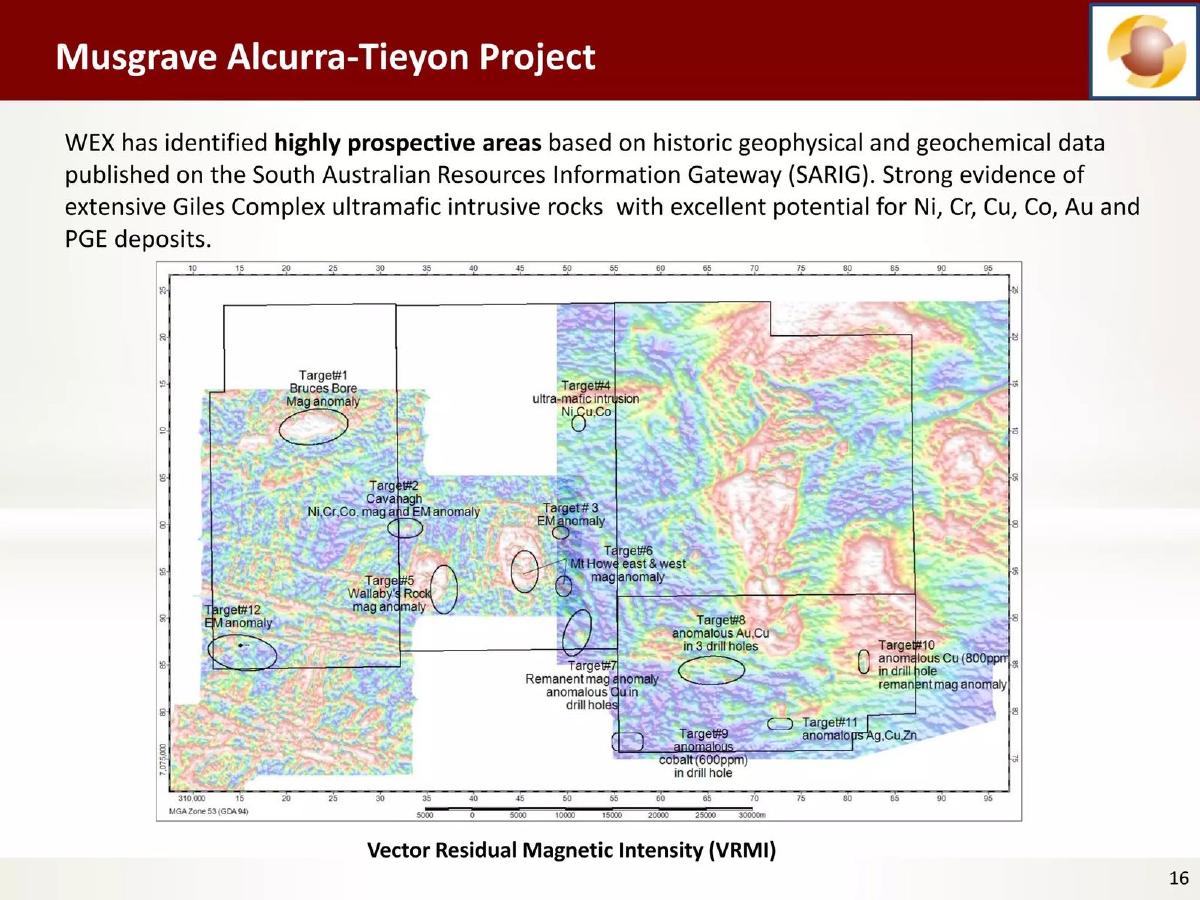
- Geophysical targeting at the Musgrave Alcurra-Tieyon Project has identified 12 distinct magnetic and EM anomalies (Slide 16).
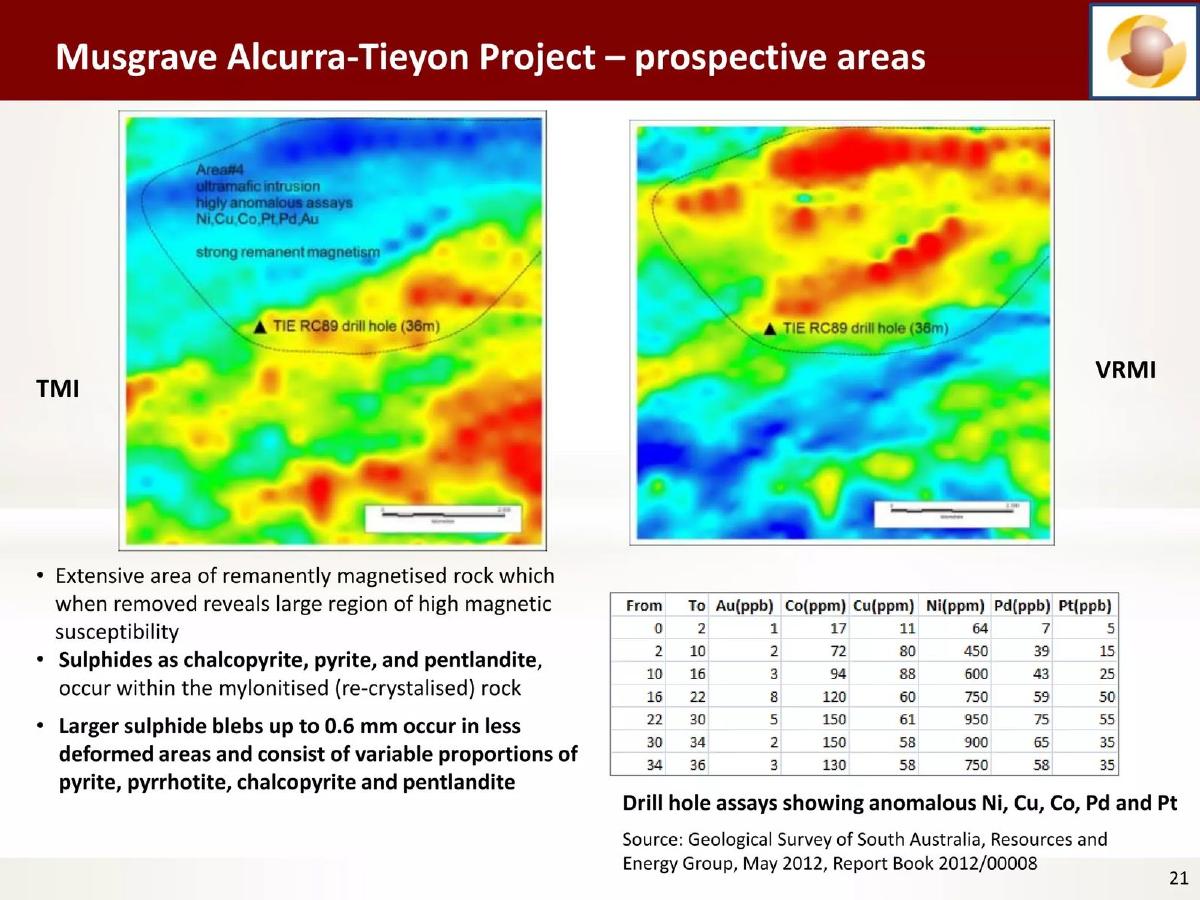
- Historical drill hole assays at the Musgrave project show anomalous levels of Nickel, Copper, Cobalt, Palladium, and Platinum (Slide 21).
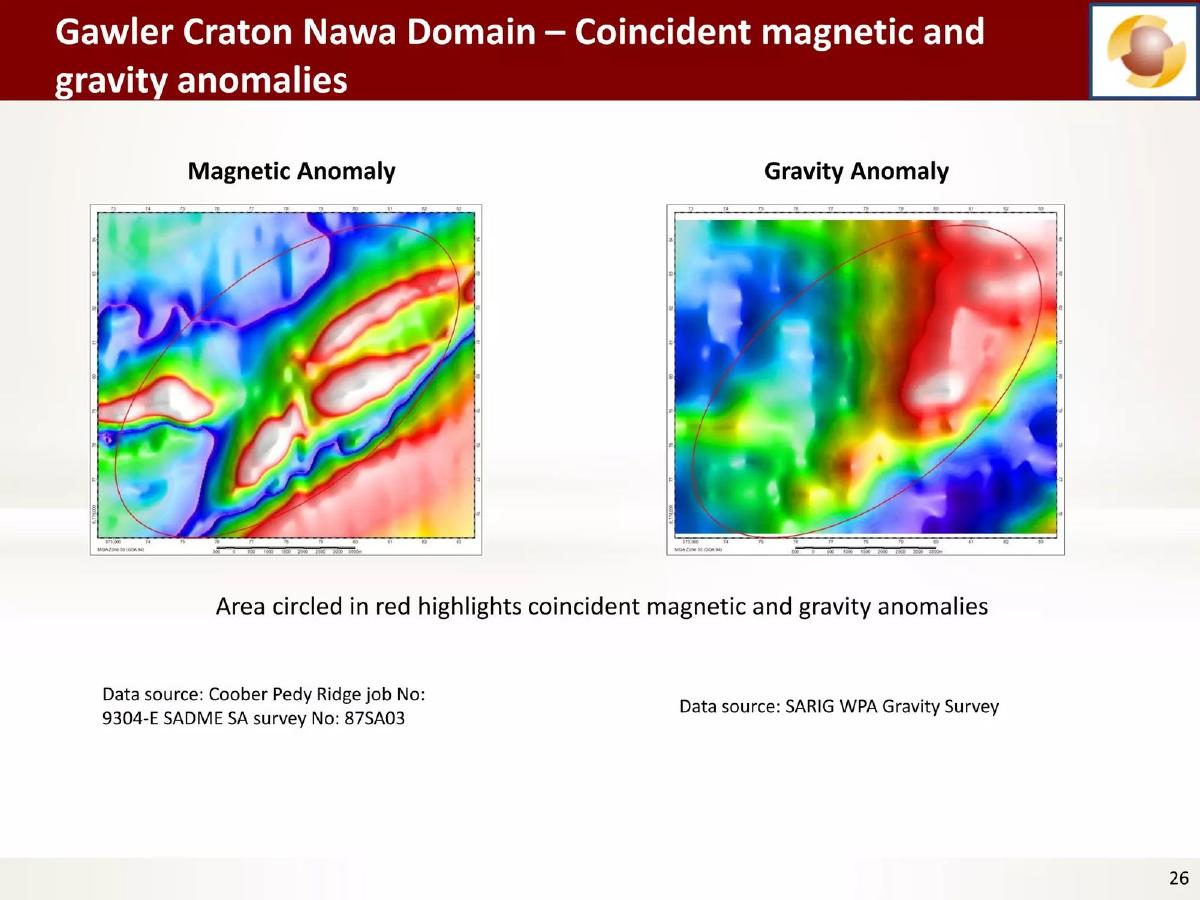
- The Gawler Craton Nawa Domain is highlighted for coincident magnetic and gravity anomalies, suggesting potential for large-scale mineralization (Slide 26).
- The Lakes Lithium Project is identified as having lithium concentrations approximately 50 times that of sea water (Slide 31).
Executive Summary and Corporate Identity
Slide 1: Title and Renaming
The opening slide establishes the primary purpose of the presentation: the rebranding of Ausroc Metals Ltd to Woomera Mining Limited . The subtitle defines the geographic and geological scope, focusing on the Gawler Craton and Musgrave Province in South Australia, alongside lithium tenements in Western Australia. The date is explicitly stated as December 2017 . The imagery of a long, open road in the Australian outback serves as a metaphor for the exploration journey ahead, though it provides no technical value.
Slide 6: Re-listing and Capital Structure
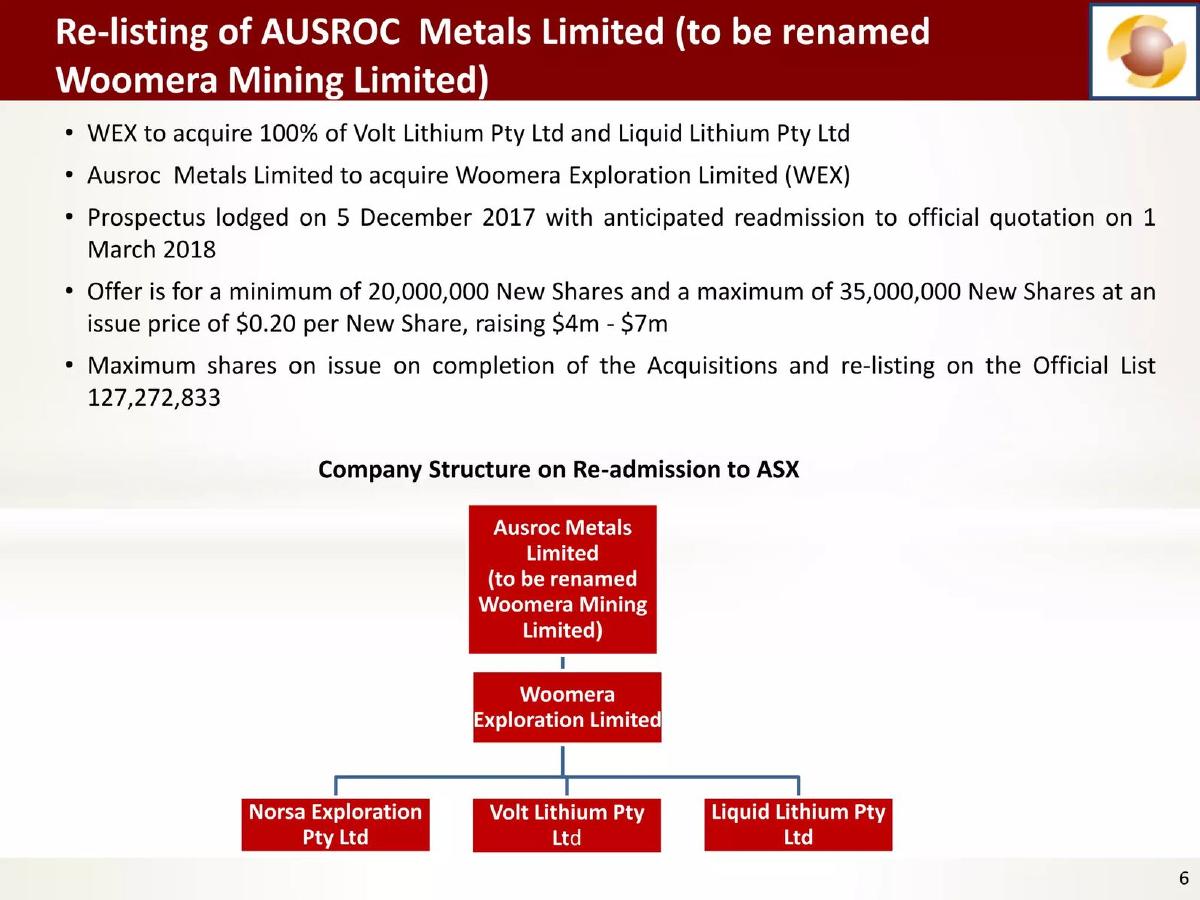
This slide is the core of the financial 'Ask.' It outlines a complex reverse takeover (RTO) structure. WEX (Woomera Exploration Limited) is set to acquire 100% of Volt Lithium Pty Ltd and Liquid Lithium Pty Ltd . Subsequently, Ausroc Metals Limited will acquire WEX. The slide notes that a prospectus was lodged on 5 December 2017 with an anticipated re-listing date of 1 March 2018 . The financial terms are specific: a minimum raise of $4,000,000 and a maximum of $7,000,000 at $0.20 per share . Upon completion, the maximum shares on issue will be 127,272,833 . A flow chart at the bottom clarifies the hierarchy, showing Woomera Exploration Limited as the primary subsidiary holding three exploration entities.
Geological Assets and Exploration Strategy
Slide 11: Pilgangoora Hard Rock Lithium Project
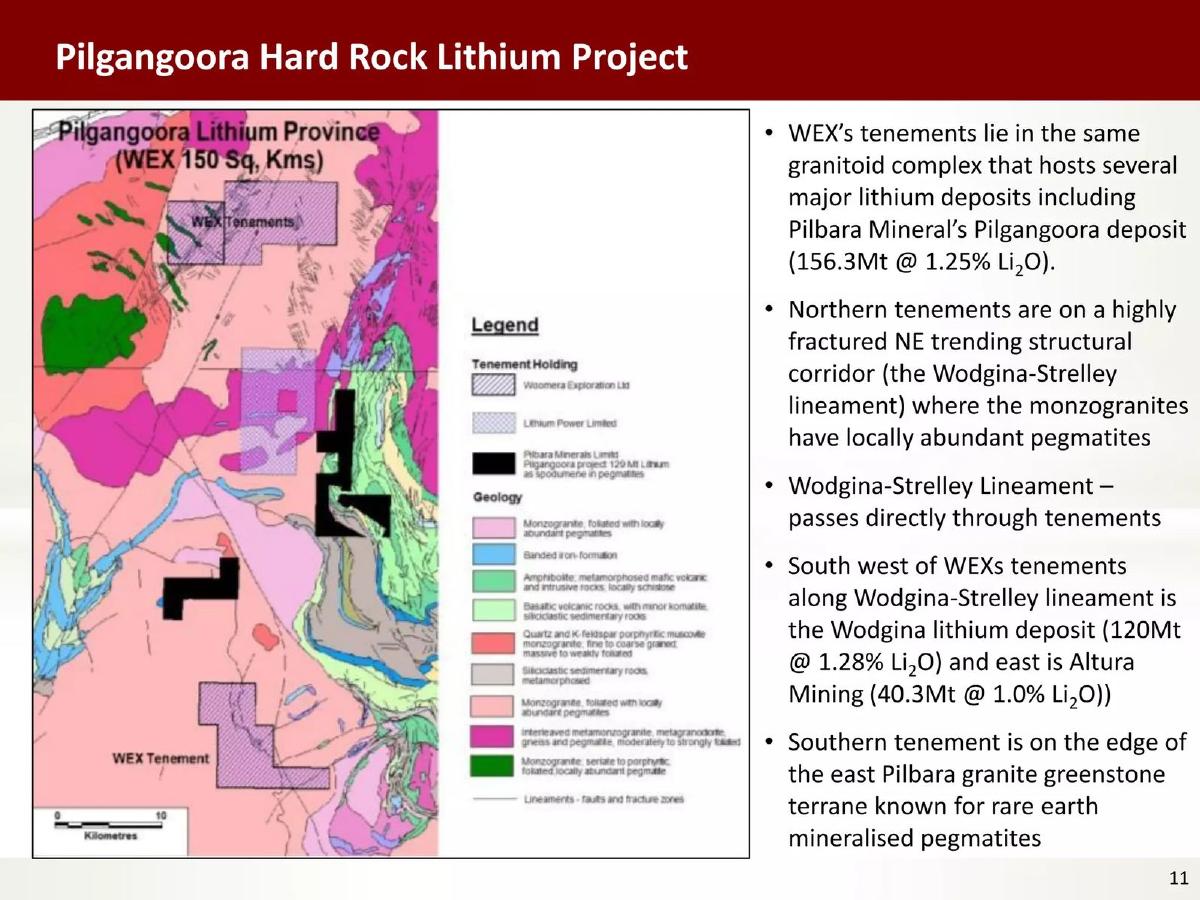
Woomera utilizes a proximity-based argument for its Western Australian assets. The slide features a geological map of the Pilgangoora Lithium Province , where WEX holds 150 Sq Kms . The text highlights that these tenements are in the same granitoid complex as Pilbara Minerals’ Pilgangoora deposit (156.3Mt @ 1.25% Li2O) and Altura Mining (40.3Mt @ 1.0% Li2O). The slide emphasizes the Wodgina-Strelley lineament , a structural corridor that passes directly through the WEX tenements, suggesting that the geological conditions that created neighboring massive deposits are present on their land.
Slide 16: Musgrave Alcurra-Tieyon Project
This slide shifts focus to South Australia. It presents a Vector Residual Magnetic Intensity (VRMI) map. The company identifies 12 highly prospective areas based on historic data from the South Australian Resources Information Gateway (SARIG). The map is annotated with specific targets, such as 'Target #1 Bruces Bore Mag anomaly' and 'Target #4 ultra-mafic intrusion Ni, Cu, Co.' This slide is intended to demonstrate that the company is not starting from scratch but is following up on established geophysical leads for Nickel, Copper, Gold, and PGE deposits.
Slide 21: Prospective Areas and Drill Hole Assays
To move beyond theoretical geophysics, Slide 21 provides historical data. It shows Total Magnetic Intensity (TMI) and VRMI maps alongside a table of drill hole assays from the TIE RC89 hole. The table lists depths from 0 to 36 meters and provides parts per billion (ppb) or parts per million (ppm) for Gold, Cobalt, Copper, Nickel, Palladium, and Platinum. For example, at 22-30 meters, the assay shows 950ppm Nickel and 75ppb Palladium . By citing a May 2012 report from the Geological Survey of South Australia, the deck adds a layer of third-party validation to its claims of 'anomalous' mineral levels.
Slide 26: Gawler Craton Nawa Domain
This slide focuses on the Gawler Craton , comparing a Magnetic Anomaly map with a Gravity Anomaly map. The red circles highlight 'coincident' anomalies. In the mining industry, when a magnetic high aligns with a gravity high, it often indicates a dense, metallic ore body. The slide cites data sources from SADME SA and SARIG WPA . This is a classic exploration pitch slide: it identifies a specific 'bullseye' for future drilling, though it does not provide a timeline for when that drilling will occur.
Supplementary and Technical Data
Slide 31: Lakes Lithium Project
In the appendix, the deck provides more detail on the Lakes Tay and Sharpe Lithium targets. The slide claims a Lithium brine target with concentrations approximately 50x sea water . It notes that Geoscience Australia identified the area as having Li-B-K (Lithium-Boron-Potassium) potential. The map shows a strong K-U-Th anomaly (Potassium-Uranium-Thorium) in the northern part of Lake Tay. This slide is meant to appeal to investors looking for 'brine' lithium exposure as a counterpoint to the 'hard rock' lithium mentioned on Slide 11.
Slide 36: Priority Drill Target Area #7
This map provides a broader geographic context of the Musgrave Block and Gawler Craton . It shows the location of WEX tenements relative to major landmarks like Coober Pedy and Woomera , and existing mines like Challenger , Prominent Hill , and Roxby Downs . The map also indicates Defence use zones (infrequent, periodic, and continuous), which is a critical disclosure for this region of Australia, as military activity can impact land access and exploration schedules.
Slide 41: Gawler Craton Labyrinth Project
The final technical slide in the selection details the EL 5113 Lake Labyrinth Project . It lists a diverse range of targets: Copper, Gold, Rare Earths, Lithium, Boron, and Potassium . It references a CRA Drill Hole (DD88ME2) at a depth of 302.5m and notes that Lake Labyrinth contains Lithium at 27x sea water . This slide reinforces the 'multi-commodity' nature of the company’s portfolio, suggesting that if one mineral market fails, the company has other assets to pivot toward.
What Woomera Mining Limited Does Well
The deck is exceptionally strong on technical substantiation . For a pre-revenue exploration company, the 'product' is the land and the data associated with it. Woomera provides high-resolution geophysical maps, specific assay results from historical drilling (Slide 21), and clear references to government geological surveys (SARIG). This level of detail is necessary to satisfy the due diligence requirements of sophisticated mining investors and the regulatory standards of the ASX.
Furthermore, the corporate transparency regarding the RTO structure on Slide 6 is commendable. It clearly defines the minimum and maximum raise amounts, the price per share, and the resulting share capital. This prevents any ambiguity about the deal terms, which is often a point of confusion in complex reverse takeovers.
Omissions and Weaknesses
The most glaring omission in the provided slides is the Team Slide . In early-stage mining, the 'jockey' is as important as the 'horse.' Investors need to know who the geologists and directors are, their history of discoveries, and their experience in managing public companies. Without this, the deck feels like a collection of maps rather than a business plan.
Additionally, there is no Use of Proceeds slide. While we know they are raising up to $7 million, the deck does not specify how much will go toward drilling at Pilgangoora versus the Musgrave Province, or how much is reserved for corporate overhead and the costs of the re-listing. A Timeline or Roadmap is also missing; there is no indication of when the first drill rigs will be on-site or when the first results from Woomera’s own exploration (rather than historical data) are expected.
Founder Takeaways
1. Use 'Nearology' Wisely: If your startup is in a crowded or competitive space, show your proximity to 'unicorns' or market leaders. Woomera does this effectively on Slide 11 by mapping their land right next to established, multi-million-ton deposits. It creates a sense of 'guilt by association' in a positive way.
2. Substantiate with Third-Party Data: Don't just say your product is good; show data from recognized authorities. Woomera’s use of SARIG and Geoscience Australia data (Slides 16 and 31) makes their claims much harder to dismiss than if they had simply drawn their own circles on a map.
3. Clarity in Complexity: If your business involves a complex merger or restructuring, use a flow chart. Slide 6 takes a very complicated three-way acquisition and makes it understandable in ten seconds. Founders in fintech or biotech with complex IP or corporate structures should emulate this simplicity.
4. Address Geographic Risks: Slide 36 shows the intersection of tenements with military zones. While this could be seen as a negative, disclosing it upfront builds trust. Founders should always include a slide that addresses the 'elephant in the room' regarding their specific industry risks (regulatory, geographic, or technical).
Frequently asked questions
- What is the primary financial objective of this deck?
- The primary objective is to facilitate the re-listing of Ausroc Metals Ltd (to be renamed Woomera Mining Limited) on the ASX. According to slide 6, the company is seeking to raise between $4 million and $7 million through the issuance of up to 35,000,000 new shares at $0.20 each. This capital is intended to fund the acquisition of Woomera Exploration Limited and its subsidiaries.
- How does the company justify the value of its lithium tenements?
- Woomera uses a 'nearology' approach, particularly on slide 11. It highlights that its 150 sq km tenements in the Pilgangoora province lie within the same granitoid complex as world-class deposits like Pilbara Minerals' Pilgangoora (156.3Mt) and Altura Mining (40.3Mt). By showing their land sits on the Wodgina-Strelley lineament, they imply a high probability of similar mineralization.
- What specific minerals is Woomera Mining targeting?
- While lithium is a major focus for the Western Australian tenements (Slides 11, 31), the company is diversified. Slide 16 and 21 detail targets for Nickel (Ni), Copper (Cu), Cobalt (Co), Gold (Au), and Platinum Group Elements (PGE) in the Musgrave Province. Slide 41 also mentions Rare Earths, Boron, and Potassium at the Labyrinth Project.
- What is the significance of the magnetic and gravity anomalies shown?
- In mineral exploration, coincident anomalies (Slide 26) often indicate dense, magnetic bodies beneath the surface, which can be indicative of Iron Oxide Copper Gold (IOCG) deposits or ultramafic intrusions. Woomera uses these geophysical maps to prove they have 'drill-ready' targets rather than just empty land, reducing the perceived risk for investors.
- What is missing from this deck that a typical VC investor would expect?
- This is a public markets (ASX) deck, so it lacks a 'Problem/Solution' narrative. More importantly, the provided slides omit a Team slide, a detailed Use of Funds breakdown, and an exploration timeline. Investors are asked to buy into the geological potential and corporate structure without seeing the track record of the individuals managing the $7m raise.