Whim enters the crowded dating market with a specific focus on spontaneity and efficiency, promising same-day dates with no messaging required. The deck is notable for its direct attack on industry giants like Tinder and Match.com, using a detailed time-investment comparison to highlight friction in existing platforms. The most provocative element is the revenue model, which includes a $10 per-date fee and a $10 no-show penalty, effectively monetizing real-world outcomes rather than digital engagement. While the deck provides a clear product roadmap and projected income statements, it lacks h…
Key takeaways
- The company positions itself as the solution to 'dating burnout' by eliminating browsing and messaging entirely (Slide 3).
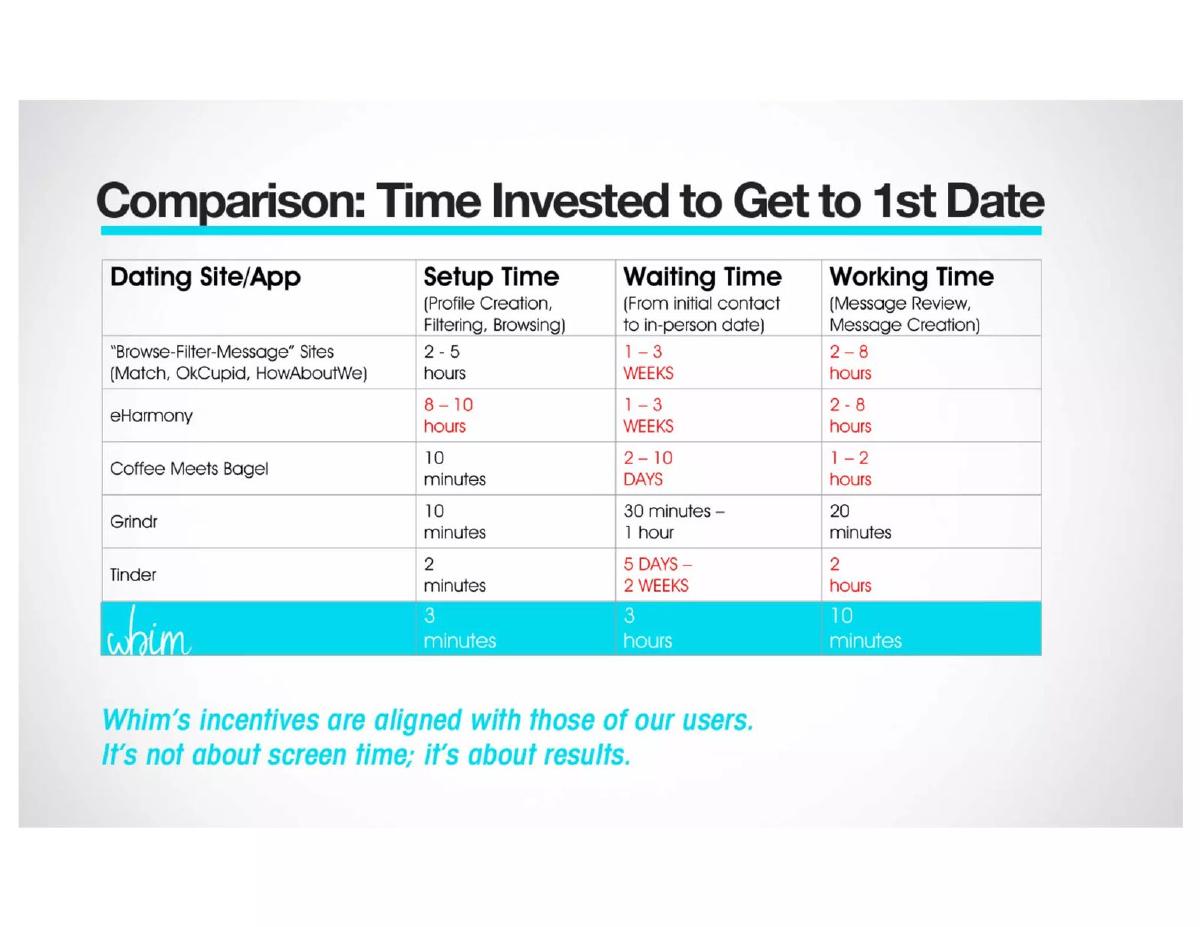
- Whim claims a significant efficiency advantage, stating users can get to a first date in 3 hours compared to weeks on Match or eHarmony (Slide 6).
- The revenue model is diversified across four streams: per-date payments, subscriptions, sponsored venues, and no-show fees (Slide 10).
- Market sizing is based on a $2 billion online dating industry as of 2013, with mobile revenue growing at 14.4% annually (Slide 11).
- The deck includes a dedicated 'Moment Just For Tinder' slide to highlight that platform's 100:3 match-to-meetup ratio (Slide 15).
- Whim projects reaching 3,000 dates per week and $30,000 in weekly revenue by the end of 2015 (Slide 17).
- The financial projections suggest a net income of $787,400 in 2016 on total revenues of $2,129,400 (Slide 18).
- The ask is for a $350k - $500k convertible note to bridge the company to a Series A round (Slide 19).
Whim Pitch Deck Analysis
Whim's pitch deck is a study in aggressive positioning. In a market dominated by 'swipe-right' culture, Whim attempts to pivot the entire category from entertainment to utility. The deck focuses heavily on the 'time-to-value' metric, arguing that the current leaders in the space are actually failing their users by keeping them trapped in digital loops rather than facilitating real-world meetings.
Slide 1: Title and Tagline
The deck opens with a minimalist cover slide featuring the Whim logo and the tagline: "Go on a date. TONIGHT." This immediately establishes the core promise of the product: immediacy and results.
Slide 2: The Team
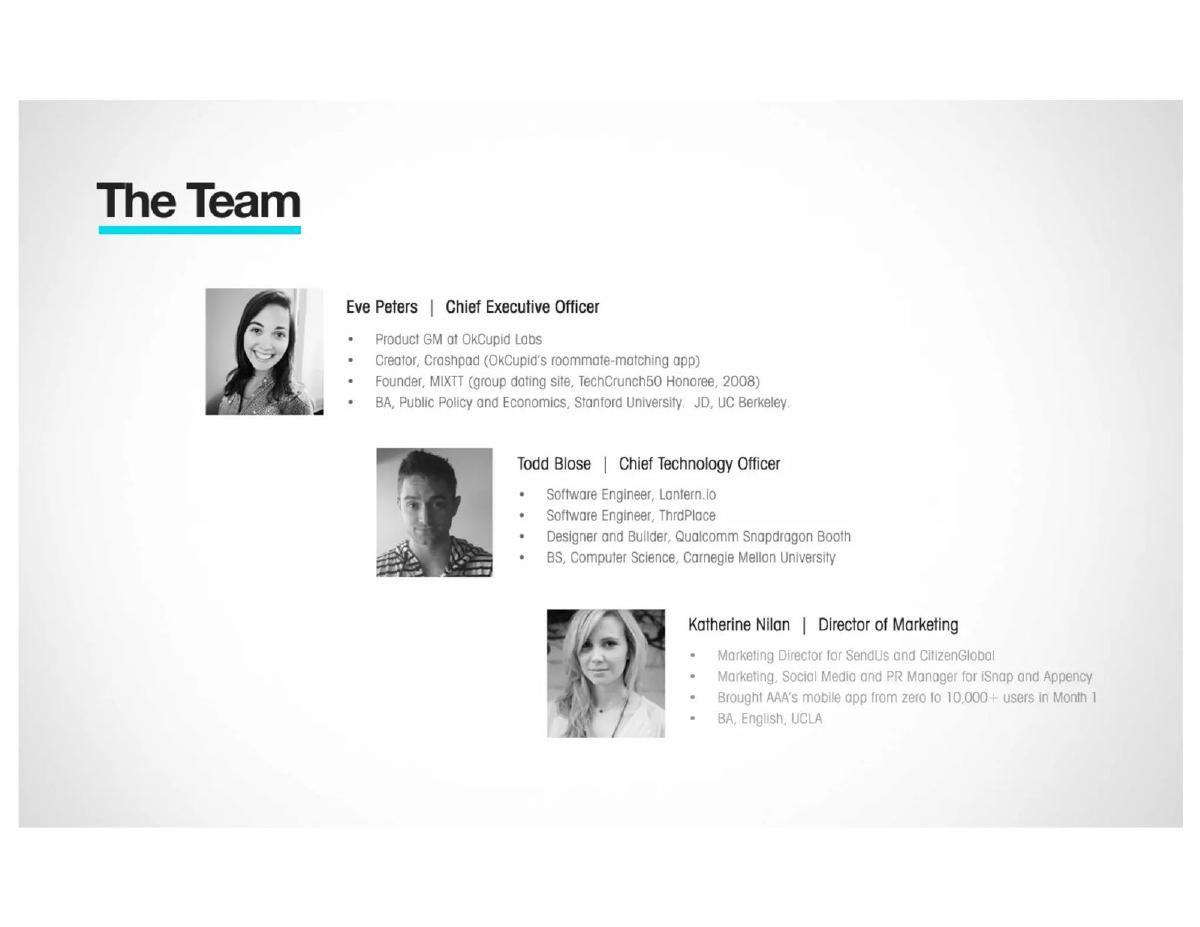
The team slide highlights a strong pedigree in the dating space. CEO Eve Peters is credited as a Product GM at OkCupid Labs and the creator of Crashpad. CTO Todd Blose and Marketing Director Katherine Nilan round out the leadership, with Nilan's experience bringing a mobile app from zero to 10,000 users in one month listed as a key credential.
Slide 3: In a Nutshell
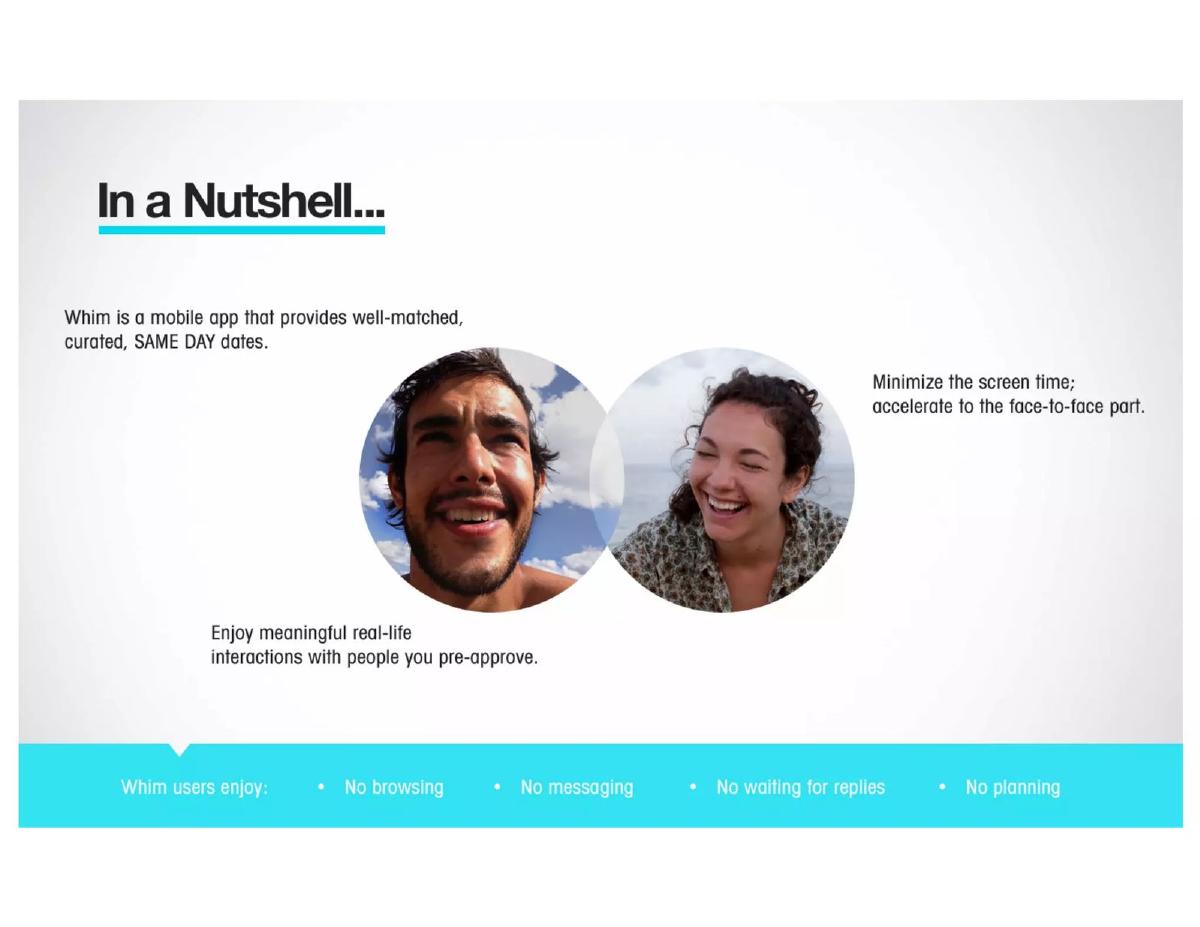
This slide defines the product as a mobile app providing "well-matched, curated, SAME DAY dates." It emphasizes four 'nos': No browsing, no messaging, no waiting for replies, and no planning. This is the central thesis of the deck: that the 'work' of dating is a bug, not a feature.
Slide 4: Evolution of Online Dating
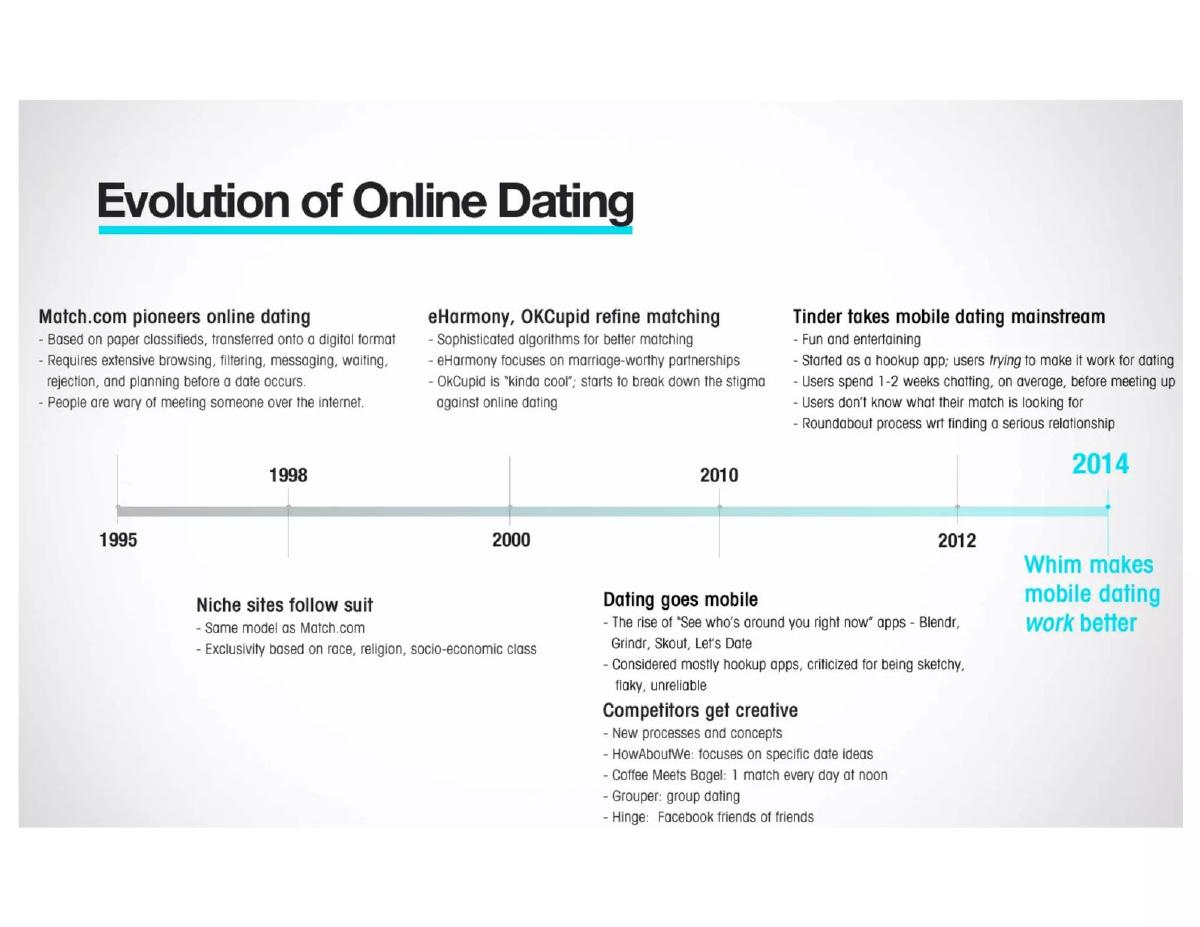
Whim uses a timeline from 1995 to 2014 to show the progression of the industry. It categorizes Match.com as the pioneer, eHarmony as the algorithm refiner, and Tinder as the mainstream mobile catalyst. Whim positions itself at the end of this timeline (2014) as the player that "makes mobile dating work better."
Slide 5: The Problem
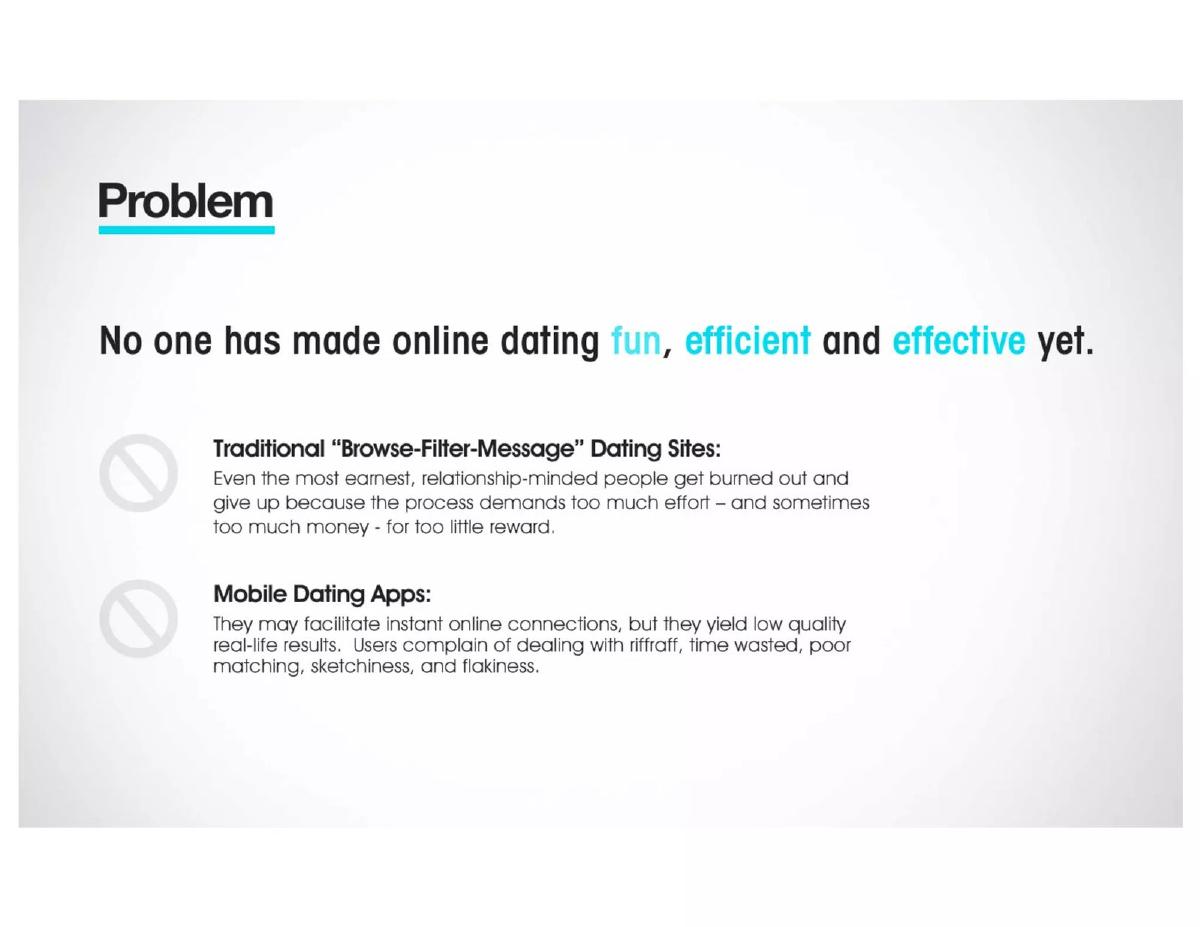
The problem is stated bluntly: "No one has made online dating fun, efficient and effective yet." It critiques traditional sites for 'burnout' and mobile apps for 'low quality real-life results,' specifically citing 'riffraff, time wasted, poor matching, sketchiness, and flakiness.'
Slide 6: Time Investment Comparison
This is arguably the most important slide in the deck. It provides a table comparing 'Setup Time,' 'Waiting Time,' and 'Working Time' across competitors. Whim claims a 3-minute setup and a 3-hour wait for a date, whereas it lists Tinder as having a 5-day to 2-week wait and Match/eHarmony as having a 1-3 week wait. This quantitative approach to a qualitative experience is a strong way to frame the competitive advantage.
Slide 7: Our Solution
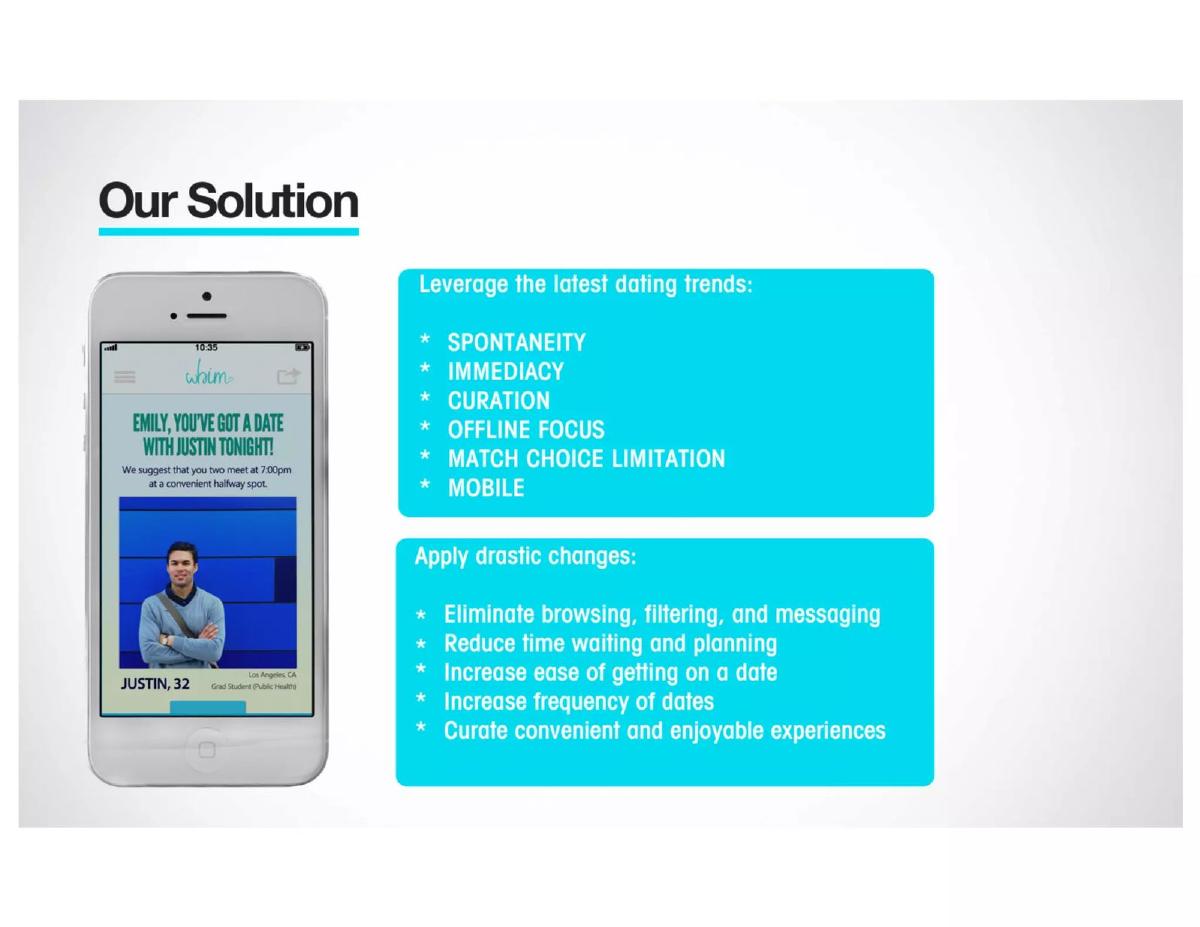
The solution slide lists trends Whim leverages, such as spontaneity and match choice limitation. It promises to 'eliminate browsing, filtering, and messaging' and 'increase frequency of dates.'
Slide 8: Product Walkthrough
The product flow is shown in three steps: 1. Check in by 4 PM. 2. Review three potential matches ('Yay or nay'). 3. Get paired up and go out. The UI shown is clean and focuses on a single call to action per screen.
Slide 9: Partnerships
Whim integrates the venue into the product experience. The app suggests a specific place to meet, and businesses offer perks like "free drinks to Whim customers." This slide introduces the offline component of the business model.
Slide 10: Revenue Model
Per-Date Payments: $5/date from each user ($10 total). · Monthly Subscriptions: $20/month. · Sponsored Venues: Restaurants, bars, and concerts. · Fees: A $10 fee for 'No Shows.'
This model is distinct because it monetizes the successful outcome (the date) rather than the usage of the app.
Slide 11: Opportunity
The market slide cites that online dating is a $2 billion industry as of 2013. It notes that mobile dating revenue is growing at 14.4% per year and is on track to double to $415M by 2017.
Slide 12: Competition
This slide uses icons to show competitive advantages: Real Life Meetups, Quality Control, Reduced Screen Time, Fast Results, and Curated Experiences. It places logos of competitors like Tinder, Blendr, and Match.com in a faded blue box at the bottom, suggesting they lack these features.
Slides 13-14: Differentiation
These two slides provide a detailed breakdown of how Whim differs from both 'Browse-Filter-Message' sites and 'New Evolution/Mobile' apps. It specifically calls out Coffee Meets Bagel (CMB) for the hassle of coordination and Grindr for being 'largely used for hookups, not dates.' It positions Whim as the 'professional' and 'well-educated' choice for women.
Slide 15: A Moment Just For Tinder
Whim dedicates a full slide to attacking Tinder's efficiency. It claims a 100:3 ratio of matches to actual meetups and a < 1,000:1 ratio of matches to relationships formed. The takeaway: "A Whim user could go out on 4-5 dates... in the time it takes to build up to a single date via Tinder."
Slide 16: Marketing / User Acquisition
The acquisition strategy includes browser-based beta, in-app sharing incentives, offline pop-up events, and targeted Facebook ads. It also mentions 'paid local ambassadors' and 'women's groups' as key channels.
Slide 17: Where We're Headed
Whim sets a goal for the end of 2015: 15 major cities, 200 dates per week per city (3,000 total), and $1,560,000 in annual revenue. This slide provides the scale the founders believe is achievable in the short term.
Slide 18: Projected Income Statements
The financial projections show a jump from $672,000 in revenue in 2015 to $2,129,400 in 2016. The largest expense is 'HQ Salaries' ($320k in 2015, $480k in 2016). The company projects a net loss of $0 (or a tiny $4k profit) in 2015, turning into a significant profit in 2016.
Slide 19: The Offer
The deck concludes with the ask: Raising $350k - $500k via a Convertible Note to Series A. It provides a contact email for Eve Peters.
What Works in This Deck
The strongest element of the Whim deck is its clarity of purpose. By Slide 3, the investor knows exactly what the product does and how it differs from the status quo. The use of a 'Time Investment' table (Slide 6) is a brilliant way to turn a subjective user experience into a objective, comparable metric. Furthermore, the revenue model is refreshingly direct. In an era where many social apps were struggling to monetize, Whim's pay-per-date and no-show fee model showed a clear path to unit profitability.
What is Missing
The most glaring omission is historical traction. While Slide 16 mentions a 'browser-based beta,' there are no figures regarding how many users were in that beta, what the actual conversion rate to dates was, or what the retention looked like. The deck relies entirely on projections (Slides 17 and 18) rather than realized data. Additionally, while the deck mentions 'Sponsored Venues,' it does not list any specific partners or signed LOIs, which would have validated the B2B side of their revenue model.
Founder Takeaways
Founders should study Slide 6 and Slide 15 for competitive positioning. Instead of a standard 'check-box' grid, Whim uses specific ratios and time-based metrics to make their competitors look inefficient. Another takeaway is the alignment of incentives. By charging for the date rather than the app access, Whim tells investors that their interests are perfectly aligned with the user's desire to get offline. Finally, the inclusion of a 'No Show' fee (Slide 10) is a bold move that signals to investors that the company is serious about quality control and user reliability, which are major pain points in the dating industry.
Frequently asked questions
- What is Whim's core value proposition?
- Whim's value proposition is 'Same Day Dates' with zero messaging. As stated on Slide 3, the app aims to minimize screen time and accelerate face-to-face interaction. It achieves this by having users 'check in' by 4 PM, providing three curated matches, and then automatically scheduling the date at a partner venue if both parties agree.
- How does Whim plan to make money?
- According to Slide 10, Whim utilizes a multi-pronged revenue strategy. This includes a 'Per-Date' payment of $10 ($5 from each participant), a $20/month subscription option, revenue from 'Sponsored Venues' like bars and restaurants, and a $10 'No Show' fee to ensure user accountability and reliability.
- Who are the founders and what is their background?
- The team is led by CEO Eve Peters, who was previously a Product GM at OkCupid Labs and founder of the group dating site MIXTT. CTO Todd Blose has engineering experience at Lantern.io and ThirdPlace, while Director of Marketing Katherine Nilan previously managed marketing for AAA's mobile app (Slide 2).
- How does Whim differentiate itself from Tinder?
- Slide 15 explicitly compares the two, claiming Tinder has a match-to-meetup ratio of 100:3. Whim differentiates by removing the 'useless messaging' phase. It asserts that a user could go on 4-5 dates via Whim in the time it takes to secure a single date on Tinder.
- What are the company's financial goals for 2015-2016?
- Slide 18 outlines a projected revenue of $672,000 for 2015, barely breaking even with a $4,000 net income. By 2016, they project revenue to triple to over $2.1 million, with a net income of $787,400, driven largely by 'A La Carte Dates' ($1.8M).