Bramble Energy’s 12-slide deck, used during their 2022-2024 fundraising efforts, centers on a core technological innovation: the PCBFC™. By repurposing the global printed circuit board (PCB) supply chain, Bramble claims to offer a fuel cell solution that is scalable, adaptable, and significantly lower in cost than traditional graphite or metal plate technologies. The deck highlights a zero-manufacturing-CAPEX model and a roadmap spanning portable power to aviation. While the deck is visually clean and emphasizes hardware versatility—demonstrated by a form-factor comparison to a Tesla Model S…
Key takeaways
- The company utilizes existing global PCB supply-chain infrastructure to manufacture fuel cells, avoiding the need for bespoke production lines (Slide 3).
- Bramble claims a 'c.4x fewer components' advantage in their Bill of Materials compared to traditional fuel cells (Slide 11).
- The technology allows for a zero-manufacturing-CAPEX spend model by leveraging third-party PCB factories (Slide 11).
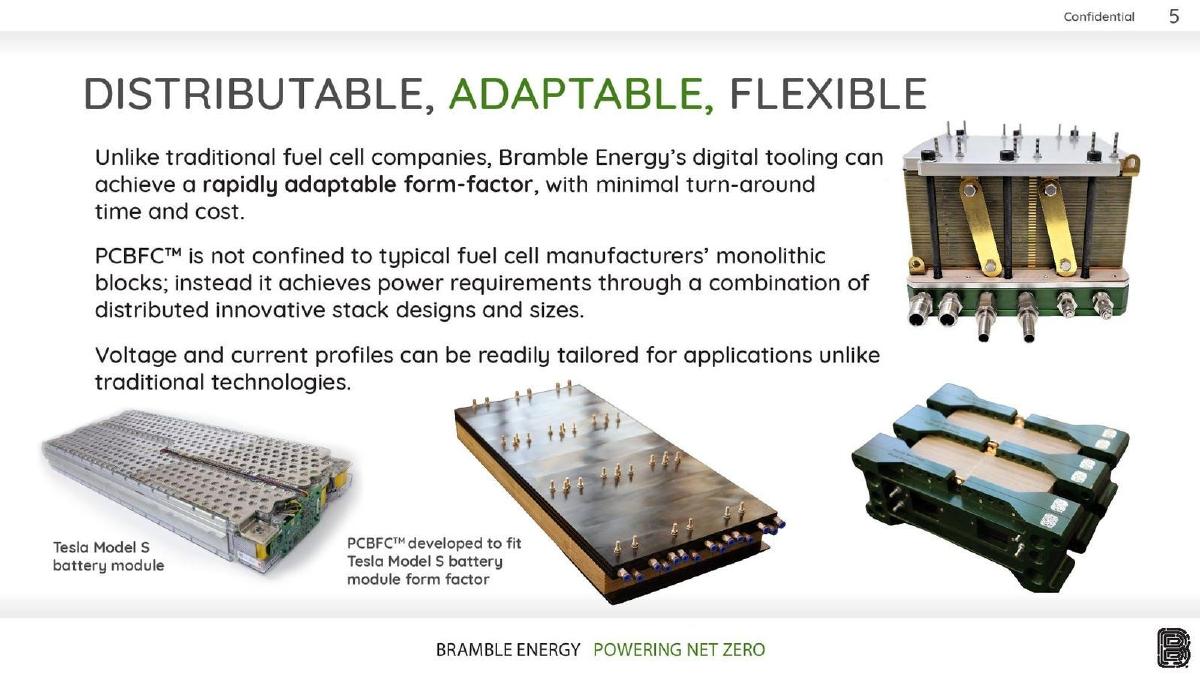
- Digital tooling enables rapidly adaptable form factors, including a design specifically tailored to fit a Tesla Model S battery module (Slide 5).
- The product roadmap targets four distinct phases from H1 2022 to H2 2023, moving from light commercial vehicles to 100 kW systems (Slide 9).
- Target markets are bifurcated into portable power (CCTV, lighting) and mobility (marine, aviation, automotive) (Slides 7 and 9).
- The deck lacks a dedicated team slide, financial history, or specific 'Ask' regarding the use of funds.
- Competitive positioning focuses on the fragility and high cost of graphite and metal plate alternatives (Slide 11).
Bramble Energy: A Masterclass in Supply Chain Arbitrage
Bramble Energy’s pitch deck is a focused technical argument for why the hydrogen economy has failed to scale and how they intend to fix it. Reported by Business Insider as part of a $47M Series B raise in 2024, the deck (dated 2022) presents a hardware solution that is less about the chemistry of hydrogen and more about the efficiency of manufacturing. By utilizing the Printed Circuit Board (PCB) industry, Bramble positions itself as a 'fabless' hardware company in a sector usually defined by massive capital expenditures.
Slide 1-2: Branding and Vision
The opening slides are minimalist, featuring the company logo and the tagline 'Powering Net Zero.' The date 'INTRO: 2022' suggests this was an early-stage version of the deck used to build momentum for the eventual Series B. The visual identity is clean, utilizing a dark aesthetic that aligns with modern climate-tech branding.
Slide 3: The Core Value Proposition
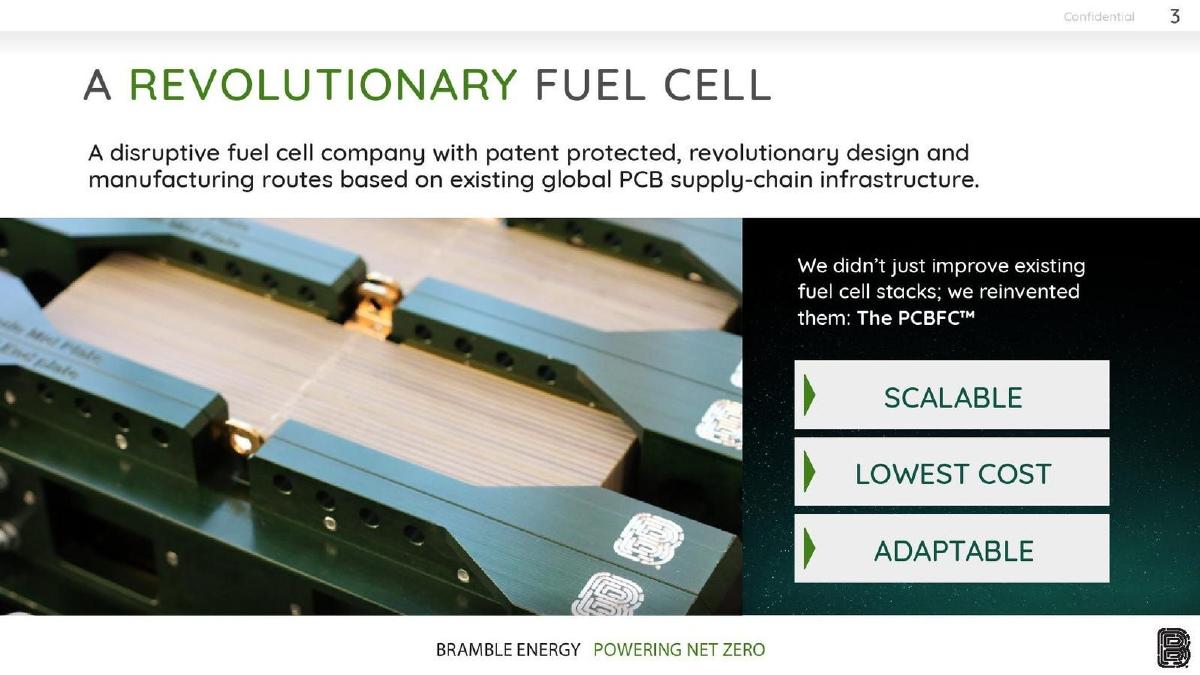
Slide 3 introduces the 'Revolutionary Fuel Cell.' This is the most critical slide in the deck. It defines Bramble as a disruptive company with a design based on 'existing global PCB supply-chain infrastructure.' The keyword here is 'existing.' By not building their own factories, Bramble signals to investors that they can scale at the speed of software, despite being a hardware company. They introduce the trademarked term 'PCBFC™' and highlight three pillars: Scalable, Lowest Cost, and Adaptable.
Slide 4: Visualizing the Hardware
Slide 4 (text only in summary) continues the branding, but the visual context provided by the surrounding slides suggests a focus on the physical stack. The deck uses high-quality photography of the fuel cell stacks to ground the abstract concept of 'PCB manufacturing' in a tangible product.
Slide 5: Adaptability and the Tesla Benchmark
Slide 5, titled 'Distributable, Adaptable, Flexible,' addresses the 'monolithic block' problem of traditional fuel cells. Traditional stacks are often heavy, rigid, and difficult to integrate into varied vehicle designs. Bramble showcases their 'digital tooling' which allows for rapid form-factor changes. The most effective visual on this slide is the side-by-side comparison of a Tesla Model S battery module and a PCBFC™ stack designed to fit that exact footprint. This demonstrates immediate market readiness for retrofitting or direct competition with EV battery layouts.
Slide 6: Technology Deep Dive
Slide 6 (text only) reinforces the 'Powering Net Zero' mission. While the specific imagery is not detailed in the text, the narrative flow suggests a transition from the 'how' (PCB technology) to the 'where' (market applications).
Slide 7: Portable Power Applications
Slide 7 moves into Go-To-Market (GTM) strategy. It highlights four immediate use cases for portable power: Mobile Equipment Recharge, Environmental Sensing, CCTV/Surveillance, and Off-Grid Lighting. By focusing on these 'smaller' applications, Bramble demonstrates a path to early revenue that doesn't require the massive infrastructure of the automotive industry. The mention of 'silent power' for surveillance and 'zero emission' for lighting provides specific value propositions for B2B customers.
Slide 8: Scaling the Vision
Slide 8 (text only) serves as a bridge to the mobility sector. The deck structure implies that while portable power is the entry point, mobility is the ultimate scale play.
Slide 9: The Mobility Roadmap
Slide 9 presents a 'Mobility Products - Timeline' covering H1 2022 through H2 2023. It lists several key milestones:
H1 '22: Automotive quality fuel cell short stack available and Autonomous Marine demonstrator. · H2 '22: Light commercial vehicle system (van) launch and >30 kW demonstrator stack. · H1 '23: Marine demonstrator (electrified range extender). · H2 '23: 100 kW fuel cell system availability and Aviation fuel cell powertrain demonstration.
This timeline is aggressive and shows a clear progression from small stacks to high-power aviation systems.
Slide 10: Strategic Positioning
Slide 10 (text only) prepares the investor for the competitive analysis. It sets the stage for why the status quo in fuel cell manufacturing is insufficient for the 'Net Zero' goals mentioned in the intro.
Slide 11: The Competitive Advantage Matrix
Slide 11 is a classic 'Checkmark vs. X' comparison table. It compares the PCBFC™ against Graphite Plate and Metal Plate technologies across five metrics:
Cost Efficiency: Bramble claims a 'clear pathway to lowest cost stack' while others are hampered by high cost bases or gold coatings. · Simplified BoM: Bramble claims 'c.4x fewer components.' · Adaptable Solution: Bramble is 'fully customisable' vs. 'monolithic blocks.' · Low CAPEX: The standout claim is '£0 manufacturing CAPEX spend' for Bramble. · Robustness: Bramble claims 'robust & durable' vs. 'fragile construction' or 'poor lifetime metrics' for competitors.
This slide is designed to de-risk the investment by showing that the primary barriers to fuel cell adoption (cost and manufacturing complexity) are solved by their architecture.
Slide 12: Conclusion
The final slide (text only) concludes the presentation. In a standard pitch, this would include contact information and a final call to action, though the provided text remains consistent with the branding of the previous slides.
What Bramble Energy Does Well
The deck’s greatest strength is its clarity of 'The Wedge.' Many hardware startups fail because they try to reinvent the entire manufacturing process. Bramble’s decision to piggyback on the multi-billion dollar PCB industry is a brilliant strategic move that they communicate effectively. By showing a fuel cell that looks like a circuit board, they make a complex chemical engineering problem look like a solved manufacturing problem.
The use of the Tesla Model S battery module as a reference point (Slide 5) is another high-water mark. It provides an immediate sense of scale and application that words alone cannot convey. It tells the investor, 'We can fit into the world’s most popular EV platform today.'
What is Missing from the Deck
Despite the successful $47M raise, this specific 12-slide version of the deck is missing several components that are usually considered mandatory for a Series B:
Team Slide: There is no mention of the founders, their academic backgrounds (Bramble originated from UCL and Imperial College London), or their previous exits. In deep-tech, the 'who' is often as important as the 'what.' · Financials and Unit Economics: While Slide 11 mentions 'lowest cost,' it does not provide the actual $/kW figures. Investors at the Series B stage typically require a detailed breakdown of margins and projected revenue. · The Ask: The deck does not explicitly state how much money is being raised or how the funds will be allocated (e.g., R&D vs. Sales vs. Operations). · Regulatory and IP Detail: For a company claiming a 'patent protected' design, a slide detailing the IP moat (number of patents filed/granted) would have strengthened the case.
Founder Takeaways: Copy the 'Fabless' Narrative
Founders in the hardware space should study Slide 11. The '£0 manufacturing CAPEX' claim is a powerful way to attract investors who are usually allergic to the high costs of building factories. If you can prove that your product can be built using existing infrastructure, you significantly lower the perceived risk of your venture.
Additionally, the 'Timeline' on Slide 9 is a good example of how to balance multiple industries. By showing a progression from portable power to vans to planes, Bramble shows a massive Total Addressable Market (TAM) without appearing unfocused. They have a clear 'crawl, walk, run' strategy that builds technical credibility at each step.
Frequently asked questions
- How does Bramble Energy achieve lower costs than competitors?
- According to Slide 11, Bramble achieves lower costs through a simplified Bill of Materials with approximately four times fewer components than traditional fuel cells. Crucially, they claim a '£0 manufacturing CAPEX spend' because their design, the PCBFC™, is manufactured using existing, global printed circuit board (PCB) infrastructure rather than requiring specialized, expensive fuel cell factories.
- What specific industries is Bramble Energy targeting?
- The deck identifies two primary sectors. Slide 7 focuses on 'Portable Power Applications' such as mobile equipment recharging, environmental sensing, CCTV/surveillance, and off-grid lighting. Slide 9 outlines 'Mobility Products,' including light commercial vehicles (vans), autonomous marine vessels, and aviation fuel cell powertrains.
- What is the significance of the Tesla Model S mention in the deck?
- On Slide 5, Bramble uses the Tesla Model S battery module as a benchmark for form-factor adaptability. They show a PCBFC™ stack developed specifically to match that form factor, illustrating that their digital tooling allows them to fit hydrogen power into existing battery compartments with minimal turnaround time and cost.
- What are the main technical advantages of the PCBFC™ over traditional plates?
- Slide 11 compares the PCBFC™ to graphite and metal plates. It notes that graphite plates have a high cost base and fragile construction, while metal plates require expensive gold coatings and have poor lifetime metrics. In contrast, Bramble claims their solution is robust, durable, and fully customizable in terms of voltage and current profiles.
- What key fundraising information is missing from this deck?
- The 12-slide deck is primarily a technical and product overview. It omits a team slide (founder backgrounds), a detailed breakdown of the 'Ask' (how much they are raising and why), financial projections (revenue targets), and specific details on their current intellectual property portfolio beyond the mention of being 'patent protected' on Slide 3.