Licensing and Royalty Business Model Pitch Deck Slides
How to present a licensing or royalty business model on a pitch deck: what you license, what the licensee pays, what the royalty is charged on.
How to Present a Licensing Business Model on a Pitch Deck
Nine slides from real pitch decks show how founders explain earning money by letting other companies use their technology, designs or content: upfront licence fees, royalties per unit, fees tied to a customer's output, and how licence income compares with selling products directly.
TL;DR
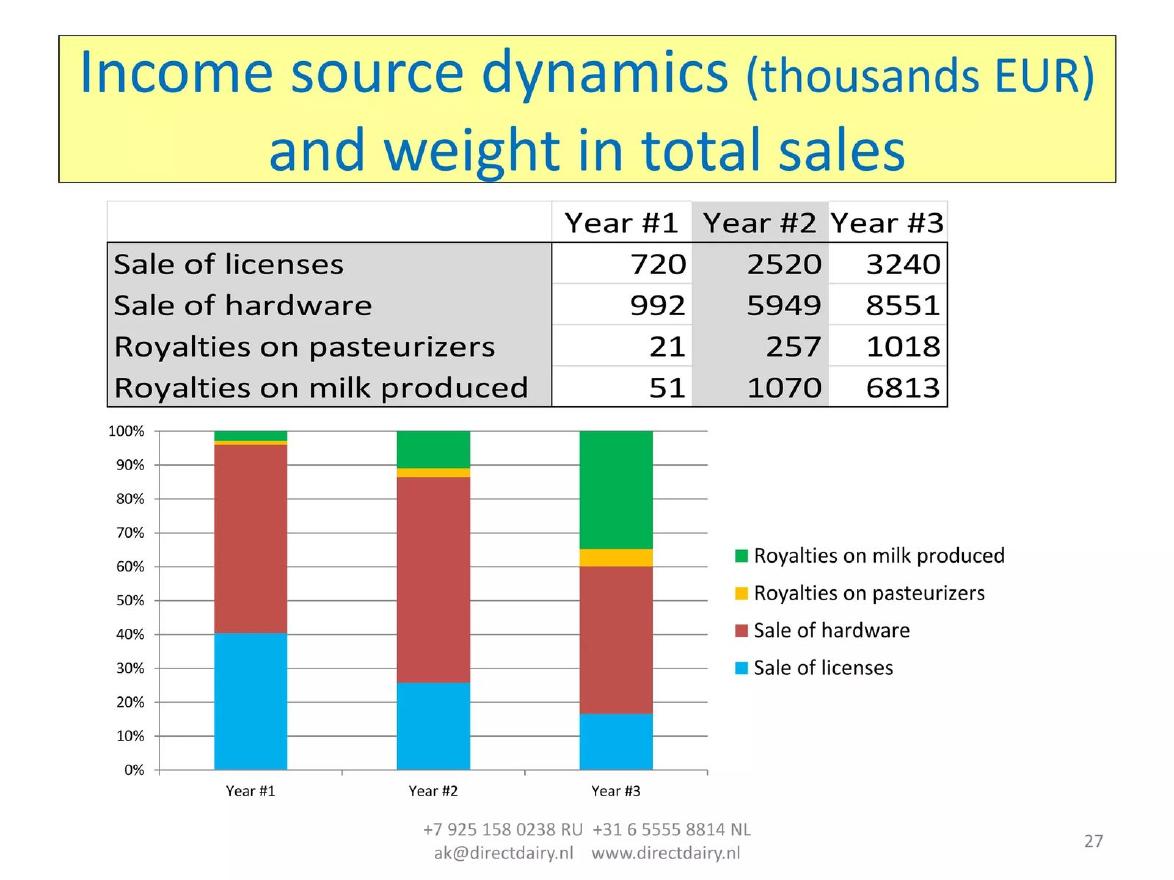
A licensing business model slide should say what is licensed, who pays, what the licensee pays upfront, and what any royalty is charged on. DDH, a dairy technology company, gives the most complete example in this set: a three-year table splitting income into licence sales, hardware sales, royalties on pasteurisers and royalties on milk produced, rising from €1.78 million in year one to €19.62 million in year three by our sums, with royalties growing from 4% of income to 40%. Deep Render sells two kinds of licence for its video compression technology, a fixed-price enterprise licence to encode video and a per-account annual royalty to decode it, though its prices are blacked out. EnergyX charges a licence fee tied to the tonnes of lithium a customer produces each year. Besstech, A-Champs and Bramble Energy describe licensing next to other income without figures. Beatdapp gives royalty rates of 1% and 3% but not what they are charged on. DSTLRY is the contrast: it pays royalties to creators instead of collecting them.
Licensing business model slides from real pitch decks
Each example shows the exact stored slide above its analysis and links to the full teardown. Stage and year are given only where the deck states them. Figures are the company's own claims.
DDH business model slide — slide 27
Dairy technology: milking robots and on-farm pasteurisation.
DDH deck, slide 27. Exact stored slide matched to this analysis.
Our analysis: The most complete example: four income sources over three years, with royalties growing from about 4% to about 40% of income (our calculation).
Evidence and limitation: A table with no total; we had to add the columns ourselves (1,784 / 9,796 / 19,622).
What a founder can adapt: Add the number of licensees and the royalty rate behind each line.
Supporting analysis
What the deck claims: Income by year (thousand EUR): sale of licences 720 / 2,520 / 3,240; sale of hardware 992 / 5,949 / 8,551; royalties on pasteurisers 21 / 257 / 1,018; royalties on milk produced 51 / 1,070 / 6,813. Stacked chart of each source's share.
Presentation choice: The most complete example: four income sources over three years, with royalties growing from about 4% to about 40% of income (our calculation).
When it does not fit: A table with no total; we had to add the columns ourselves (1,784 / 9,796 / 19,622).
Deep Render deck, slide 31. Exact stored slide matched to this analysis.
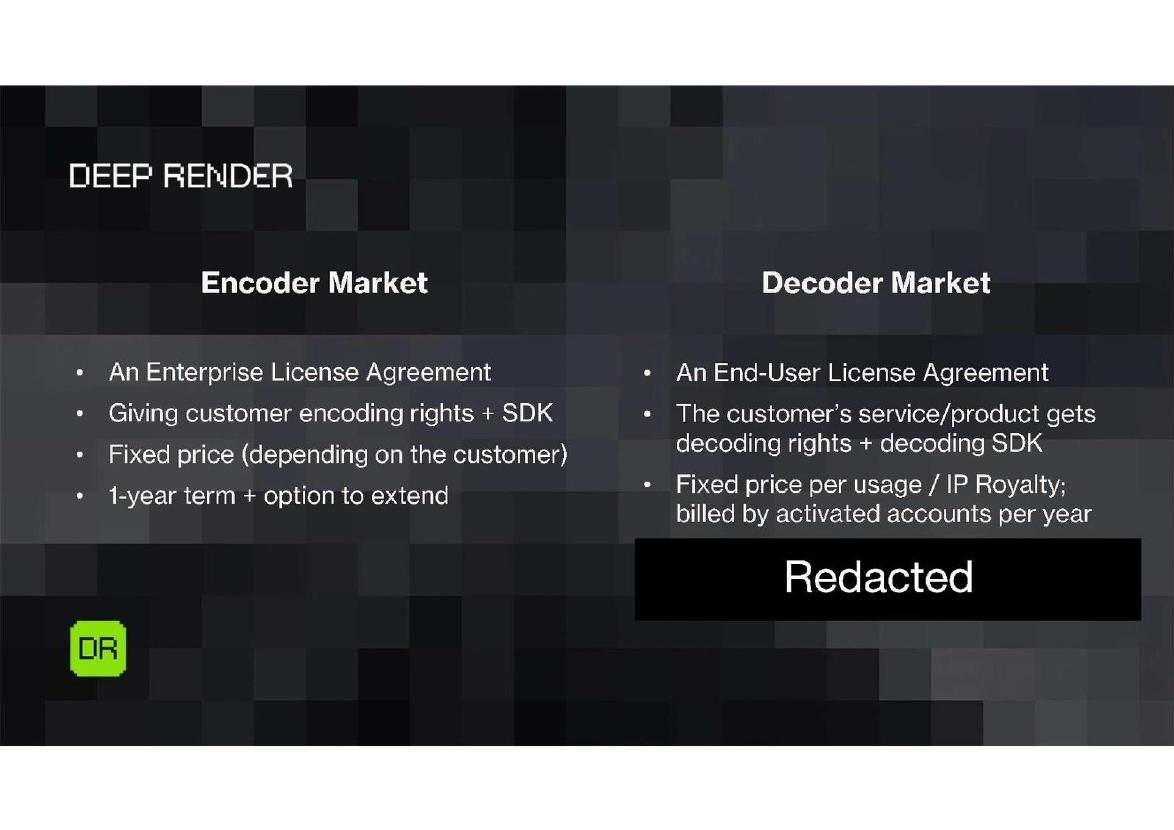
Our analysis: Shows two licences for two sides of the same technology, each with its own pricing basis.
Evidence and limitation: Redacting the one number that makes the model testable.
What a founder can adapt: Give a price range, or the value of a typical contract, even if exact prices are confidential.
Supporting analysis
What the deck claims: Encoder market: enterprise licence, encoding rights plus SDK, fixed price depending on customer, one-year term with option to extend. Decoder market: end-user licence, decoding rights plus SDK, fixed price per usage / IP royalty billed by activated accounts per year. Price redacted.
Presentation choice: Shows two licences for two sides of the same technology, each with its own pricing basis.
When it does not fit: Redacting the one number that makes the model testable.
EnergyX deck, slide 22. Exact stored slide matched to this analysis.
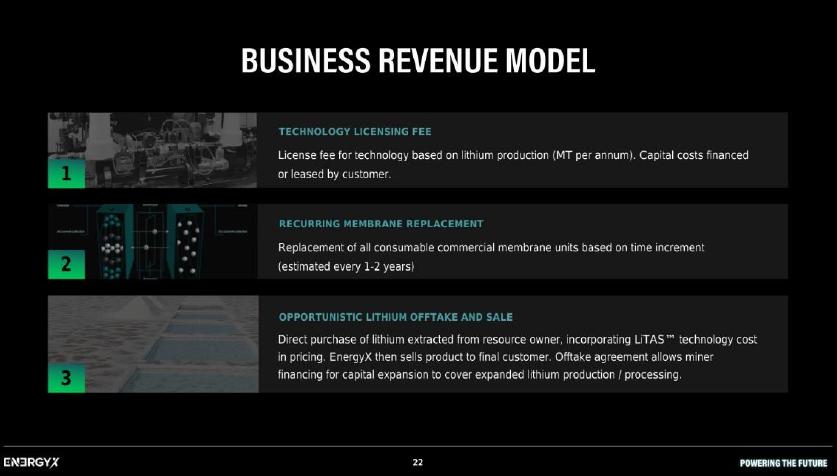
Our analysis: Ties the licence fee to the customer's output, so income grows with production.
Evidence and limitation: A clear base with no rate.
What a founder can adapt: Add the fee per tonne and a typical customer's annual tonnage.
Supporting analysis
What the deck claims: 1. Technology licensing fee based on lithium production (MT per annum); capital costs financed or leased by customer. 2. Recurring membrane replacement every 1–2 years. 3. Opportunistic lithium offtake and sale.
Presentation choice: Ties the licence fee to the customer's output, so income grows with production.
Besstech deck, slide 11. Exact stored slide matched to this analysis.
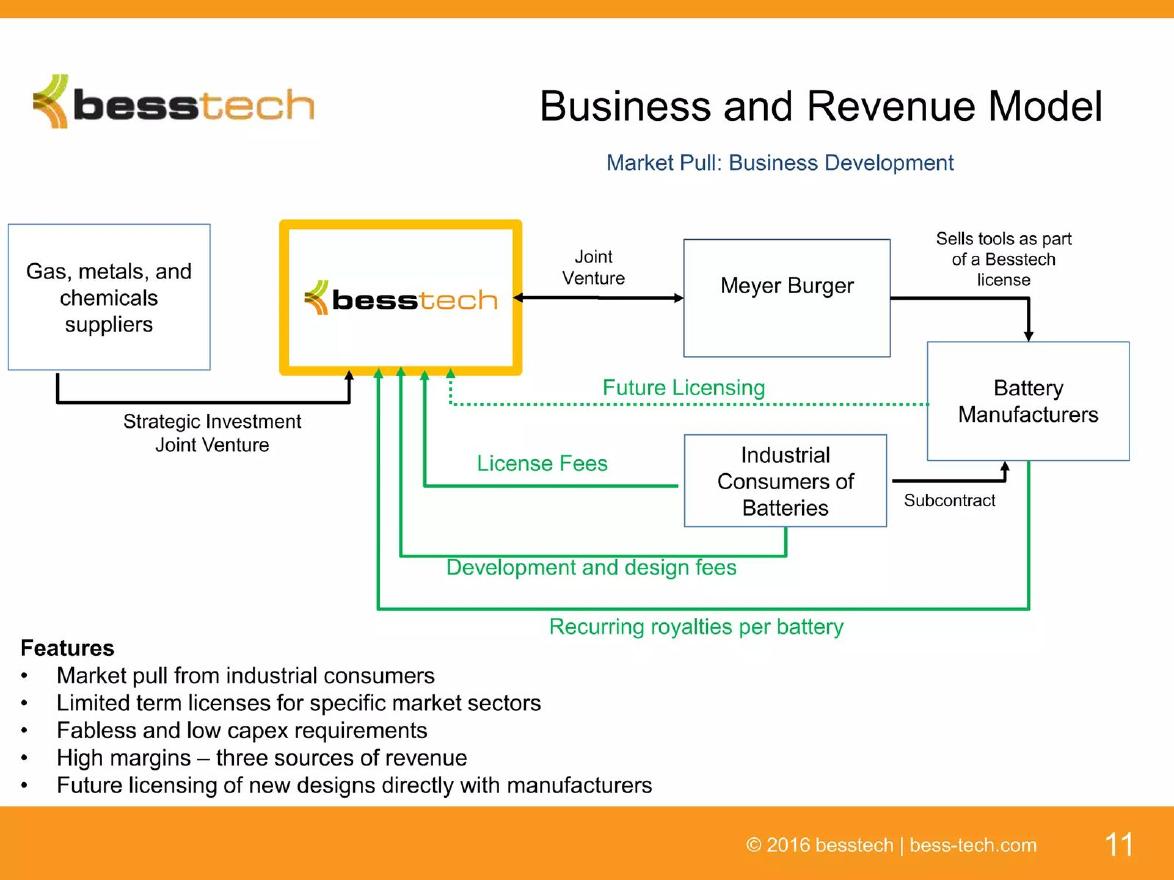
Our analysis: Makes the flow of licence money clear, but gives no amounts.
Evidence and limitation: A diagram that names payments without sizing them.
What a founder can adapt: Put a figure on each arrow: fee, royalty per battery, expected volume.
Supporting analysis
What the deck claims: Diagram: joint venture with Meyer Burger sells tools as part of a Besstech licence; industrial consumers pay licence fees and development and design fees; battery manufacturers pay recurring royalties per battery. Features: limited-term licences by sector, fabless, high margins, three revenue sources.
Presentation choice: Makes the flow of licence money clear, but gives no amounts.
When it does not fit: A diagram that names payments without sizing them.
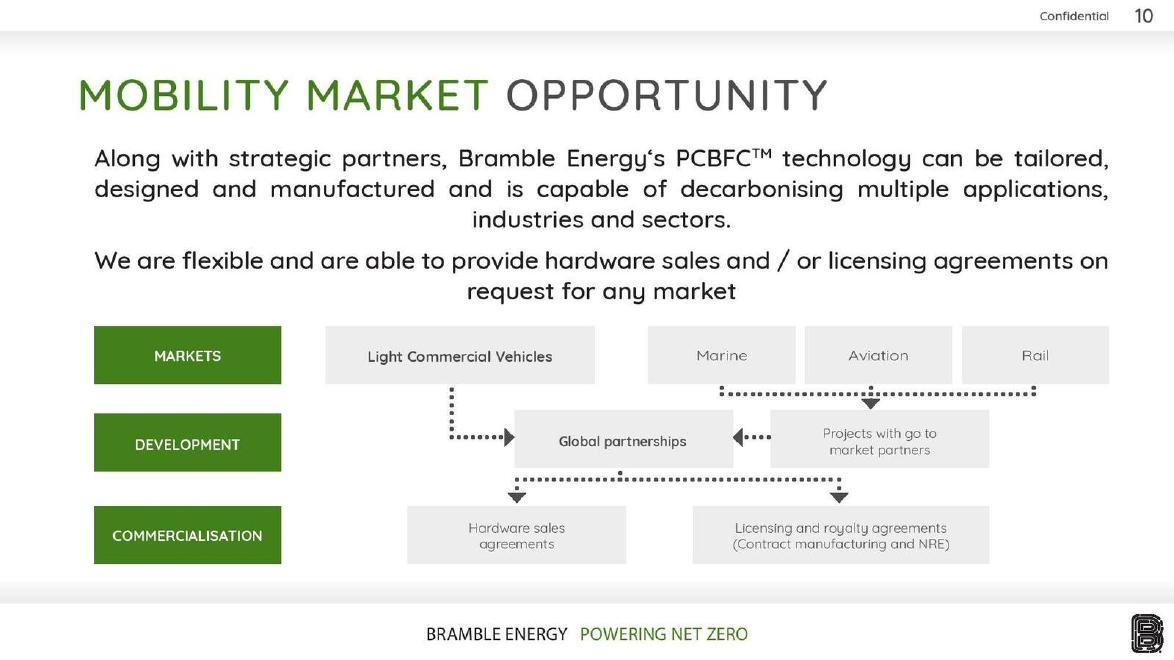
Bramble Energy deck, slide 10. Exact stored slide matched to this analysis.
Our analysis: Shows licensing as one of two routes to market, but not which earns more.
Evidence and limitation: Offering every model with no priority.
What a founder can adapt: Say which route you expect to lead and the margin on each.
Supporting analysis
What the deck claims: "We are flexible and are able to provide hardware sales and / or licensing agreements on request for any market." Commercialisation split into hardware sales agreements and licensing and royalty agreements (contract manufacturing and NRE).
Presentation choice: Shows licensing as one of two routes to market, but not which earns more.
When it does not fit: Offering every model with no priority.
Most slides name licensing; few give the fee, the royalty base and the income over time.
Example
What is licensed
Upfront / fixed fee
Royalty base
Income over time
DDH
Dairy technology
Yes (licence sales)
Per pasteuriser, per milk produced
Yes (3 years)
Deep Render
Encoding / decoding SDK
Yes (redacted)
Per activated account per year
No
EnergyX
Lithium extraction
No
Tonnes of lithium per year
No
Besstech
Battery technology
Named
Per battery
No
A-Champs
Not stated
Named
No
No
Bramble Energy
Fuel cell design
No
Named
No
Makoo
Design software
Named
No
No
Beatdapp
Not stated
No
Rate only (1% / 3%)
No
DSTLRY
Pays creators
Pays fees
Pays royalties
No
Key Takeaways
Say exactly what you license: a patent, software, a design, a process or content.
Give the upfront fee and the royalty, and say what the royalty is charged on.
Show how licence income grows: per unit sold, per unit produced, per account or per year.
If you also sell products, show how much of your income comes from each source over time.
Name your licensees or the kind of company that will pay, and how long the licence runs.
Test your licensing slide before you send it
Answer these with numbers, even if they are targets.
What. What exactly does the licensee get the right to use?
Who. What kind of company pays, and how many do you expect?
Upfront. What is the upfront or annual fee?
Royalty. What is the royalty rate, and what is it charged on?
Term. How long does a licence run, and is it exclusive?
Copyable framework: [Licensees] license our [technology] for [upfront fee] plus [rate]% of [base]; typical licensee pays [amount] in year one and [amount] by year three
Illustrative example 1 — written by us
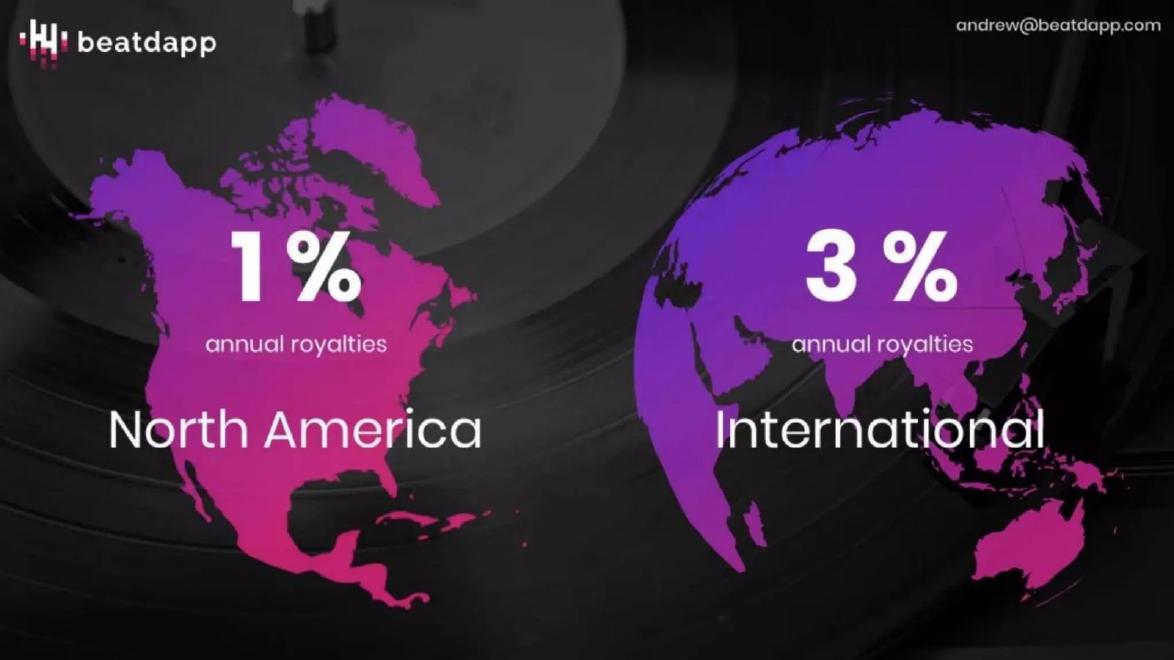
Before: 1% annual royalties North America. 3% annual royalties international.
After: [Rate]% of [base] protected per year; [n] clients paying an average [amount]; [share]% of revenue recurring
What improved: Our illustrative rewrite, not Beatdapp's text. Bracketed parts are placeholders, not company facts. It gives the rate a base an investor can test.
What this guide covers
Licensing means letting another company use something you own, usually a technology, a patent, a design or content, in return for payment. The payment can be a one-off upfront fee, a recurring annual fee, a royalty on every unit the licensee sells or produces, or a mix. The licensee does the manufacturing, selling or distribution; the licensor collects the fees.
Investors like licensing because it can produce high-margin income without the cost of building factories or sales teams. They worry about it for the same reason: the licensor depends on licensees to sell, and a royalty is only worth something if the licensee's sales are large. A good licensing slide answers three questions: what is the licensee paying for, how much do they pay, and how big will their sales be?
Our business model guides cover SaaS, hardware, marketplaces, franchises and white-label products, but none explains how to present licensing. The franchise guide covers royalties paid by franchisees; this guide covers technology, content and IP licensing more broadly. We searched our corpus for licence fees, licensing models, royalties and upfront and milestone payments, and found 200 matches across 116 decks. Many came from biotech and mining companies already listed on a stock market when they made their decks, which we exclude. Nine slides from nine private companies were readable and differ enough to teach something.
Say what you license and who pays
The first job of the slide is to name the thing being licensed and the kind of company paying for it. Licensing a patent to a manufacturer is a very different business from licensing a software toolkit to a streaming service.
Deep Render, a London company building AI-based video compression, splits its slide into two markets. In the encoder market it sells an enterprise licence agreement: the customer gets encoding rights and a software development kit (SDK), at a fixed price that depends on the customer, for a one-year term with an option to extend. In the decoder market it sells an end-user licence: the customer's service or product gets decoding rights and a decoding SDK, priced as "fixed price per usage / IP royalty" and billed by activated accounts per year. The slide shows that the two sides of the same technology are licensed in different ways, to different buyers, with different pricing. Its actual prices are blacked out in the deck itself.
Besstech, a battery technology company, shows who pays as a diagram. Besstech sits in the middle. A joint venture with Meyer Burger sells tools as part of a Besstech licence to battery manufacturers. Industrial consumers of batteries pay licence fees and development and design fees. Battery manufacturers pay recurring royalties for each battery. A note lists the features: market pull from industrial consumers, limited-term licences for specific market sectors, no factory and low capital needs, high margins and three sources of revenue. The diagram makes the flow of money clear even though it gives no amounts.
Give the fee and say what the royalty is charged on
A royalty rate means nothing without a base. Five percent of what? Every unit sold, every unit produced, net sales, gross revenue or profit? The slide should say.
EnergyX, which develops lithium extraction technology, ties its licence fee to the customer's output: "License fee for technology based on lithium production (MT per annum)", with capital costs financed or leased by the customer. That one line tells an investor exactly how licence income grows: the more tonnes of lithium a customer produces each year, the more EnergyX earns. The slide adds two other sources of income: replacement of consumable membrane units every one to two years, and buying lithium from the resource owner and selling it on to customers. It gives no rates, but the base for the fee is clear.
Beatdapp, which detects fraud in music streaming, shows the opposite problem. Its slide gives two big numbers, 1% annual royalties in North America and 3% annual royalties internationally, over a world map. It does not say what the royalties are charged on: a share of royalty payments it protects, of streaming revenue, or of something else. An investor cannot turn the rates into income without asking. We treat it as a weak example for that reason.
DDH gives two royalty bases in one table: royalties on pasteurisers (a charge per machine) and royalties on milk produced (a charge per unit of output). Separating them shows which part of the royalty income depends on equipment sold and which depends on how much the equipment is used.
Show how licence income grows over time
Licensing businesses often start with upfront fees and grow into royalties as licensees' sales build. The slide should show that shift.
DDH's income table covers three years, in thousands of euros. Sale of licences: 720, 2,520 and 3,240. Sale of hardware: 992, 5,949 and 8,551. Royalties on pasteurisers: 21, 257 and 1,018. Royalties on milk produced: 51, 1,070 and 6,813. By our sums, total income is €1.78 million in year one, €9.80 million in year two and €19.62 million in year three. A stacked bar chart shows each source's share. Licence sales fall from about 40% of income in year one to about 17% in year three, and the two royalty lines grow from about 4% to about 40%, by our calculation from the slide's figures.
That shift is the most important thing the slide shows. Licence sales are one-off; royalties recur as long as the equipment is in use. An investor reading DDH's table can see the business becoming more recurring over time. The slide would be stronger if it said how many licensees sit behind each year's figures and what royalty rate produces the milk-royalty line.
Licensing next to selling products
Many startups license as one option among several, especially hardware companies that can either sell their product or license the design to a manufacturer. The slide should say which comes first and why.
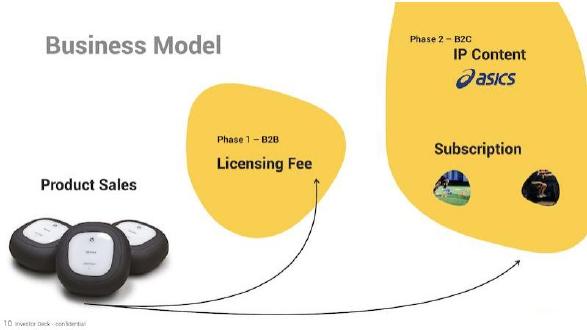
A-Champs, which makes connected training devices, shows three phases on one slide: product sales first, then a B2B licensing fee, then a B2C subscription built on licensed IP content, with the ASICS logo next to the content phase. It is a clear sequence, but there are no figures, no timing and no explanation of what is licensed in phase one.
Bramble Energy, a London fuel cell company, says it is "flexible and able to provide hardware sales and / or licensing agreements on request for any market". Its slide shows target markets (light commercial vehicles, marine, aviation, rail), a development stage with global partnerships, and a commercialisation stage split between hardware sales agreements and licensing and royalty agreements (contract manufacturing and non-recurring engineering). It shows the options but not which one Bramble expects to earn most from.
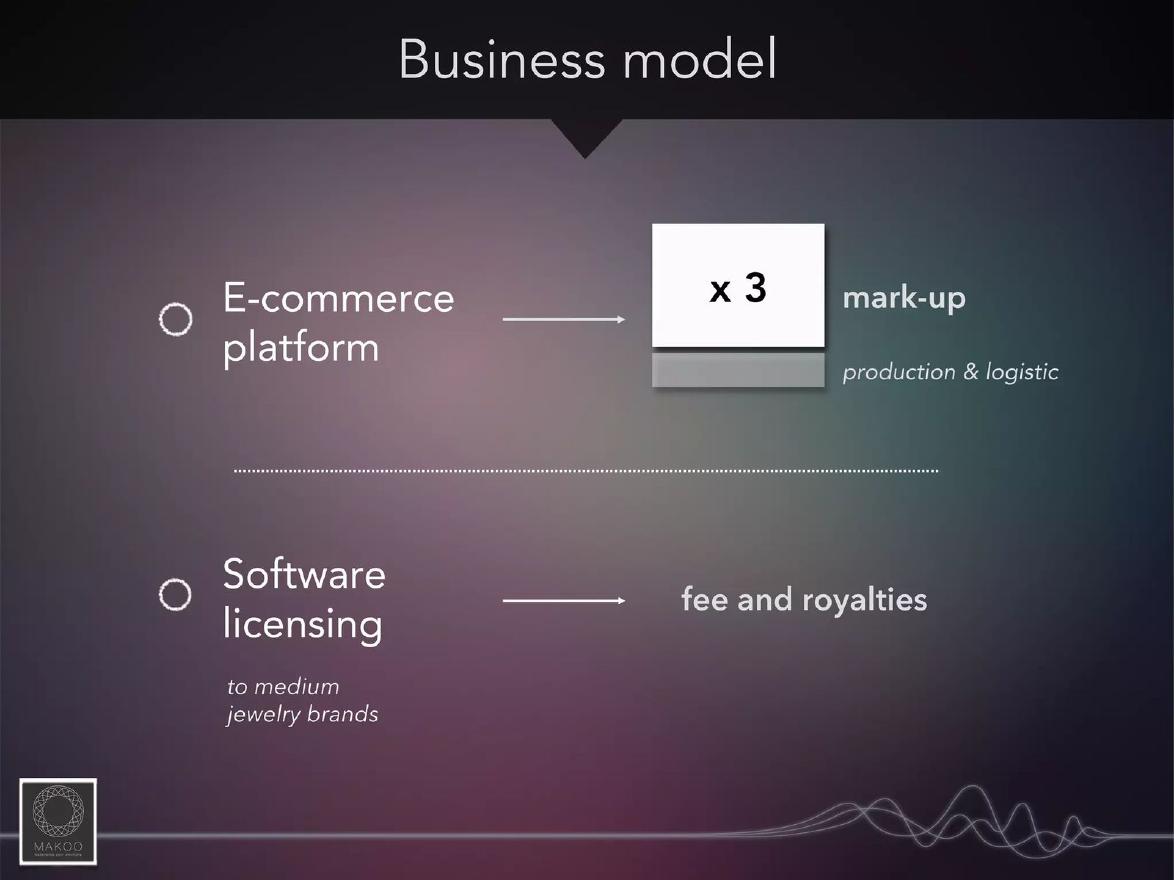
Makoo, a jewellery design platform, puts two models side by side: an e-commerce platform with a three-times mark-up on production and logistics, and software licensing to medium-sized jewellery brands for a "fee and royalties". The mark-up is specific; the licensing line gives no rate. It is a weak example of licensing next to direct sales.
The contrast: paying royalties instead of collecting them
Some startups sit on the other side of a licence: they pay royalties to the people who create what they sell. That cost belongs on the business model slide too, because it decides the gross margin.
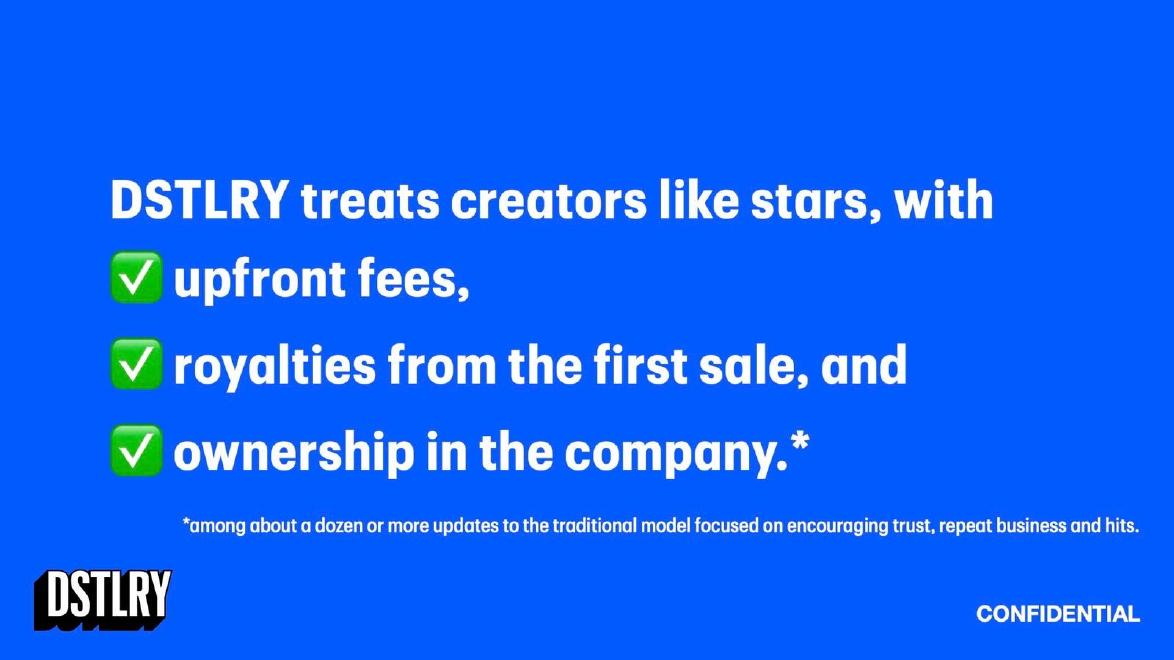
DSTLRY, a comics publisher, says it "treats creators like stars, with upfront fees, royalties from the first sale, and ownership in the company". For DSTLRY, royalties are a cost and a way to attract the best creators, not income. Including it here shows why the direction of the royalty matters: the same word can mean revenue for one company and a cost of goods for another.
A worked example: licence fee plus royalty
This example uses illustrative figures, not company data. Suppose you license a manufacturing process to a factory for a €200,000 upfront fee plus a 4% royalty on the factory's sales of products made with it.
If the factory sells €2 million of those products in year one, the royalty is €80,000, so you earn €280,000 that year. If its sales grow to €5 million in year two, the royalty is €200,000 and there is no upfront fee, so you earn €200,000. If sales reach €10 million in year three, you earn €400,000. Over three years you earn €880,000 from one licensee, and from year two onwards all of it is recurring royalty.
Put that on a slide as one licensee's income by year, then show how many licensees you expect. It tells an investor how much one deal is worth and how much depends on the licensee's own sales.
Common mistakes
No base. Say what the royalty is charged on.
No fee. Give the upfront or annual fee.
Every model at once. Say which route to market comes first.
Licensee sales ignored. Royalties depend on the licensee's volume; estimate it.
Hidden royalty costs. If you pay royalties, show them.
Diagnostic checklist
What is licensed, and to whom.
Upfront or annual fee stated.
Royalty rate and base stated.
Income by source over time.
Number of licensees, current or expected.
Frequently asked questions
How we chose these examples
Corpus: published pitch deck teardowns on StartupFundraising.com. Founder-uploaded private decks are excluded.
Selection (2026-10-01): we searched extracted slide text for licence fees, licensing models, royalties and upfront and milestone payments (200 matches, 116 decks), then read each candidate from images made from the original deck files.
Eligibility: each company was private when its deck was made. Deep Render (Series A, March 2023), EnergyX (Series B led by GM Ventures, April 2023), Bramble Energy (Series B, February 2022), Beatdapp (2019 and 2023 rounds) and DSTLRY (seed, 2024) were checked against public funding announcements. DDH, Besstech, A-Champs and Makoo rest on their own decks and the absence of any known listing.
Not used: listed companies at deck date, including IntelGenx, Can-Fite, Advanced Medical Isotope, Athersys, Sirona Biochem and Finjan; mining royalty slides; Elix (deck file unavailable).
Arithmetic: DDH's yearly totals (1,784 / 9,796 / 19,622 thousand EUR) and each source's share are our sums from its table.
Overlap check: the franchise business model guide covers franchise royalties; no guide covers technology, content or IP licensing.
Review: all nine slide images were inspected on 2026-10-01 and matched to company, deck and slide number (AI editorial model review). No person has yet completed an editorial review of this page. The worked licence example uses illustrative figures, not company data.
Figures are the companies' own claims; we did not verify underlying data. We make no claim that any slide caused a fundraising outcome.