Deep Render’s 50-slide deck is a highly technical presentation that successfully raised $9M in 2022. The company addresses the massive infrastructure costs of global data transmission by proposing a complete rebuild of video compression using AI. The deck relies heavily on Mean Opinion Score (MOS) data to prove their technology outperforms industry standards like AV1 and HEVC by significant margins—specifically claiming up to 81.52% better performance than AVC. By targeting high-bandwidth markets like India and outlining a dual-revenue stream through encoder and decoder licensing, Deep Render…
Key takeaways
- Deep Render claims their technology outperforms the AVC standard by 81.52% in video compression efficiency (Slide 4).
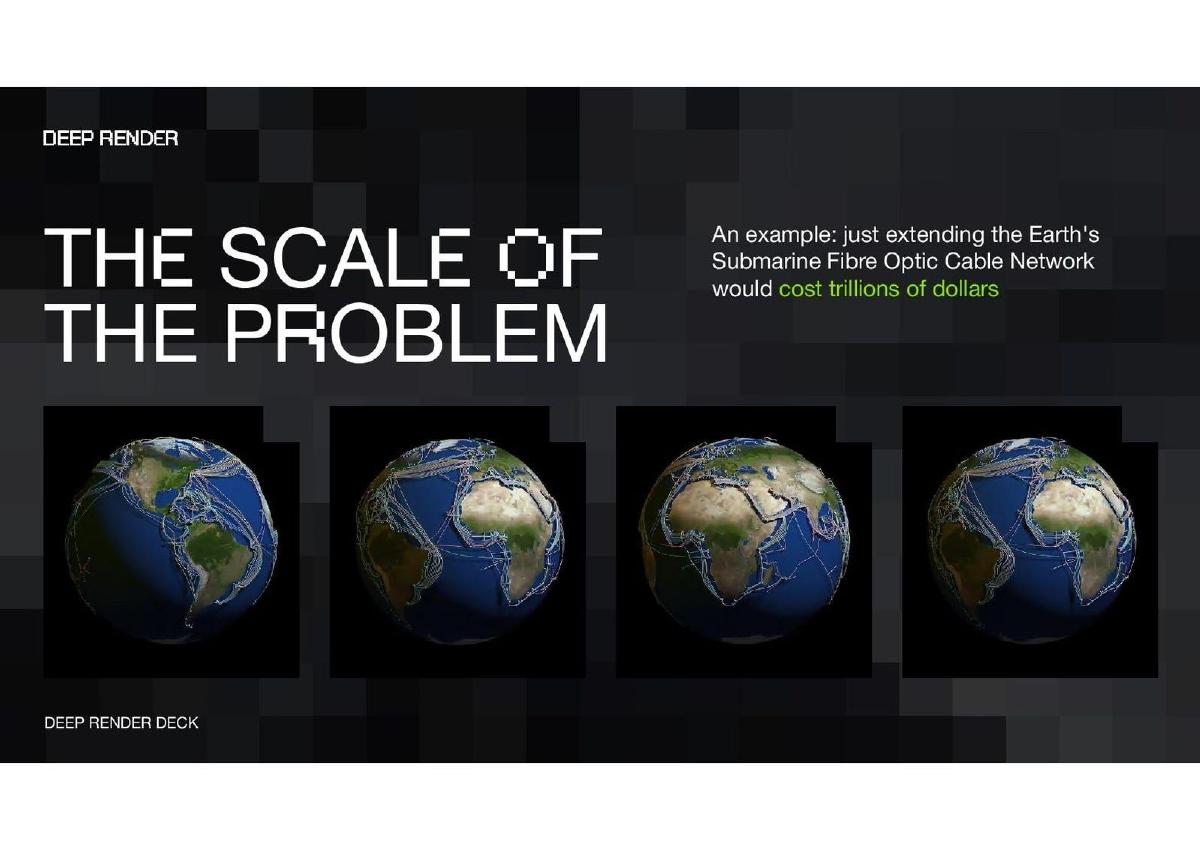
- The company identifies a massive infrastructure problem, noting that extending submarine fiber optic networks costs trillions of dollars (Slide 2).
- The business model is split into two distinct markets: Enterprise License Agreements for Encoders and usage-based royalties for Decoders (Slide 7).
- Deep Render targets the Indian market specifically, where 100M VoD users are currently limited by a 2-3GB daily data cap (Slide 6).
- The technology is designed to work across diverse hardware, including Apple NPUs, Qualcomm NPUs, and NVIDIA Tensor Cores (Slide 9).
- The deck positions the product as a necessity for high-growth sectors like VR/AR streaming and cloud gaming (Slide 5).
- A six-stage sales pipeline is presented, moving from outreach to a final rollout, with reference calls explicitly offered to investors (Slide 8).
- Performance metrics show Deep Render achieving a MOS of 4.5 at significantly lower bitrates (approx. 1.5 Mbps) compared to competitors (Slide 4).
Deep Render: Rebuilding the Foundation of the Internet
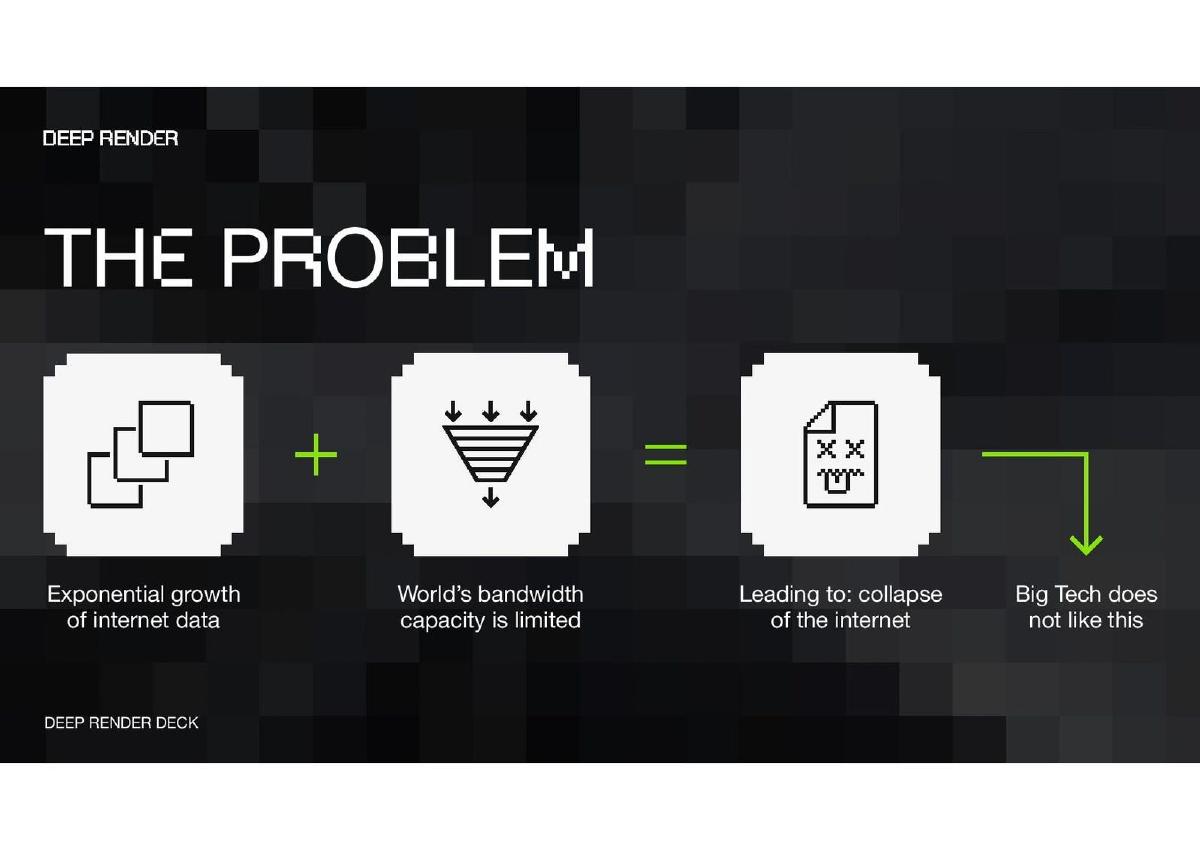
Deep Render’s pitch deck is a masterclass in deep-tech storytelling. Rather than starting with features, it begins with the existential crisis of the modern internet: bandwidth. As reported by Business Insider, the company raised a $9M Series A in 2022 to bring AI-native compression to the enterprise market. The deck, spanning 50 slides, moves from a high-level societal problem to granular technical benchmarks, providing the 'proof of work' required for a high-conviction Series A round.
Slide 1-3: The Vision and the Problem
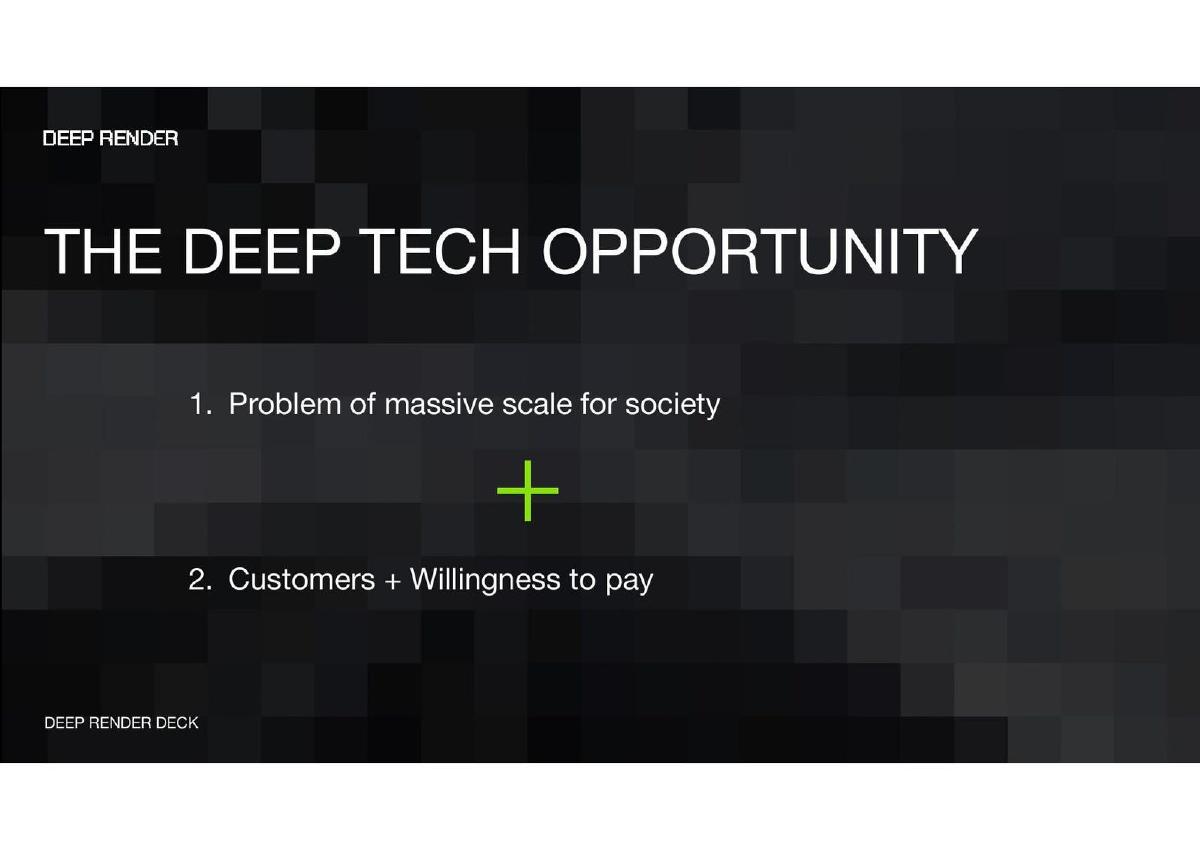
The deck opens with a bold, minimalist aesthetic. Slide 1 sets the tone with the statement: "COMPRESSION IS BROKEN. WE'RE REBUILDING IT." This is a classic 'disruption' hook, signaling that the company isn't just making incremental improvements but is rethinking the category from the ground up. Slide 2, titled "THE SCALE OF THE PROBLEM," contextualizes this by showing the Earth's submarine fiber optic network. It notes that extending this network would "cost trillions of dollars," immediately framing Deep Render not as a software utility, but as a multi-billion dollar infrastructure alternative. Slide 3 summarizes the "DEEP TECH OPPORTUNITY" as the intersection of a massive societal problem and a clear willingness to pay from customers.
Slide 4: The Technical 'Aha' Moment
Slide 4 is perhaps the most important slide in the deck for a technical investor. It displays a "VIDEO COMPRESSION (MOS)" graph. MOS, or Mean Opinion Score, is the industry standard for perceived visual quality. The graph shows Deep Render's curve (in green) reaching a high quality score of 4.5 at a much lower bitrate (Mbps) than competitors. The accompanying table provides the hard numbers: Deep Render claims a -66.56% improvement over AV1, -73.68% over HEVC, and a staggering -81.52% over AVC. For an investor, these figures represent a generational leap in efficiency, not a marginal gain.
Slide 5-6: Market Application and the India Case Study
Slide 5 lists the target sectors, including Video on Demand (YouTube, Netflix, Disney+), Live Streaming (Twitch, Facebook), Video Chat (Zoom, Teams), and upcoming products like VR/AR and Cloud Gaming. Slide 6 dives into a specific geographic opportunity: "UNLOCKING MARKETS: INDIA." It highlights that 100M VoD users in India are limited by a 2-3GB daily data cap , forcing them to watch SD content. Deep Render claims their tech enables an "effective cap of 10-15 GB/day," which would allow HD streaming for the masses. This slide is crucial because it moves the conversation from 'cool tech' to 'market expansion,' showing how the product creates new revenue for customers.
Slide 7-8: Business Model and Sales Pipeline
Slide 7 outlines a sophisticated dual-licensing model. The "Encoder Market" is handled via Enterprise License Agreements with fixed pricing and SDK access. The "Decoder Market" operates on an End-User License Agreement with usage-based IP royalties. This ensures Deep Render captures value both from the content creators and the platforms delivering the content. Slide 8, "CURRENT STATE," shows a six-stage sales funnel. While specific names are redacted in this version, the timeline moves from Outreach to Rollout, and the company explicitly states that "Reference calls are available," a high-confidence signal for due diligence.
Slide 9-10: Hardware Compatibility and Conclusion
Slide 9 addresses a common concern for AI startups: hardware requirements. It shows that Deep Render is compatible with a wide array of chips, including Apple, Qualcomm, Samsung, and MediaTek NPUs , as well as NVIDIA Tensor Cores . This demonstrates that the technology is ready for the existing device ecosystem. Finally, Slide 10 transitions to the end of the presentation with a "thought experiment," likely leading into a discussion about the future of a fully AI-compressed world.
What Deep Render Does Exceptionally Well
Deep Render avoids the 'feature creep' trap common in AI decks. Instead of listing twenty things the AI can do, they focus on one metric: efficiency. By showing an 81% improvement over the industry standard (Slide 4), they make the investment case almost purely mathematical. If the tech works as described, the ROI for a company like Netflix or YouTube is self-evident in reduced server and bandwidth costs.
The inclusion of the India case study (Slide 6) is also a brilliant move. It demonstrates that the founders understand the global macro trends. They aren't just selling to Silicon Valley; they are selling to the next billion internet users. This expands the Total Addressable Market (TAM) from 'cost savings for existing players' to 'revenue enablement in emerging markets.'
What is Missing from the Deck
In the selection provided, there are a few notable omissions that a founder should be aware of. First, there is no Team Slide . For a deep-tech company, the pedigree of the engineers and researchers is paramount. Investors need to know if the team has the PhD-level expertise to actually deliver on these radical performance claims. Second, there is no Unit Economics or Financial Projection slide. While the licensing model is explained, the deck doesn't show how these royalties scale into a $100M+ ARR business.
Finally, the Competitive Landscape is only addressed via technical standards (AV1, HEVC). It does not mention other AI-based compression startups or internal projects at Google and Meta. A dedicated slide showing why Deep Render's specific neural network architecture is superior to other AI approaches would strengthen the 'moat' argument.
Founder Takeaways: How to Pitch Deep Tech
If you are building a company in the infrastructure or deep-tech space, copy Deep Render's focus on industry-standard benchmarks . Don't invent your own metrics; use the ones your customers already use (like MOS and Mbps). This builds immediate credibility with technical reviewers.
Additionally, use the 'Problem Scale' approach seen on Slide 2. If your solution saves money, don't just say 'it's cheaper.' Show the multi-trillion dollar physical infrastructure you are bypassing. This elevates your startup from a 'software tool' to a 'strategic asset.' Lastly, always include a slide on Hardware Compatibility . In the world of AI, software is only as good as the chips it runs on. Proving you can run on a standard iPhone or a Qualcomm-powered Android device (Slide 9) removes a massive layer of adoption risk for the investor.
Frequently asked questions
- What is the primary problem Deep Render is solving?
- Deep Render addresses the 'trillion-dollar' problem of global bandwidth limitations. As stated on Slide 2, physical infrastructure like submarine cables is prohibitively expensive to expand. By rebuilding compression with AI, they allow existing infrastructure to carry more high-quality data, effectively 'unlocking' markets where users are currently restricted by low data caps and slow speeds.
- How does Deep Render's performance compare to existing video standards?
- According to the performance chart on Slide 4, Deep Render significantly outperforms current standards. It shows a -66.56% improvement over AV1, -73.68% over HEVC, and -81.52% over AVC. This means they can deliver higher visual quality (measured by Mean Opinion Score) at a fraction of the bitrate required by traditional codecs.
- What is the company's go-to-market strategy for India?
- Slide 6 highlights India as a key growth market with 100 million Video-on-Demand (VoD) users. Because these users face a 2-3GB daily data cap, they are often limited to Standard Definition (SD) content. Deep Render claims their tech enables an effective cap of 10-15GB/day, allowing HD content for the masses and giving providers a competitive edge.
- How does Deep Render plan to make money?
- The company utilizes a two-pronged licensing model detailed on Slide 7. For the 'Encoder Market,' they offer Enterprise License Agreements with fixed pricing and one-year terms. For the 'Decoder Market,' they use End-User License Agreements with fixed price-per-usage or IP royalties, billed annually based on activated accounts.
- What hardware is required to run Deep Render's AI compression?
- Slide 9 shows that the technology is hardware-agnostic but optimized for AI-specific processors. For encoding, it utilizes GPUs and Tensor Cores. For decoding, it supports a wide range of Neural Processing Units (NPUs) from manufacturers like Apple, Qualcomm, Samsung, and MediaTek, as well as standard CPUs.