Decisive Health’s 11-slide deck from 2015 is a masterclass in framing a dual-sided problem. By contrasting the 'Patient Experience' of billing shock with the 'Doctor Experience' of $44.6 billion in unpaid bills, the company establishes immediate urgency. The deck transitions from these emotional and financial pain points to a clean product mockup that simplifies complex insurance codes into a 'You will pay' figure. Despite its brevity, the deck provides strong evidence of product-market fit, citing $45,000 in annual revenue booked within just two months of selling. While it lacks a formal 'As…
Key takeaways
- The deck identifies a massive financial leakage of $44.6 billion in unpaid medical bills on slide 5.
- Decisive Health targets the urgent care market, which accounts for 160 million annual patient visits and $16.2 billion in value, according to slide 8.
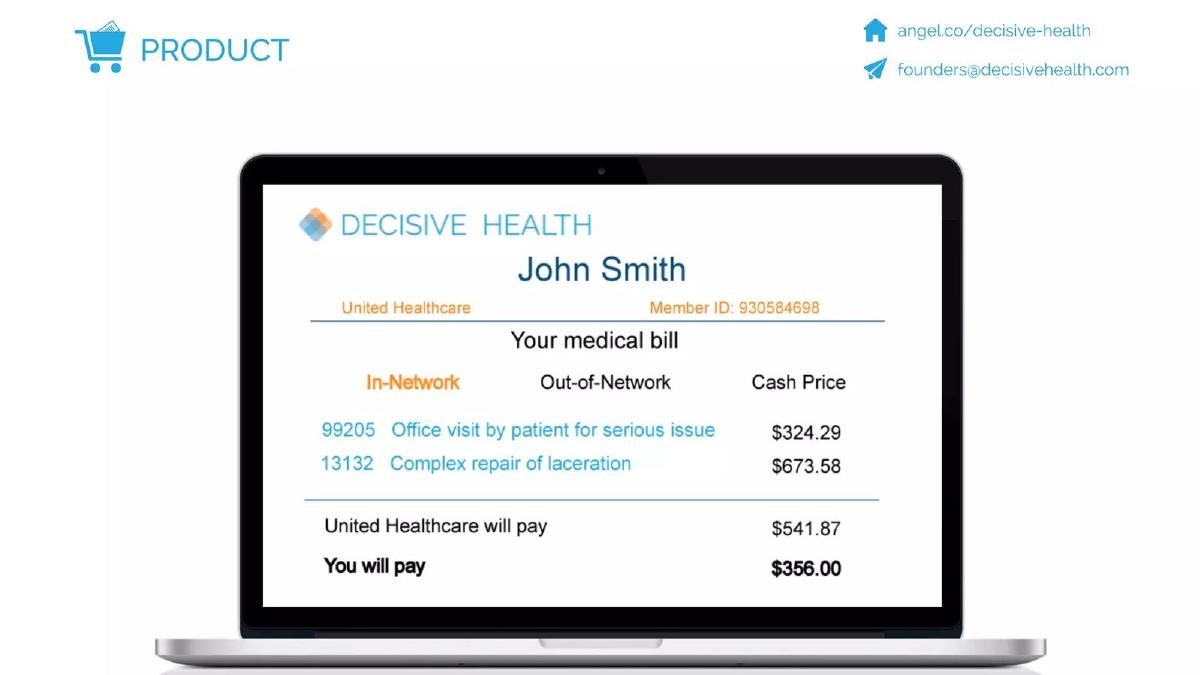
- The product simplifies billing by showing patients exactly what insurance covers versus their out-of-pocket cost, as shown on slide 6.
- Early traction is significant, with $45,000 in annual revenue booked in only two months of selling, per slide 9.
- The business model boasts a 70% profit margin per patient for insurance and billing queries, cited on slide 9.
- The founding team features high academic pedigree, including two PhDs from Stanford, UCSF, and Cornell, as detailed on slide 10.
- The deck omits a specific funding request, valuation, or use-of-funds breakdown.
- There is no dedicated slide for competition or a long-term product roadmap beyond the initial urgent care focus.
Executive Summary: The Power of Contrast
Decisive Health’s 2015 pitch deck is a lean, 11-slide presentation that focuses heavily on the friction between healthcare providers and patients. The deck’s primary strength lies in its ability to quantify a 'soft' problem—patient confusion—into a 'hard' financial metric: $44.6 billion in unpaid bills. By positioning themselves as the bridge that increases patient satisfaction while simultaneously securing provider revenue, they create a compelling 'must-have' narrative rather than a 'nice-to-have' tool.
Slides 1-3: The Emotional Hook
Slide 1 is a standard title slide, establishing the brand identity with the tagline 'Clear Medical Billing.' The date, October 2015, places this in the midst of the post-ACA digital health boom.
Slide 2 and Slide 3 use a 'Before and After' storytelling technique. Slide 2 shows a calm patient experience during a check-up. Slide 3, titled 'The Patient Experience: 6 Months Later,' shows a man in visible shock while looking at a medical bill. This highlights the lag time and lack of transparency that defines the current system. By starting with the patient's emotional pain, the founders build empathy before pivoting to the financial pain of the customer (the doctor).
Slides 4-5: Quantifying the Provider's Pain
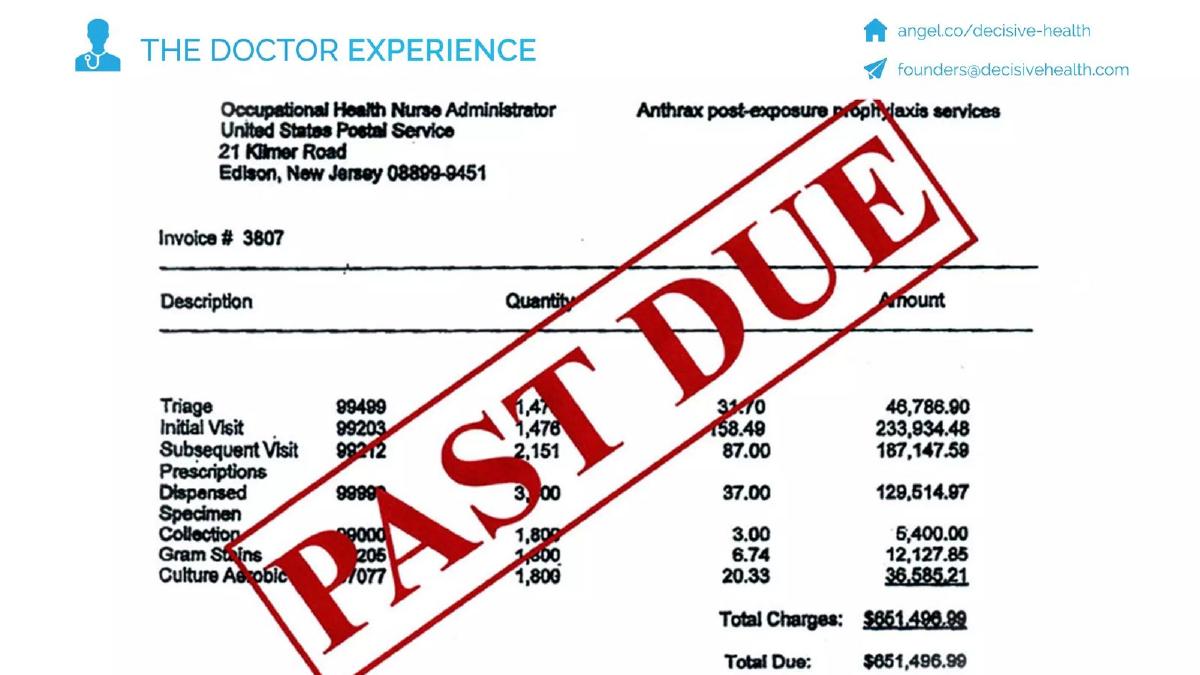
Slide 4 introduces 'The Doctor Experience' by showing a 'PAST DUE' invoice for $651,496.99. This is a visceral image for any practice manager or physician. It shifts the narrative from 'patients are confused' to 'doctors are losing massive amounts of money.'
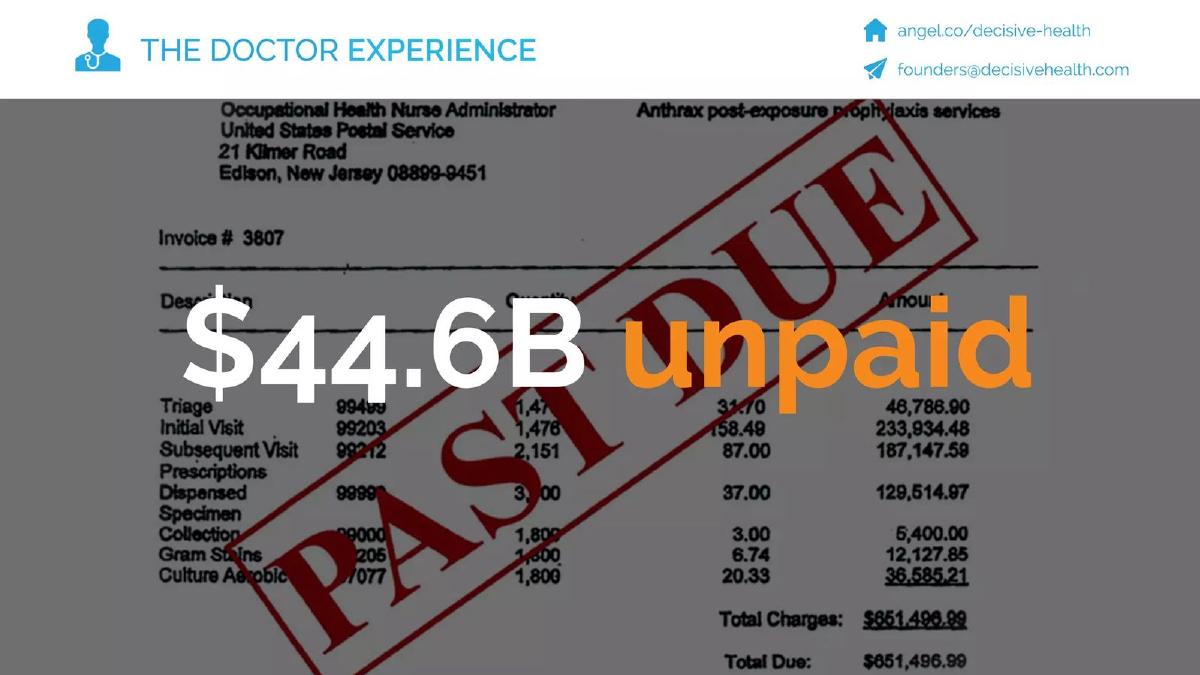
Slide 5 scales this problem to the national level. Overlaid on the same past-due invoice is the figure $44.6B unpaid . This is a crucial slide for a Seed round, as it justifies the existence of a new venture-backed solution by pointing to a massive, systemic inefficiency. It moves the conversation from a small-scale tool to a large-scale financial platform.
Slides 6-7: The Solution and Value Proposition
Slide 6 provides a product mockup. The interface is clean and focuses on the 'Bottom Line.' It breaks down specific codes, such as '99205 Office visit by patient for serious issue,' and provides a clear calculation: 'United Healthcare will pay $541.87' and 'You will pay $356.00.' This slide demonstrates the product's ability to translate 'med-speak' into 'wallet-speak.'
Slide 7 summarizes the dual-sided value proposition. For the Patient , it increases satisfaction and decreases billing confusion. For the Doctor , it increases revenue and decreases unpaid bills. The use of simple up and down arrows makes the business case unmistakable. This is the 'aha' moment of the deck, where the solution is shown to align the interests of two usually adversarial parties.
Slide 8: Market Opportunity
Slide 8 defines the 'Initial Market' as the Urgent Care Market. It cites a $16.2 Billion market size and 160 Million patient visits . Choosing a specific niche like urgent care is a smart tactical move for a Seed-stage company. Urgent care is high-volume and transactional, making it the perfect testing ground for a billing transparency tool. It suggests the founders have a 'wedge' strategy rather than trying to boil the ocean of the entire healthcare system at once.
Slide 9: Traction and Unit Economics
Slide 9 is the most important slide for investors. It shows a 'Booked Revenue' graph with a sharp upward trend from August to October. The key figures are:
$45K Annual Revenue booked in 2 months of selling. · 70% Profit Margins Per Patient for insurance and billing queries.
These numbers prove two things: first, that there is immediate market demand (the 'Sales' PhD is doing his job), and second, that the business is scalable and highly profitable at the unit level. A 70% margin in healthcare IT is a strong signal of a software-first approach rather than a service-heavy one.
Slide 10: The Team
Slide 10 presents the three founders. The pedigree is high, which is often a requirement for Seed investors in complex fields like HealthTech. Jonathan Shih, PhD (Product) brings Stanford and UCSF credentials. Nathanael Rosidi, PhD (Sales) brings Cornell and Booz Allen Hamilton experience. Emily McGovern, MS, RD (Growth Marketing) provides the clinical context from the South Dakota Sanford School of Medicine. This team covers the three pillars of a successful startup: building, selling, and domain expertise.
Slide 11: Contact Information
Slide 11 is a simple closing slide with the company logo and a contact email. It lacks a 'call to action' or a summary of the investment opportunity, which is a missed chance to reinforce the pitch's urgency.
What Decisive Health Does Well
The deck is exceptionally good at problem framing . By using the 'Patient Experience' vs. 'Doctor Experience' framework, they explain a complex B2B2C dynamic in just four slides. Many healthcare decks get bogged down in regulatory talk or technical architecture; Decisive Health stays focused on the money. The traction slide is also a standout. Showing $45k in booked revenue within 60 days of launching sales is a powerful way to mitigate 'execution risk' in the eyes of an investor.
What Is Missing from the Deck
Despite its strengths, the deck has several notable omissions:
The Ask: There is no slide stating how much money they are raising, what the terms are, or what the milestones will be for the next 18 months. · Competition: The deck assumes they are the only ones solving this. In 2015, companies like Zocdoc and various billing aggregators were already in the space. A 'Competitor Matrix' would have helped define their unique moat. · Technology/Integration: Healthcare is notorious for difficult EHR (Electronic Health Record) integrations. The deck does not explain how they pull the data from insurance companies or how they push it into the doctor's existing workflow. · Roadmap: The deck focuses entirely on the present. Investors want to see the 'Vision'—how does this move from urgent care to hospitals, or from billing to full-scale patient financial management?
Founder's Takeaway: The 'Wedge' Strategy
Founders should copy Decisive Health’s market segmentation . By identifying 'Urgent Care' as the initial market, they make the $16.2B opportunity feel attainable. It is much easier to sell a Seed investor on a plan to dominate a specific $16B niche than a vague plan to 'disrupt healthcare.' Additionally, the use of visceral imagery (the 'Past Due' stamp) is a highly effective way to make a dry topic like medical billing feel urgent and actionable. If you are solving a financial leakage problem, show the leak.
Frequently asked questions
- What specific problem does Decisive Health solve?
- Decisive Health addresses the disconnect between medical billing and patient payments. As shown on slides 3 and 4, patients are often shocked by bills arriving six months after treatment, leading to non-payment. This results in a $44.6 billion annual loss for healthcare providers. Decisive Health provides transparency at the point of care to ensure patients understand their financial responsibility immediately, which increases the likelihood of collection.
- How does the product actually work for a patient?
- Based on the mockup on slide 6, the software translates complex medical codes (like 99205 and 13132) into plain English descriptions. It then displays a side-by-side comparison of the in-network, out-of-network, and cash prices. Most importantly, it calculates the exact amount the insurance provider will pay and the final amount the patient is responsible for, removing the ambiguity that typically leads to 'billing confusion.'
- What is the size of the market Decisive Health is entering?
- The company is initially targeting the Urgent Care market. Slide 8 quantifies this as a $16.2 billion industry with 160 million patient visits annually. By focusing on this high-volume, transactional segment of healthcare, the company aims to prove its value proposition before potentially expanding into other medical specialties or hospital systems.
- What does the team's background look like?
- The team is highly technical and academically credentialed. Slide 10 lists Jonathan Shih, PhD (Product) with ties to Stanford and UCSF; Nathanael Rosidi, PhD (Sales) with experience at Cornell and Booz Allen Hamilton; and Emily McGovern, MS, RD (Growth Marketing) from the University of South Dakota Sanford School of Medicine. This mix of product development, strategic sales, and clinical marketing suggests a well-rounded foundation for a healthcare startup.
- Is there evidence that providers are willing to pay for this?
- Yes. Slide 9 shows a steep upward trajectory in 'Booked Revenue' from August to October. The company reported $45,000 in annual revenue booked within the first two months of active selling. Furthermore, they claim a 70% profit margin per patient query, indicating that the cost to deliver the service is low relative to the value provided to the doctor's office.