Defacto’s 20-slide Series A deck is a masterclass in demonstrating momentum and product-market fit within the crowded fintech lending space. By contrasting the 'painful multi-stage process' of traditional banks with their own 5-second automated application, the founders establish a clear value proposition. The deck leans heavily on its embedded distribution model, showcasing partnerships with platforms like Qonto and Pennylane to prove low-cost acquisition. While the deck redacts specific financial figures (ARR and burn rates) in this public version, the narrative arc is compelling: it moves…
Key takeaways
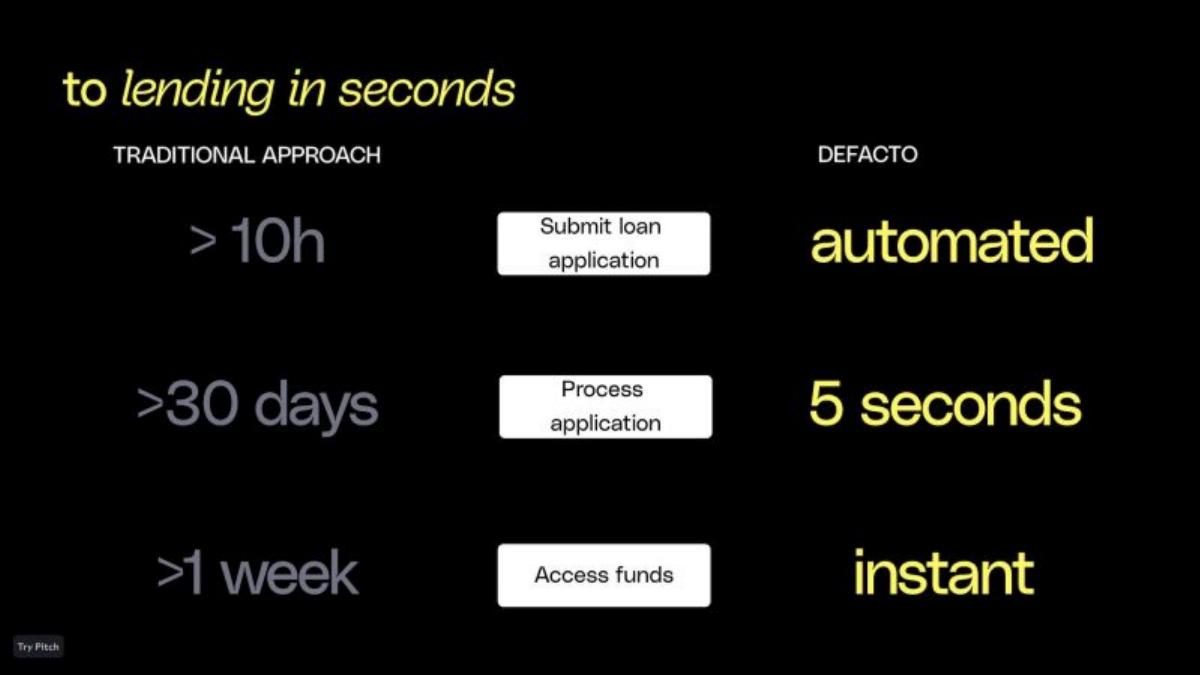
- The company claims to reduce loan application processing from over 30 days in traditional banking to just 5 seconds (Slide 6).
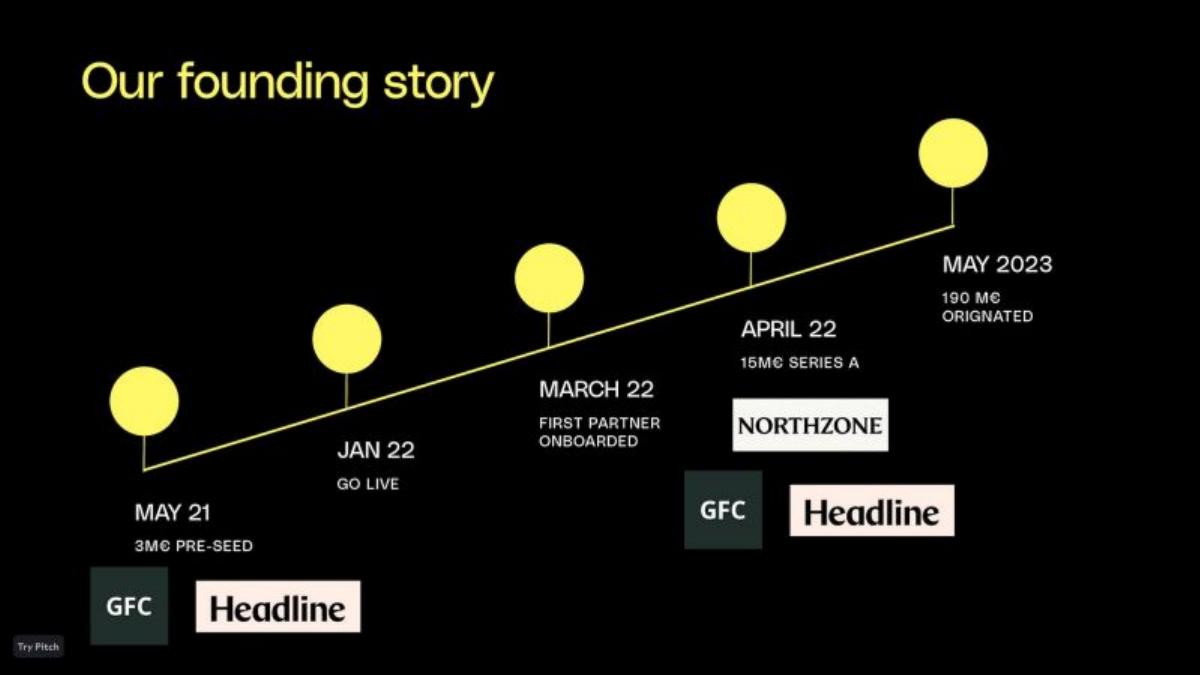
- Defacto reached 190M€ in total originations by May 2023, just two years after their pre-seed round (Slide 3).
- The product focuses on uncollateralized short-term loans with a maximum duration of 120 days and an average maturity of 48 days (Slide 7).
- Distribution is entirely embedded, targeting SMEs through accounting, banking, invoicing, and marketplace platforms (Slide 9).
- The deck highlights a high customer satisfaction rate with a CSAT of 82% and an 80% return rate for second loans (Slide 11).
- Growth velocity is a core theme, showing it took 12 months to reach 100M€ in originations, but only 4 months to go from 200M€ to 300M€ (Slide 13).
- A strategic debt transaction with Citi is cited as the primary driver for halving funding costs and reaching gross margin targets by 2025 (Slide 16).
- The long-term vision is to evolve from a lender into an 'Open infrastructure' provider, selling standalone modules for scoring, fraud, and servicing (Slide 19).
Executive Summary and Brand Identity
Slide 1: Title Slide
The deck opens with a minimalist, high-contrast yellow and black design. The brand name 'defacto' is prominent, and the footer indicates the year is 2023. There is no tagline on the cover, relying instead on the brand's established presence in the fintech ecosystem by the time of this Series A pitch.
The Team and Momentum
Slide 2: Our Founding Story (Team)
Defacto introduces its three founders: Marco Gires (Tech & Data), Morgan O’hana (Partnerships & Marketing), and Jordane Giuly (Product & Finance). The slide uses logos to establish credibility, featuring Spendesk, BCG, Stanford, and UC Berkeley. This highlights a mix of deep fintech operational experience (Spendesk) and top-tier consulting/academic backgrounds.
Slide 3: Our Founding Story (Timeline)
This slide serves as a traction proof point. It tracks the journey from a 3M€ pre-seed in May 2021 to a 15M€ Series A in April 2022 led by Northzone, GFC, and Headline. Crucially, it notes that by May 2023, the company had originated 190M€. This timeline demonstrates a rapid execution pace, moving from 'Go Live' in January 2022 to significant volume in under 18 months.
The Problem and Solution
Slide 4: The Macro Problem
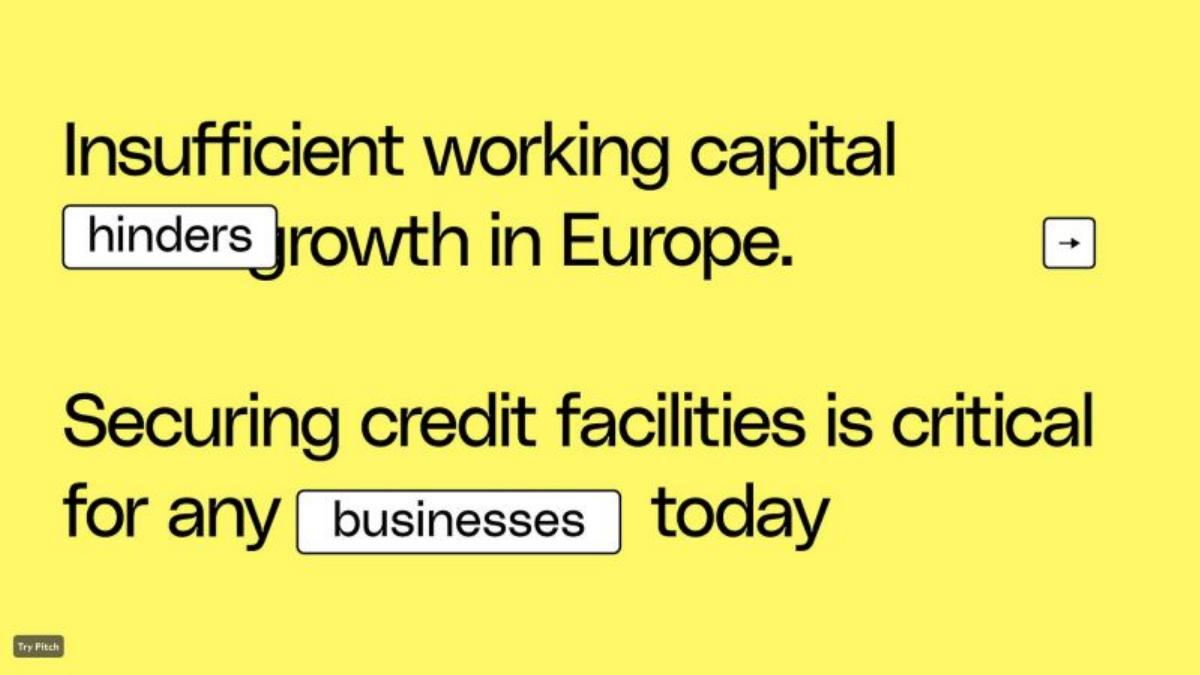
The deck identifies a lack of working capital as a hindrance to European growth. It frames securing credit facilities as 'critical' for businesses today. The language is simple and focuses on the systemic gap in the European market rather than just a technical deficiency.
Slide 5: The Painful Process
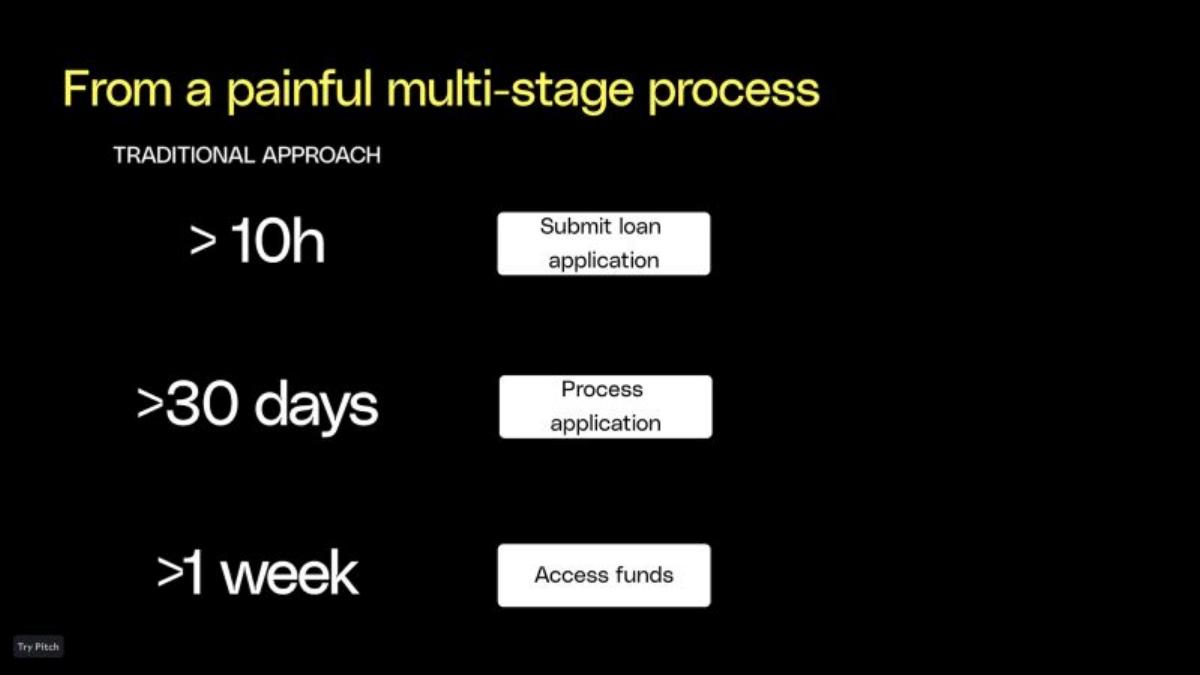
This slide quantifies the 'Traditional Approach' to lending: over 10 hours to submit an application, over 30 days to process it, and over a week to actually access funds. By breaking the problem down into these three specific time-based friction points, Defacto sets up an easy comparison for their solution.
Slide 6: Lending in Seconds
The 'After' state is presented in direct contrast to Slide 5. Defacto claims to make the application 'automated,' the processing time '5 seconds,' and the access to funds 'instant.' This is the core value proposition: a 30-day process compressed into seconds. This level of speed is the primary 'hook' for the Series A round.
Product and Value Chain
Slide 7: Short Term Loans to SMBs
Defacto defines its product parameters clearly: uncollateralized loans with a 120-day maximum duration and a 48-day average maturity. They specify that they do not purchase the underlying invoice, which allows them to finance both Accounts Payable (AP) and Accounts Receivable (AR). The 'Contextualized' pillar explains that they leverage invoice data for underwriting, which is a key technical differentiator from traditional lenders.
Slide 8: Ownership of the Value Chain
The company argues that owning the entire value chain maximizes user experience. They divide this into three stages: 1) Embedded distribution (API-first), 2) Underwriting (ML-driven decision making), and 3) Financing & Servicing (SPV management and regulatory relations). This slide is intended to show investors that Defacto isn't just a front-end; they manage the complex backend and capital markets aspects of lending.
Go-To-Market and Distribution
Slide 9: GTM Strategy
Defacto’s strategy is to 'be the first to lend to good borrowers.' They achieve this by being present where SMEs think about working capital: Accounting, Banking, Invoicing, and Marketplaces. They list three 'bricks' of partnership: Acquisition, Scoring, and Origination. This clarifies that they are a B2B2B player, using partners as their primary sales force.
Slide 10: Partner Integrations
This slide provides visual proof of their embedded strategy. It shows the Defacto interface within Qonto (a neobank) and Pennylane (an accounting platform). By showing 'Tester votre éligibilité' (Test your eligibility) directly within these third-party apps, they prove that their 'instant' promise is integrated into the user's existing workflow.
Slide 11: Customer Satisfaction
The company reports a CSAT of 82% and an 80% retention rate. The slide includes three testimonials. One customer mentions saving 15K€ per year in factoring fees, while another highlights the 'responsiveness' and 'online process.' These quotes serve to validate that the speed mentioned on Slide 6 translates into tangible customer value and loyalty.
Data and Technology
Slide 12: Data Management
This is a technical 'moat' slide. Defacto contrasts their 'State of the art' data management with 'Others.' They use transactional data access for instant eligibility, real-time event-based architecture for dynamic scoring, and automated ML for scalability. They criticize competitors for relying on 'declarative data,' 'financial statements,' and '6 months data lag' (citing Codat as an example of a lagged provider). This positions Defacto as a real-time data company rather than a traditional financial services firm.
Financial Performance and Projections
Slide 13: Origination Velocity
This chart shows an accelerating growth curve. It took 12 months to reach the first 100M€ in originations, 6 months to reach the next 100M€ (200M€ total), and only 4 months to reach the third 100M€ (300M€ total). The visual of the shrinking time intervals is a powerful way to demonstrate exponential growth without needing to disclose exact monthly revenue.
Slide 14: Partnership Diversification
This slide (partially redacted with 'XX' and 'XXX') shows the growth of their outstanding balance. It highlights that while their largest partnership continues to grow, they have successfully diversified with other partners who grew 3x in 6 months. This addresses the 'concentration risk' that investors often flag in embedded finance models.
Slide 15: Road to ARR
The deck projects a 'Road to XM€ ARR' through December 2025. While the specific numbers are redacted, the bar chart shows a significant step-up in revenue. They list three reasons they will win: Dominant API advantage, Superior Experience (dynamic exposure), and European coverage (listing Germany, Spain, Netherlands, and Belgium).
Slide 16: Gross Margin Expansion
This is a critical slide for a Series A fintech. It shows gross margin increasing as a percentage of the total. The key drivers are: 1) Halving funding costs through a debt transaction with Citi, 2) Reducing defaults via ML, and 3) Cutting operations costs through automation. This slide explains the path to a sustainable, high-margin business model.
Slide 17: Path to Profitability
The deck shows a 'Yearly Burn Rate' chart where the line crosses from negative to positive. They claim their GTM strategy ensures the 'lowest CAC in the market' and highlight a high 'ARR per head' metric. They emphasize a '10X engineers' hiring strategy and a preference for automation over manual operations.
Vision and Conclusion
Slide 18: The Defacto Way
A summary slide reiterating the three pillars: Explosive growth via GTM, Differentiated data for underwriting, and Lean servicing via automation. It serves as a final reinforcement of the pitch's main themes before moving to the long-term vision.
Slide 19: Future Roadmap
Defacto outlines its evolution into 'European credit infrastructure.' The three stages are: 1) Dive-in (current), 2) European champion (profitable growth), and 3) Open infrastructure. In the final stage, they plan to 'Sell standalone modules (scoring, fraud, servicing),' suggesting a shift toward a high-margin SaaS-like model for their internal tools.
Slide 20: Closing Slide
The deck ends with a 'Thank you!' and a photo of the three founders in a playful pose (covering eyes, ears, and mouth). It includes the website URL and the company logo, maintaining the consistent brand aesthetic found throughout the deck.
What Defacto's Deck Does Well
Speed as a Moat: By repeatedly emphasizing the '5 seconds' and 'instant' nature of their product, they turn a commodity (money) into a differentiated service (speed). · Embedded Distribution: The deck clearly explains how they avoid the high CAC trap of direct-to-SME lending by piggybacking on established platforms like Qonto. · Capital Efficiency: Mentioning the Citi debt transaction on Slide 16 is a major signal to investors that the company has the institutional backing to lower its cost of capital, which is the lifeblood of a lending business. · Visualizing Velocity: Slide 13 is an excellent example of how to show acceleration. Instead of just a standard bar chart, the 'months to reach' metric tells a much more compelling story of momentum.
What is Missing from the Deck
Specific Unit Economics: While the deck mentions 'lowest CAC' and 'Gross Margin expansion,' it lacks specific dollar or euro amounts for LTV, CAC, or current contribution margins. · Default Rates: For a lending company, the 'Default' bar on Slide 16 is quite small, but there is no historical data provided on actual loss rates or NPLs (Non-Performing Loans). Investors would want to see how these held up during market volatility. · Competitive Landscape: Aside from a brief mention of 'Traditional Approaches' and a jab at 'Others' regarding data lag, there is no dedicated slide analyzing direct competitors in the embedded lending space (e.g., YouLend or Liberis). · The Ask: This version of the deck does not include a specific 'Ask' slide detailing how much capital is being raised in this round and exactly how it will be allocated.
What Other Founders Should Copy
The 'Before and After' Comparison: Slides 5 and 6 are a perfect template for any startup disrupting a legacy process. Quantify the pain of the old way and the relief of the new way. · Product-in-Context: Slide 10 shows the product living inside the partner's ecosystem. This is much more effective than a standalone screenshot because it proves the distribution model works. · The Vision Pivot: Slide 19 shows how a company can start as a 'service' (lending) and evolve into a 'platform' (infrastructure). This helps justify a higher 'tech' valuation rather than being valued as a traditional bank. · Founder Credibility Logos: Slide 2 uses logos effectively to tell a story of expertise without requiring the reader to scan long paragraphs of bio text.
Frequently asked questions
- What is Defacto's core product offering?
- Defacto offers uncollateralized, short-term working capital loans to small and medium-sized enterprises (SMEs). According to slide 7, these loans have a maximum duration of 120 days and an average maturity of 48 days. The key differentiator is the 'contextualized' nature of the lending, where the company uses AP/AR invoices to draw on credit lines and perform underwriting.
- How does Defacto acquire customers?
- Defacto utilizes a B2B2B embedded finance strategy. Instead of direct marketing to SMEs, they integrate their API into platforms where SMEs already manage their finances, such as banking (Qonto), accounting (Pennylane), and invoicing tools. Slide 9 explains that they partner on three 'bricks': acquisition, scoring, and origination.
- What are the key performance metrics mentioned in the deck?
- The deck emphasizes origination volume and speed. It notes 190M€ originated by May 2023 (Slide 3) and a growth chart on slide 13 showing a trajectory toward 300M€. They also boast a 5-second application processing time, an 82% CSAT score, and an 80% repeat borrower rate (Slide 11).
- How does Defacto plan to improve its margins?
- Slide 16 outlines a three-pronged approach to margin expansion: halving funding costs through a new debt fund (specifically mentioning a transaction with Citi), reducing default costs via predictive machine learning, and cutting operational costs through further automation. This is intended to help the company reach profitability by 2025.
- What is the long-term vision for the company?
- Defacto aims to move beyond being a balance-sheet lender. Slide 19 details a roadmap where they transition from 'Dive-in' (penetrating the market) to becoming a 'European champion' and finally an 'Open infrastructure' player. In this final stage, they plan to sell standalone modules for scoring, fraud detection, and loan servicing to other firms.