Della’s 15-slide Seed deck is a masterclass in identifying a high-friction pain point—legal document review—and positioning a technical solution as a human-centric relief. By citing that 63% of lawyers report daily stress (Slide 2), the company immediately establishes empathy with its user base. The deck effectively transitions from this emotional hook to a $1 billion total addressable market (Slide 5), eventually introducing an AI model that learns across its entire client network to create a defensive moat (Slide 13). While the deck lacks specific revenue traction or unit economics, the str…
Key takeaways
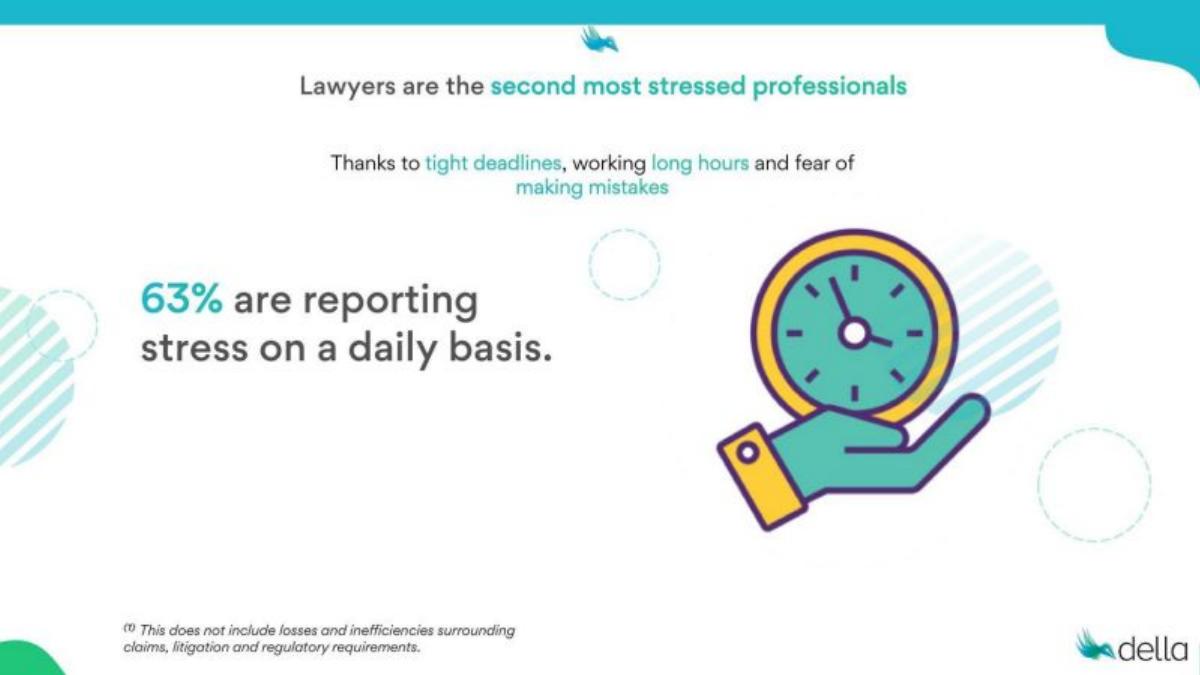
- The deck identifies a high-stress environment, noting that 63% of lawyers report daily stress due to tight deadlines and fear of mistakes (Slide 2).
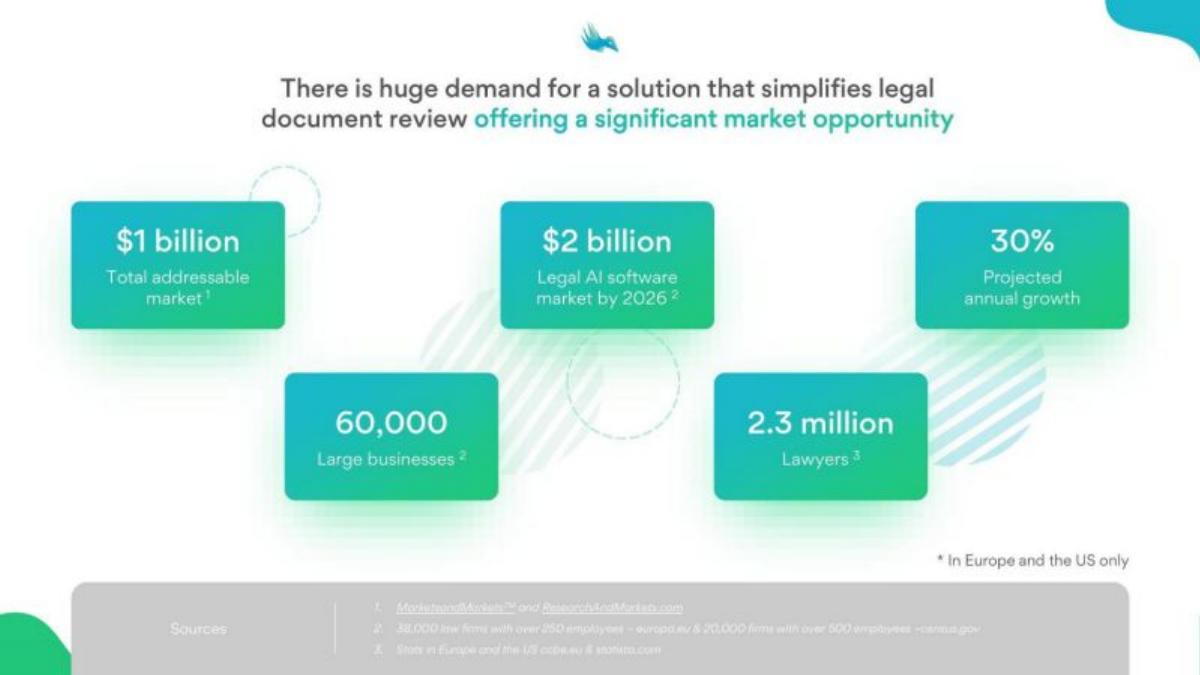
- Della targets a $1 billion total addressable market, with the legal AI software market projected to reach $2 billion by 2026 (Slide 5).
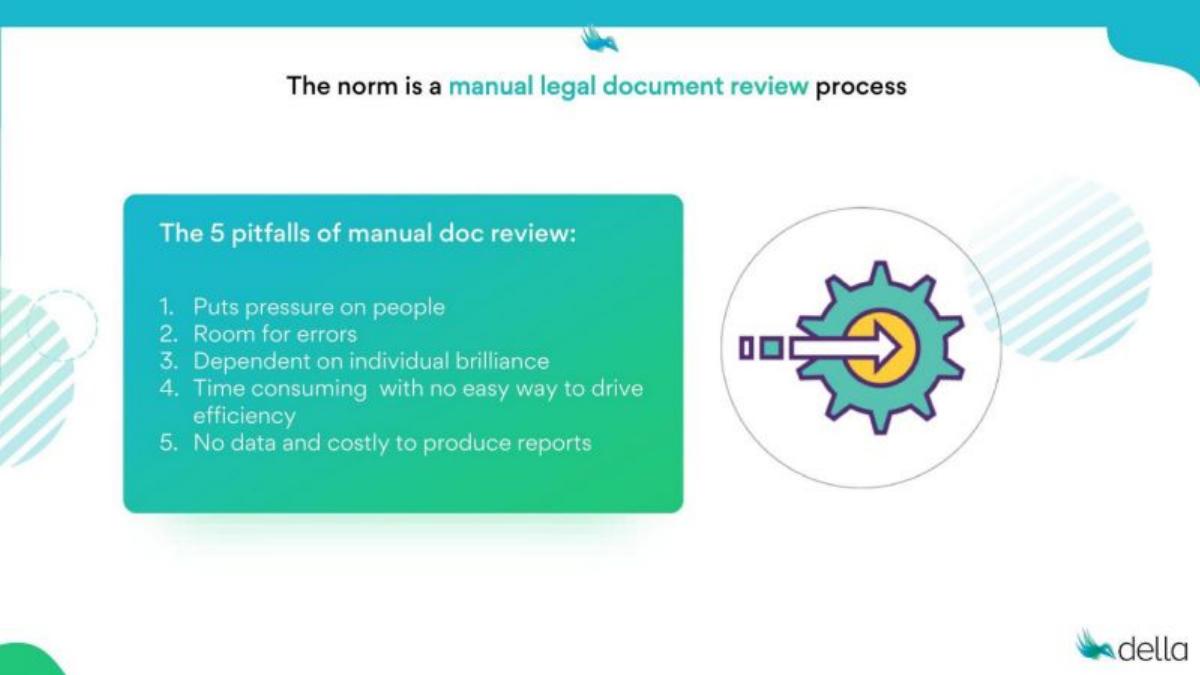
- The product addresses five specific pitfalls of manual review, including dependence on 'individual brilliance' and high costs for reporting (Slide 4).
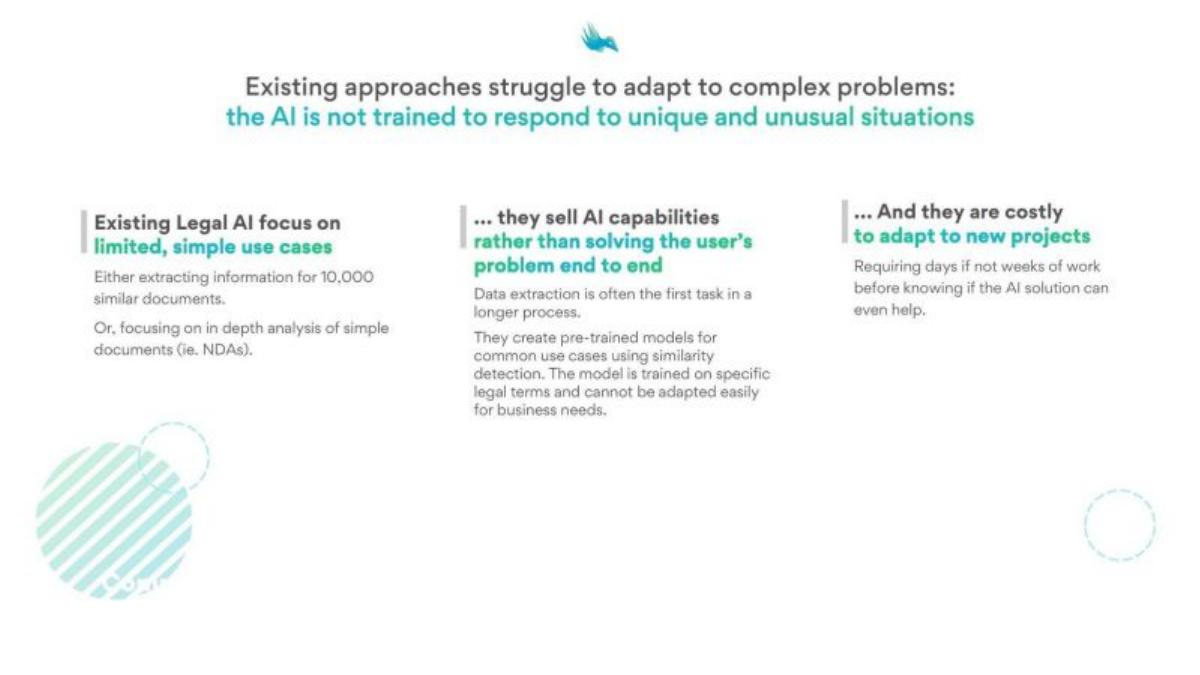
- Della differentiates itself from existing legal AI by focusing on end-to-end problem solving rather than just simple data extraction for NDAs (Slide 6).
- The 'Winning Strategy' relies on a network effect where the AI gets smarter for all users every time a question is corrected on the platform (Slide 13).
- The leadership team features deep domain expertise, including a CEO with a previous exit to Nasdaq and a COO who was a corporate solicitor (Slide 14).
- The go-to-market strategy is dual-pronged, targeting both large corporate legal departments and top law firms (Slide 10).
- The deck omits specific financial projections, current revenue, or a detailed breakdown of the $2.5M use of funds.
The Hook: Emotional Resonance in Legal Tech
Della opens its pitch not with a technical specification, but with a human problem. Slide 2, titled 'Lawyers are the second most stressed professionals,' sets the stage by highlighting that 63% of lawyers report stress on a daily basis. This is a strategic choice for a Seed-stage deck; it identifies a massive, underserved pain point that justifies the need for a new solution. By framing the problem around 'tight deadlines' and 'fear of making mistakes,' Della positions its AI as a tool for risk mitigation and mental well-being, rather than just another piece of enterprise software.
Slides 1-4: The Problem and the Pitfalls
Slide 1 is a standard title slide featuring the tagline 'Building the future of legal review.' It establishes the brand identity early with a clean, professional aesthetic.
Slide 2 delivers the emotional hook mentioned above. It uses a simple clock graphic to emphasize the time-sensitive nature of legal work. The footnote clarifies that the 63% figure does not even include losses from litigation or regulatory requirements, suggesting the actual business impact is even higher.
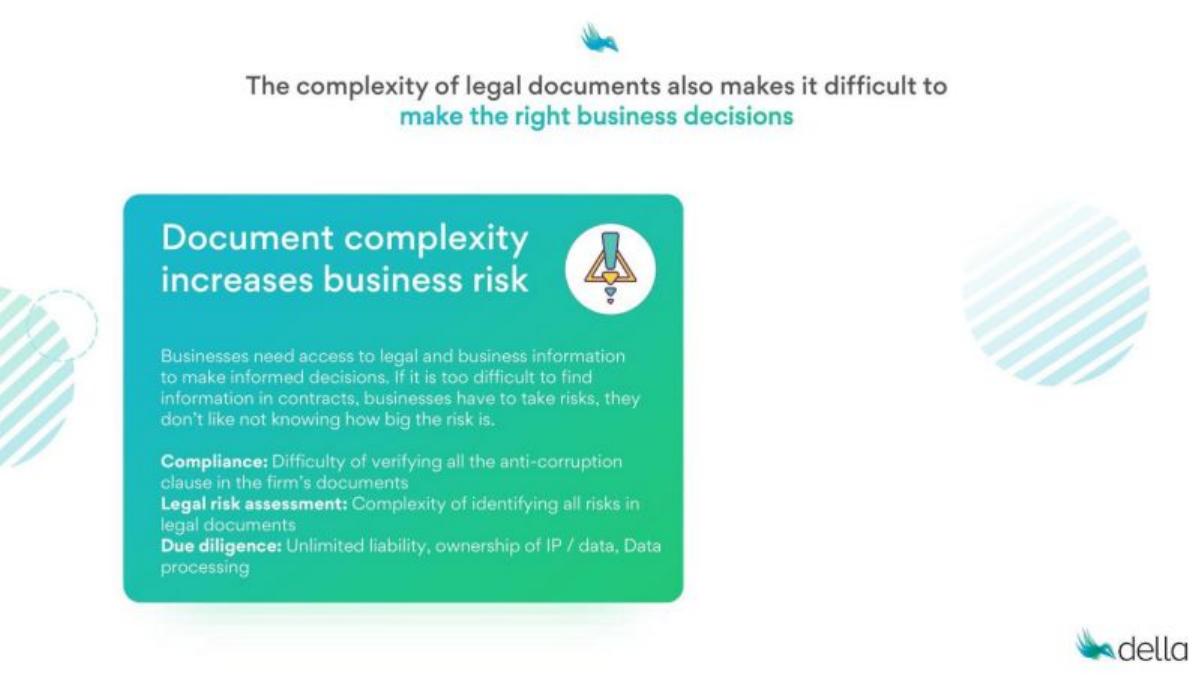
Slide 3 transitions from the individual to the organization. It argues that 'Document complexity increases business risk.' It lists three specific areas where this complexity causes friction: Compliance (anti-corruption clauses), Legal risk assessment, and Due diligence. This slide is critical because it moves the value proposition from 'helping lawyers feel better' to 'protecting the company's bottom line.'
Slide 4 identifies the status quo: 'The norm is a manual legal document review process.' Della lists five pitfalls of this manual process, most notably that it is 'Dependent on individual brilliance' and offers 'No data and costly to produce reports.' This sets up the 'Why Now'—the legal industry is reaching a breaking point where human effort alone cannot scale with document volume.
Slides 5-6: Market Opportunity and Competitive Gaps
Slide 5 provides the macro-economic justification for the investment. Della claims a $1 billion Total Addressable Market (TAM) and cites a projected $2 billion legal AI software market by 2026. The slide also notes there are 2.3 million lawyers in Europe and the US alone. By citing sources like MarketsandMarkets and Statista, the founders demonstrate they have done the legwork to validate the opportunity size.
Slide 6 is a 'Competitor Gap' slide, though it doesn't name specific companies. Instead, it critiques 'Existing Legal AI' for focusing on 'limited, simple use cases' like NDAs. Della argues that competitors sell 'AI capabilities' rather than 'solving the user’s problem end to end.' This is a common trope in AI pitching: positioning the startup as the 'second generation' of AI that is more flexible and user-centric than the rigid 'first generation' tools.
Slides 7-9: The Mission and Product Approach
Slide 7 defines the mission: 'To offer a solution that allows legal professionals to continuously improve their legal document review processes.' It explicitly mentions targeting both law firms and legal departments.
Slide 8 introduces the 'Approach.' It uses a timeline of legal roles—Junior, Associate, Senior, and Partner—to show how Della adds value at every level. For Juniors, it’s 'Scalable Data extraction'; for Partners, it’s answering 'Is it market? Is there something worth noting?' This is a sophisticated way to show that the product isn't just a tool for low-level clerks, but a strategic asset for firm leadership.
Slide 9 narrows the current focus to two primary use cases: reviewing documents quickly for due diligence/audits and summarizing long documents into reports (Excel, Word, or PDF). This focus is important for a Seed round; it shows the team isn't trying to boil the ocean and has a clear starting point for their go-to-market.
Slides 10-13: Strategy and the 'Winning' Moat
Slide 10 outlines the Go-to-market strategy. It is a straightforward SaaS model selling directly to large legal departments and top law firms. While simple, it confirms the business model is a standard B2B subscription play.
Slide 11 is a transition slide titled 'Our future story,' which leads into the company's long-term defensibility.
Slide 12 (labeled 'Our winning strategy') is perhaps the most important slide for an investor. It details the 'Network Effect.' Della claims their AI 'learns from all of our clients' and 'gets smarter over time.' They state that every single question corrected on the platform makes the model more accurate for everyone. This is a classic 'data moat' argument—the more users Della has, the better the product becomes, making it harder for new entrants to catch up.
Slides 14-15: The Team and The Ask
Slide 14 presents the leadership team. This is a high-pedigree group. CEO Christophe Frèrebeau is noted as a 'Serial Entrepreneur' with a previous exit to Nasdaq. CTO Nicolas Chauville brings 'Quant' experience from Nomura and RBS, and COO Hugo Seymour provides the domain expertise as a former corporate solicitor at Freshfields. For a $2.5M Seed round, this level of experience is a significant de-risking factor.
Slide 15 is the contact slide. Notably, the deck does not include a 'The Ask' slide or a 'Use of Funds' slide. While the catalogue facts state they raised $2.5M, the deck itself leaves the specific financial requirements to the verbal pitch or a follow-up document.
What Works in This Deck
Strong Problem/Solution Fit: The deck does an excellent job of connecting a high-level business problem (risk) with a low-level human problem (stress). · Clear Differentiation: By critiquing 'first-gen' AI that only handles simple NDAs, Della carves out a space for itself in the 'complex document' category. · The Data Moat: The explanation of the network effect (Slide 12) gives investors a reason to believe the company can maintain a competitive advantage as it scales. · Team Credibility: The mix of serial entrepreneurship, deep technical quant skills, and 'Big Law' experience is exactly what VCs look for in this sector.
What Is Missing
Traction Metrics: There are no mentions of current revenue, number of pilots, or specific law firm logos. Even at the Seed stage, showing some early validation (e.g., '3 pilots in progress') is usually expected. · The Ask: The deck ends abruptly without stating how much they are raising or what they plan to do with the capital. · Product Visuals: While the deck explains the approach to AI, there are no screenshots of the actual interface. For a product claiming to be 'extremely easy to use,' seeing the UI would be beneficial. · Unit Economics: There is no mention of pricing tiers, customer acquisition costs, or expected lifetime value.
What Other Founders Should Copy
The 'Role-Based' Value Prop: Slide 8 is a great example of how to show a product's utility across an entire organization. Founders should map their solution to the specific personas within a target company. · The Emotional Hook: Starting with a statistic about user stress (Slide 2) is much more memorable than starting with a generic market size slide. · Clean Design: The deck uses a consistent color palette and avoids cluttered slides, making it very easy to digest in a 3-minute skim.
Frequently asked questions
- How much did Della raise with this deck?
- According to the catalogue facts, Della raised $2.5M in a Seed round in 2022. The deck itself focuses on the vision and product-market fit rather than the specific terms of the raise.
- What is Della's core product differentiation?
- As shown on Slide 6 and Slide 13, Della differentiates itself by moving beyond simple data extraction. Their AI uses a 'question-answering' approach that is designed to be intuitive for lawyers and learns from corrections made by any user across the entire platform, creating a network effect for accuracy.
- Who is the target customer for Della?
- Slide 10 outlines a two-part go-to-market strategy. They target 'Companies' (specifically large legal departments) and 'Professional Services Providers' (top law firms). Slide 9 further specifies that they focus on due diligence and internal audit use cases.
- Is there any mention of existing traction or revenue?
- No. The 15-slide deck does not include a traction slide, revenue figures, or a list of current logos. It relies on the market opportunity and the pedigree of the founding team to build investor confidence.
- What is the background of the founding team?
- The team (Slide 14) is highly experienced. CEO Christophe Frèrebeau is a serial entrepreneur with a previous company acquired by Nasdaq. CTO Nicolas Chauville has a background in quantitative finance at Nomura and RBS, and COO Hugo Seymour is a former corporate solicitor trained at Freshfields.