Court Buddy utilized an 11-slide deck to raise $7.3 million in Series A funding in 2016. The deck is characterized by an extreme economy of words, relying on large-scale statistics and high-contrast visuals rather than dense technical explanations. It identifies a massive disconnect in the legal market: 129.2 million Americans avoiding lawyers due to cost, and 600,000 solo attorneys struggling with marketing. The deck highlights a 4x growth in revenue over just nine months, reaching $200,000+ in recurring revenue by April 2017. While the deck lacks traditional sections like a detailed competi…
Key takeaways
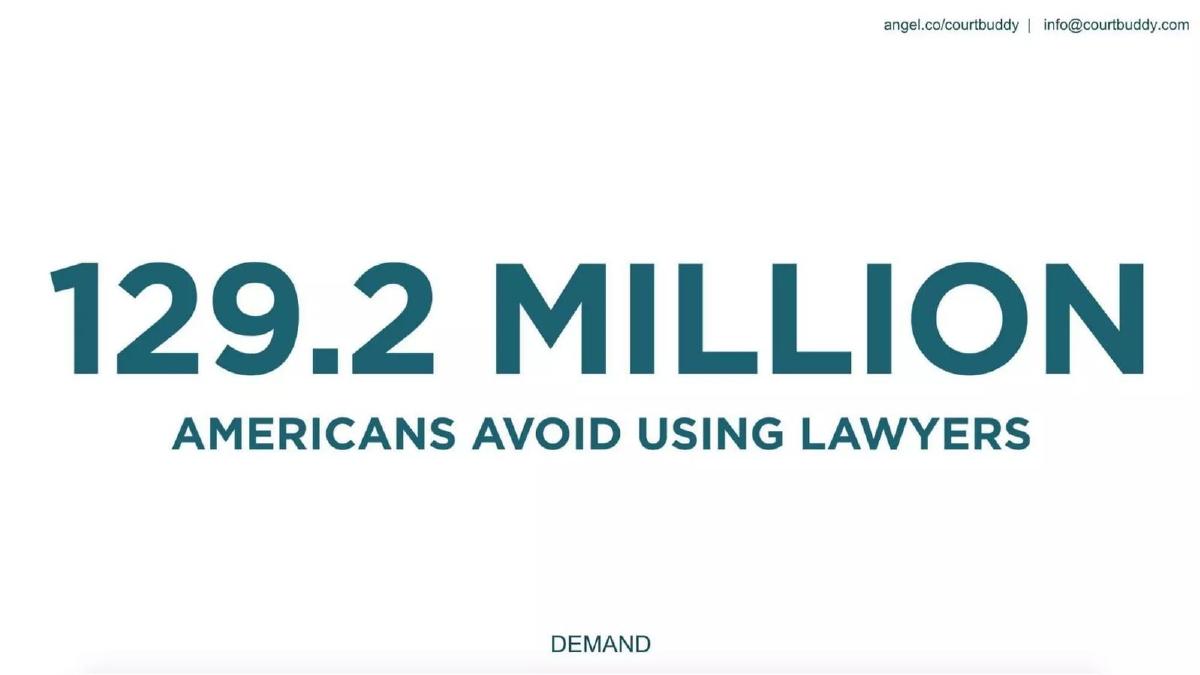
- The deck identifies a massive demand gap, stating that 129.2 million Americans avoid using lawyers (Slide 5).
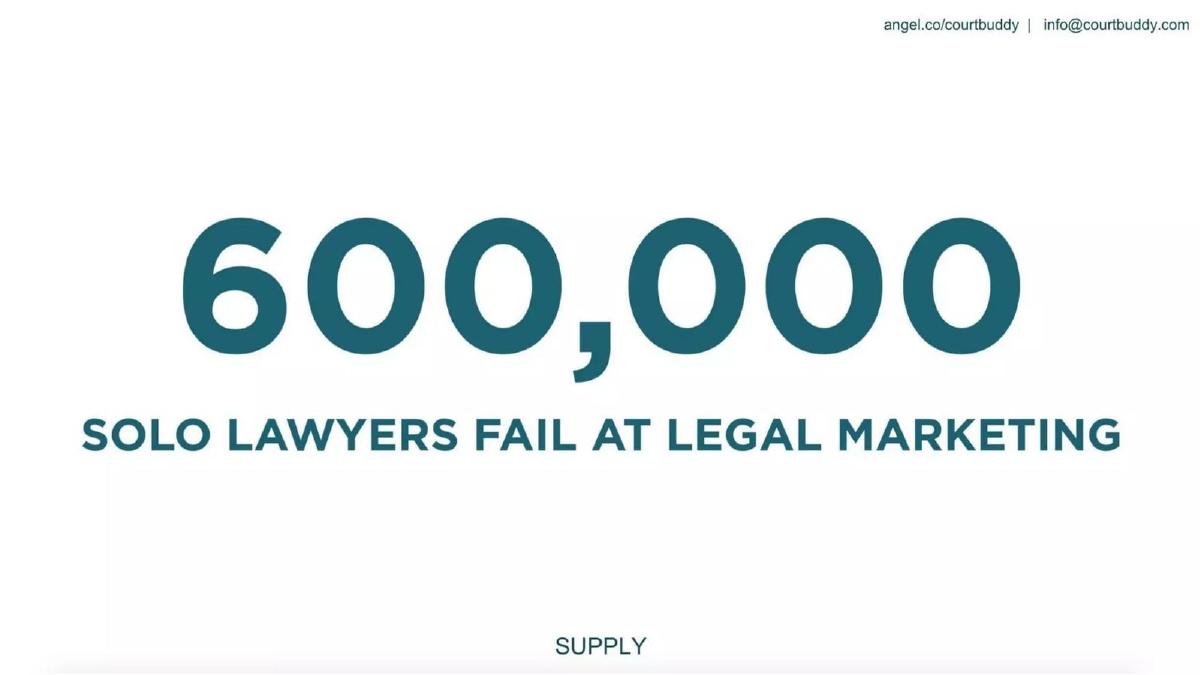
- On the supply side, the company targets 600,000 solo lawyers who 'fail at legal marketing' (Slide 6).
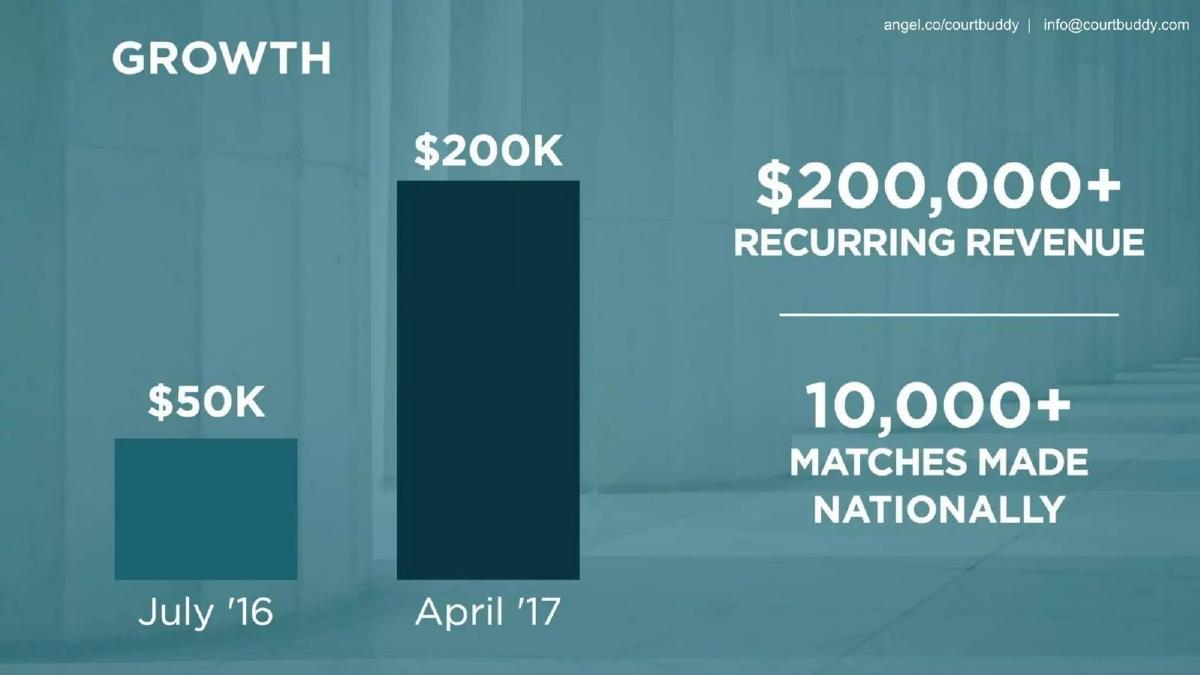
- Traction is demonstrated by a jump from $50,000 in revenue in July '16 to $200,000 in April '17 (Slide 4).
- The marketplace had facilitated over 10,000 matches nationally by the time of the pitch (Slide 4).
- Court Buddy defines its specific addressable market at $45 billion within a broader $400 billion legal industry (Slide 7).
- The business model centers on 'Transparent Flat Fees,' specifically showcasing court appearance rates between $200 and $500 (Slide 3, Slide 8).
- The team slide emphasizes domain expertise and brand experience, featuring a former solo attorney and an advertising art director (Slide 9).
- The deck completely omits a 'Competitors' slide and a 'Financial Projections' slide, relying instead on historical growth.
The Minimalist Marketplace: A Teardown of Court Buddy’s Series A Deck
Court Buddy’s pitch deck is a striking example of 'less is more.' In an industry as document-heavy and jargon-laden as law, the founders chose to present a deck that is almost entirely devoid of small print. With only 11 slides, the presentation focuses on three core pillars: a massive underserved population, a struggling supply of solo practitioners, and a simple flat-fee solution. This teardown examines how they used this brevity to secure $7.3 million in funding.
Slides 1-3: The Value Proposition
Slide 1: Title The deck opens with the company logo and the tagline 'LEGAL. FOR EVERYONE.' The background image shows a professional interaction, immediately setting a tone of accessibility. The contact information is clearly visible in the top right corner, including an AngelList link, which suggests a background in the tech-startup ecosystem.
Slide 2: The Two-Sided Marketplace This slide uses a split-screen visual to define the users. On the left, 'I NEED AN ATTORNEY'; on the right, 'I AM AN ATTORNEY.' It establishes Court Buddy as a classic marketplace platform. The imagery shows both parties using mobile devices, hinting at the 'CourtBuddy Chat' app mentioned in the company's self-description.
Slide 3: The Core Solution The phrase 'TRANSPARENT FLAT FEES' is centered in a bold box. This is the 'hook' of the business model. By leading with pricing transparency, Court Buddy addresses the number one fear consumers have when hiring lawyers: the billable hour. There is no mention of technology or algorithms here; the focus is entirely on the economic benefit to the consumer.
Slides 4-7: The Market Opportunity and Traction
Slide 4: Growth This is the most data-dense slide in the deck. It shows a bar chart comparing July '16 ($50K) to April '17 ($200K). The text highlights '$200,000+ RECURRING REVENUE' and '10,000+ MATCHES MADE NATIONALLY.' This 4x growth in less than a year provides the 'why now' for investors, demonstrating that the model is not just theoretical but actively scaling.
Slide 5: Demand Court Buddy presents a staggering figure: '129.2 MILLION AMERICANS AVOID USING LAWYERS.' By framing the problem this way, they aren't just competing for existing legal spend; they are claiming to unlock a massive, dormant market. This is a classic 'Top-Down' market sizing approach designed to excite Series A investors looking for billion-dollar outcomes.
Slide 6: Supply The deck then pivots to the supply side: '600,000 SOLO LAWYERS FAIL AT LEGAL MARKETING.' This identifies the specific pain point for the service providers. Solo attorneys are often great at law but poor at business development. Court Buddy positions itself as the outsourced marketing arm for these 600,000 individuals.
Slide 7: Market Size The company compares the 'CURRENT LEGAL INDUSTRY VALUE' of $400B to 'COURT BUDDY’S MARKET' of $45B. While the slide doesn't explain how the $45B figure was calculated, it serves to show that even a conservative slice of the legal pie is enormous. The use of a bridge in the background suggests a connection between the two figures.
Slides 8-11: Product, Team, and Validation
Slide 8: Product in Action This slide shows a mobile phone interface with the message 'YOU’VE BEEN MATCHED!' It lists three price tiers for a 'SINGLE COURT APPEARANCE': $200-300, $300-400, and $400-500. This is the only slide that gives a glimpse into the actual user experience, reinforcing the flat-fee promise made on Slide 3.
Slide 9: Team The team slide features James Jones Jr., Esq. and Kristina Jones. The logos beneath James (Carnival, Royal Caribbean, Norwegian) and Kristina (Walmart, Disney, SeaWorld) are likely former clients or employers, though the slide doesn't specify. The key takeaway is the combination of legal expertise ('Former Solo Attorney') and high-level branding experience ('Former Advertising Art Director').
Slide 10: Validation A dedicated slide for the 'AMERICAN BAR ASSOCIATION’S 2017 LEGAL ACCESS WINNER.' In a highly regulated industry like law, an endorsement from the ABA is a powerful de-risking mechanism for investors who might be worried about unauthorized practice of law (UPL) issues or ethical hurdles.
Slide 11: Conclusion The final slide repeats the traction metrics: '$200,000+ RECURRING REVENUE' and '10,000+ MATCHES.' It ends with the logo and tagline, leaving the investor with the most impressive numbers fresh in their mind.
What Works in the Court Buddy Deck
Clarity of Mission: The deck never wavers from its 'Legal for Everyone' and 'Flat Fee' messaging. Every slide supports the idea that the current system is broken and Court Buddy is the simple fix. For a Series A, where the goal is to prove you have a repeatable model, this consistency is vital.
The 'Solo Attorney' Angle: Most legal tech companies try to sell to big law firms. Court Buddy identifies a specific, underserved supply niche (solo attorneys) and a specific failure (marketing). This makes their go-to-market strategy feel much more attainable than a broad 'disrupt the legal industry' claim.
Visual Hierarchy: The deck uses very large fonts for its most important numbers (129.2 Million, 600,000, $200K). An investor scanning this deck for 30 seconds would walk away knowing exactly what the market size and current traction are.
What is Missing from the Court Buddy Deck
The 'Ask' Slide: Remarkably, the deck does not state how much money they are looking for or how they plan to spend it. While this information is often handled in the verbal pitch or a separate document, its absence in the deck leaves a gap in the narrative regarding the company's future roadmap.
Competitive Landscape: There is no mention of LegalZoom, Rocket Lawyer, or Avvo. Investors in 2016 would have certainly asked how Court Buddy differs from these established players. The deck assumes the 'flat fee' and 'solo attorney' focus is enough of a differentiator, but a competitive matrix would have strengthened the case.
Unit Economics: While we see 'Recurring Revenue,' we don't see Customer Acquisition Cost (CAC) or Lifetime Value (LTV). For a marketplace, understanding the cost to acquire a lawyer versus the cost to acquire a consumer is critical for evaluating long-term sustainability.
Technology/Product Depth: The deck shows one screen of a match. It doesn't explain the 'CB Direct Pay' system or the 'CourtBuddy Chat' app mentioned in the company's description. Investors are left to guess how much of this is a manual matching service versus an automated platform.
What a Founder Should Copy
The 'Problem' Framing: Instead of saying 'legal services are expensive,' Court Buddy says '129 million people avoid them.' This frames the problem as a massive loss of participation, which makes the market feel much larger. Founders should look for the 'non-consumer' metric in their own industry.
Third-Party Validation: If you have an award from a major industry body (like the ABA), give it its own slide. Don't bury it in a corner. It acts as an immediate 'seal of approval' that can bypass dozens of technical questions.
Minimalist Design: This deck proves you don't need 50 slides to raise millions. By focusing on one big number per slide, the founders controlled the narrative and ensured their key metrics were not lost in a sea of bullet points. If your traction is strong, let the numbers speak for themselves.
Frequently asked questions
- How does Court Buddy handle the complexity of legal pricing?
- Court Buddy simplifies legal pricing by enforcing a 'Transparent Flat Fees' model. As shown on Slide 8, they categorize services like a 'Single Court Appearance' into three distinct price tiers: $200-300, $300-400, and $400-500. This removes the uncertainty of hourly billing, which the deck identifies as a primary reason why 129.2 million Americans avoid legal counsel.
- What is the primary revenue model indicated in the deck?
- The deck explicitly mentions '$200,000+ Recurring Revenue' on Slide 4 and Slide 11. While it doesn't detail the exact subscription tiers, the mention of 'recurring' suggests a membership or SaaS-style fee for attorneys to access the platform's lead generation and payment tools, rather than just a one-time transaction fee.
- Why is the team slide significant for this specific company?
- The team slide (Slide 9) balances legal credibility with marketing prowess. James Jones Jr. is highlighted as a 'Former Solo Attorney,' providing the necessary domain expertise to understand the supply side's pain points. Kristina Jones, a 'Former Advertising Art Director' with experience at Walmart and Disney, addresses the 'failure at legal marketing' mentioned on Slide 6.
- Is there a clear exit strategy or competitive analysis in the deck?
- No. The deck is remarkably brief and omits both a competitive landscape and an exit strategy. It relies entirely on the 'blue ocean' narrative—that the current market is so underserved (129 million people) that traditional competition is less relevant than the sheer scale of the untapped opportunity.
- What stage of funding was this deck used for?
- According to catalogue facts, this deck was used for a $7.3 million Series A round in 2016. The presence of 2017 dates on the traction slides suggests the deck was updated during the rolling close or used for a subsequent extension within that funding period.